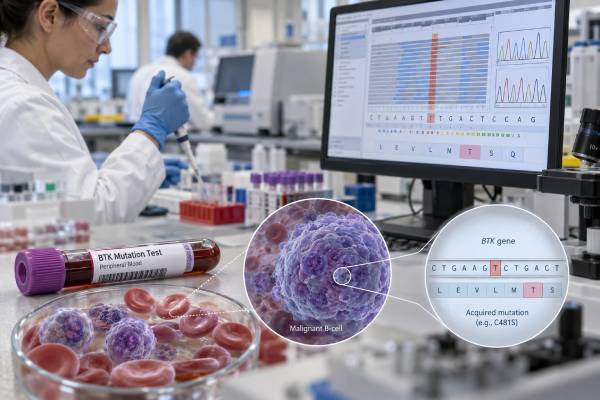
A BTK mutation test looks for acquired changes in the BTK gene that can help explain resistance to Bruton tyrosine kinase inhibitors in certain B-cell cancers, especially chronic lymphocytic leukemia (CLL). The test is not a general cancer-screening test and, in most oncology settings, it is not used to diagnose CLL or lymphoma by itself. Its greatest value is usually at or near disease progression in a person who has been treated with a BTK inhibitor such as ibrutinib, acalabrutinib, zanubrutinib, or a noncovalent agent such as pirtobrutinib. Different mutations can affect different drugs. The classic C481 mutation can reduce binding of covalent BTK inhibitors, while other kinase-domain changes can emerge with newer agents. A negative test does not rule out resistance because progression can occur through PLCG2 mutations, alternative signaling pathways, or mechanisms that current assays do not detect. Results should therefore be interpreted together with treatment history, disease behavior, and other molecular findings.
- A positive BTK resistance mutation can support an acquired molecular mechanism of BTK-inhibitor failure, but the clinical meaning depends on the exact amino-acid change and the drug being used.
- C481 substitutions are classic resistance findings after covalent BTK inhibitors because ibrutinib, acalabrutinib, and zanubrutinib depend on binding at cysteine 481.
- Non-C481 mutations also matter: changes involving sites such as T474 or L528 can emerge with second-generation or noncovalent BTK inhibitors.
- A negative result does not exclude drug resistance: PLCG2 mutations and non-genetic escape mechanisms can produce progression without a detectable BTK mutation.
- Testing is usually most informative at progression: blood, bone marrow, lymph node tissue, or circulating tumor DNA may be used depending on disease distribution and the assay.
Table of Contents
- What BTK mutation testing measures
- Why BTK mutations can cause drug resistance
- When BTK testing is used
- How BTK testing is performed
- How to interpret BTK mutation results
- How results can affect treatment decisions
- Limitations and practical next steps
What BTK mutation testing measures
BTK stands for Bruton tyrosine kinase, a signaling protein that sits downstream of the B-cell receptor. Normal B cells use this pathway to receive growth and survival signals. Many B-cell cancers also depend on it, which is why BTK became an important treatment target.
A BTK mutation test usually looks for somatic, or acquired, variants in cancer cells. These are not the same as inherited BTK variants that cause X-linked agammaglobulinemia. In leukemia and lymphoma care, the purpose is generally to detect changes that alter how the BTK protein interacts with a drug or how the kinase functions.
The test can be a focused assay that examines known resistance hotspots or part of a broader next-generation sequencing panel. Some laboratories report the exact DNA change, the resulting amino-acid change, and a variant allele frequency. Variant allele frequency estimates the proportion of sequencing reads carrying the mutation; it can offer a rough sense of clone size, but it is not a direct measurement of the percentage of cancer cells.
BTK mutation testing is best established in CLL and small lymphocytic lymphoma. It may also be considered in other B-cell malignancies treated with BTK inhibitors, including mantle cell lymphoma or Waldenström macroglobulinemia, although resistance biology and the strength of evidence vary by disease.
For CLL specifically, BTK results are only one part of molecular assessment. A CLL FISH panel, TP53 evaluation, and IGHV mutation testing answer different questions about prognosis and treatment biology. BTK testing should not be substituted for those baseline markers.
Why BTK mutations can cause drug resistance
The best-known resistance mechanism involves amino acid 481 of BTK. Ibrutinib, acalabrutinib, and zanubrutinib are covalent BTK inhibitors. They form a durable bond with the cysteine residue at position 481, usually written as C481.
If the cancer acquires a substitution such as BTK C481S, the drug may no longer form the same covalent bond. The inhibitor can become less effective at maintaining BTK blockade, allowing B-cell receptor signaling to recover. Other substitutions at C481, including C481R, C481F, or C481Y, can also occur.
This mechanism led to development of noncovalent BTK inhibitors, which do not require irreversible binding to C481. Pirtobrutinib, for example, can retain activity against many C481-mutant clones. But resistance can evolve again. Studies have identified non-C481 mutations in the kinase domain, including changes at T474, L528, V416, A428, and M437, among others. Some alter drug binding, while kinase-impaired variants may preserve signaling through BTK’s scaffolding functions or associated proteins.
Resistance can also arise downstream. PLCG2 encodes phospholipase C gamma 2, a signaling protein directly below BTK in the B-cell receptor pathway. Activating PLCG2 mutations may allow signaling to continue even when BTK itself is inhibited.
The practical lesson is that there is no single universal “BTK resistance mutation.” The meaning depends on:
- which BTK inhibitor the patient received;
- whether the drug binds covalently or noncovalently;
- the exact BTK variant;
- whether PLCG2 or other resistance alterations are present;
- how the cancer is progressing clinically; and
- what therapies remain available.
When BTK testing is used
BTK mutation testing is most useful when there is a specific clinical question about resistance. It is generally not needed simply because a patient has CLL, and it is not usually a routine screening test before every BTK inhibitor is started.
The strongest use case is suspected progression during continuous BTK-inhibitor therapy. Examples include rising lymphocyte counts with other evidence of relapse, enlarging lymph nodes, worsening splenomegaly, new cytopenias attributable to disease, or other findings that indicate true progression rather than a temporary laboratory fluctuation.
Testing can also be useful after progression when clinicians are selecting the next targeted therapy or trying to understand why a prior BTK inhibitor failed. In some cases, a resistance mutation may be detectable months before overt clinical progression, but routine serial screening of asymptomatic patients is not universally recommended because detecting a small resistant clone does not always mean treatment should change immediately.
The timing of the sample matters. A resistance clone may expand under drug pressure and then shrink after therapy is stopped. Testing long after discontinuation can therefore miss a mutation that was present at progression.
It is also important to distinguish progression from intolerance. A person who stops ibrutinib because of atrial fibrillation, bleeding, or another adverse effect has a different clinical problem from someone whose cancer has escaped BTK inhibition. Resistance testing is much more relevant in the latter situation.
For a focused explanation of this setting, the BTK mutation test for CLL drug resistance addresses how these findings fit specifically into chronic lymphocytic leukemia care.
How BTK testing is performed
BTK mutations can be assessed using blood, bone marrow, tissue, or circulating tumor DNA, depending on where the cancer is most active and what the laboratory has validated.
Peripheral blood is convenient when there are enough circulating CLL cells. No fasting is usually required, and medications generally do not need to be stopped just for sample collection. However, blood can be falsely negative when disease is mainly in lymph nodes or other tissues and few malignant cells circulate.
Bone marrow may be informative when marrow involvement is prominent, although it is more invasive. Lymph node or other tissue can be useful when progression is primarily nodal or when Richter transformation is suspected. In suspected transformation, tissue biopsy is important because a BTK mutation result alone cannot diagnose transformation.
Circulating tumor DNA, sometimes called a liquid biopsy, can sample DNA released from multiple disease sites. Its usefulness depends on assay sensitivity and the amount of tumor DNA in plasma.
Methods include allele-specific PCR, digital PCR, and next-generation sequencing. Highly sensitive assays can detect small mutant clones at low variant allele fractions. That sensitivity is valuable, but it also creates a need for careful interpretation: a tiny clone may not yet be the dominant cause of progression.
A complete laboratory report should identify the exact variant and, when possible, the assay’s limit of detection. A result such as “BTK mutation detected” without the specific amino-acid change provides less clinical information than a report naming C481S, T474I, L528W, or another defined variant.
How to interpret BTK mutation results
A BTK result is interpreted in the context of the drug exposure that selected the clone. The same variant can have different implications depending on the therapy.
| Finding | Typical context | General meaning |
|---|---|---|
| C481S or another C481 substitution | Progression on a covalent BTK inhibitor | Supports on-target resistance caused by loss of effective covalent binding |
| T474 or L528 mutation | Can occur after newer covalent or noncovalent BTK inhibitors | May confer cross-resistance or altered kinase behavior; drug-specific interpretation is needed |
| Multiple BTK mutations | Heavily treated or evolving disease | Suggests clonal heterogeneity, with more than one resistant subclone |
| No BTK mutation detected | Clinical progression | Does not rule out resistance; test sensitivity, disease site, PLCG2, and other mechanisms matter |
| Low-level BTK mutation without progression | Surveillance or research testing | May indicate an emerging clone, but usually is not enough by itself to justify a treatment switch |
A positive result is most compelling when the variant has an established functional relationship to the drug being used and the patient is clinically progressing. It supports a biologic explanation, but it does not automatically identify one mandatory next treatment.
A negative result has several possible explanations. There may truly be no BTK mutation. The mutation may be below the assay’s detection limit. Disease may be concentrated in a tissue not represented by the sample. A PLCG2 mutation or another signaling pathway may be responsible. Or progression may reflect transformation into a biologically different lymphoma.
Variant allele frequency should also be interpreted cautiously. A change from 1% to 10% can suggest clonal expansion, but different assays and sample types are not always directly comparable. Clinical decisions should not be based on a single numerical cutoff unless the laboratory and treatment protocol specifically define one.
How results can affect treatment decisions
The main treatment value of BTK mutation testing is to explain resistance and help frame therapeutic sequencing. It is not a stand-alone prescription test.
When CLL progresses on a covalent BTK inhibitor and a C481 mutation is present, simply switching from one covalent BTK inhibitor to another often will not overcome the underlying C481-based resistance because all three approved covalent agents rely on that residue. A noncovalent inhibitor can bypass C481 dependence, which is one reason pirtobrutinib has activity after covalent BTK-inhibitor exposure.
If progression occurs on a noncovalent BTK inhibitor, non-C481 kinase-domain mutations may be relevant. Some can reduce binding of multiple BTK inhibitors. In that situation, clinicians may consider a therapy with a different mechanism rather than another drug that depends on the same target.
Other options in CLL can include BCL2-directed therapy, cellular therapy in selected patients, clinical trials, or newer strategies such as BTK degraders. The exact sequence depends on prior treatments, TP53 status, comorbidities, duration of response, disease tempo, and drug availability.
One important safety principle is that patients should not stop a BTK inhibitor abruptly on their own after seeing a resistance mutation. In some people, disease can flare after interruption. Treatment transitions are usually planned so that disease remains controlled while the next therapy is started.
BTK testing can also help avoid an overly simple interpretation of “class failure.” A person who discontinued a BTK inhibitor because of toxicity may still benefit from another BTK-directed approach, whereas a person with clear molecular and clinical resistance requires a different strategy.
Limitations and practical next steps
BTK mutation testing has important limitations. Resistance biology is evolving quickly, and commercial panels differ in which codons they cover and how sensitively they detect small clones. A panel designed only for C481 can miss clinically important non-C481 mutations. Conversely, a very broad panel may identify variants whose treatment relevance is not yet established.
The result also reflects one moment in an evolving cancer. CLL can contain several subclones, and treatment changes which clones expand. A mutation that dominates at one progression may not dominate later.
If a BTK result is being reviewed because of suspected treatment failure, useful next steps include:
- Confirm that the patient meets clinical criteria for progression rather than reacting to one isolated blood count.
- Identify the exact BTK inhibitor, dose, duration, and reason for stopping or testing.
- Review the exact mutation and whether the assay also evaluates PLCG2 and other relevant genes.
- Consider whether the sample came from the disease site most likely to contain resistant cells.
- Discuss the result with a hematologist before changing treatment, especially if the patient is clinically stable.
- Consider tissue biopsy if rapid nodal growth, high LDH, systemic symptoms, or other features raise concern for transformation.
BTK mutations are best thought of as resistance biomarkers, not as a measure of how much leukemia or lymphoma is present. They can clarify why a drug stopped working, but disease burden still requires clinical examination, blood counts, imaging when indicated, and other hematologic assessment.
A further practical issue is clonal complexity. A person can carry more than one BTK-resistant subclone at the same time, and the dominant clone can change after a treatment switch. This is why a broad resistance panel can be more informative than a one-mutation assay after several lines of therapy. The laboratory may report C481S together with another BTK kinase-domain mutation or a PLCG2 alteration. That pattern does not necessarily mean the test is contradictory; it can reflect parallel evolutionary routes inside the same cancer.
The clinical pace of progression also matters. Slowly enlarging nodes in an otherwise stable patient and rapidly progressive disease with fevers, weight loss, rising LDH, or a dominant mass should not be managed as equivalent situations. The latter pattern can raise concern for Richter transformation, which requires tissue diagnosis because transformed lymphoma has different biology and treatment from ordinary CLL progression.
Finally, resistance testing is most useful when it answers a decision that is actually available. If several next-line options exist, molecular data may help prioritize them. If the immediate treatment is dictated by an urgent clinical problem, mutation testing may still explain biology but should not delay needed therapy.
Mutation results must be interpreted in treatment sequence
The same BTK mutation can have different practical meaning depending on which BTK inhibitor the patient is taking or has already received. Covalent inhibitors bind BTK differently from noncovalent inhibitors, and resistance substitutions that disrupt one drug-binding strategy do not necessarily predict the same degree of resistance to every agent in the class. The report should therefore be reviewed together with the exact drug history, response duration, adherence, dose interruptions, and other resistance findings.
A molecular result is most actionable when it is connected to the next available treatment choice. In CLL, that often means considering the patient’s prior exposure to BTK and BCL2 inhibitors, comorbidities, disease tempo, cytopenias, and eligibility for cellular therapy or a clinical trial.
References
- Resistance mechanisms and approach to chronic lymphocytic leukemia after BTK inhibitor therapy 2025 (Review)
- Novel mechanisms of resistance in CLL: variant BTK mutations in second-generation and noncovalent BTK inhibitors 2025 (Review)
- Bruton’s Tyrosine Kinase (BTK) Mutations in Chronic Lymphocytic Leukemia (CLL): A Clinical View 2025 (Review)
- Mechanisms of Resistance to Noncovalent Bruton’s Tyrosine Kinase Inhibitors 2022
- Acquired BTK mutations associated with resistance to noncovalent BTK inhibitors 2023
- Resisting the Resistance: Navigating BTK Mutations in Chronic Lymphocytic Leukemia (CLL) 2023 (Review)
Disclaimer
BTK mutation results should be interpreted by a hematology or oncology team together with the exact treatment history and evidence of disease progression. A detected resistance mutation does not by itself determine the next therapy, and a negative result does not rule out resistance. Do not stop or change a BTK inhibitor based only on a laboratory report without medical guidance.