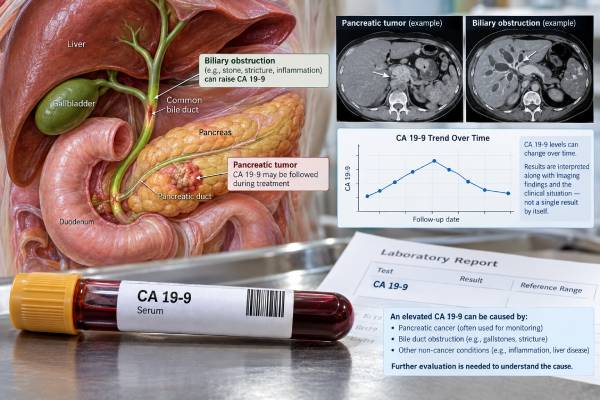
Cancer antigen 19-9, or CA 19-9, is a blood tumor marker used mainly in pancreatic and biliary tract cancers. It can help estimate disease burden, follow treatment response, and detect a concerning trend after treatment when a patient’s cancer produces the marker. It is not accurate enough to diagnose pancreatic cancer by itself or to screen average-risk people. A common upper reference limit is about 37 U/mL, but laboratories differ. Interpretation is especially difficult when bile flow is blocked, because gallstones, cholangitis, and other causes of obstructive jaundice can raise CA 19-9 dramatically without cancer. Another major limitation is genetics: people who do not express the Lewis antigen pathway may produce little or no CA 19-9 even when they have pancreatic cancer. The most useful result is therefore a trend obtained in the right clinical setting, ideally after biliary obstruction has been addressed and interpreted alongside imaging, bilirubin, pathology, symptoms, and treatment response.
- A common CA 19-9 upper reference limit is about 37 U/mL: the laboratory’s own range should be used.
- CA 19-9 is most useful in pancreatic and bile duct cancers after diagnosis: it can support prognosis and treatment monitoring.
- It is not a stand-alone screening or diagnostic test: early cancer can have normal CA 19-9, and benign disease can cause high values.
- Biliary obstruction can markedly raise CA 19-9: levels often need reinterpretation after drainage or treatment of cholangitis.
- About 5–10% of people are Lewis-antigen negative or poor secretors: their cancers may not produce a useful CA 19-9 signal.
Table of Contents
- What CA 19-9 Measures
- Normal Range and Causes of High CA 19-9
- CA 19-9 in Pancreatic Cancer
- CA 19-9 in Bile Duct Disease and Cholangiocarcinoma
- Using CA 19-9 to Monitor Treatment and Recurrence
- Lewis Antigen Status and Other Limitations
- What to Do After a High CA 19-9 Result
What CA 19-9 Measures
CA 19-9 is the circulating form of a carbohydrate structure called sialyl-Lewis A. Cells in the pancreas, bile ducts, stomach, colon, and other epithelial tissues can express related carbohydrate antigens. Pancreatic ductal adenocarcinoma and biliary cancers often shed increased amounts into the blood.
The marker is measured with an immunoassay. Results are usually reported in units per milliliter, or U/mL. Because assay platforms and calibrators differ, serial values are easiest to compare when the same laboratory is used.
CA 19-9 is not produced only by cancer. Normal pancreatic and biliary epithelium can release it, and obstruction or inflammation can cause antigen to leak into the circulation. That is why jaundice and cholangitis can create results that look “tumor-like” even when the obstruction is caused by a benign gallstone.
The CA 19-9 blood test is therefore primarily a contextual marker. It gains meaning when there is a pancreatic or biliary lesion, known cancer, or a treatment course to follow. It loses meaning when it is ordered without a specific clinical question.
CEA is sometimes measured as an additional marker in pancreatic or gastrointestinal cancers, but it is also nonspecific. A broad blood tumor marker panel does not overcome the limitations of CA 19-9 and is not a substitute for appropriate imaging or biopsy.
Another key biological feature is dependence on the Lewis blood-group pathway. Synthesis of CA 19-9 requires specific fucosyltransferase activity. People who lack that pathway may be unable to generate a typical CA 19-9 elevation even when a cancer is present.
Normal Range and Causes of High CA 19-9
Many laboratories use 37 U/mL as the upper reference limit. Some use slightly different cutoffs. The result should always be read with the reference interval on the report.
A value above 37 U/mL is not equivalent to a positive cancer test. Mild elevations occur frequently in benign gastrointestinal and hepatobiliary disease. Even values in the hundreds or thousands can occur with severe obstruction or inflammation.
Common noncancer causes include:
- choledocholithiasis or other bile duct stones;
- acute or chronic cholangitis;
- obstructive jaundice from benign strictures;
- pancreatitis;
- chronic liver disease and cirrhosis;
- some pulmonary and inflammatory disorders;
- cystic or other benign pancreatic disease.
The bilirubin level is especially important. When a bile duct is obstructed, both bilirubin and CA 19-9 can rise. Older clinical studies and modern reviews show substantial overlap between benign and malignant obstruction, which means the marker has reduced specificity before drainage.
If a patient with jaundice has a very high CA 19-9, clinicians often treat infection and relieve the obstruction first when clinically feasible. A repeat value after bilirubin falls can be far more informative. A dramatic decrease toward normal supports a major benign obstruction-related contribution. Persistent elevation does not prove cancer, but it increases concern when imaging also shows a suspicious lesion.
In contrast, a normal CA 19-9 does not rule out pancreatic cancer. Early tumors may be too small to produce a large signal, and Lewis-negative patients may make little antigen at any stage.
There is no single value that cleanly separates benign from malignant disease. Very high concentrations in a nonjaundiced patient with a pancreatic mass are more concerning than a borderline increase, but pathology and imaging remain decisive.
CA 19-9 in Pancreatic Cancer
CA 19-9 is the most widely used serum tumor marker in pancreatic ductal adenocarcinoma, or PDAC. Its role begins after there is clinical suspicion or a diagnosis; it is not recommended as a general population screening test.
Pancreatic cancer is usually evaluated with high-quality pancreatic-protocol CT or MRI, endoscopic ultrasound in selected cases, and tissue sampling when needed. CA 19-9 adds information but cannot tell whether a pancreatic mass is malignant or identify its histologic type with enough certainty to replace those tests.
Before treatment, the marker can serve as a baseline. A high value may correlate with larger tumor burden, occult metastatic disease, and worse prognosis. However, interpretation should be cautious when bilirubin is elevated because cholestasis can inflate the number independently of tumor size.
In potentially resectable cancer, CA 19-9 is one of several factors used during multidisciplinary planning. A markedly elevated result can increase concern about biologically aggressive or radiographically occult disease, but surgery is not denied or recommended from the number alone. Imaging-defined anatomy, performance status, pathology, and response to neoadjuvant therapy are central.
During chemotherapy, falling CA 19-9 often supports treatment response. Recent research continues to show value in dynamic change rather than a single threshold. A substantial reduction may accompany tumor shrinkage or stable disease, while a sustained rise can indicate progression.
After pancreatic resection, postoperative CA 19-9 can provide prognostic and surveillance information in patients who are secretors. Studies have shown that relative increases during follow-up may precede imaging-detected recurrence. That does not mean treatment should begin from the marker alone; it means a reliable rise can prompt timely imaging and clinical reassessment.
The marker is much less useful in a patient whose CA 19-9 was normal despite a substantial tumor at diagnosis. If the tumor did not secrete CA 19-9 before treatment, a normal value later cannot provide strong reassurance.
CA 19-9 in Bile Duct Disease and Cholangiocarcinoma
Biliary tract cancers include intrahepatic and extrahepatic cholangiocarcinoma and gallbladder cancer. CA 19-9 is commonly used as a supportive biomarker in this group, particularly for cholangiocarcinoma, but it is constrained by the same problem that makes it difficult in pancreatic cancer: bile duct obstruction itself raises the marker.
A patient with a malignant bile duct stricture may have jaundice, cholangitis, and high CA 19-9. A patient with a benign stone or inflammatory stricture may have the same combination. The marker cannot reliably distinguish these scenarios on its own.
Evaluation may include ultrasound, CT, MRI/MRCP, endoscopic retrograde cholangiopancreatography, endoscopic ultrasound, brushings or biopsy, and sometimes cholangioscopy. CA 19-9 supports these investigations rather than replacing them.
In primary sclerosing cholangitis, interpretation is particularly difficult. These patients have an increased cholangiocarcinoma risk but can also have recurrent inflammation and obstruction that raise CA 19-9. A concerning trend may prompt imaging and specialist assessment, yet false positives are common.
Once biliary tract cancer is confirmed, CA 19-9 may be used to follow treatment. Declining levels during chemotherapy or after relief of tumor-related obstruction can be encouraging, while a sustained increase may raise concern for progression. Because biliary drainage itself can lower the value, the clinical team must separate treatment response from improved bile flow.
Contemporary ESMO guidelines for biliary tract cancer emphasize imaging, pathology, molecular testing, and systemic treatment selection. CA 19-9 is useful supportive information but is not the principal determinant of diagnosis or therapy.
Using CA 19-9 to Monitor Treatment and Recurrence
Serial CA 19-9 works best when four conditions are met: the cancer produced a clear elevation at baseline, the patient is not experiencing major biliary obstruction, the same assay is used, and the marker trend agrees with other evidence.
A falling result
A consistent decline during chemotherapy can support response. If bilirubin is also falling after stent placement, however, part of the decrease may come from improved drainage. Clinicians therefore compare the marker with imaging and liver tests rather than attributing every change to tumor kill.
A stable result
Stable CA 19-9 can support disease stability but cannot prove it. Some tumors progress without a large change, especially in weak secretors. Scheduled imaging remains necessary.
A rising result
A repeated rise can precede radiographic progression or recurrence in patients whose cancers reliably secrete the antigen. This can be clinically useful because it signals that an earlier scan or closer review may be warranted.
The magnitude and timing matter. A move from 34 to 42 U/mL is very different from a repeated increase from 200 to 500 to 1,200 U/mL with stable bilirubin. The first may reflect assay variation or a mild benign process; the second is much more concerning in someone with known PDAC.
After curative-intent pancreatic surgery, studies have explored fold-change thresholds for recurrence detection. These research thresholds should not be treated as universal home-monitoring rules because follow-up schedules, assay platforms, and patient populations differ. The treating oncology team interprets the trajectory in context.
CA 19-9 also should not be used to declare treatment failure during a short, isolated fluctuation if imaging and symptoms are improving. Confirmed trends are more reliable than single values.
Why bilirubin should be checked with the marker
Bilirubin is not a tumor marker, but it is one of the most useful companion results for interpreting CA 19-9. A rising bilirubin can indicate worsening biliary obstruction from tumor, a blocked stent, stones, or inflammation. Any of these can push CA 19-9 upward. If bilirubin falls after drainage while CA 19-9 also drops sharply, the original value probably included a substantial obstruction-related component.
The reverse situation is more concerning: CA 19-9 continues to rise over repeated measurements even after bilirubin normalizes and infection resolves. In a patient with known pancreatic or biliary cancer, that pattern is more likely to reflect tumor biology and usually warrants reassessment. It is still not diagnostic of progression without clinical or imaging correlation.
This paired interpretation is also useful before comparing results across treatment cycles. A value drawn during cholangitis should not be treated as directly equivalent to one drawn weeks later after successful drainage.
Lewis Antigen Status and Other Limitations
The Lewis-antigen issue is one of the most important limitations of CA 19-9. Roughly 5–10% of people are Lewis negative, often because they lack functional FUT3-mediated fucosylation. Many such individuals produce little or no CA 19-9.
This creates a false-negative problem. A person can have advanced pancreatic cancer and still have a normal CA 19-9. If a large, biopsy-proven PDAC is present but CA 19-9 is repeatedly very low, nonsecretor status is one possible explanation.
Lewis status is not routinely tested in every patient, and biology is more complex than a simple secretor/nonsecretor switch. Some people traditionally categorized as Lewis negative may still have measurable antigen. The practical lesson is simpler: normal CA 19-9 never excludes pancreatic or biliary cancer.
Other limitations include assay differences, inflammation, liver dysfunction, and expression by other malignancies. Gastric, colorectal, ovarian, and other cancers can sometimes raise CA 19-9, so the marker cannot determine the organ of origin for an unknown tumor.
A tumor-marker result can also be distorted by the timing of a biliary procedure. ERCP, stent placement, acute cholangitis, and rapid changes in bilirubin can make short-term values difficult to compare. Waiting until the acute biliary picture stabilizes may improve interpretation when the clinical situation allows.
CA 19-9 is also not an ideal early-detection marker in average-risk populations. Pancreatic cancer is uncommon, and benign pancreaticobiliary conditions are relatively frequent. The resulting false positives would lead to large numbers of unnecessary scans and invasive procedures.
People with inherited pancreatic cancer risk or pancreatic cyst surveillance require specialized protocols. Research is evaluating combinations of CA 19-9 with imaging, methylated DNA, circulating tumor DNA, proteins, and other biomarkers, but these approaches do not turn a standard CA 19-9 test into a general screening test today.
What to Do After a High CA 19-9 Result
The first question is why the test was ordered. An incidental high CA 19-9 in a person without a pancreatic or biliary diagnosis should be interpreted very differently from a rising value in someone receiving chemotherapy for pancreatic cancer.
If the person is jaundiced, evaluate for obstruction and cholangitis. Liver tests, bilirubin, ultrasound, CT, or MRCP may identify stones, strictures, or a mass. Treating infection and restoring bile flow can be urgent regardless of whether cancer is ultimately found.
If imaging shows a pancreatic or bile duct lesion, specialist evaluation is appropriate. The workup may involve gastroenterology, hepatobiliary surgery, oncology, endoscopic ultrasound, ERCP, and tissue diagnosis depending on the location and resectability of the lesion.
If the elevation is mild and imaging is unremarkable, the clinician may repeat the test after an acute inflammatory or biliary problem resolves. Persistent unexplained elevation deserves targeted evaluation, but serial tumor-marker testing without a diagnostic plan can create anxiety without improving accuracy.
For a patient with known cancer, compare CA 19-9 with bilirubin, recent procedures, treatment timing, symptoms, weight, performance status, and imaging. A rising value with stable bilirubin and radiographic progression is much more meaningful than a rise during acute cholangitis.
Seek urgent medical care for fever with jaundice, severe upper abdominal pain, confusion, low blood pressure, persistent vomiting, or rapidly worsening weakness. These can indicate cholangitis or another serious complication requiring immediate treatment.
CA 19-9 is a valuable pancreatic and biliary tumor marker precisely when its limitations are respected. Used after diagnosis and interpreted around bile duct obstruction and Lewis biology, it can provide meaningful prognostic and monitoring information. Used as an isolated “cancer number,” it can mislead in both directions.
References
- CA19-9 as a Dynamic Biomarker for Continuous Monitoring of Therapeutic Efficacy in Pancreatic Adenocarcinoma 2025 (Review)
- Pan-Asian adapted ESMO Clinical Practice Guidelines for the diagnosis, treatment and follow-up of patients with pancreatic cancer 2025 (Practice Guideline)
- ESMO Clinical Practice Guideline interim update on the management of biliary tract cancer 2025 (Practice Guideline)
- Dynamics of Serum CA19-9 in Patients Undergoing Pancreatic Cancer Resection 2024
- Tumor-Associated Carbohydrate Antigen 19-9 (CA 19-9), a Promising Target for Antibody-Based Detection, Diagnosis, and Immunotherapy of Cancer 2024 (Review)
- Pancreatic cancer: ESMO Clinical Practice Guideline for diagnosis, treatment and follow-up 2023 (Practice Guideline)
Disclaimer
CA 19-9 cannot diagnose or exclude pancreatic or biliary cancer by itself. Biliary obstruction, cholangitis, pancreatitis, other benign conditions, assay differences, and Lewis-antigen biology can cause misleading high or low results. Interpretation should be performed by a qualified clinician using imaging, bilirubin and liver tests, pathology, and serial trends.