
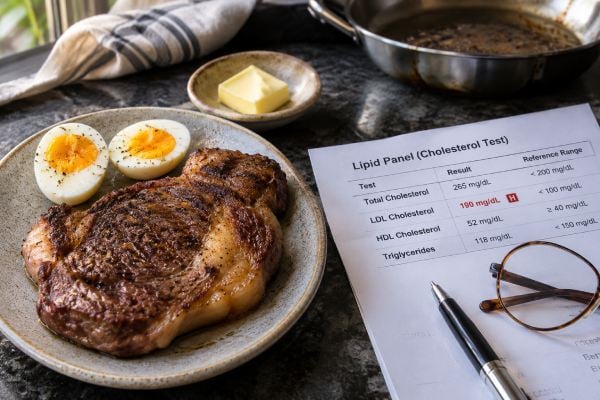
A carnivore diet can cause a large rise in LDL cholesterol in some people, even when triglycerides fall, HDL rises, weight drops, and blood sugar looks better. That pattern is not a contradiction. Very-low-carbohydrate diets change how the body transports fat for fuel, while a high intake of saturated fat can reduce LDL clearance from the blood. The size of the LDL response varies widely, and lean, active people with low triglycerides sometimes report especially dramatic increases. However, a favorable triglyceride or HDL level does not make a very high LDL harmless. LDL-containing particles are involved in atherosclerosis, and current cholesterol guidance treats severe LDL elevation as clinically important regardless of the diet that produced it. Evidence specific to strict carnivore diets is still sparse, so most research comes from ketogenic or carbohydrate-restricted diets. If your LDL rises sharply after starting carnivore, confirm the result, review the diet in detail, look for other causes, and discuss your overall cardiovascular risk rather than assuming the change is either automatically dangerous or automatically safe.
Table of Contents
- Why LDL can rise on a carnivore diet
- Why triglycerides and HDL may move the other way
- What a large LDL increase means for heart risk
- The lean mass hyper-responder question
- What to check if your LDL spikes
- How to lower LDL without abandoning low carb
- When a carnivore-related LDL rise needs medical attention
Why LDL can rise on a carnivore diet
Strict carnivore diets usually eliminate grains, legumes, fruit, most vegetables, and other carbohydrate-containing plant foods. What replaces those foods is often meat, eggs, cheese, butter, cream, and animal fat. That can dramatically change both the amount of fat eaten and the proportion that is saturated.
Saturated fat is one of the clearest dietary factors that can raise LDL cholesterol. It can reduce the liver’s ability to clear LDL particles from the bloodstream, allowing more LDL cholesterol to circulate. The effect is highly individual. One person may see a modest increase; another may see LDL climb by 100 mg/dL or more after a major dietary shift.
Carbohydrate restriction can also alter lipid traffic. When carbohydrate intake becomes very low, the body relies more heavily on fatty acids and ketones for energy. The liver packages triglyceride and cholesterol into lipoproteins that deliver fuel through the circulation. In some lean, active people, this high-fat flux may be associated with a striking LDL increase, especially when the diet is energy-dense and saturated-fat-rich.
Weight loss can complicate the picture. During active weight loss, stored fat is being mobilized, and lipid values may temporarily shift. Yet a persistent high LDL months after weight stabilizes deserves attention. Do not assume every rise is simply a temporary “fat-burning” effect.
It is also important to separate a strict carnivore diet from the broader ketogenic-diet literature. Most randomized trials have studied ketogenic or low-carbohydrate patterns that may still include nuts, seeds, avocado, olive oil, and non-starchy vegetables. Those foods can change the fatty-acid profile and fiber intake substantially. Therefore, results from keto studies are informative but do not prove that an all-animal-food diet has the same long-term effects.
If you want a broader explanation of why LDL changes with diet and genetics, high LDL cholesterol has several common causes beyond food alone.
Why triglycerides and HDL may move the other way
A common carnivore or ketogenic lipid pattern is higher LDL alongside lower triglycerides and higher HDL. This can feel confusing because these markers are often discussed as if they should all improve or worsen together.
They reflect different parts of lipid metabolism. Triglycerides often fall when people reduce refined carbohydrate, lose weight, improve insulin sensitivity, and stop drinking sugary beverages or excess alcohol. HDL may rise with weight loss, physical activity, and a higher intake of some fats. Those changes can be metabolically favorable.
LDL, however, tracks cholesterol carried in LDL particles and is influenced strongly by saturated fat intake, genetics, thyroid status, body composition, and other factors. A low triglyceride level does not erase the biological role of LDL particles in atherosclerosis. Similarly, a high HDL level should not be used as a shield against a markedly elevated LDL.
Modern lipid assessment often looks beyond the classic three numbers. Non-HDL cholesterol reflects cholesterol carried by all potentially atherogenic particles. Apolipoprotein B, or ApoB, estimates the number of those particles more directly because each atherogenic particle generally carries one ApoB molecule. When LDL cholesterol is extremely high, ApoB is often high too, although discordance can occur.
This is why a complete interpretation should not rely on ratios alone. A low triglyceride-to-HDL ratio may suggest good insulin sensitivity in some contexts, but it is not a validated reason to ignore severe LDL elevation. If the terminology is unfamiliar, LDL, HDL, and triglycerides measure different aspects of blood lipids.
The practical message is that several things can be true at once: your triglycerides can improve, your glucose can improve, and your LDL can rise enough to require action. Health decisions should account for all of those changes rather than selecting only the numbers that support the diet.
What a large LDL increase means for heart risk
LDL-containing lipoproteins can enter the artery wall and contribute to atherosclerotic plaque. Decades of genetic, epidemiologic, and randomized treatment evidence support a causal relationship between exposure to atherogenic lipoproteins and cardiovascular disease. In general, both the concentration and the duration of exposure matter.
That does not mean a single high LDL test predicts that a heart attack is imminent. Risk is shaped by age, blood pressure, smoking, diabetes, kidney disease, family history, existing plaque, lipoprotein(a), and many other factors. But a very high LDL is not a minor laboratory curiosity simply because other markers look good.
Current U.S. dyslipidemia guidance specifically recognizes that ketogenic diets can produce severe hypercholesterolemia in some people. A clinician evaluating this pattern should take a dietary history and look for ways to reduce LDL exposure. That is especially important when LDL reaches ranges often associated with severe primary hypercholesterolemia.
A useful way to think about the issue is cumulative exposure. If LDL was 110 mg/dL before carnivore and becomes 240 mg/dL for years, the arteries are being exposed to substantially more LDL over time. We do not yet have long-term randomized outcome trials showing that a low-triglyceride, high-HDL phenotype makes that exposure safe.
Shorter-term imaging studies in selected people eating ketogenic diets are interesting but cannot settle the question. One 2024 study compared 80 people with carbohydrate-restriction-associated LDL levels of at least 190 mg/dL with matched controls and did not find greater coronary plaque burden in the ketogenic group. However, it was not a randomized long-term trial of cardiovascular events, participants were highly selected, and the design could not prove that years of severe LDL elevation are harmless. Such findings justify more research, not dismissal of established LDL biology.
This difference between a risk marker and a clinical outcome is important. Randomized trials of a strict carnivore diet lasting long enough to measure heart attacks, strokes, or cardiovascular death do not exist. Even if such a trial began today, it would take years and enormous numbers of participants to answer the question reliably. In the meantime, clinicians have to combine what is known about LDL causality with the shorter-term diet data that are available.
Also distinguish relative and absolute risk. A healthy 30-year-old with no smoking, normal blood pressure, and no diabetes may have a low short-term event risk even with a high LDL. That does not mean the LDL has no consequence; it means the person has time for exposure to accumulate. An older adult with existing coronary disease or multiple risk factors can have a much higher absolute risk from the same LDL level. This is why “I feel great” and “my 10-year risk is low” are not complete arguments for leaving severe hypercholesterolemia untreated.
If you are unsure how high is high, cholesterol ranges are interpreted in the context of overall risk, not as a single universal cutoff for everyone.
The lean mass hyper-responder question
The term “lean mass hyper-responder,” often shortened to LMHR, was proposed to describe people on carbohydrate-restricted diets who develop a combination of very high LDL, high HDL, and low triglycerides. The commonly discussed pattern uses LDL of 200 mg/dL or higher, HDL of 80 mg/dL or higher, and triglycerides of 70 mg/dL or lower, although the concept is not an established medical diagnosis.
The hypothesis is that lean people with low carbohydrate availability may traffic more fat through very-low-density lipoproteins to supply energy, eventually generating more LDL particles. This is sometimes called the “lipid energy model.” It is biologically plausible enough to study, but the clinical meaning remains uncertain.
Initial evidence came largely from self-selected survey data. A 2022 report found that lower body mass index and favorable triglyceride-to-HDL patterns were associated with larger LDL increases on carbohydrate-restricted diets. Because participants volunteered their own diet and laboratory data, the study was useful for generating a hypothesis but could not establish prevalence, causation, or long-term safety.
The LMHR label can therefore be descriptive without being reassuring. It tells you what the lipid pattern looks like; it does not prove that the arteries are protected from LDL. Some researchers argue the phenotype has been defined too loosely and that clinically important LDL rises occur across body-size categories.
If your numbers fit this pattern, the most constructive response is to document the change carefully. Compare pre-diet and current results, note weight and calorie changes, and measure a broader risk profile. Avoid turning the label into a reason to stop asking questions.
What to check if your LDL spikes
First, confirm the result. Lipid measurements have normal biological and laboratory variation. A repeat test is especially useful if the increase is surprising, extremely large, or occurred during acute illness or rapid weight loss. Fasting is not always required for a standard lipid panel, but your clinician may request it when triglycerides or other details need clarification.
Second, compare the result with your baseline. The change from before the diet helps distinguish a diet-associated response from longstanding high LDL that was simply discovered after you started eating differently.
Third, review the actual food pattern rather than the diet label. Two people can both say “carnivore” while one eats mostly lean meat and fish and the other consumes large amounts of butter, cream, fatty red meat, processed meat, and cheese. Estimate how much saturated fat you are getting and identify the biggest contributors.
Fourth, look for secondary causes of high cholesterol. Common considerations include untreated hypothyroidism, certain kidney or liver conditions, some medications, and major weight changes. Very high LDL can also reflect familial hypercholesterolemia. A strong family history of early heart attacks or strokes makes that possibility more important. Learn more about familial hypercholesterolemia signs and diagnosis if LDL is severe or family history is concerning.
A clinician may also consider ApoB, non-HDL cholesterol, lipoprotein(a), blood pressure, A1C or glucose, kidney function, and other risk markers. In selected adults where a treatment decision is uncertain, coronary artery calcium scoring may help refine risk, but a zero calcium score is not a lifetime guarantee and does not automatically negate severe LDL elevation in younger people.
Bring the timeline to your appointment: pre-diet lipid values, date the diet started, weight change, current foods, supplements, medications, and family history. Include home blood pressure readings and any prior cardiac testing if you have them. That makes the discussion far more useful than debating whether carnivore is “good” or “bad” in the abstract.
How to lower LDL without abandoning low carb
If you want to remain low carbohydrate, the first experiment is usually to change fat quality. You do not have to choose between strict carnivore and a high-carbohydrate diet. Many people can keep carbohydrate intake relatively low while reducing saturated fat and adding foods that have a better LDL profile.
Consider these changes for 6 to 12 weeks before retesting, unless your clinician recommends faster action:
- Reduce butter, ghee, heavy cream, coconut oil, and large amounts of high-fat cheese.
- Choose more fish, skinless poultry, and leaner cuts of meat in place of very fatty cuts.
- If your diet philosophy allows it, use olive oil, avocado, nuts, and seeds as major fat sources.
- Add soluble-fiber foods such as oats, barley, beans, lentils, fruit, or psyllium if you are willing to move away from strict carnivore.
- Avoid relying on processed meats as staple foods; they add sodium and may displace less processed options.
- Keep exercise, sleep, smoking avoidance, and blood pressure control in the plan rather than treating cholesterol as the only heart-health target.
Even a modest amount of soluble fiber can help lower LDL, and a more deliberate fiber strategy can have a larger effect. If you are open to adding plant foods, oats, psyllium, and legumes can be combined for stronger LDL lowering.
If strict carnivore is non-negotiable, options become narrower. Replacing fatty ruminant cuts with leaner animal foods and emphasizing fish can lower saturated fat while staying animal-based, but there is no guarantee LDL will normalize. The absence of plant fiber also means you give up one well-established dietary mechanism for reducing LDL.
Medication may still be appropriate if LDL remains high relative to your risk. Needing medication does not mean your other lifestyle improvements are worthless. It means the LDL reduction required may exceed what your preferred diet can deliver.
When a carnivore-related LDL rise needs medical attention
Schedule a medical review if LDL becomes severely elevated, especially around 190 mg/dL or higher, if the increase is dramatic compared with your previous level, or if you have known cardiovascular disease, diabetes, chronic kidney disease, high lipoprotein(a), or a strong family history of premature heart disease. These factors can substantially change how aggressively LDL should be treated.
Seek urgent care for symptoms such as new chest pressure, severe shortness of breath, fainting, or neurologic symptoms such as facial droop, weakness, or trouble speaking. A cholesterol result itself is not an emergency, but symptoms of a possible heart attack or stroke are.
For routine follow-up, do not rely on how you feel. High LDL usually causes no symptoms. Repeat measurements are what tell you whether a dietary adjustment is working. If you make a substantial change, a follow-up lipid panel after about 6 to 12 weeks is often reasonable, although your clinician may choose a different interval.
The most balanced conclusion is that carnivore diets can improve some metabolic markers while worsening LDL dramatically in susceptible people. Evidence does not support assuming that low triglycerides and high HDL neutralize a very high LDL. Because strict carnivore diets have little long-term outcomes research, the safest interpretation is to take a major LDL rise seriously, investigate it, reduce modifiable causes, and make treatment decisions from your complete risk profile rather than from diet ideology.
References
– 2026 ACC/AHA/AACVPR/ABC/ACPM/ADA/AGS/APhA/ASPC/NLA/PCNA Guideline on the Management of Dyslipidemia: A Report of the American College of Cardiology/American Heart Association Joint Committee on Clinical Practice Guidelines 2026. Clinical practice guideline. – The Impact of the Ketogenic Diet on the Lipid Profile in Adults: A Comprehensive Review and Meta-Regression Analysis of Randomized Controlled Trials 2026. Systematic review and meta-analysis. – Effects of ketogenic diet on health outcomes: an umbrella review of meta-analyses of randomized clinical trials 2023. Umbrella review. – Carbohydrate Restriction-Induced Elevations in LDL-Cholesterol and Atherosclerosis: The KETO Trial 2024. Observational imaging study. – Elevated LDL Cholesterol with a Carbohydrate-Restricted Diet: Evidence for a “Lean Mass Hyper-Responder” Phenotype 2022. Observational survey study.
Disclaimer
This article is for general education and does not diagnose or treat high cholesterol. A marked LDL increase, especially LDL around 190 mg/dL or higher, should be reviewed with a qualified healthcare professional who can assess family history, secondary causes, and overall cardiovascular risk. Do not stop prescribed lipid-lowering medication or replace medical follow-up with diet changes alone.