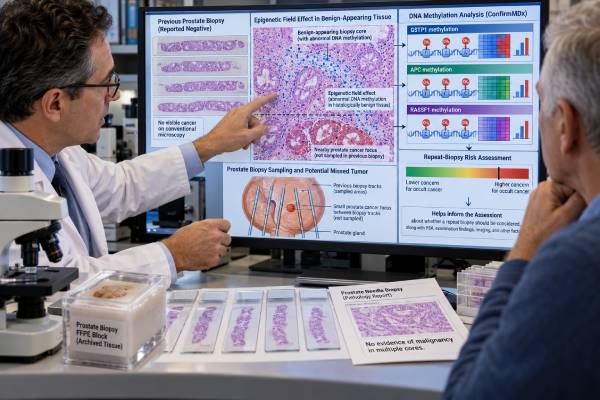
ConfirmMDx is a tissue-based molecular test used after a prostate biopsy has been reported as negative for cancer but clinical concern remains. Instead of looking for visible tumor cells, the test measures abnormal DNA methylation in apparently benign biopsy tissue. It focuses on epigenetic changes in GSTP1, APC, and RASSF1 that can occur in and around prostate cancer. This surrounding “field effect” can help identify cases in which the original biopsy may have missed a nearby tumor focus. A negative ConfirmMDx result can lower the estimated chance of cancer on repeat biopsy, while a positive result suggests that occult cancer remains more likely. The test does not diagnose prostate cancer and does not replace MRI or repeat biopsy when clinical risk is high. Its main role is to help decide whether another biopsy is likely to add value after a previous negative biopsy. Results should be interpreted together with PSA, PSA density, MRI findings, family history, age, prior biopsy quality, and other risk markers.
- ConfirmMDx uses tissue from a previous negative prostate biopsy; it does not require a new blood or urine sample.
- The assay measures DNA methylation of GSTP1, APC, and RASSF1 to detect an epigenetic field effect around potentially missed cancer.
- A negative result can support avoiding or delaying repeat biopsy when other risk factors are also reassuring.
- A positive result raises concern that cancer may have been missed, but only a repeat biopsy can confirm the diagnosis.
- MRI, PSA density, PSA trend, and overall clinical risk remain important even when ConfirmMDx is negative.
Table of Contents
- What ConfirmMDx Measures
- Who May Benefit From ConfirmMDx
- How the Test Is Performed
- How to Interpret Positive and Negative Results
- How ConfirmMDx Compares With MRI and Other Biomarkers
- Limitations and Common Misunderstandings
- Repeat Biopsy Decisions After ConfirmMDx
What ConfirmMDx Measures
ConfirmMDx is an epigenetic test, meaning it looks at chemical changes that affect how genes are regulated rather than changes in the DNA sequence itself. The assay evaluates DNA methylation in three genes strongly associated with prostate cancer biology: GSTP1, APC, and RASSF1.
Methylation is the addition of small chemical groups to DNA. In certain gene regions, abnormal hypermethylation can switch off tumor-suppressive or protective functions. Prostate cancer commonly shows altered methylation patterns, especially in GSTP1.
The key idea behind ConfirmMDx is the field effect, sometimes called a halo effect. A prostate biopsy samples only tiny cylinders of tissue from a much larger gland. Cancer may be present between biopsy cores and therefore missed by routine microscopy. Tissue that looks benign under the microscope can still carry molecular changes because it is near an occult tumor focus.
ConfirmMDx analyzes those cancer-negative cores for methylation patterns associated with nearby cancer. If the pattern is absent, the previous biopsy is more likely to represent a true negative. If the pattern is present, there is greater concern that the biopsy missed cancer.
This makes ConfirmMDx different from a prognostic genomic classifier such as Decipher. Decipher is used after cancer has already been diagnosed to estimate disease aggressiveness and metastatic risk. ConfirmMDx is used when the biopsy is negative and the question is whether cancer may still be hiding in the prostate.
It is also different from a blood test such as 4Kscore or a urine biomarker. ConfirmMDx requires preserved biopsy tissue from a prior procedure.
Who May Benefit From ConfirmMDx
The test is designed primarily for men who have had a negative prostate biopsy but still have enough residual risk to make repeat biopsy a real consideration.
Examples include:
- Persistently elevated or rising PSA after a negative biopsy.
- A prior biopsy that may have had limited sampling.
- Ongoing clinical concern despite benign histology.
- A patient who wants additional information before deciding on another biopsy.
- Situations in which MRI is negative or equivocal but risk is not fully resolved.
- A need to distinguish a likely true-negative biopsy from a potentially false-negative biopsy.
ConfirmMDx is not generally useful if the prior biopsy already showed prostate cancer. Once cancer has been diagnosed, the clinical question shifts from “Was cancer missed?” to “How aggressive is the cancer, and how should it be managed?”
The test is also less useful when the repeat-biopsy decision is already obvious. For example, a highly suspicious MRI lesion, very high PSA density, strong hereditary risk, or concerning clinical progression may justify another biopsy regardless of a molecular tissue result. In that setting, a negative ConfirmMDx result should not be used to override stronger evidence.
Conversely, if the patient has very low ongoing risk and no intention of undergoing another biopsy even if the assay is positive, the test may not change management.
Current prostate-cancer guidelines emphasize that repeat biopsy should be used judiciously. After a negative biopsy, clinicians now integrate MRI, PSA density, PSA trend, age, family history, prior biopsy findings, and selected biomarkers rather than repeating biopsy automatically.
The test therefore works best as a decision aid in an intermediate-risk situation, where additional information could reasonably shift the plan toward surveillance or repeat sampling.
How the Test Is Performed
ConfirmMDx does not require another prostate biopsy just to run the assay. The laboratory uses preserved tissue from the previous cancer-negative biopsy.
The process generally involves several steps:
- The pathology laboratory identifies archived biopsy cores from the prior negative procedure.
- Tissue sections are prepared from the stored paraffin blocks.
- DNA is extracted from the apparently benign biopsy tissue.
- The laboratory uses methylation-specific molecular methods to measure GSTP1, APC, and RASSF1 methylation.
- The result is reported as a molecular assessment of whether the prior negative biopsy is more or less likely to have missed cancer.
Because the test depends on archived tissue, the original biopsy material must still be available and suitable for analysis. The quality and amount of tissue can affect whether testing is technically successful.
No fasting or medication preparation is required because the patient is not providing a new blood sample. The relevant preparation is administrative: confirming where the original biopsy blocks are stored and arranging transfer or release of the tissue to the testing laboratory.
The test does not re-read the biopsy as a second pathology opinion. A pathologist has already judged the tissue to be cancer-negative by routine histology. ConfirmMDx adds a molecular layer by asking whether epigenetic changes suggest an occult nearby tumor despite the benign microscopic appearance.
This distinction matters. A negative pathology report can be wrong because the needle simply did not pass through the cancer. ConfirmMDx is designed to reduce uncertainty from that sampling error, not to replace the pathologist’s ability to recognize cancer cells when they are present in the core.
How to Interpret Positive and Negative Results
A ConfirmMDx result is best understood as a change in repeat-biopsy probability, not a cancer diagnosis.
A negative result means the assay did not detect the methylation pattern associated with the epigenetic field effect in the tested biopsy tissue. Validation studies reported negative predictive values around the high-80% to approximately 90% range for cancer on repeat biopsy, depending on the study population and endpoint.
That can be clinically useful. If the MRI is reassuring, PSA density is low, PSA is stable, and ConfirmMDx is negative, the combined evidence may support avoiding or postponing another biopsy.
However, a negative result does not mean there is a 0% chance of cancer. Negative predictive value depends on the underlying prevalence of cancer in the tested population. It can also differ depending on whether the outcome is any prostate cancer or clinically significant Grade Group 2 or higher disease.
A positive result means one or more tested methylation markers show a pattern associated with increased likelihood of occult cancer. The result suggests that the original biopsy may have sampled tissue within the molecular field surrounding a missed tumor.
A positive result does not reveal:
- The exact location of a tumor.
- Whether cancer is Grade Group 1 or higher grade.
- Tumor size or stage.
- Whether cancer has spread.
- Whether treatment will be needed.
Only repeat biopsy can establish a histologic diagnosis and Grade Group.
| Result | General meaning | Possible next step |
|---|---|---|
| Negative | Lower likelihood that the prior biopsy missed cancer | Consider surveillance if MRI and other risk factors are reassuring |
| Positive | Higher likelihood of occult cancer near sampled tissue | Reassess MRI and clinical risk; repeat biopsy may be appropriate |
| Noninformative or technically limited | Insufficient molecular information | Use MRI, PSA-based risk, other biomarkers, or repeat biopsy as clinically indicated |
The result should therefore be interpreted as one component of a multivariable risk estimate.
How ConfirmMDx Compares With MRI and Other Biomarkers
ConfirmMDx answers a narrower question than many modern prostate biomarkers: Did the prior negative biopsy leave molecular evidence that cancer may have been missed?
Multiparametric MRI answers a different question. MRI looks for suspicious regions within the prostate, assigns a PI-RADS category, estimates prostate volume, and can guide targeted biopsy. MRI has become central to repeat-biopsy evaluation because it can identify lesions that systematic cores may have missed.
Blood and urine biomarkers can also refine risk. The Prostate Health Index, 4Kscore, ExoDx, SelectMDx, PCA3, and other assays use different biological signals and have different intended-use populations.
These tools are not interchangeable:
- ConfirmMDx uses prior negative biopsy tissue and looks for methylation field effects.
- MRI shows anatomy and suspicious lesions.
- PSA density combines serum PSA with prostate size.
- 4Kscore and PHI refine blood-based risk of clinically significant cancer.
- Urine tests analyze prostate- or tumor-associated RNA or other markers.
In a modern workflow, the strongest plan may combine methods rather than rely on one. For example, a man with a negative biopsy but no prior MRI may first undergo MRI. If MRI is negative and repeat-biopsy risk remains uncertain, a tissue or liquid biomarker may provide additional reassurance or concern.
The usefulness of ConfirmMDx is therefore partly dependent on what information is already available. The test was validated before MRI became as central to prostate diagnosis as it is today, so older performance estimates should be interpreted within current imaging-based practice.
Head-to-head evidence comparing all available biomarkers in the same modern pathway remains limited. Cost, tissue availability, insurance coverage, local expertise, and patient preference can influence which test is selected.
Limitations and Common Misunderstandings
ConfirmMDx has several limitations that are important for realistic interpretation.
A negative result is not a guarantee. The test improves confidence that the prior biopsy was truly negative, but false-negative molecular results can occur. Clinically significant cancer can still be present.
A positive result is not a cancer diagnosis. It indicates a higher-risk molecular field effect, not visible tumor cells. A positive result can justify closer evaluation, but the diagnosis still requires biopsy.
The assay does not grade cancer. It cannot tell whether a missed tumor is indolent or aggressive. Although some studies evaluate prediction of higher-grade disease, the test is not a substitute for histologic Grade Group.
Performance depends on the population. Negative predictive value changes with baseline cancer prevalence. A test can have a high NPV in a lower-risk population and a lower NPV in a higher-risk referral population even if sensitivity and specificity are unchanged.
MRI has changed repeat-biopsy practice. Many validation studies were performed before widespread pre-biopsy multiparametric MRI. Today, MRI-targeted biopsy may identify lesions that older systematic-biopsy pathways missed, which changes the context in which ConfirmMDx adds value.
Tissue availability can be a barrier. The prior biopsy blocks must be retrievable and adequate for molecular testing.
It does not replace hereditary testing. ConfirmMDx measures epigenetic changes in prostate tissue and does not determine whether a patient carries a germline BRCA, ATM, or other inherited cancer-risk variant.
It does not monitor known cancer. Once cancer is diagnosed, other tests are used for risk stratification, surveillance, treatment selection, and follow-up.
A common misunderstanding is that ConfirmMDx “finds cancer missed by the pathologist.” More accurately, it detects molecular changes in benign-appearing tissue that can be associated with an occult nearby cancer. That distinction explains both its value and its limits.
The test’s value depends on the idea of an epigenetic field effect. Prostate cancer can cause abnormal DNA methylation not only within the visible tumor focus but also in nearby histologically benign-appearing tissue. ConfirmMDx looks for methylation changes in genes such as GSTP1, APC, and RASSF1 in tissue from a prior negative biopsy. Detecting that pattern can suggest that the original needles may have sampled the molecular neighborhood of a tumor without directly capturing malignant glands.
This explains why a positive result is not equivalent to finding cancer. The assay does not provide a Grade Group, tumor size, or stage, and it cannot tell a clinician exactly where to place the next biopsy needle. A positive result mainly increases concern that clinically relevant cancer may have been missed. MRI findings and the pattern of the original biopsy remain important for deciding whether and where to sample again.
A negative result also reduces rather than eliminates risk. Historical validation studies reported high negative predictive values, but predictive value changes with the underlying prevalence of cancer in the population being tested. A man with a highly suspicious MRI lesion, rising PSA density, abnormal examination, or strong hereditary risk may still warrant repeat biopsy despite a negative epigenetic result.
Repeat Biopsy Decisions After ConfirmMDx
The repeat-biopsy decision should combine ConfirmMDx with the patient’s current risk rather than relying only on the circumstances that led to the first biopsy.
Factors that can strengthen the case for repeat biopsy include:
- A suspicious MRI lesion.
- Rising or persistently high PSA after appropriate repeat testing.
- Elevated PSA density.
- Abnormal digital rectal examination.
- Strong family history or known hereditary cancer-risk mutation.
- High-risk ancestry or other clinical risk factors.
- Concerning pathology findings from the first biopsy, such as atypical lesions in an appropriate context.
- A positive ConfirmMDx result.
Factors that may support surveillance include a negative ConfirmMDx result, negative MRI, low PSA density, stable PSA, high-quality prior sampling, and low overall clinical risk.
If repeat biopsy is chosen, MRI-targeted cores can sample visible lesions and systematic cores may be added depending on the situation. The exact approach should reflect prior biopsy technique, MRI findings, infection-risk considerations, and local standards.
Useful questions to ask after the result include:
- Was my original biopsy adequate and was MRI performed before it?
- What is my current PSA density?
- Is my PSA truly rising or just fluctuating?
- Does my MRI show a target that should be biopsied regardless of ConfirmMDx?
- How much does this result change my estimated risk of Grade Group 2 or higher cancer?
- What are the risks of another biopsy compared with structured surveillance?
- If we defer biopsy, when should PSA and MRI be repeated?
The purpose of ConfirmMDx is not to eliminate repeat biopsy. It is to make repeat biopsy more selective. A reassuring molecular result may help a lower-risk patient avoid another invasive procedure, while a positive result can strengthen the case for re-evaluation when cancer suspicion persists.
References
- Updates to Early Detection of Prostate Cancer: AUA/SUO Guideline (2026) 2026 (Guideline)
- New biomarkers and multiplex tests for diagnosis of aggressive prostate cancer and therapy management 2025 (Review)
- Contemporary Update on Clinical and Experimental Prostate Cancer Biomarkers: A Multi-Omics-Focused Approach to Detection and Risk Stratification 2024 (Review)
- How to Integrate Prostate Cancer Biomarkers in Urology Clinical Practice: An Update 2024 (Review)
- Early Detection of Prostate Cancer: AUA/SUO Guideline Part II: Considerations for a Prostate Biopsy 2023 (Guideline)
Disclaimer
This article is for general education and does not replace individualized urologic evaluation. ConfirmMDx results should be interpreted with PSA, PSA density, MRI, prior biopsy quality, family history, and overall cancer risk. A positive molecular result does not diagnose prostate cancer, and a negative result does not completely exclude it.