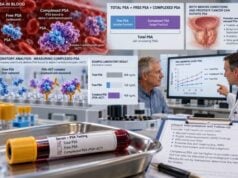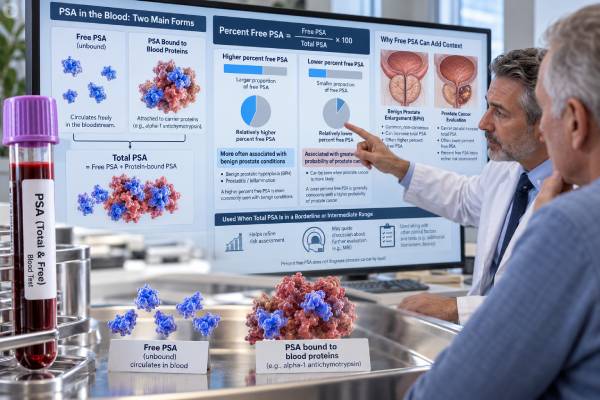
The free PSA test helps refine prostate cancer risk when a total PSA result is elevated or otherwise difficult to interpret. PSA circulates in blood in two main forms: protein-bound PSA and unbound, or “free,” PSA. The laboratory can measure both and calculate percent free PSA, which is the free PSA divided by total PSA and multiplied by 100. In general, a lower percent free PSA is associated with a higher likelihood of prostate cancer, while a higher percentage is more often seen with benign prostate enlargement. The test is especially useful when total PSA falls in an intermediate range where benign conditions and cancer overlap, traditionally around 4–10 ng/mL, although newer evidence suggests the ratio can also add information at lower PSA levels in selected men. Percent free PSA does not diagnose cancer and has no single universal cutoff. Its value is strongest when combined with age, PSA trend, prostate volume, examination, MRI findings, family history, and the patient’s preferences about biopsy.
- Calculation: Percent free PSA = free PSA ÷ total PSA × 100; it is a ratio, not a separate cancer marker with its own “normal” concentration.
- General pattern: Lower percentages mean higher cancer risk; values around 10% or less are more concerning than values above 25%, but cutoffs vary by setting and assay.
- Common use: The test is often used when total PSA is roughly 4–10 ng/mL and the decision about prostate biopsy is uncertain.
- Important limitation: A high percent free PSA does not rule out cancer, and a low percentage does not prove cancer.
- Best interpretation: Use the ratio with total PSA, age, prostate size, MRI, examination, family history, and prior biopsy information rather than as a stand-alone result.
Table of Contents
- What free PSA and percent free PSA mean
- Percent free PSA ranges and cancer risk
- When the free PSA test is most useful
- Factors that can affect free and total PSA results
- How free PSA fits with MRI and newer biomarkers
- Limitations and common interpretation mistakes
- What to do after a percent free PSA result
What free PSA and percent free PSA mean
Free PSA is the portion of prostate-specific antigen circulating in blood that is not attached to carrier proteins. Total PSA includes both free PSA and PSA bound to proteins. The useful clinical measure is usually the free-to-total PSA ratio, reported as percent free PSA.
The calculation is simple. If free PSA is 0.8 ng/mL and total PSA is 5.0 ng/mL, percent free PSA is 16%:
0.8 ÷ 5.0 × 100 = 16%
The biological reason the ratio helps is that prostate cancer tends, on average, to release a larger proportion of PSA in forms that circulate bound to proteins, while benign prostate tissue often contributes a relatively larger free fraction. The distributions overlap substantially, so the test is probabilistic rather than diagnostic.
That is why percent free PSA is different from simply repeating a total PSA test. Total PSA asks how much PSA is present overall. Percent free PSA asks what fraction of that PSA is unbound, which can sharpen risk estimates when the total concentration alone is ambiguous.
Percent free PSA is usually interpreted together with the total PSA measured from the same or closely matched blood sample. Comparing a free PSA measurement from one date with a total PSA measurement from a distant date can produce a misleading ratio because PSA varies over time.
The ratio also should not be confused with complexed PSA, which measures PSA bound to certain proteins. Both approaches arose from the same goal—improving cancer specificity beyond total PSA—but they are different laboratory measurements.
Percent free PSA ranges and cancer risk
There is no universal “normal” percent free PSA, but lower values consistently signal greater prostate cancer risk. The most familiar interpretation comes from men with total PSA around 4–10 ng/mL and a non-suspicious digital rectal examination.
A landmark multicenter study found that using a 25% free PSA cutoff preserved about 95% sensitivity for cancer while avoiding some unnecessary biopsies in that population. Since then, clinicians have often used broad ranges such as the following:
| Percent free PSA | General interpretation | What it may mean for follow-up |
|---|---|---|
| 10% or less | Higher concern for prostate cancer | Biopsy or additional evaluation is often discussed more strongly |
| About 10%–25% | Intermediate risk range | Interpret with age, PSA, MRI, prostate volume, family history, and other risk factors |
| Above 25% | Lower cancer probability on average | May support observation or further noninvasive assessment when other findings are reassuring |
These are decision aids, not fixed biological boundaries. A result of 24% is not meaningfully different from 26% in isolation. Different assays, patient populations, total PSA levels, ages, and biopsy practices can shift the most useful threshold.
Recent studies reinforce the same direction of effect. In men with PSA below 4 ng/mL who already had an indication for biopsy, a free-to-total ratio of 0.15 or less was associated with more clinically significant cancer than a ratio of 0.20 or greater. Another contemporary study of men with PI-RADS scores below 3 and PSA at or below 10 ng/mL found that a percent free PSA threshold around 17.6% helped separate men with higher and lower rates of Grade Group 2 or higher disease.
Those studies do not mean every laboratory should use 15%, 17.6%, 20%, or 25% as the “correct” cutoff. They show that the ratio carries information across several clinical settings. The most useful number is the one interpreted within the validated context of the assay and the patient’s overall risk.
A lower ratio can also matter more when other findings point in the same direction. For example, total PSA of 7 ng/mL, percent free PSA of 9%, a suspicious MRI lesion, and a strong family history create a different risk picture than PSA of 7 ng/mL, percent free PSA of 28%, a large benign-appearing prostate, and a negative MRI.
When the free PSA test is most useful
Percent free PSA is most useful when total PSA is elevated enough to raise concern but not high enough to make the next step obvious. Historically, this has meant the 4–10 ng/mL range, often called the PSA “gray zone.”
A clinician may order free PSA when:
- a first elevated PSA is confirmed and the cause remains uncertain;
- total PSA is mildly or moderately elevated and the patient is deciding whether to have MRI or biopsy;
- a previous biopsy was negative but PSA-related concern persists;
- the prostate is enlarged and the clinician wants another clue about benign versus malignant PSA production;
- MRI is negative or equivocal and residual risk still needs clarification;
- a patient wants to avoid biopsy if the estimated risk of clinically significant cancer is sufficiently low.
The test can also be incorporated into multivariable risk assessment rather than used as a separate yes-or-no step. A person’s age, total PSA, percent free PSA, prostate volume, family history, ancestry, examination, and MRI can be combined informally or through validated risk calculators.
Percent free PSA is less helpful when the biopsy decision is already clear. A highly suspicious MRI lesion, a distinctly abnormal prostate examination, or other high-risk findings may warrant biopsy regardless of the ratio. Likewise, a man with major competing health problems who would not pursue diagnosis or treatment may not benefit from additional biomarker testing.
The free PSA test is also not a screening substitute for total PSA. It is typically a reflex or secondary test used after a total PSA result has raised a question. For a broader comparison of secondary options, the prostate cancer biomarker panel includes free PSA alongside PHI, 4Kscore, and urine-based markers.
Factors that can affect free and total PSA results
Anything that changes total PSA can change how the percent free PSA result should be interpreted, even if the ratio itself is less affected than the total concentration. The safest approach is to obtain the measurements under reasonably stable conditions and interpret both values together.
Benign prostate enlargement is a major factor. A larger prostate can release more PSA and often produces a higher free fraction, which is one reason a higher percent free PSA can point toward benign prostatic hyperplasia. Prostate size therefore adds useful context, and PSA density may provide another way to relate PSA to gland volume.
Inflammation and infection can raise total PSA. Acute prostatitis or a urinary tract infection can produce substantial PSA elevations, and clinicians often delay risk interpretation until the acute problem has resolved. Recent urinary retention, catheterization, cystoscopy, prostate biopsy, or other manipulation can also affect PSA.
Ejaculation and vigorous activities that put pressure on the prostate may cause small temporary changes in PSA in some men. Laboratories and clinicians vary in their preparation instructions, but following the same conditions for repeat testing can reduce avoidable variation.
Medications matter too. 5-alpha-reductase inhibitors such as finasteride and dutasteride can lower PSA substantially over time. The clinician needs to know about these drugs because a raw PSA value cannot be interpreted the same way as in someone not taking them. Testosterone therapy and drugs affecting androgen levels may also change the clinical context.
Age affects both prostate size and cancer risk. Older men tend to have larger prostates and may have higher percent free PSA, while cancer risk also rises with age. This is one reason age-specific and multivariable approaches often outperform a single rigid cutoff.
Analytical differences between laboratory platforms can also matter. Free PSA is present at a lower concentration than total PSA and requires accurate measurement. When possible, repeat testing should use the same laboratory or assay system, especially when small changes could alter a biopsy decision.
How free PSA fits with MRI and newer biomarkers
Percent free PSA remains useful because it is inexpensive, widely available, and easy to add to a standard blood draw, but it now competes with more complex biomarkers and prostate MRI. The best choice depends on the specific clinical question.
Multiparametric MRI can show suspicious lesions and guide targeted biopsy. It also provides prostate volume, which allows calculation of PSA density. MRI therefore contributes structural information that free PSA cannot provide.
Blood tests such as the Prostate Health Index use free PSA as part of a more complex formula. PHI combines total PSA, free PSA, and [-2]proPSA, a PSA isoform associated with cancer. The Prostate Health Index can provide more refined risk information than percent free PSA alone in some settings.
The 4Kscore uses four kallikrein measurements plus clinical information to estimate the chance of Grade Group 2 or higher disease. Urine tests such as ExoDx, SelectMDx, and PCA3 analyze different molecular signals. These tests may offer greater specificity in selected populations, but they are generally more expensive and may have more limited availability or insurance coverage.
No evidence-based rule says every man with an elevated PSA should receive all of these tests. Multiple overlapping biomarkers can create contradictory probabilities and increase cost without a validated way to combine every score. A better strategy is to identify the decision that remains unresolved, choose one appropriate secondary tool, and define beforehand what result would change management.
For example, a man with PSA 5.5 ng/mL and no MRI yet may reasonably use percent free PSA as a low-cost next step. Another man with the same PSA but a strong family history and concerning PSA density may go directly to MRI. A third may choose a validated molecular biomarker if avoiding biopsy is a high priority and the result would materially influence the decision.
Limitations and common interpretation mistakes
The main limitation is overlap: men with benign disease can have low percent free PSA, and men with prostate cancer can have high percent free PSA. The test changes probability; it does not create certainty.
Several mistakes are common:
- Calling a percentage “normal” or “abnormal” without context. Percent free PSA has risk ranges rather than a universal reference interval.
- Using 25% as an automatic biopsy rule. The 25% threshold came from a specific population and should not replace individualized assessment.
- Ignoring the total PSA. A ratio has different implications at total PSA of 2.5 ng/mL versus 12 ng/mL.
- Ignoring MRI and examination findings. A reassuring ratio should not override a clearly suspicious lesion or examination.
- Comparing results from mismatched dates. The free and total PSA values used to calculate the ratio should reflect the same testing period.
- Assuming a low ratio measures cancer aggressiveness perfectly. It can correlate with clinically significant disease, but biopsy Grade Group and stage require tissue and imaging information.
- Reacting to one unexpected PSA panel during infection or urinary symptoms. Acute benign conditions can distort the risk assessment.
Another limitation is that much of the classic cutoff literature predates modern MRI-first biopsy pathways. Contemporary studies show that percent free PSA can still add value, including in men with low-suspicion MRI, but its role increasingly sits inside a larger diagnostic pathway rather than functioning as the sole trigger for biopsy.
What to do after a percent free PSA result
The next step should be based on the combination of total PSA, percent free PSA, clinical risk factors, and imaging—not the percentage alone. A useful appointment after testing focuses on how the result changed the estimated risk and whether that change is large enough to alter the plan.
If percent free PSA is relatively high and the rest of the evaluation is reassuring, the clinician may recommend repeat PSA monitoring, MRI, or observation rather than immediate biopsy. The follow-up interval depends on age, baseline PSA, PSA trend, family history, prostate size, and prior findings.
If percent free PSA is low, especially around 10% or below, the discussion usually shifts toward additional evaluation. That may include prostate MRI, a more advanced secondary biomarker, or biopsy. A low ratio becomes more concerning when total PSA is persistently elevated, PSA density is high, examination is abnormal, or family history is strong.
Useful questions to ask include:
- Were my free and total PSA measured from the same sample?
- What percent free PSA range does this laboratory use in my PSA range?
- How does my age and prostate size affect the interpretation?
- Do I need a repeat PSA before making a biopsy decision?
- Would MRI add more useful information than another blood or urine biomarker?
- If MRI is negative, what level of residual risk would still justify biopsy?
- If we defer biopsy, when will we reassess PSA and what change would trigger further testing?
The goal is not to drive percent free PSA as high as possible or to “treat the ratio.” It is a diagnostic risk marker, not a therapeutic target. Lifestyle changes or supplements should not be used to manipulate the number in place of appropriate evaluation.
When used in the setting it was designed for, percent free PSA remains a practical way to make an ambiguous total PSA more informative. Its greatest value is helping a patient and clinician make a more proportionate decision—proceeding with biopsy when risk is meaningful and avoiding or delaying biopsy when the combined evidence supports a safer watch-and-reassess approach.
References
- Usefulness of free PSA ratio to enhance detection of clinically significant prostate cancer in patients with PI-RADS<3 and PSA≤10 2025
- Utility of PSA free-to-total ratio for clinically significant prostate cancer in men with a PSA level of <4 ng/mL 2025
- Individual risk prediction of high grade prostate cancer based on the combination between total prostate-specific antigen (PSA) and free to total PSA ratio 2023
- Early Detection of Prostate Cancer: AUA/SUO Guideline Part I: Prostate Cancer Screening 2023 (Guideline)
- Early Detection of Prostate Cancer: AUA/SUO Guideline Part II: Considerations for a Prostate Biopsy 2023 (Guideline)
- Use of the percentage of free prostate-specific antigen to enhance differentiation of prostate cancer from benign prostatic disease: a prospective multicenter clinical trial 1998
Disclaimer
This article is for general education and does not replace individualized medical advice. Percent free PSA should be interpreted by a qualified clinician together with total PSA, symptoms, medications, examination, imaging, prostate size, family history, and prior biopsy information. Seek timely medical care for fever with urinary symptoms, inability to urinate, visible blood in the urine, severe pelvic pain, or other acute symptoms rather than relying on PSA testing alone.