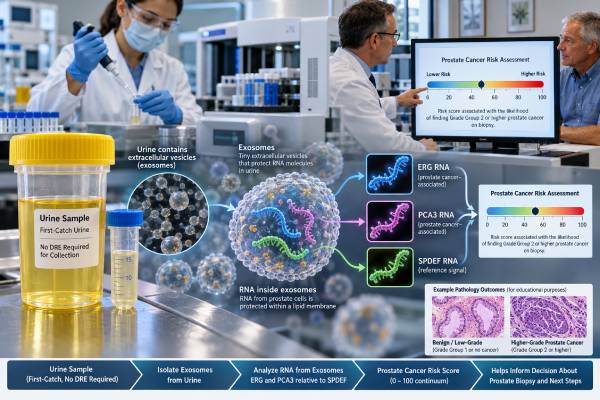
The ExoDx Prostate test is a urine-based biomarker test used to estimate the chance that a prostate biopsy will find clinically significant prostate cancer. It analyzes RNA carried inside urinary exosomes, tiny membrane-bound particles released by cells, and produces a risk score rather than a simple positive or negative result. The test is most often considered for men age 50 or older with a PSA in the approximate 2–10 ng/mL “gray zone” who are deciding whether an initial biopsy is needed. Unlike some older urine biomarker tests, ExoDx does not require a digital rectal examination before urine collection. A lower score can support a decision to defer biopsy when the rest of the clinical picture is reassuring, while a higher score strengthens the case for further evaluation. The result should still be interpreted with PSA history, prostate MRI, family history, age, exam findings, and personal preferences because no biomarker test can diagnose or exclude prostate cancer by itself.
- What it measures: ExoDx measures urinary exosomal RNA from three genes—ERG, PCA3, and SPDEF—and converts the pattern into an EPI risk score.
- Common cutoff: A score of 15.6 is widely used; scores below 15.6 are associated with lower risk of Grade Group 2 or higher cancer, while scores at or above 15.6 indicate greater risk.
- Who it is mainly for: Men age 50 or older with PSA roughly 2–10 ng/mL who are considering an initial prostate biopsy.
- Preparation: The urine sample is collected without a prior digital rectal examination, and some programs allow collection outside the clinic.
- What the result cannot do: ExoDx does not confirm cancer, determine cancer stage, or replace biopsy when the overall risk is high.
Table of Contents
- What the ExoDx Prostate test measures
- Who may use ExoDx before prostate biopsy
- ExoDx score meaning and the 15.6 cutoff
- How the urine test is collected and processed
- How ExoDx fits with PSA, MRI, and other biomarkers
- Benefits, limitations, and common interpretation mistakes
- What to do after an ExoDx result
What the ExoDx Prostate test measures
ExoDx estimates the likelihood of clinically significant prostate cancer by measuring prostate-related RNA inside exosomes found in urine. Its formal score is often called the ExoDx Prostate IntelliScore, or EPI. It is a risk-stratification test, not a cancer diagnosis.
Exosomes are microscopic vesicles released by many types of cells. They carry molecules such as RNA and proteins from the cells that produced them. Prostate cells release exosomes into urine, which makes urine a useful source of molecular information without requiring tissue removal.
The assay evaluates RNA expression from three genes:
- PCA3, a prostate-cancer-associated noncoding RNA that is often overexpressed in prostate cancer cells.
- ERG, an oncogene commonly involved in prostate cancer through TMPRSS2-ERG gene fusion biology.
- SPDEF, a gene used in the assay as part of the expression model that helps normalize and interpret the cancer-associated signal.
The laboratory combines these measurements into a numerical score. The key target is not simply “any prostate cancer.” The test is designed to estimate the chance of finding Grade Group 2 or higher disease on biopsy. Grade Group 2 corresponds to Gleason score 3+4=7 and is commonly used as a threshold for clinically significant cancer because it contains a meaningful component of Gleason pattern 4.
That distinction matters. Many prostate cancers are Grade Group 1 and may be suitable for active surveillance rather than immediate treatment. A test that focuses on higher-grade disease can help reduce biopsies that are unlikely to uncover cancer needing near-term treatment.
ExoDx also differs from the PCA3 urine test. Although PCA3 is one component of the ExoDx assay, ExoDx combines multiple RNA signals in exosomes and does not report a PCA3 score by itself.
Who may use ExoDx before prostate biopsy
The clearest use case is a man age 50 or older with a PSA of about 2–10 ng/mL who has not yet had a prostate biopsy and wants more information before deciding on biopsy. This is the population in which the test has been prospectively studied and commercially positioned.
A PSA in this range can be difficult to interpret because PSA rises for many reasons. Benign prostate enlargement, inflammation, recent urinary procedures, and normal biologic variation can all increase PSA. The PSA test therefore identifies risk rather than cancer itself.
ExoDx can be especially useful when the biopsy decision is genuinely uncertain. Examples include:
- PSA is persistently elevated but not dramatically high.
- The prostate examination is not strongly suspicious.
- MRI is negative, equivocal, unavailable, or has not yet been performed.
- The patient wants to reduce the chance of an unnecessary biopsy but also wants reasonable sensitivity for higher-grade cancer.
- Clinical risk factors point in different directions—for example, a reassuring MRI but concerning family history.
The test is less useful when the answer will not change management. If a patient has a very suspicious MRI lesion, a markedly abnormal examination, rapidly concerning clinical findings, or other reasons that already make biopsy appropriate, an additional biomarker may add little. At the other extreme, a man with low baseline risk who would not consider biopsy regardless of the score may also gain little from testing.
ExoDx is not designed to screen the general population independently of PSA. It also does not replace germline genetic testing in men with a strong hereditary cancer history, and it is not the same type of test as a tissue-based genomic classifier used after prostate cancer has already been diagnosed.
Age, race or ancestry, family history, prior PSA values, prostate volume, medications, and life expectancy still affect the real-world meaning of the result. A numerical score should therefore be interpreted as one part of an individualized biopsy decision rather than an isolated verdict.
ExoDx score meaning and the 15.6 cutoff
A lower ExoDx score means a lower estimated risk of Grade Group 2 or higher prostate cancer, while a higher score means greater risk. The most established decision threshold is 15.6.
In pooled prospective validation data involving more than 1,200 men undergoing an initial biopsy, use of the 15.6 cutoff produced high sensitivity and negative predictive value for Grade Group 2 or higher cancer. In practical terms, the test was designed to help identify a group in whom biopsy could reasonably be deferred after discussion with a clinician while accepting a small risk of delayed detection.
| Score | General meaning | Typical clinical implication |
|---|---|---|
| Below 15.6 | Lower estimated risk of Grade Group 2+ cancer | May support deferring biopsy if other findings are reassuring |
| 15.6 or higher | Higher estimated risk | Strengthens the case for MRI, biopsy, or closer evaluation |
| Well above the cutoff | Risk generally rises as the score rises | Should be interpreted with the full clinical risk profile rather than as a stand-alone diagnosis |
A cutoff is not a biological boundary. A score of 15.5 and 15.7 do not represent sharply different diseases. The number is a statistical risk estimate, so values close to the threshold deserve context. The question is whether the result changes the balance between the harms of biopsy and the risk of delaying diagnosis.
The score also does not translate directly into a guaranteed personal probability unless the laboratory report provides an individualized estimate. Predictive values depend on how common clinically significant cancer is in the population being tested. A “low-risk” result in a high-risk patient may still leave enough residual risk to justify biopsy, while a modestly elevated score in an otherwise low-risk patient may lead to MRI or repeat clinical assessment before biopsy.
Another cutoff, 20, has been examined in validation studies. Raising the threshold can avoid more biopsies but also reduces sensitivity. For most readers, the important point is that changing the threshold changes the tradeoff: fewer procedures come at the cost of missing or delaying more clinically significant cancers. Decisions should use the validated threshold and reporting framework used by the ordering laboratory rather than an improvised cutoff.
How the urine test is collected and processed
ExoDx requires a urine sample and does not require a digital rectal examination before collection. That makes the process simpler than urine tests that depend on prostate massage to increase the amount of prostate-derived material in the sample.
The exact collection instructions should come from the ordering laboratory, but the usual process is straightforward:
- A clinician determines that the patient fits the intended testing situation and orders the assay.
- The patient provides a first-catch urine specimen according to the kit instructions. Some programs may allow home collection.
- The sample is packaged and sent to the designated laboratory.
- The laboratory isolates urinary exosomes, measures the relevant RNA targets, and applies the validated algorithm.
- A report returns an EPI score and interpretation for risk of Grade Group 2 or higher cancer.
Because the assay examines RNA inside exosomes, the specimen has handling requirements. Patients should follow the kit directions rather than transferring urine into a household container or saving an unapproved sample for later. Collection timing, minimum volume, shipping materials, and storage conditions can affect whether the laboratory can process the specimen.
No fasting is normally required. The test is also not a blood test, so it is not affected by the same immediate collection issues as serum PSA. However, clinical context still matters. A urinary tract infection, visible blood in the urine, recent urinary instrumentation, or other active urologic problem should be discussed before collection because it may change the broader evaluation plan even if it does not automatically invalidate the molecular assay.
Results should be reviewed with the clinician who ordered the test. The useful question is not simply “Is it positive?” but “How much did this result change my pretest risk, and what should we do differently because of it?”
How ExoDx fits with PSA, MRI, and other biomarkers
ExoDx works best as an additional layer of risk information after PSA, not as a replacement for PSA, MRI, or biopsy. Modern prostate-cancer evaluation often combines several partially independent signals rather than relying on one number.
PSA is usually the starting point. If PSA remains elevated after appropriate confirmation, the next step may include a risk calculator, prostate MRI, a secondary biomarker, or some combination of these. The prostate cancer biomarker panel overview helps explain how urine- and blood-based tests answer different versions of the biopsy-risk question.
MRI contributes anatomic information. It can reveal a suspicious lesion, estimate prostate volume, and help target biopsy. ExoDx contributes molecular information from urinary exosomes. Because they measure different features, a biomarker and MRI can sometimes be complementary. A negative MRI does not guarantee absence of clinically significant cancer, and a low biomarker score does not make a suspicious lesion disappear.
Other commonly considered secondary tests include the Prostate Health Index, 4Kscore, SelectMDx, and MyProstateScore. There is no universal rule that one biomarker is best for every patient. Head-to-head evidence remains limited, and test availability, prior biopsy status, MRI use, cost, insurance coverage, and local practice all matter.
It is usually unnecessary to order several overlapping commercial biomarkers at once. Doing so can produce conflicting probabilities without a validated method for combining them. A more useful strategy is to choose the test whose intended population matches the patient, decide in advance how different result ranges would change management, and then integrate the result with the existing clinical evidence.
Benefits, limitations, and common interpretation mistakes
The main benefit of ExoDx is that it can reduce unnecessary initial biopsies while preserving relatively high sensitivity for clinically significant cancer. Its noninvasive collection and lack of a required digital rectal examination also make it convenient.
Other practical advantages include a focus on Grade Group 2 or higher disease, a standardized laboratory algorithm, and molecular information that is not simply another transformation of serum PSA. Because the EPI calculation is designed to provide independent information, it can add value when PSA-based clinical variables alone leave uncertainty.
The limitations are just as important:
- It can miss cancer. A low score reduces risk but does not reduce it to zero.
- It cannot diagnose cancer. Only tissue sampling can establish the histologic diagnosis and Grade Group.
- It does not stage cancer. It cannot determine extracapsular extension, lymph-node involvement, or distant metastasis.
- Performance depends on the population tested. Results from men in the validated PSA and age range should not automatically be generalized to every clinical scenario.
- It does not replace MRI when imaging is indicated. Molecular and imaging tests answer different questions.
- Clinical utility is not the same as perfect outcome proof. Studies show that the test changes biopsy decisions and risk estimates, but long-term randomized evidence proving improved survival from biomarker-guided use is much more difficult to establish.
Common interpretation mistakes include treating 15.6 as an absolute disease boundary, assuming a low result means “no cancer,” or treating a high result as proof that aggressive cancer is present. Another mistake is ordering the assay without first deciding what action would follow a low or high score. A biomarker is most useful when it resolves a real decision.
Cost and insurance coverage also vary. Patients should ask whether the laboratory is in network, whether prior authorization is required, and what their estimated out-of-pocket cost will be before the sample is processed.
What to do after an ExoDx result
The next step depends on the score and the rest of the prostate-cancer risk picture. The result should change the probability of clinically significant cancer, not replace clinical judgment.
For a score below 15.6, a common approach is to consider deferring biopsy when PSA trend, examination, MRI, family history, and other factors are also reassuring. Deferring biopsy is not the same as ending follow-up. PSA usually continues to be monitored, and changes in PSA, symptoms, examination, MRI, or risk factors can reopen the biopsy discussion.
For a score at or above 15.6, the clinician may recommend prostate MRI if it has not already been done, biopsy, or closer evaluation depending on how high the score is and what other risk indicators show. A higher EPI result does not tell the biopsy where to sample, so MRI-guided targeting may still be useful.
Questions worth asking after the result include:
- What was my estimated risk before this test, and how did the EPI score change it?
- Does my MRI agree with the biomarker result?
- How does my family history or ancestry change the interpretation?
- If we defer biopsy, when should PSA or imaging be repeated?
- If we proceed to biopsy, will it include MRI-targeted cores, systematic cores, or both?
- What level of residual risk am I comfortable accepting to avoid a biopsy now?
If follow-up is based mainly on PSA, trends and context matter more than a single isolated value. Depending on the situation, clinicians may also consider measures such as PSA density when prostate volume is known.
The best use of ExoDx is therefore as a decision aid at a specific fork in the road. A low score can provide evidence for watchful follow-up when other findings are reassuring; a high score can justify moving forward when uncertainty has delayed evaluation. Either way, the score is most informative when the patient and clinician use it alongside the rest of the evidence.
References
- The impact of urine biomarkers for prostate cancer detection-A systematic state of the art review. 2025 (Systematic Review)
- Evaluation of blood and urine based biomarkers for detection of clinically-significant prostate cancer 2025 (Review)
- Liquid Biomarkers in Prostate Cancer Diagnosis: Current Status and Emerging Prospects 2024 (Review)
- Clinical Biofluid Assays for Prostate Cancer 2024 (Review)
- Early Detection of Prostate Cancer: AUA/SUO Guideline Part II: Considerations for a Prostate Biopsy 2023 (Guideline)
- Predicting high-grade prostate cancer at initial biopsy: clinical performance of the ExoDx (EPI) Prostate Intelliscore test in three independent prospective studies 2022
Disclaimer
This article provides general information about the ExoDx Prostate test and is not a diagnosis or a substitute for individualized medical advice. Biomarker results should be interpreted by a qualified clinician together with PSA history, examination, imaging, personal risk factors, and preferences. Seek prompt medical evaluation for new urinary obstruction, visible blood in the urine, severe pain, fever with urinary symptoms, or other concerning symptoms rather than relying on a biomarker result.