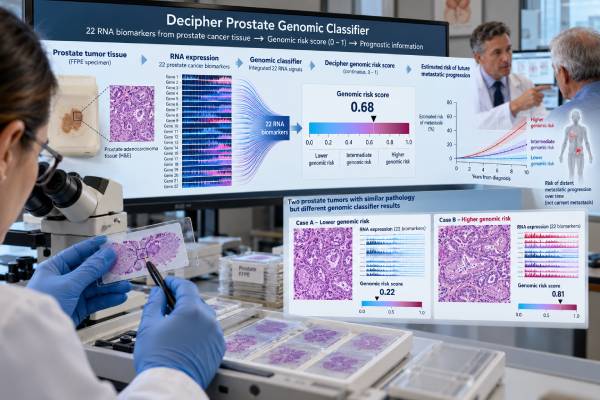
The Decipher Prostate Genomic Classifier is a tissue-based genomic test that estimates how biologically aggressive a diagnosed prostate cancer may be. It measures RNA expression from tumor tissue obtained during a prostate biopsy or radical prostatectomy and summarizes that information as a genomic classifier score from 0 to 1. Higher scores are associated with a greater risk of outcomes such as metastasis, prostate cancer recurrence, and prostate cancer-specific death. Decipher is not a screening test and does not diagnose prostate cancer; pathology must already have established the cancer. Its main role is to add prognostic information when standard features such as PSA, Grade Group, tumor stage, MRI findings, and the amount of cancer leave an important treatment decision uncertain. The score may help selected patients and clinicians refine choices about active surveillance, definitive treatment, and treatment after prostatectomy, but it should not replace the clinical and pathology information that already defines prostate cancer risk.
- Decipher analyzes the activity of 22 genes in prostate cancer tissue and reports a genomic classifier score from 0 to 1.
- A higher score is associated with a higher probability of metastasis and other adverse prostate cancer outcomes; it does not prove that spread will occur.
- Commonly cited risk categories are low below 0.45, intermediate from 0.45 to 0.60, and high above 0.60, although current report versions and decision thresholds should be checked directly.
- The test can be performed on biopsy tissue or radical prostatectomy tissue, and the clinical question differs depending on when it is ordered.
- Guidelines support selective—not routine—use of tissue genomic classifiers when the result is likely to change a meaningful management decision.
Table of Contents
- What the Decipher Test Measures
- Who May Benefit From Decipher Testing
- How to Read the Decipher Score
- What Decipher Says About Metastasis and Prognosis
- How Decipher Can Affect Treatment Decisions
- Limitations and Common Misunderstandings
- Questions to Discuss With Your Clinician
What the Decipher Test Measures
Decipher is a gene-expression classifier. Instead of looking for an inherited mutation in DNA, it measures patterns of RNA activity within the prostate tumor. RNA reflects which genes are being turned on or off in the sampled cancer cells. The assay evaluates 22 genes involved in several aspects of tumor biology, including cell proliferation, differentiation, motility, immune signaling, and androgen-receptor-related pathways.
The laboratory uses formalin-fixed, paraffin-embedded tumor tissue that was already collected during a prostate biopsy or radical prostatectomy. In most cases, a patient does not need another biopsy solely to obtain material for the test if enough suitable tumor remains in the pathology block. A pathologist identifies an appropriate tumor area, RNA is extracted, and the expression pattern is processed by the classifier algorithm.
The result is a continuous score from 0 to 1. Values closer to 1 represent genomic features associated with more aggressive behavior. The score does not measure the percentage of the prostate occupied by cancer, the fraction of cancer cells carrying a mutation, or the chance that a person has inherited a cancer-risk gene.
This distinction is important. Decipher is different from a hereditary test for BRCA1, BRCA2, ATM, or other DNA-repair genes. A hereditary test asks whether a pathogenic variant is present in the germline and may have implications for relatives. Decipher instead asks how the existing tumor is behaving at the level of gene expression. It is also different from a PSA test, which is a blood marker used before and after diagnosis for different clinical purposes.
The assay can be used on two main specimen types:
- Biopsy tissue, when the question is often whether a cancer that looks favorable by routine clinical measures may have more aggressive biology than expected.
- Radical prostatectomy tissue, when the question is often the risk of recurrence or metastasis after surgery and whether additional treatment should be considered more strongly.
A genomic classifier is therefore best viewed as an extra layer of risk information. It does not replace the Grade Group, pathologic stage, surgical margins, PSA, MRI, or other standard findings.
Who May Benefit From Decipher Testing
Decipher is most useful when a management decision is genuinely uncertain and additional prognostic information could change the choice. Professional guidance has emphasized selective use of tissue-based genomic classifiers rather than testing every person with localized prostate cancer.
After a prostate biopsy, a clinician may consider Decipher when a patient has localized cancer and is deciding between active surveillance and definitive treatment. Examples can include some men with higher-volume Grade Group 1 disease or selected favorable intermediate-risk cancers where the clinical features do not point clearly in one direction. A lower genomic score may add reassurance when surveillance is otherwise appropriate, while a higher score may strengthen concern that closer monitoring or treatment deserves consideration.
The test may also be considered before radiation treatment in some intermediate- or high-risk settings when the team is trying to refine the expected aggressiveness of disease. The result can contribute to discussions about treatment intensity, but it should not be used as a simple rule for adding or withholding androgen-deprivation therapy.
After radical prostatectomy, Decipher may be ordered when adverse pathologic findings or a rising PSA raise questions about the likelihood of progression and the timing or intensity of postoperative therapy. Standard postoperative factors still matter greatly, including:
- Grade Group and Gleason pattern.
- Pathologic tumor stage.
- Seminal vesicle invasion.
- Lymph-node involvement.
- Surgical-margin status.
- Postoperative PSA level and PSA trend.
- Time from surgery to biochemical recurrence.
For a patient whose clinical risk is already clearly very low and who is comfortable with surveillance, a genomic test may not add enough information to justify ordering it. Likewise, when disease is clearly high risk and treatment is already indicated regardless of the result, testing may not change management.
The practical question is not simply, “Can Decipher be ordered?” It is, “What decision would be different if the score is low, intermediate, or high?” If there is no plausible answer, the test may have limited clinical value.
Other tissue classifiers, including Prolaris and Oncotype DX Genomic Prostate Score, address related but not identical questions. Results from different assays should not be treated as interchangeable because the genes, algorithms, validation cohorts, and reported endpoints differ.
How to Read the Decipher Score
The Decipher report centers on a numerical genomic classifier score from 0 to 1. The score is continuous: a value of 0.64 reflects more adverse genomic biology than a value of 0.34, even though clinicians often group results into categories for easier discussion.
Commonly cited cut points for the traditional Decipher classifier are:
| Score | Common category | General meaning |
|---|---|---|
| Below 0.45 | Low genomic risk | Lower relative risk of adverse outcomes compared with higher scores |
| 0.45 to 0.60 | Intermediate genomic risk | Risk falls between the traditional low- and high-risk groups |
| Above 0.60 | High genomic risk | Higher relative risk of metastasis and other adverse outcomes |
These categories are useful shorthand, but they should not be treated as universal biological boundaries. The classifier has been updated over time, and research published in 2025 comparing Decipher versions 1.0 and 1.1 showed that score distributions can shift with algorithm changes. Some studies also use different cut points for a specific analysis. For that reason, the categories and outcome estimates printed on the current individual laboratory report are more important than a cutoff copied from an older paper.
A score also needs clinical context. Consider two patients with the same Decipher value of 0.62. One may have a small-volume Grade Group 2 tumor and otherwise favorable findings; the other may have Grade Group 4 disease, seminal vesicle invasion, and a detectable postoperative PSA. The genomic number is identical, but the total risk and treatment discussion are not.
The report may provide estimated probabilities for outcomes such as metastasis or prostate cancer-specific mortality at defined time points. Those estimates are not guarantees. They are derived from groups of patients with similar test patterns and are influenced by the clinical model and specimen type used. A 10% estimated risk means that the event occurred in roughly that range among comparable populations; it does not identify which individual patient will experience it.
Changes of a few hundredths around a category boundary should therefore be interpreted cautiously. A score of 0.59 and a score of 0.61 are numerically close even if one falls into an “intermediate” label and the other into “high.” The continuous value, standard clinical risk, treatment context, and patient priorities all matter more than the label alone.
What Decipher Says About Metastasis and Prognosis
The strongest established role of Decipher is prognostic. Prognostic means the result is associated with the likelihood of future outcomes regardless of whether it identifies a specific treatment that will work better.
Studies have repeatedly found that higher Decipher scores are associated with greater risks of biochemical recurrence, distant metastasis, and prostate cancer-specific mortality. A large contemporary real-world analysis published in 2024 included 58,935 patients tested on either biopsy or radical prostatectomy tissue. After adjustment for standard clinical or pathologic factors, each 0.1 increase in the genomic classifier score was associated with about a 20% increase in the relative hazard of metastasis. This does not mean the absolute metastasis risk rises by 20 percentage points; relative and absolute risk are different concepts.
A systematic review of genomic classifiers in localized prostate cancer identified 39 studies involving more than 10,000 patients, including 22 studies of Decipher. The review concluded that genomic classifiers provided a small but consistent improvement in prognostic information beyond standard clinical classification. However, the certainty of evidence was rated low or very low for many outcomes because most studies were retrospective, treatment approaches varied, and some cohorts came from earlier treatment eras.
That limitation explains why Decipher should refine rather than replace standard risk assessment. The established clinical variables remain powerful. A clinician typically integrates the genomic score with PSA, Grade Group, stage, tumor volume, imaging, and, after surgery, pathologic findings and postoperative PSA.
The term metastasis risk can also be misunderstood. Decipher does not image the body and cannot show whether metastases are currently present. If there is concern that prostate cancer has already spread, staging tests such as PSMA PET or other imaging are used. A PSMA-based test answers a different question from a tissue genomic classifier.
Likewise, a high Decipher score is not the same as metastatic prostate cancer. It means the tumor’s gene-expression pattern resembles tumors that, on average, have had more aggressive outcomes. A low score is favorable, but it cannot reduce the future risk to zero.
Prognostic information is most useful when it changes the balance of benefits and harms in a real decision. For example, a patient choosing active surveillance may value information about the chance that apparently favorable disease will behave more aggressively. A patient after prostatectomy may value a refined estimate of metastatic risk when deciding how strongly to consider early salvage treatment.
How Decipher Can Affect Treatment Decisions
A Decipher result should be interpreted through the specific decision being made rather than as a general instruction to “treat” or “do not treat.” The same score can have different implications before treatment, after surgery, or at biochemical recurrence.
For active surveillance decisions, biopsy-based Decipher testing may help clarify risk in selected patients whose pathology is not clearly low or clearly high risk. A lower score can support the overall case for surveillance when the rest of the clinical picture is favorable. A higher score may lead to a discussion about more intensive surveillance, confirmatory testing, or definitive treatment. The score does not automatically disqualify a patient from surveillance.
For treatment of localized disease, the classifier can sometimes help refine the aggressiveness assessment. It may be considered alongside MRI, PSA density, tumor volume, Grade Group, and clinical stage. It is not a substitute for those variables and is not a stand-alone staging system.
After radical prostatectomy, Decipher has been studied extensively as a way to refine the risk of metastasis. This can be relevant when pathology shows features such as extracapsular extension, seminal vesicle invasion, high Grade Group, or positive margins, or when PSA becomes detectable after surgery. A high score may strengthen the case for prompt multidisciplinary discussion about salvage radiation and whether systemic therapy should be added.
Randomized-trial ancillary research supports the prognostic value of Decipher in men receiving salvage radiotherapy after prostatectomy. In an analysis of the NRG/RTOG 9601 trial, the genomic classifier was independently associated with metastasis, prostate cancer-specific mortality, and overall survival. The study also suggested that the absolute benefit from added hormone therapy may differ across genomic-risk groups, but it was not originally powered to establish Decipher as a definitive predictive treatment-selection test. That distinction matters.
A predictive biomarker tells clinicians that one treatment is more or less likely to help because of the biomarker result. Decipher has promising predictive applications under study, but its most secure use remains prognostic risk refinement. Treatment decisions should therefore follow current guideline-based risk categories and trial evidence, with the genomic score serving as additional information rather than overriding them.
For patients with advanced or metastatic disease, a different type of genomic testing may be more important. Tumor or blood sequencing can identify actionable alterations such as BRCA1, BRCA2, other homologous-recombination repair genes, or mismatch-repair abnormalities. A metastatic prostate cancer biomarker panel addresses treatment-selection questions that Decipher was not designed to answer.
Limitations and Common Misunderstandings
Decipher can improve risk stratification, but the result is only as useful as the clinical question it is being used to answer. Several limitations are important.
It does not diagnose prostate cancer. The test is performed on tissue in which prostate cancer has already been identified. A high score cannot confirm cancer in a person who has not had diagnostic pathology.
It does not detect inherited cancer risk. Because Decipher measures tumor RNA expression, it is not a germline test and should not be used to determine whether children, siblings, or other relatives carry a hereditary mutation. Family-history or hereditary-risk concerns may require separate genetic counseling and germline testing.
It does not show where cancer is located or whether it has spread. Imaging and pathology provide anatomic staging information. Decipher estimates biological risk.
A low score is not a guarantee. Some cancers with low genomic scores still recur or metastasize. The test shifts probability; it does not create certainty.
A high score does not mean metastasis is inevitable. Many patients with high genomic scores do not develop distant disease, especially when effective treatment is given. The score describes risk within a population, not a fixed personal destiny.
Evidence is stronger for prognosis than for prediction of treatment benefit. Systematic reviews find consistent additional prognostic information, but much of the evidence is retrospective. Prospective trials are continuing to test how genomic classifiers should guide radiation, hormone therapy, and other treatment choices.
Tissue quality and sampling matter. A biopsy samples only part of the prostate, and prostate cancer can be biologically heterogeneous. The tested focus may not capture every clone within a multifocal tumor. Laboratory quality-control processes reduce technical problems but cannot eliminate biological sampling limitations.
Score versions can change. As with many commercial genomic assays, algorithms and reporting can evolve. Current reports should be interpreted using the version-specific information supplied by the laboratory and the clinician, rather than assuming that every historical threshold or outcome estimate is identical today.
Cost and insurance coverage can also matter. Before testing, it is reasonable to ask whether prior authorization is required and whether the result is likely to change management enough to justify the expense.
Questions to Discuss With Your Clinician
The most useful conversation begins with the decision that is actually unresolved. A patient can ask, “What would you recommend if my Decipher score is low, and what would you recommend if it is high?” The answer helps show whether the test is likely to add value.
Other useful questions include:
- Is the test being ordered on biopsy tissue or prostatectomy tissue, and why does that matter in my case?
- What are my standard clinical risk group, Grade Group, stage, PSA level, and other major risk factors before considering Decipher?
- What exact Decipher score did I receive, and what risk category does the current report assign?
- Are the percentage risks on my report absolute risks, and over what time period are they estimated?
- Would a lower score support active surveillance, less intensive treatment, or simply provide reassurance?
- Would a higher score change the timing of treatment, radiation planning, or the discussion about androgen-deprivation therapy?
- How much weight should the genomic result receive compared with MRI, pathology, PSA, and my age and health?
- Does my family history or disease pattern indicate separate germline genetic testing?
- Would the recommended plan be the same if Decipher had not been performed?
For someone with a borderline score, it is reasonable to ask the clinician to discuss the continuous number, not just the low/intermediate/high label. Small numerical differences around a threshold usually deserve less weight than major differences in Grade Group, stage, postoperative PSA, or other well-established clinical findings.
If the result changes a major treatment choice, a second opinion from a urologist, radiation oncologist, or medical oncologist can be helpful. The goal is not to make one test decisive. It is to combine pathology, clinical risk, genomic information, treatment evidence, and personal priorities into a plan that fits the individual patient.
References
- Clinically Localized Prostate Cancer: AUA/ASTRO Guideline Amendment (2026) 2026
- Clinical Comparison of Decipher 1.0 and 1.1 for Localized Prostate Cancer: Results in Prostatectomy and Active Surveillance Patients 2025
- Genomic classifiers and prognosis of localized prostate cancer: a systematic review 2025
- Association Between the Decipher Genomic Classifier and Prostate Cancer Outcome in the Real-world Setting 2024
- Clinically Localized Prostate Cancer: AUA/ASTRO Guideline, Part I: Introduction, Risk Assessment, Staging, and Risk-Based Management 2022
- Validation of a 22-Gene Genomic Classifier in Patients With Recurrent Prostate Cancer: An Ancillary Study of the NRG/RTOG 9601 Randomized Clinical Trial 2021
Disclaimer
Decipher results should be interpreted by the treating prostate cancer team together with pathology, PSA, imaging, stage, other health conditions, and treatment goals. A genomic classifier cannot guarantee whether cancer will recur or metastasize and should not be used by itself to start, delay, intensify, or avoid treatment. Current assay versions, report thresholds, guideline recommendations, and insurance coverage may change over time.