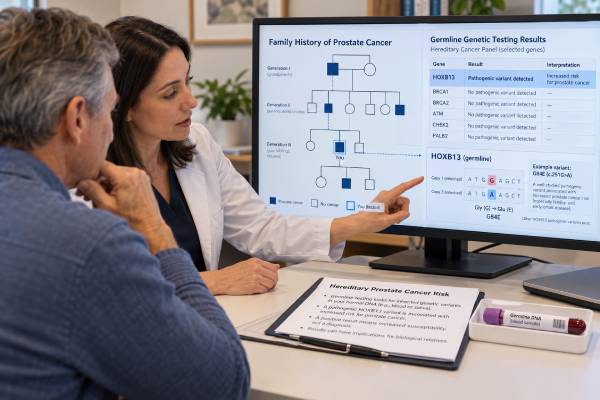
A HOXB13 genetic test looks for inherited variants in the HOXB13 gene that can raise a person’s lifetime risk of prostate cancer. The best-studied variant is G84E, which is most strongly associated with men of European ancestry and is linked to roughly a 3- to 5-fold higher prostate cancer risk overall, with even greater relative risk in some early-onset and strongly familial cases. A positive result does not mean prostate cancer is present, and it does not reliably predict whether any future cancer will be aggressive. Instead, HOXB13 testing is used as part of hereditary cancer risk assessment, especially when prostate cancer occurs at a young age, affects multiple relatives, or appears in a family with other clues to inherited cancer susceptibility. Modern germline panels usually test HOXB13 alongside genes such as BRCA1, BRCA2, ATM, CHEK2, and mismatch-repair genes. Results should be reviewed with a genetics professional because a pathogenic variant can affect screening decisions for the person tested and may also have implications for biological relatives.
- What it tests: HOXB13 testing looks for germline, or inherited, variants associated with prostate cancer susceptibility; G84E is the most established variant in European-ancestry populations.
- Risk with G84E: Current evidence places overall prostate cancer risk at about 3–5 times that of noncarriers, with higher relative risk for early-onset disease and a lifetime risk reported near 60% by age 80 in some populations.
- What a positive result means: A pathogenic HOXB13 variant raises inherited risk but does not diagnose prostate cancer and does not by itself determine treatment.
- Family meaning: A confirmed germline variant can be inherited by children and shared by siblings, so genetic counseling and targeted family testing may be appropriate.
- Important limitation: A negative HOXB13 result does not eliminate hereditary prostate cancer risk because many other genes and polygenic factors can contribute.
Table of Contents
- What HOXB13 is and why it matters
- Who should consider HOXB13 genetic testing
- How the test is done and what results mean
- HOXB13 G84E risk, penetrance, and ancestry
- Family testing and prostate cancer screening
- How HOXB13 differs from BRCA and other prostate cancer genes
- Limitations and next steps after testing
What HOXB13 is and why it matters
HOXB13 is a gene involved in prostate development and regulation of prostate-cell biology, and certain inherited variants can substantially increase prostate cancer susceptibility. It was the first gene identified as a major hereditary prostate cancer susceptibility gene in families without a classic BRCA-type syndrome.
The gene encodes a transcription factor, meaning a protein that helps regulate the activity of other genes. HOXB13 also interacts with androgen-receptor signaling, a central pathway in normal prostate function and prostate cancer. The exact way an inherited variant increases cancer risk is complex and remains an active area of research.
The variant with the strongest evidence is G84E, also written p.Gly84Glu or c.251G>A. It is a rare germline change found mainly in people of Northern and Western European ancestry. The association was first established in hereditary prostate cancer families and has since been replicated in large case-control studies and meta-analyses.
HOXB13 testing is different from a tumor biomarker. A tumor test asks what molecular changes are present in an existing cancer. A germline HOXB13 test asks whether a person was born with a risk variant that is present in essentially every cell and can potentially be passed to relatives.
That distinction also explains why a HOXB13 result does not replace PSA screening. A carrier still needs ordinary clinical tools such as the PSA test, examination, and when appropriate, MRI or biopsy. The genetic result changes the baseline level of inherited risk and may change how early or how intensively screening is considered.
Who should consider HOXB13 genetic testing
HOXB13 testing is most useful when the personal or family history suggests inherited prostate cancer risk. In practice, it is usually included in a multigene hereditary cancer panel rather than ordered as a single-gene test.
Testing may be considered when a person has prostate cancer plus one or more of the following features:
- prostate cancer diagnosed at a relatively young age;
- multiple close relatives with prostate cancer, especially across generations;
- a family pattern of early-onset or metastatic prostate cancer;
- high-risk, very-high-risk, regional, or metastatic prostate cancer where germline testing is already indicated for broader reasons;
- a known pathogenic variant in HOXB13 in a biological relative;
- a family history that meets hereditary cancer testing criteria even if the exact gene is unknown.
Men without prostate cancer may also be tested when a pathogenic HOXB13 variant has already been identified in the family. This is called cascade testing. In that setting, the laboratory can perform targeted testing for the known familial variant, which is usually simpler to interpret than broad testing in an unaffected person with no known family mutation.
Testing an affected relative first is often more informative when possible. If a family contains several men with prostate cancer, starting with a person who had early-onset, aggressive, or metastatic disease increases the chance that a clinically relevant hereditary variant will be found. A negative result in an unaffected relative is harder to interpret if no affected family member has been tested.
Modern prostate cancer genetics usually evaluates more than HOXB13. A clinician may recommend a panel that includes BRCA1 and BRCA2, ATM, CHEK2, PALB2, and mismatch-repair genes such as MSH2, MSH6, MLH1, and PMS2. This matters because different genes have different implications for prostate cancer risk, other cancer risks, family counseling, and treatment.
Genetic counseling is especially useful before testing when the family history is complex, ancestry-specific variants are possible, or the result could affect several relatives. Counseling also helps distinguish a true pathogenic variant from a variant of uncertain significance, which should not be treated as a positive hereditary cancer result.
How the test is done and what results mean
HOXB13 germline testing usually uses blood or saliva, and the most important result categories are pathogenic/likely pathogenic, negative, and variant of uncertain significance. The sample type does not change the inherited information being tested.
A typical process includes:
- The clinician or genetics professional documents the patient’s cancer history and a three-generation family history when possible.
- A hereditary cancer panel is selected based on the clinical scenario and family pattern.
- Blood, saliva, or sometimes a cheek-swab sample is collected.
- The laboratory sequences HOXB13 and other included genes and may analyze certain deletion or duplication changes depending on the assay.
- Results are classified using accepted genetic-variant interpretation standards.
- A clinician or genetic counselor reviews what the result means for the patient and family.
A pathogenic or likely pathogenic variant means there is strong evidence that the change impairs gene function or is associated with disease risk. For HOXB13, G84E is the best-established example. This type of result can justify enhanced risk counseling and may support earlier or more structured prostate cancer screening.
A negative result means the laboratory did not identify a reportable pathogenic variant in the genes tested. It does not mean the person has average risk. Family history, ancestry, common genetic risk variants, and undiscovered genes can still create inherited susceptibility. A negative panel is most reassuring when it tests for a known familial variant and the person truly did not inherit that variant.
A variant of uncertain significance, or VUS, means the laboratory found a genetic change but current evidence cannot determine whether it increases cancer risk. A VUS should generally not trigger surgery, intensified cancer treatment, or predictive testing of relatives as though it were pathogenic. Laboratories may reclassify variants as evidence accumulates.
Some people see the term “positive HOXB13” and assume it means cancer is present. That is incorrect. Germline testing is a risk test. Cancer detection still relies on screening and diagnostic evaluation.
HOXB13 G84E risk, penetrance, and ancestry
The G84E variant is associated with a large increase in prostate cancer susceptibility, but the exact absolute risk varies with ancestry, age, family history, and the population studied. Current NCI-reviewed evidence summarizes overall relative risk at roughly 3- to 5-fold, with early-onset risk reported as high as about 10-fold in some analyses.
Relative risk and absolute risk are not the same. A fivefold relative increase does not mean a 500% chance of cancer. Absolute lifetime risk depends on the underlying risk in the population and the carrier’s other characteristics.
Several studies estimate substantial penetrance—the probability that a carrier develops prostate cancer over a lifetime. Population-specific analyses have reported cumulative risks in the range of roughly one-third to around 60% or more by older age. The NCI’s current genetics summary cites an approximate 60% lifetime risk by age 80 for G84E carriers, while emphasizing that estimates vary.
Family history modifies risk further. A G84E carrier with several first-degree relatives diagnosed young may face a higher absolute risk than a carrier with no known family history. This is why genetic counseling should combine the molecular result with the pedigree rather than reducing the discussion to one percentage.
Ancestry is also important. G84E is most closely associated with European ancestry and appears to have a founder effect in Northern Europe. It is uncommon in many non-European populations. That does not mean HOXB13 is irrelevant outside Europe. Other ancestry-associated variants have been described, including G132E in Japanese populations and X285K in men of West African ancestry. Evidence for these variants is growing, but their frequencies, effect sizes, and clinical interpretation are not identical to G84E.
The relationship between G84E and aggressiveness is less clear than the relationship with cancer occurrence. Some older studies suggested enrichment in aggressive disease, but larger analyses and NCI-reviewed evidence do not show a consistent, definitive association with worse stage, Gleason grade, or survival. Therefore, a carrier should not assume that any future prostate cancer will necessarily be aggressive.
Family testing and prostate cancer screening
A confirmed pathogenic HOXB13 variant can matter to blood relatives because germline variants are inherited, but the exact screening plan should be individualized. Each first-degree relative—parent, sibling, or child—may have a meaningful chance of carrying the same familial variant depending on which parent transmitted it.
If a pathogenic variant is found, genetic counseling can identify which relatives are appropriate for targeted testing. Testing adults for a known family variant can clarify who needs enhanced prostate-risk discussion and who did not inherit that specific variant.
For male carriers, screening commonly centers on PSA-based surveillance with shared decision-making. Major guidelines increasingly recommend earlier consideration of prostate screening for men with strong hereditary risk, although the exact starting age and interval vary by guideline, gene, family history, and baseline PSA.
A practical plan may include:
- establishing a baseline PSA earlier than for an average-risk man;
- repeating PSA at an interval based on age, baseline value, family history, and prior results;
- using MRI or secondary biomarkers when PSA creates uncertainty about biopsy;
- paying attention to changes in PSA rather than relying on one universal “normal” threshold;
- documenting the genetic result in the medical record so future clinicians understand the inherited risk.
A HOXB13 carrier with an elevated PSA may still use standard secondary tools. Depending on the situation, clinicians may consider percent free PSA, PHI, 4Kscore, MRI, or a urine biomarker before biopsy. The Prostate Health Index, for example, evaluates PSA isoforms and answers a different question from hereditary genetic testing.
Female relatives can also inherit HOXB13 variants, but the strongest established clinical association is prostate cancer risk in men. Current evidence does not support treating G84E as a broad high-penetrance breast or colorectal cancer syndrome in the same way as certain BRCA or Lynch syndrome variants. Family counseling should therefore focus on the evidence for the specific variant rather than assuming it carries the same cancer spectrum as another hereditary gene.
How HOXB13 differs from BRCA and other prostate cancer genes
HOXB13 is mainly a prostate cancer susceptibility gene, while genes such as BRCA2, ATM, and mismatch-repair genes can affect both inherited risk and treatment selection in established cancer. This is an important difference when interpreting a panel result.
BRCA2 pathogenic variants are associated with increased prostate cancer risk and a greater tendency toward aggressive disease. In metastatic prostate cancer, homologous-recombination repair defects can also help identify candidates for PARP-inhibitor-based treatment. The prostate cancer HRR gene panel is therefore relevant to both inherited risk and precision oncology.
Mismatch-repair gene variants can indicate Lynch syndrome and may have implications for colorectal, endometrial, and other cancers in a family. In a prostate tumor, mismatch-repair deficiency or high microsatellite instability can also have immunotherapy implications in selected advanced disease.
HOXB13 is different. Its strongest established value is risk prediction and family counseling. A germline HOXB13 result by itself is not currently a standard predictive biomarker for choosing a specific drug in metastatic prostate cancer. That is why a multigene panel is often preferable to single-gene testing in an affected patient: one assay can evaluate genes that answer different but clinically important questions.
Another distinction is frequency by ancestry. G84E is rare overall and concentrated in European-derived populations. A panel designed only around that one variant could miss other relevant hereditary genes or other HOXB13 variants that matter in different populations.
Limitations and next steps after testing
The most important limitation is that genetic risk is not destiny: HOXB13 cannot tell whether or when a particular person will develop prostate cancer. It also cannot determine whether a current PSA elevation is cancer, what a tumor’s Grade Group would be, or how a diagnosed cancer should be treated on its own.
Other limitations include incomplete penetrance, ancestry-dependent evidence, changing variant classification, and the possibility of finding a VUS. Some commercial panels also differ in which HOXB13 variants and genomic regions they analyze, so the laboratory’s methodology matters.
After a pathogenic result, useful next steps are to:
- meet with a genetics professional to review the exact variant and evidence;
- confirm whether screening should begin earlier or occur more frequently;
- share a copy of the laboratory report with appropriate clinicians;
- discuss targeted testing with adult biological relatives;
- review whether the broader panel found other genes with additional cancer or treatment implications;
- update the family history over time because new diagnoses can change risk interpretation.
After a negative result, the next step depends on why testing was performed. Someone from a strongly affected family may still be considered at elevated risk based on family history alone. If a known familial HOXB13 pathogenic variant was tested and not inherited, the person’s risk from that specific variant returns to baseline, but other independent risk factors still apply.
After a VUS, management should generally follow personal and family history rather than treating the uncertain variant as pathogenic. Reclassification can occur, so keeping contact information current with the ordering genetics clinic or laboratory can help ensure important updates are received.
The most useful way to think about HOXB13 testing is as one layer of inherited-risk information. It can explain why prostate cancer clusters in some families and help identify relatives who may benefit from earlier risk assessment, but it works best when combined with a complete family history, evidence-based screening, and careful genetic counseling.
References
- Genetics of Prostate Cancer (PDQ®)–Health Professional Version 2025 (Review)
- Germline Testing for Prostate Cancer Patients: Evidence-Based Evaluation of Genes Recommended by NCCN Guidelines 2025
- Evaluation of homeobox protein B13 (HOXB13) gene G84E mutation in patients with prostate cancer 2024
- Aligning germline and somatic mutations in prostate cancer. Are genetics changing practice? 2023 (Review)
- An Update on Genetic Predisposition for Prostate Cancer: Perspectives and Prospects. 2023 (Review)
- Germline mutations in HOXB13 and prostate-cancer risk 2012
Disclaimer
This article provides general information about inherited HOXB13 testing and is not a substitute for genetic counseling or individualized medical care. Cancer-risk estimates vary by variant, ancestry, family history, and evolving evidence, so results should be interpreted from the original laboratory report by a qualified clinician or genetics professional. A genetic result does not diagnose prostate cancer; new symptoms or abnormal screening results still require appropriate medical evaluation.