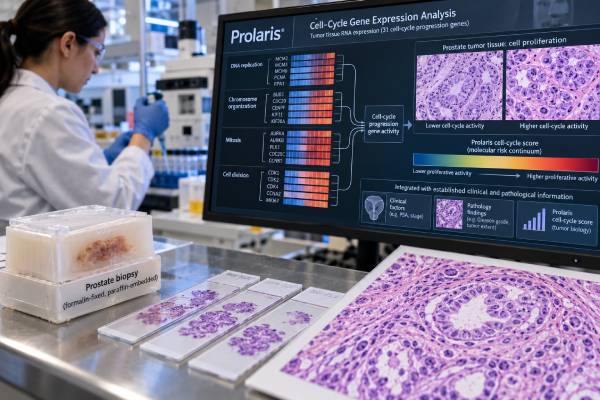
The Prolaris test is a tissue-based prostate cancer prognostic test that measures the activity of 31 cell-cycle progression genes to estimate how quickly the sampled tumor is biologically programmed to grow. Its molecular result is often called the cell-cycle progression (CCP) score or Prolaris Molecular Score. Higher values reflect greater cell-cycle activity and are generally associated with more aggressive disease, while lower values support a less aggressive molecular pattern. Prolaris is used after prostate cancer has been diagnosed, mainly in localized disease where the choice between active surveillance and treatment, or between different treatment intensities, is uncertain. Current Prolaris reporting combines molecular information with clinical factors to estimate risks such as prostate cancer-specific mortality or metastasis and to show decision thresholds. In 2026, the commercial test also added an AI-based digital pathology component for active-surveillance risk refinement. Prolaris does not diagnose cancer, detect inherited cancer genes, or replace Gleason Grade Group, PSA, MRI, stage, and expert pathology review.
- What it measures: Prolaris analyzes RNA expression from 31 genes involved in cell-cycle progression in prostate tumor tissue.
- Score meaning: Higher cell-cycle activity generally indicates faster-growing, more aggressive tumor biology; lower activity supports a more favorable prognosis.
- Main use: Results can refine decisions about active surveillance, definitive treatment, and treatment intensity in localized prostate cancer.
- No universal normal range: Prolaris is a continuous prognostic score interpreted with clinical risk, not a blood-test value with a normal laboratory interval.
- Current reporting: The molecular score is integrated with clinical-pathologic data, and the 2026 Prolaris + AI version also incorporates digital pathology for selected active-surveillance decisions.
Table of Contents
- What Prolaris measures
- Who may benefit from Prolaris testing
- How the test is performed
- How to interpret the cell-cycle score
- How Prolaris may affect treatment decisions
- Evidence, limitations, and comparison with other tests
- What to do after receiving a Prolaris result
What Prolaris measures
Prolaris measures the expression of genes that control cell division, giving a molecular readout of tumor proliferation. Cancer cells that are strongly activating cell-cycle programs tend to behave more aggressively than cells with lower proliferation signals.
The core assay evaluates RNA from 31 cell-cycle progression genes in prostate tumor tissue. Earlier descriptions of the assay also include reference, or housekeeping, genes used to normalize the measurements. The resulting molecular score summarizes the level of cell-cycle activity in the sampled cancer.
This is different from simply counting dividing cells under a microscope. Gene expression can capture a coordinated molecular program across many cell-cycle pathways. It is also different from DNA sequencing: Prolaris is not primarily asking which mutations are present. It is asking how actively a set of proliferation genes is being expressed.
The test is therefore considered a tissue-based genomic or gene-expression prognostic assay. Despite the word “genomic,” it is not a hereditary test. A Prolaris result does not show whether someone inherited BRCA2, HOXB13, ATM, or another cancer-predisposition variant.
Prolaris also differs from blood-based PSA testing. PSA helps detect and monitor prostate disease, while Prolaris measures tumor biology after cancer tissue is available. The two results may move in different directions because they measure different processes.
Current Prolaris reporting goes beyond the molecular score alone. The assay can combine cell-cycle information with clinical features such as PSA, Grade Group, stage, and validated clinical risk measures to generate a clinical cell-cycle risk (CCR) assessment. This integrated approach is intended to place tumor biology into the context of the patient’s known disease.
Who may benefit from Prolaris testing
Prolaris is most useful when prostate cancer is localized and the treatment choice could reasonably change based on a more precise estimate of aggressiveness. It is not a routine requirement for every person with prostate cancer.
A common use is in men with low- or favorable intermediate-risk disease who are considering active surveillance. Standard features can sometimes point in different directions. For example, the biopsy may show Grade Group 1 disease, but PSA density, the amount of tumor in the cores, family history, or MRI findings may cause concern. Molecular proliferation information may help resolve some of that uncertainty.
Testing may also be considered in selected patients with intermediate- or higher-risk localized disease when clinicians are discussing treatment intensity. Current commercial reporting includes estimates related to metastasis and prostate cancer-specific mortality and may help frame whether single-modality treatment is sufficient or whether multimodal therapy deserves consideration.
Situations in which the test can be particularly relevant include:
- A newly diagnosed patient who meets criteria for active surveillance but wants another measure of tumor behavior.
- Favorable intermediate-risk disease where the amount of Gleason pattern 4 is limited but not trivial.
- Discordance among PSA, biopsy grade, MRI, and clinical stage.
- A treatment decision in which a small change in estimated long-term risk would alter the patient’s preference.
- Selected radiation decisions where clinicians are weighing the potential value of adding androgen-deprivation therapy.
The assay is less likely to add value when the disease is obviously metastatic or when standard clinical findings already make the treatment choice clear. A patient with extensive metastatic prostate cancer needs systemic staging and treatment biomarkers rather than a localized-tumor proliferation score.
Likewise, a genomic result should not be ordered simply because it is available. Before testing, the clinician and patient should identify the decision it is expected to inform. If neither a low nor a high result would change management, the test may add cost without adding practical value.
How the test is performed
Prolaris usually uses prostate cancer tissue that has already been collected during the diagnostic biopsy, so a new procedure is often unnecessary. The laboratory extracts RNA from a tumor-containing specimen and measures the cell-cycle gene signature.
The typical process is:
- A prostate biopsy confirms cancer and a pathologist identifies suitable tumor tissue.
- The preserved biopsy block or slides are sent to the testing laboratory.
- RNA is extracted from the cancer-containing area.
- Expression of the 31 cell-cycle progression genes is measured and normalized.
- The laboratory calculates the molecular score and integrates it with relevant clinical information for the report.
- The clinician reviews the result together with Grade Group, PSA, clinical stage, imaging, tumor volume, age, overall health, and treatment goals.
Testing can also be performed on prostatectomy tissue in some clinical and research contexts, but the major value for initial management comes from biopsy tissue because that information is available before a treatment decision.
There is no fasting, urine collection, or blood preparation. The main practical questions are whether enough suitable tumor tissue remains, whether insurance covers the assay, and whether the result will arrive in time to influence a decision.
Biopsy sampling remains important. Prostate cancer can contain several separate tumor foci, and one biopsy core may not capture the highest-grade area. A gene-expression assay can add information from the sampled tumor, but it cannot prove that no more aggressive focus exists elsewhere.
That is why MRI and high-quality pathology remain essential. If a suspicious MRI lesion was not adequately sampled, repeating or targeting the biopsy may answer a more fundamental question than molecular testing.
In 2026, Prolaris + AI added a digital-pathology component that analyzes biopsy images to estimate the chance of Gleason Grade Group reclassification at a confirmatory biopsy in active-surveillance candidates. The classic molecular component remains based on the 31 cell-cycle progression genes.
How to interpret the cell-cycle score
A higher Prolaris cell-cycle score means more cell-cycle gene activity and, on average, a higher risk of aggressive behavior; a lower score means less proliferation activity and a more favorable molecular profile. The score is continuous, so it should not be treated like a laboratory value with a single “normal” cutoff.
Older publications often reported a numeric CCP score and showed that each one-unit increase represented a substantial rise in relative risk. Modern reports place more emphasis on the patient-specific absolute risk generated after molecular and clinical information are combined. This makes the report more clinically useful than reading the raw molecular number alone.
A practical interpretation looks like this:
| Result pattern | General implication | What it cannot establish |
|---|---|---|
| Lower molecular/CCR risk | Less proliferative biology and lower estimated risk within the clinical context | That progression is impossible or surveillance requires no follow-up |
| Intermediate result | Risk is not at either extreme and should be weighed with clinical features | That one specific treatment is mandatory |
| Higher molecular/CCR risk | Greater proliferation and higher estimated risk of adverse outcomes | That metastasis or death will definitely occur |
Current reports may display an active-surveillance threshold and a multimodal-treatment threshold, along with individualized estimates of disease-specific mortality or metastasis. Those thresholds are designed for defined clinical contexts and should be read exactly as the report describes them.
A study published in 2026 found that higher CCP scores helped identify a small group of men whose biopsies had missed Grade Group 5 disease at prostatectomy. That does not create a universal CCP cutoff for all patients. It supports the broader concept that unusually high proliferation can flag risk beyond the biopsy grade.
The most common mistake is to compare a Prolaris number directly with another assay’s number. A score from the Genomic Prostate Score or the Decipher genomic classifier uses a different gene set, algorithm, scale, endpoint, and evidence base. The numeric values are not interchangeable.
How Prolaris may affect treatment decisions
The test is most valuable when it changes the estimated balance between the harms of treatment and the risk of leaving the cancer untreated. It supports a decision; it does not make one.
For active surveillance, a lower-risk result can strengthen confidence that careful monitoring is reasonable when the clinical picture is otherwise favorable. Surveillance still requires a structured plan. PSA testing, repeat clinical review, MRI, and follow-up biopsy remain important because prostate cancer can be undersampled at diagnosis or change over time.
A higher-risk result can lead to a closer look at whether surveillance is appropriate. Depending on the patient, that may mean confirming pathology, reassessing MRI, repeating biopsy, or discussing surgery or radiation.
For patients already planning radiation, the report may contribute to discussions about whether hormone therapy is likely to provide enough additional benefit to justify its side effects. Current Prolaris materials report individualized estimates of absolute metastasis-risk reduction from adding androgen-deprivation therapy in selected settings. Such estimates should be interpreted by a radiation oncologist in the context of established clinical evidence and the patient’s comorbidities.
The CCR framework can also help distinguish patients whose risk appears low enough for conservative management from those whose combined molecular and clinical risk crosses a treatment threshold. This is more informative than treating the CCP result as a free-standing number.
Recent evidence strengthens the prognostic case. A 2026 individual-patient-data meta-analysis of 14 studies involving more than 8,000 patients found that the CCR score provided risk stratification for distant metastasis and prostate cancer-specific mortality across localized disease populations. Because industry-affiliated authors contributed to that analysis, it is still appropriate to consider the total independent evidence rather than a single publication.
The key distinction is between prognosis and treatment prediction. Prolaris is well established as a prognostic tool: it estimates how risky the disease appears. Evidence that a particular Prolaris-defined subgroup benefits from a specific treatment strategy can be narrower and should be reviewed separately.
Evidence, limitations, and comparison with other tests
Systematic reviews find that Prolaris can add prognostic information beyond conventional risk groups, but the certainty of evidence is not equally strong for every clinical use. This is why major decisions should never rest on the test alone.
A 2025 systematic review of localized prostate cancer classifiers concluded that Decipher, GPS, and Prolaris each provided a small but consistent improvement in prognosis beyond standard clinical classification, while noting that much of the evidence was retrospective and of low or very low certainty. Another 2025 review emphasized that further research is still needed to define how best to use Prolaris and GPS in treatment selection.
Important strengths include:
- Direct measurement of a biologically relevant proliferation program.
- Use of existing biopsy tissue.
- Integration with standard clinical risk through the CCR score.
- Evidence linking higher scores with recurrence, metastasis, and prostate cancer-specific mortality.
- A growing evidence base for active surveillance and treatment-intensity decisions.
Important limitations include:
- The biopsy may not capture every tumor focus.
- Gene expression can add risk information but cannot guarantee an outcome.
- Much of the foundational evidence is retrospective.
- Clinical utility depends on whether the result changes management.
- Results from different commercial classifiers cannot be converted into one another.
- Coverage, access, and patient cost vary.
- Current Prolaris + AI includes a newer digital-pathology component whose evidence base is younger than that of the molecular CCP score.
The 2026 AI component illustrates how these tests are evolving. A recent validation study showed that an AI-derived biopsy image score could predict Grade Group reclassification at confirmatory biopsy in active-surveillance candidates. That feature complements rather than replaces the molecular score.
Prolaris should also be distinguished from protein-based testing such as ProMark and from prebiopsy urine or blood biomarkers. A prebiopsy biomarker panel asks whether clinically significant cancer is likely enough to justify biopsy. Prolaris asks how aggressive a known cancer appears after tissue diagnosis.
What to do after receiving a Prolaris result
The right next step is to translate the result into an absolute-risk discussion tied to a real management choice. Ask what the score changes compared with the recommendation based on clinical information alone.
Bring these questions to the appointment:
- What is my Grade Group, clinical stage, PSA, and PSA density?
- What does my Prolaris Molecular Score indicate about cell-cycle activity?
- What is my combined CCR result?
- Which absolute risks are shown on my report, and over what time period?
- Am I above or below an active-surveillance or multimodal-treatment threshold?
- How reliable is the biopsy sample, and does MRI suggest a higher-grade area was missed?
- Would the result change how often I need MRI or repeat biopsy during surveillance?
- If radiation is planned, does the report change the expected absolute benefit of hormone therapy?
- Would another genomic classifier provide genuinely different information, or would it duplicate testing?
When molecular and clinical results agree, the decision may become easier. A low-risk clinical picture plus a low molecular score can reinforce surveillance, while high-risk findings plus a high proliferation score can reinforce treatment.
Discordant results deserve more care. A high Prolaris result with favorable biopsy findings may justify pathology review or closer imaging rather than immediate treatment based on the score alone. A low result should not override clear high-grade pathology, extracapsular extension, or other evidence of aggressive disease.
The best use of Prolaris is therefore not to label a tumor “safe” or “dangerous.” It is to improve the estimate of risk enough that the patient and clinician can choose a level of monitoring or treatment that better matches the biology, clinical findings, life expectancy, and personal priorities.
References
- Robust Meta-Analysis of a Clinical Cell-Cycle Risk (CCR) Score Demonstrates Broadly Applicable Metastasis and Disease-Specific Mortality Risk Stratification in Men With Localized Prostate Cancer 2026 (Systematic Review)
- Cell Cycle Progression Score Identifies Biopsy-Undetected Grade Group 5 Prostate Cancer 2026
- Development and validation of a digital pathology artificial intelligence (DPAI)-derived risk score predicting Gleason grade group reclassification for patients who are candidates for active surveillance 2026
- Impact of Genomic Classifiers on Risk Stratification and Treatment Intensity in Patients With Localized Prostate Cancer : A Systematic Review. 2025 (Systematic Review)
- Genomic classifiers and prognosis of localized prostate cancer: a systematic review. 2025 (Systematic Review)
- Tissue-based gene expression testing in localized prostate cancer 2025 (Review)
Disclaimer
Prolaris is a prognostic aid and cannot determine by itself whether active surveillance, surgery, radiation, hormone therapy, or another treatment is best for an individual. The result should be interpreted by a prostate cancer specialist with pathology, PSA, imaging, stage, health status, life expectancy, and patient preferences. Current report features and thresholds may change as the commercial assay evolves.