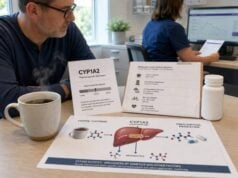
A CYP3A4 genetic test looks for inherited variants that may change the activity of CYP3A4, a liver and intestinal enzyme involved in processing many medicines. The result can help explain unusually high drug levels, side effects, or a need for lower doses in selected situations, but it does not predict medication response by itself. CYP3A4 activity also changes with other medicines, grapefruit products, liver disease, inflammation, age, and smoking-related or dietary factors. Most people carry two usual-function copies, while the decreased-function CYP3A4*22 allele is the main variant included on many clinical tests. Actionable guidance is still limited compared with genes such as CYP2D6, CYP2C19, or CYP3A5. A report should therefore be interpreted for the exact drug being considered, not as a general statement that all medicines will be metabolized “slowly” or “quickly.”
- CYP3A4 testing estimates inherited enzyme function; it does not directly measure the amount of enzyme active today.
- CYP3A4*22 usually lowers enzyme expression and may raise exposure to certain CYP3A4-metabolized medicines.
- A normal result does not rule out strong drug interactions, liver impairment, or unexpectedly high drug levels.
- Routine dose changes based only on CYP3A4 are established for very few drug–gene pairs.
- No fasting or medication pause is usually needed for a cheek-swab or blood DNA test.
- Severe sedation, fainting, breathing difficulty, jaundice, or a serious rash requires prompt medical assessment regardless of genotype.
Table of Contents
- What CYP3A4 Testing Measures
- When the Test May Be Useful
- How the Test Is Performed
- Understanding Variants and Phenotypes
- Drug-Specific Meaning of Results
- Limits, Interactions, and Other Influences
- Using the Report Safely
What CYP3A4 Testing Measures
CYP3A4 is one member of the cytochrome P450 enzyme family. It is produced mainly in the liver and the lining of the small intestine. Many medicines pass through this enzyme before they reach the bloodstream or before the body removes them. CYP3A4 may inactivate a drug, convert it into another active compound, or create a metabolite that is easier to eliminate.
The test reads selected parts of the CYP3A4 gene. It commonly reports a genotype using “star allele” names, such as CYP3A41/1 or CYP3A41/22. Each star allele represents a defined group of DNA changes inherited together. The laboratory may then translate that genotype into a predicted phenotype, such as normal, intermediate, or poor metabolizer.
That phenotype is an estimate of inherited capacity, not a live enzyme measurement. A person with a usual-function genotype can have low CYP3A4 activity while taking a strong inhibitor. A person with a decreased-function allele may still tolerate a standard dose because the medicine has a wide safety margin or because other clearance pathways compensate.
The distinction is important because CYP3A4 handles a broad but uneven range of drugs. Some medicines depend heavily on it; others use several enzymes and transporters. Even two drugs described as “CYP3A4 substrates” can respond differently to the same genotype. The clinical question is always drug specific: does this variant change exposure enough to alter efficacy or safety for this medicine at this dose?
CYP3A4 is closely related to CYP3A5. Some assays test both because the enzymes overlap in substrate preference, especially for tacrolimus. They are not interchangeable. CYP3A5 often has a clearer dosing role for tacrolimus, while CYP3A4 results usually provide supporting rather than primary guidance. A broader pharmacogenetic panel may include both genes along with other enzymes, transporters, and immune-response markers.
When the Test May Be Useful
CYP3A4 testing is most useful when a clinician has a defined medication question and knows that the result can change management. It is less useful as a stand-alone screen for every prescription.
Testing may be considered when someone has unexpectedly high concentrations or dose-related adverse effects from a medicine with substantial CYP3A4 metabolism. Examples include excessive sedation from quetiapine, difficult-to-explain tacrolimus exposure after transplant, or unusually high levels of a narrow-therapeutic-index drug after common interaction causes have been reviewed. The result may help separate an inherited contribution from adherence problems, dosing errors, organ dysfunction, or interacting products.
A test can also be ordered before treatment when a health system has a preemptive pharmacogenomics program. In that setting, CYP3A4 is usually one part of a multi-gene profile stored in the medical record. The result becomes relevant only if a covered drug is prescribed later. This approach can reduce delays, but the report must be updated when interpretation standards change.
Quetiapine is the clearest current example of a CYP3A4-specific guideline. The Dutch Pharmacogenetics Working Group provides an action for a predicted CYP3A4 poor metabolizer because reduced metabolism can increase quetiapine exposure. The recommendation is not a general rule for all antipsychotics or all CYP3A4 substrates. Other genes, clinical factors, and the reason for treatment still affect the choice and dose.
Testing may add context in transplant care, but it should not replace trough-level monitoring. Tacrolimus concentrations vary substantially during the first days and weeks after transplantation because of intestinal function, corticosteroid use, hematocrit, inflammation, interacting medicines, and time since surgery. CYP3A5 usually explains more of the inherited dose difference, which is why a dedicated CYP3A5 tacrolimus test is often more directly actionable.
Testing is usually not needed merely because a person takes a common CYP3A4 substrate. Millions of people use drugs such as atorvastatin, amlodipine, certain benzodiazepines, or hormonal therapies without genotype-guided dosing. Medication review, symptom monitoring, laboratory tests, and therapeutic drug monitoring may answer the clinical question more directly.
How the Test Is Performed
CYP3A4 genotyping uses DNA from a cheek swab, saliva, or blood sample. The collection method does not change the inherited result. Most people do not need to fast, stop medicines, or alter caffeine intake before collection because the assay reads DNA rather than current enzyme activity.
A cheek swab requires rubbing a collection tip firmly along the inside of the cheek. Laboratories often ask patients to avoid food, drink, gum, tobacco, and tooth brushing for 30 minutes beforehand so the sample contains enough human cells and less contamination. Blood collection follows routine venipuncture procedures.
The laboratory may use targeted genotyping, an array, or DNA sequencing. Targeted assays search for a defined list of known alleles. Sequencing can detect a wider range of variants, but broader detection does not guarantee clearer interpretation. Rare changes may have uncertain function, and some platforms do not fully resolve the combination of variants on each chromosome.
CYP3A4*22 is usually the minimum clinically relevant allele on modern panels. Some assays also include rare decreased- or no-function alleles such as *20 and other population-specific variants. The report should state which alleles were tested. “No variant detected” means none of the included changes was found; it does not prove that every possible CYP3A4 variant is absent.
Turnaround time ranges from a few days to several weeks. A single-gene test may be faster than a large panel, although local laboratory workflow matters more than the number of genes. Results normally remain valid for life because inherited DNA does not change. The interpretation can change as new evidence and guidelines appear, so an older raw genotype may deserve re-evaluation rather than repeat collection.
Quality standards matter. CYP3A4 and CYP3A5 share sequence similarities, and star-allele calling can be technically complex. Consensus recommendations define variants that clinical laboratories should prioritize and encourage standardized nomenclature, reference materials, and reporting. Before acting on a consumer report, a clinician may confirm the finding in a clinical laboratory, particularly when the result would support a large dose reduction or avoidance of an important medicine.
Understanding Variants and Phenotypes
Most clinical reports identify two star alleles, one inherited from each biological parent. The common 1 allele generally represents usual function. CYP3A422 is an intronic variant that reduces gene expression in many carriers, leading to less enzyme in the liver. Its effect is often measurable, but the size differs by drug, study population, and coexisting factors.
| Example result | Typical laboratory interpretation | General meaning |
|---|---|---|
| *1/*1 | Normal metabolizer | No tested decreased-function allele was found; normal does not guarantee typical drug levels. |
| *1/*22 | Intermediate metabolizer | One decreased-function copy may reduce clearance of selected substrates. |
| *22/*22 | Poor metabolizer | Two decreased-function copies may cause a larger exposure increase for susceptible drugs. |
| Rare no-function allele | Depends on the paired allele | Interpretation requires the laboratory’s functional assignment and drug-specific evidence. |
| No call or indeterminate | Unresolved | The sample or assay could not support a reliable phenotype. |
Not every laboratory uses identical phenotype terms. One report may say “decreased function,” while another says “intermediate metabolizer.” Some laboratories report genotype only because evidence does not support a universal phenotype across all drugs. The star alleles and the tested-allele list are therefore more durable than a colored risk category.
Allele frequencies differ among populations. CYP3A4*22 is more often identified in people with European ancestry than in many East Asian or African populations, while other rare variants may be more relevant in specific groups. Ancestry should not be used to assume an individual result, and a panel designed around one population can miss variants found elsewhere.
A heterozygous result is not automatically “half-speed metabolism.” Enzyme activity does not scale in a simple linear way, and the drug’s dependence on CYP3A4 may be partial. The same 1/22 result might produce a clinically meaningful concentration change for one medicine and almost no noticeable difference for another.
Reports sometimes combine CYP3A4 with CYP3A5 to estimate overall CYP3A activity. That can be reasonable for a specific drug model, but it should not erase the individual genotypes. The clinician needs to know which gene drove the recommendation and whether the evidence applies to the patient’s medication.
Drug-Specific Meaning of Results
A CYP3A4 result becomes clinically useful only after it is connected to a named medicine, indication, dose, and monitoring plan. Broad labels such as “poor metabolizer of many drugs” can cause unnecessary fear or inappropriate avoidance.
Quetiapine
Quetiapine is metabolized mainly by CYP3A4. A predicted poor metabolizer may have higher exposure at the same dose, increasing the chance of sedation, dizziness, orthostatic hypotension, and other concentration-related effects. Dutch guidance advises a substantial dose reduction for poor metabolizers when quetiapine is used for indications other than depression, with titration based on response and adverse effects. An alternative that is not primarily metabolized by CYP3A4 may also be considered.
The recommendation does not mean that everyone carrying one *22 allele requires a lower dose. Intermediate metabolizers generally do not receive a universal genotype-based adjustment under that guideline. Strong CYP3A4 inhibitors can still create a larger effect than genotype and may require separate action.
Tacrolimus
CYP3A4*22 can be associated with lower tacrolimus dose requirements, especially when CYP3A5 status is considered. However, tacrolimus treatment is adjusted using measured trough concentrations and clinical status. A CYP3A4 result may improve an initial dose model, but it cannot determine the maintenance dose without repeated monitoring. A normal CYP3A4 genotype does not rule out rapid or slow tacrolimus clearance.
Statins and cardiovascular medicines
Simvastatin, lovastatin, and atorvastatin depend partly on CYP3A4. Reduced activity could increase exposure, but routine CYP3A4-guided statin dosing is not established. Drug interactions, dose, kidney or liver disease, thyroid status, and SLCO1B1 genotype often provide more actionable information for muscle toxicity. For persistent statin symptoms, a SLCO1B1 genetic result may be more relevant than CYP3A4 alone.
Calcium-channel blockers and some antiarrhythmics are also CYP3A4 substrates. Clinicians generally rely on blood pressure, heart rate, electrocardiography, symptoms, and interaction checking rather than genotype-based dose tables.
Sedatives, opioids, and oncology drugs
Midazolam is widely used as a CYP3A probe in research, yet CYP3A4 genotype explains only part of its variability. Fentanyl, oxycodone, and several sedatives involve CYP3A pathways, but pain response and respiratory risk depend on dose, opioid tolerance, other sedatives, organ function, and additional genes. CYP3A4 testing should never be used to justify unsupervised dose escalation.
Many targeted cancer medicines use CYP3A4. Oncology teams usually manage them through product labeling, interaction avoidance, adverse-effect monitoring, and sometimes therapeutic drug monitoring. Tumor factors and treatment combinations often dominate the response. A germline CYP3A4 finding should not be confused with tumor genomic testing, which examines cancer-specific changes that may identify a treatment target.
Limits, Interactions, and Other Influences
CYP3A4 is highly sensitive to “phenoconversion,” meaning a person’s current enzyme behavior can differ from the inherited prediction. Strong inhibitors can make a normal metabolizer function like a slow metabolizer. Strong inducers can increase enzyme activity and lower concentrations of susceptible drugs.
Important inhibitors include clarithromycin, itraconazole, ketoconazole, ritonavir or cobicistat-containing regimens, and some other antiviral or antifungal medicines. Grapefruit and Seville orange products can inhibit intestinal CYP3A4, although the effect varies with the product, amount, timing, and drug. Important inducers include rifampin, carbamazepine, phenytoin, and St. John’s wort. Induction develops over days and may persist after the inducer is stopped.
Inflammation can suppress CYP3A activity. Acute infection, major surgery, and inflammatory disease may raise drug concentrations even without a new inhibitor. Liver impairment can reduce metabolic capacity, while changes in intestinal absorption, kidney function, body composition, pregnancy, and age may alter exposure through other mechanisms.
The test also has analytical limits. Targeted panels miss untested variants, and rare alleles may lack reliable functional data. Structural variation and phasing can complicate star-allele assignment. A result from one laboratory may not map cleanly to another if their allele coverage differs.
Clinical evidence is uneven. CYP3A4*22 has reproducible pharmacokinetic effects for several drugs, yet a concentration difference does not always improve outcomes when used to guide treatment. Many studies are small, retrospective, or performed in highly selected populations. That is why a biologically plausible result may still lack a professional dosing recommendation.
Genotype cannot diagnose medication toxicity. If symptoms occur, clinicians may need a physical examination, blood counts, liver tests, kidney tests, electrocardiography, drug concentrations, or other studies. Nor can genotype prove that a medicine failed because metabolism was too fast. Adherence, diagnosis, dose duration, absorption, and pharmacodynamic differences must also be considered.
Using the Report Safely
Start with the exact genotype, tested alleles, predicted phenotype, and date of interpretation. Avoid relying only on a green, yellow, or red category. Ask whether the laboratory links the result to a recognized guideline and whether that guideline addresses the specific drug and clinical indication.
A medication review should include prescriptions, over-the-counter products, supplements, recreational substances, and foods known to affect CYP3A4. Record recent starts and stops because an interaction may explain a sudden change more convincingly than a lifelong genotype. The same review should consider liver and kidney function, age, pregnancy, inflammation, and adherence.
For a drug with an actionable recommendation, the prescriber can choose an alternative, adjust the starting dose, slow titration, or increase monitoring. Dose changes should be documented with the genotype and the clinical reason. For tacrolimus and other drugs with available concentration testing, genotype and therapeutic drug monitoring complement each other rather than compete.
Do not stop quetiapine, an anticonvulsant, an immunosuppressant, an opioid, or a cardiovascular medicine abruptly because of a test report. Sudden withdrawal can cause relapse, seizures, transplant rejection, uncontrolled pain, or cardiovascular complications. Contact the prescribing team for a planned change.
Keep the result in a durable part of the health record and share it with pharmacists and future prescribers. Because the DNA result is lifelong, it may become relevant years later when a new guideline appears. The safest interpretation treats CYP3A4 as one piece of a medication decision, alongside the drug label, interaction profile, treatment goals, measured response, and adverse effects.
Questions that make a report more useful
A well-interpreted result should answer more than “positive” or “negative.” Ask which star alleles the assay could detect, whether copy-number or rare variants were evaluated, and how the laboratory assigned function. If the report names a phenotype, ask whether that phenotype follows a recognized consensus system or a laboratory-specific translation. These details matter when a test purchased years ago is compared with a newer result.
Ask which medicine triggered the recommendation and whether the advice reflects a formal prescribing guideline, a drug label, a pharmacokinetic association, or an early research finding. Those evidence levels should not be treated as equivalent. A dose recommendation supported by a professional guideline carries more weight than a color-coded warning derived from a small observational study.
The prescriber should also define how success will be measured. For quetiapine, that may include alertness, orthostatic symptoms, symptom control, and gradual titration. For tacrolimus, it includes trough concentrations, kidney function, rejection surveillance, and interacting medicines. For a statin, it may include lipid response, muscle symptoms, creatine kinase when clinically indicated, and consideration of a different statin.
Reassessment is especially important after a hospitalization or major medication change. Antibiotics, antifungals, antivirals, anticonvulsants, and herbal products can alter CYP3A4 within days. A genotype remains constant, but the safe dose may not. Carrying an accurate medication list and telling every prescriber about recent additions can prevent more harm than repeating the genetic test.
Finally, separate future usefulness from immediate action. A CYP3A4 result that does not change today’s prescription can still be stored for later. It should not prompt broad avoidance lists, self-selected dose reductions, or the assumption that prior side effects were genetically proven. The report is most valuable when it narrows a specific clinical problem and leads to a documented monitoring plan.
References
- Dutch Pharmacogenetics Working Group (DPWG) guideline for the gene-drug interaction between CYP2D6, CYP3A4 and CYP1A2 and antipsychotics 2024 (Guideline)
- CYP3A4 and CYP3A5 Genotyping Recommendations: A Joint Consensus Recommendation of the Association for Molecular Pathology, Clinical Pharmacogenetics Implementation Consortium, College of American Pathologists, Dutch Pharmacogenetics Working Group of the Royal Dutch Pharmacists Association, European Society for Pharmacogenomics and Personalized Therapy, and Pharmacogenomics Knowledgebase 2023 (Consensus Statement)
- Characterization of Reference Materials for CYP3A4 and CYP3A5: A (GeT-RM) Collaborative Project 2023 (Research Study)
- Pharmacogenetics of Calcineurin inhibitors in kidney transplantation: what does the evidence tell us? 2024 (Review)
- CYP3A4∗22 Genotyping in Clinical Practice: Ready for Implementation? 2021 (Review)
- Cytochrome P450 in Pharmacogenetics: An Update 2018 (Review)
Disclaimer
CYP3A4 results must be interpreted for the specific medicine by a qualified clinician or pharmacist. Do not start, stop, or change a prescription based only on a genetic report. Seek urgent care for severe breathing problems, fainting, marked confusion, jaundice, or other rapidly worsening symptoms.