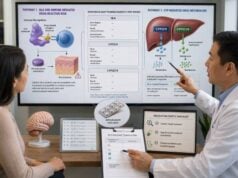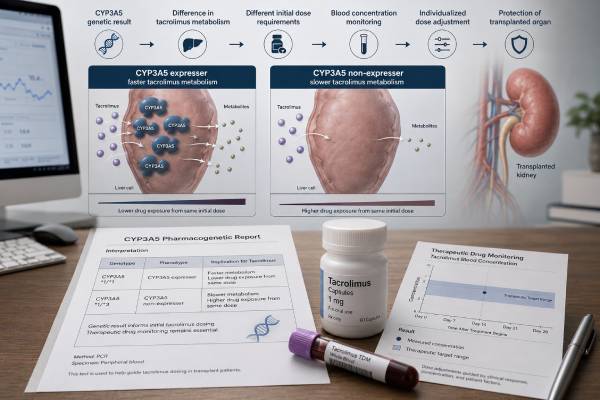
A CYP3A5 genetic test predicts how strongly a person expresses the CYP3A5 enzyme, one of the main pathways that clears tacrolimus. People who express CYP3A5 usually need a higher starting dose to reach the same tacrolimus blood concentration as people who do not express it. The result can shorten the early trial-and-adjustment period after a kidney, heart, lung, or liver transplant, when both underexposure and overexposure can be dangerous. It does not replace tacrolimus trough measurements, because concentrations also change with organ function, time after transplant, diarrhea, hematocrit, interacting medicines, and adherence. Reports commonly identify CYP3A5*1 as a functional allele and *3, *6, or *7 as no-function alleles. The transplant team combines the genotype with weight, treatment protocol, target concentration, formulation, and repeated laboratory results to select and refine the dose.
- One CYP3A5*1 allele usually makes a person a CYP3A5 expresser who may need more tacrolimus initially.
- Two no-function alleles usually indicate a nonexpresser who needs the standard starting approach rather than a genotype-based increase.
- CPIC guidance generally recommends 1.5–2 times the usual starting dose for expressers, without exceeding protocol limits.
- Tacrolimus trough monitoring remains essential even when dosing starts with genotype information.
- The DNA test needs no fasting and can use blood, saliva, or a cheek swab.
- Tremor, confusion, very low urine output, severe headache, chest symptoms, or signs of infection require prompt transplant-team contact.
Table of Contents
- Why CYP3A5 Affects Tacrolimus
- Who Benefits From Testing
- Reading CYP3A5 Results
- Turning Genotype Into a Starting Dose
- Monitoring After Transplant
- Special Situations by Transplant Type
- Test Methods and Report Quality
- Limits and Safe Use
Why CYP3A5 Affects Tacrolimus
Tacrolimus suppresses immune activity to help prevent rejection of a transplanted organ. Its therapeutic window is narrow: concentrations that are too low may permit rejection, while concentrations that are too high may contribute to kidney injury, neurotoxicity, high potassium, high blood pressure, diabetes, infection, and other complications. The safe range is not one universal number. Each transplant program sets targets according to organ type, time since transplant, rejection risk, accompanying immunosuppressants, and clinical condition.
CYP3A5 is produced in the intestine and liver. When active enzyme is present, more tacrolimus is metabolized before and after it enters the bloodstream. CYP3A5 expressers therefore tend to have a lower concentration for each milligram of tacrolimus and often require a larger total daily dose. Nonexpressers have little or no functional CYP3A5 and commonly reach target concentrations on lower doses.
The result changes predicted clearance rather than drug sensitivity at the immune receptor. It cannot tell whether tacrolimus will prevent rejection in a particular person, nor can it identify every cause of toxicity. It mainly improves the estimate of how much drug is likely to be needed at the beginning.
CYP3A4 also metabolizes tacrolimus, but CYP3A5 has the most established inherited dosing effect. The two genes sit near each other and contribute to overall CYP3A activity. A CYP3A4 result, especially CYP3A4*22, can add information in some models, yet current CPIC starting-dose recommendations are based on CYP3A5 phenotype.
The genotype is present from birth and does not change after transplantation. The observed tacrolimus concentration does change, sometimes rapidly. That difference explains why preemptive genotyping and therapeutic drug monitoring work best together: the genotype gives an early directional estimate, while measured levels show what is happening now.
Who Benefits From Testing
Testing has the greatest potential value before the first tacrolimus dose or immediately after transplantation. A result available at that point can guide the initial prescription instead of waiting for several low or high troughs to reveal the patient’s clearance pattern.
Kidney transplant recipients have the largest evidence base. CYP3A5 expressers are more likely to start below target when they receive the same weight-based dose as nonexpressers. Genotype-guided dosing can improve the proportion who reach an early target concentration, although studies have not consistently shown that it reduces rejection, graft loss, or long-term toxicity. The clinical benefit depends on rapid turnaround and a transplant service that can act on the result.
Testing can also help recipients of heart, lung, liver, or hematopoietic stem-cell transplants when tacrolimus is used. Evidence and dosing protocols are less uniform than in kidney transplantation. Clinicians may use the result as one covariate rather than apply a fixed multiplier.
A previous unexplained need for unusually high tacrolimus doses is another reason to test. Genotype may clarify why a patient repeatedly has low concentrations despite documented adherence and no strong inducer. Conversely, a nonexpresser result can support closer review when a standard dose produces high levels, although other factors still need investigation.
Preemptive testing may be performed as part of pharmacogenetic testing before transplantation. This is especially useful for candidates on a waiting list because a result can be stored and made available when an organ becomes available. Rapid testing after an urgent transplant may still be useful if results return within the first several dosing days.
Testing offers less immediate benefit when a stable patient has already been maintained on tacrolimus for months or years. The established dose and trough history directly describe that person’s current requirement. Genotype may still explain the pattern or help after a formulation change, but it rarely overrides a stable, well-monitored regimen.
The test is not a transplant-eligibility test and should not be used to rank candidates. Being an expresser does not mean a worse transplant outcome. It means the initial tacrolimus dose may need to be higher and monitored carefully.
Reading CYP3A5 Results
CYP3A5 reports use star alleles. CYP3A51 generally produces functional enzyme. CYP3A53, *6, and *7 are common no-function alleles included in clinical recommendations because their frequencies vary across ancestry groups. A good assay covers the alleles needed for the population being tested rather than checking only *3.
| Example genotype | Predicted phenotype | Expected tacrolimus pattern |
|---|---|---|
| *1/*1 | Normal metabolizer; expresser | Higher clearance and commonly a higher dose requirement |
| *1/*3, *1/*6, or *1/*7 | Intermediate metabolizer; expresser | Higher clearance than a nonexpresser, with substantial individual variation |
| *3/*3 or two other no-function alleles | Poor metabolizer; nonexpresser | Lower CYP3A5-mediated clearance and usually no genotype-based dose increase |
| Indeterminate or rare allele | Uncertain | Use clinical dosing and measured concentrations until clarified |
The word “poor” can be misleading in this setting. A CYP3A5 poor metabolizer is not necessarily at higher transplant risk and is not “poor” at responding to tacrolimus. The term means little functional CYP3A5 is produced. Many transplant recipients are nonexpressers and are treated successfully with routine concentration-guided dosing.
Allele frequencies differ markedly among populations. Functional CYP3A5 expression is more common in people with recent African ancestry than in many European populations. CYP3A5*6 and *7 are particularly important for accurate interpretation in people with African ancestry. A test that checks only *3 may incorrectly classify some patients as expressers or leave their result incomplete.
Genotype and phenotype should be displayed together, but the genotype is the more permanent part of the record. Laboratories can revise phenotype translations as knowledge changes. A report should also list the tested alleles, methodology, limitations, and the guideline used for recommendations.
An “increased dose requirement” is a population expectation, not a personal prescription. Two people with the same 1/3 genotype can need different doses because of weight, hematocrit, liver function, interacting drugs, formulation, and the transplant itself.
Turning Genotype Into a Starting Dose
CPIC guidance applies when a clinician has already decided to use tacrolimus and the CYP3A5 genotype is available. It does not tell clinicians whether tacrolimus is the best immunosuppressant or set the target trough concentration.
For CYP3A5 normal or intermediate metabolizers, CPIC recommends starting at 1.5 to 2 times the usual recommended dose, while not exceeding 0.3 mg/kg per day, followed by therapeutic drug monitoring. The local transplant protocol may choose a smaller increase, cap the dose differently, or use a population pharmacokinetic model. For poor metabolizers, the standard recommended starting dose is used, again followed by concentration monitoring.
A simple example shows how the recommendation works. If a kidney transplant protocol normally starts immediate-release tacrolimus at 0.1 mg/kg per day in two divided doses, an expresser might start near 0.15–0.2 mg/kg per day, subject to the program’s maximum and clinical judgment. A nonexpresser would generally begin with the protocol’s usual dose. The team then measures a correctly timed trough and adjusts promptly.
The multiplier should not be applied to an existing stable dose without a clinical reason. It is designed for initial dosing. Multiplying a maintenance dose after discovering an expresser genotype could cause severe overexposure because the current dose already reflects the patient’s measured requirements.
Formulation matters. Immediate-release tacrolimus is often taken every 12 hours, while extended-release products have different absorption patterns and dosing schedules. Conversion ratios vary by product and transplant program. Genotype does not make milligram doses interchangeable across formulations.
Target concentrations also matter. Early post-transplant targets are often higher than later targets, but the exact ranges differ among kidney, heart, lung, and liver programs. The laboratory number should be interpreted against the target documented for that patient on that day. A level that is appropriate six months after transplant might be too low during the first week for a high-risk recipient.
The safest genotype-guided order contains four elements: the starting dose, the target trough range, the time of the first level, and instructions for adjustment. Without that monitoring plan, the genotype multiplier is incomplete.
Monitoring After Transplant
A tacrolimus trough is usually drawn immediately before the next dose. Accurate timing is essential. A sample taken several hours early may appear falsely high compared with a true trough, while a late or post-dose sample can be difficult to interpret. The care team needs the time of the previous dose, the blood draw, and the next dose.
Levels are checked frequently during the early post-transplant period and after major changes. Frequency may be daily in the hospital, then several times per week, weekly, and eventually less often as the regimen stabilizes. Each program uses its own schedule.
Dose adjustment is rarely based on one number alone. Clinicians review the trend, kidney and liver function, potassium, magnesium, glucose, blood pressure, neurologic symptoms, rejection markers, infection, and adherence. They also confirm whether the patient took tacrolimus consistently in relation to food, because high-fat meals can alter absorption.
Hematocrit deserves special attention. Tacrolimus distributes extensively into red blood cells, so whole-blood concentrations can shift when hematocrit changes even if the unbound active exposure does not change proportionally. Early after transplantation, anemia, transfusion, bleeding, and recovery can complicate interpretation.
Diarrhea can unexpectedly raise tacrolimus concentrations by changing intestinal metabolism and transport. Vomiting can lower exposure if a dose is not retained. The transplant team should be contacted rather than repeating or skipping doses without instructions.
Strong CYP3A inhibitors such as clarithromycin, azole antifungals, ritonavir, and cobicistat can sharply increase tacrolimus exposure. Inducers such as rifampin, carbamazepine, phenytoin, and St. John’s wort can lower it. Genotype does not protect an expresser or nonexpresser from these interactions. Any new prescription, supplement, or over-the-counter product should be checked before use.
Long-term review focuses on variability as well as the average level. A patient whose troughs swing widely between visits may have inconsistent timing, food effects, adherence difficulties, changing interacting medicines, or recurrent illness. Some centers calculate intrapatient variability from several concentrations because persistent fluctuation can signal higher risk. CYP3A5 status may influence the dose needed, but it does not explain sudden week-to-week changes.
Home routines can improve interpretability. Taking the same formulation at the same times, using a medication organizer approved by the team, recording dose times before laboratory visits, and calling before starting new products reduce avoidable noise. When a level is unexpected, clinicians often repeat it under controlled timing before making a large change. They may also review the concentration-to-dose ratio, which shows how much trough concentration is achieved per milligram and can reveal a changing metabolic pattern. A written dose calendar is especially useful after alternating-dose schedules or frequent adjustments, when memory alone can create avoidable errors and misleading laboratory trends today.
Special Situations by Transplant Type
Kidney recipients are commonly dosed according to the recipient’s genotype because the recipient’s intestine and liver perform most tacrolimus metabolism. Kidney function affects toxicity assessment but does not directly clear much tacrolimus; the drug is mainly metabolized and eliminated through bile.
In liver transplantation, both donor and recipient genotypes may contribute. Early after transplant, intestinal metabolism reflects the recipient, while hepatic metabolism increasingly reflects the donor liver. The relative effect changes over time as the graft recovers. This makes a single genotype-based multiplier less straightforward than in kidney transplantation.
Heart and lung recipients often have unstable hemodynamics, inflammation, interacting anti-infective therapy, and changing organ function early after surgery. CYP3A5 can still explain part of dose demand, but measured concentrations and rapid clinical changes dominate daily decisions. Lung recipients may receive azole antifungals that strongly inhibit CYP3A metabolism, reducing or reversing the expected expresser effect.
Children often have higher weight-normalized clearance than adults, and age-related enzyme maturation affects younger patients. Pediatric models commonly include weight, post-transplant day, hematocrit, and CYP3A5 genotype. Doses require specialist calculation rather than a simple adult conversion.
Pregnancy after transplantation can increase tacrolimus clearance and alter protein binding and hematocrit. Whole-blood troughs may fall even as unbound exposure changes less dramatically. Management should involve transplant and maternal-fetal medicine specialists; genotype remains informative but cannot capture pregnancy-related changes.
Ethnicity should not substitute for testing. Population differences can help laboratories choose appropriate alleles, but they cannot determine an individual’s phenotype. The same dose assumptions should not be applied to every member of a broad racial or ethnic group.
Test Methods and Report Quality
CYP3A5 genotyping can use a blood sample, saliva, or cells collected from the inner cheek. Medicines do not need to be stopped, and fasting is not required. For saliva or cheek collection, following the laboratory’s food and drink restrictions helps prevent an inadequate sample.
Targeted tests examine selected variants, usually including *3 and often *6 and *7. Larger panels may detect additional alleles or sequence the gene. More extensive testing can improve coverage, but rare findings may have uncertain function. The report must distinguish a known no-function allele from a variant with insufficient evidence.
Turnaround time is clinically important. A perfectly accurate result delivered weeks after the initial dose may add little to early dosing. Transplant programs that use genotype-guided starts often arrange pretransplant testing or rapid laboratory workflows.
Consensus recommendations support a minimum allele set and standardized star-allele naming. Reference materials help laboratories verify that their assay correctly identifies less common genotypes. Quality reporting should include sample type, alleles interrogated, genotype, phenotype, limitations, and a versioned interpretation source.
Testing the recipient is usually the priority. In liver transplantation, the donor result may be informative, but access and timing vary. A genotype from the recipient’s blood after a solid-organ transplant still reflects the recipient’s inherited DNA; it does not become the donor organ’s genotype. After allogeneic stem-cell transplantation, blood-derived DNA can reflect donor cells, so the laboratory may need a pretransplant sample or non-blood tissue to establish the recipient’s germline genotype.
A consumer test may omit clinically relevant alleles or report a single variant without star-allele interpretation. Before changing tacrolimus dosing, the transplant team should confirm that the result comes from a clinically validated assay and represents the correct person and specimen context.
Limits and Safe Use
CYP3A5 explains a meaningful part of tacrolimus dose variability, but it does not fully predict time in therapeutic range, rejection, nephrotoxicity, infection, or long-term graft survival. Studies show more consistent improvement in early concentration attainment than in hard clinical outcomes. A program should judge testing by whether results arrive in time, are incorporated into orders, and are followed by reliable monitoring.
The test cannot detect missed doses. A patient who is an expresser and has low troughs may need a higher dose, but low concentrations can also result from delayed refills, misunderstanding, vomiting, inconsistent timing, or an inducer. Escalating without checking these factors can cause toxicity when adherence improves.
The result should be placed in the permanent medical record with the raw genotype. A medication alert can indicate that expressers often need higher initial tacrolimus doses, but it should not fire as an absolute instruction after the patient has an established maintenance dose.
Never change tacrolimus independently. Small changes can produce large concentration shifts, and interruption can place the graft at risk. Use the transplant center’s exact instructions for missed or vomited doses. Do not double a dose unless specifically directed.
Contact the transplant team urgently for reduced urine output, severe tremor, confusion, seizures, major headache, new weakness, chest pain, shortness of breath, fever, persistent vomiting or diarrhea, or signs of rejection. Emergency symptoms require immediate care even when the latest trough was reported as acceptable.
A CYP3A5 result is most effective when it is available before treatment, translated into a protocol-specific start, and followed by accurately timed troughs. The genetic information makes the first estimate more informed; the patient’s measured course determines every dose that follows.
References
- Customizing Tacrolimus Dosing in Kidney Transplantation: New Developments in Pharmacogenetics, Pharmacokinetics, and Pharmacodynamics 2025 (Review)
- Pharmacogenetics of calcineurin inhibitors in kidney transplantation: what does the evidence tell us? 2024 (Review)
- Population pharmacokinetic models of tacrolimus in paediatric solid organ transplant recipients: A systematic review 2024 (Systematic Review)
- CYP3A4 and CYP3A5 Genotyping Recommendations: A Joint Consensus Recommendation of the Association for Molecular Pathology, Clinical Pharmacogenetics Implementation Consortium, College of American Pathologists, Dutch Pharmacogenetics Working Group of the Royal Dutch Pharmacists Association, European Society for Pharmacogenomics and Personalized Therapy, and Pharmacogenomics Knowledgebase 2023 (Consensus Statement)
- Therapeutic Drug Monitoring of Tacrolimus-Personalized Therapy: Second Consensus Report 2019 (Consensus Report)
- Clinical Pharmacogenetics Implementation Consortium (CPIC) Guidelines for CYP3A5 Genotype and Tacrolimus Dosing 2015 (Guideline)
Disclaimer
CYP3A5 testing supports, but never replaces, transplant-specialist dosing and tacrolimus concentration monitoring. Do not change or miss tacrolimus doses because of a genetic result without direct instructions from the transplant team. Urgent transplant symptoms, severe neurologic changes, breathing difficulty, or markedly reduced urine output require prompt medical care.