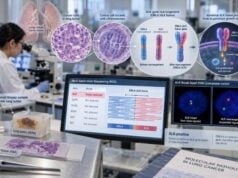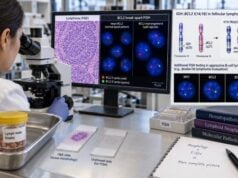
An EPCAM deletion test looks for inherited deletions at the 3′ end of the EPCAM gene that can cause Lynch syndrome by switching off the neighboring MSH2 mismatch-repair gene. EPCAM itself is not a mismatch-repair gene. The key mechanism is epigenetic: when a causative EPCAM deletion removes the normal termination region, transcription can extend into the adjacent MSH2 region and trigger MSH2 promoter methylation in EPCAM-expressing tissues. This can produce loss of MSH2 function and mismatch-repair deficiency. A pathogenic EPCAM deletion is therefore managed as a hereditary Lynch syndrome finding, not as a routine tumor copy-number change. It can raise colorectal cancer risk substantially and can affect screening recommendations for the person tested and relatives. Importantly, ordinary EPCAM sequence variants are not the typical cause; the clinically relevant Lynch syndrome changes are specific large deletions involving the terminal part of EPCAM. Testing must therefore include deletion/duplication analysis rather than sequence analysis alone.
- A pathogenic 3′ EPCAM deletion can cause Lynch syndrome by epigenetically silencing the adjacent MSH2 gene.
- EPCAM sequence analysis alone is not enough: clinically important Lynch-associated EPCAM variants are large deletions and require deletion/duplication methods.
- A positive germline EPCAM deletion raises colorectal cancer risk and usually leads to Lynch syndrome surveillance and family cascade testing.
- Cancer risks differ from a typical MSH2 mutation: some EPCAM-only deletion carriers have lower extracolonic risk, while deletions extending into MSH2 may behave more like MSH2 pathogenic variants.
- Each child of a carrier has a 50% chance of inheriting the deletion, because EPCAM-associated Lynch syndrome is usually autosomal dominant.
Table of Contents
- What EPCAM deletion testing measures
- How EPCAM deletion silences MSH2
- Who may need EPCAM testing
- How the test is performed
- How to interpret results
- Cancer risk and surveillance
- Family risk and next steps
What EPCAM deletion testing measures
EPCAM sits next to MSH2 on chromosome 2. The Lynch syndrome mechanism involves germline deletions of the 3′ end of EPCAM, usually including the last exon. These deletions are uncommon and account for a minority of Lynch syndrome cases.
Because the problem is a structural deletion, routine sequencing that only reads the letters of the EPCAM coding region can be negative even when a disease-causing deletion exists. Laboratories therefore use methods designed to detect copy-number loss, such as multiplex ligation-dependent probe amplification, targeted copy-number analysis, microarray, or validated NGS deletion/duplication analysis.
EPCAM is often included in a hereditary Lynch syndrome panel together with MLH1, MSH2, MSH6, and PMS2. A mismatch repair gene test should ideally include EPCAM deletion analysis when Lynch syndrome is being evaluated.
How EPCAM deletion silences MSH2
The biology is unusual because the deletion does not primarily cause cancer through loss of EPCAM protein. Instead, it changes gene regulation near MSH2.
Normally, EPCAM transcription stops at the end of the gene. A causative terminal deletion can remove the stop signal, allowing transcription to run into the adjacent MSH2 region. In tissues where EPCAM is expressed, this read-through transcription can lead to hypermethylation of the MSH2 promoter. Methylation acts like an off switch, reducing or eliminating MSH2 expression from that chromosome.
MSH2 is a core DNA mismatch-repair protein. When tumor cells lose the remaining normal MSH2 function, DNA replication errors accumulate, causing mismatch-repair deficiency and often microsatellite instability.
This explains why tumor immunohistochemistry from an EPCAM deletion carrier can show loss of MSH2 and MSH6 proteins even though the MSH2 DNA sequence itself may be normal.
A related microsatellite instability test can identify the downstream tumor phenotype but cannot by itself tell whether the cause is an EPCAM deletion, another germline Lynch variant, or a somatic event.
Who may need EPCAM testing
EPCAM deletion analysis is usually part of a broader Lynch syndrome workup rather than a stand-alone first test.
Testing may be considered when:
- colorectal or endometrial tumor testing shows loss of MSH2/MSH6;
- germline MSH2 sequencing is negative despite a strong Lynch-like tumor pattern;
- a family has a known EPCAM deletion;
- personal and family history strongly suggest Lynch syndrome; or
- a multigene hereditary cancer panel is being used for colorectal or endometrial cancer predisposition.
Universal mismatch-repair screening of colorectal and endometrial cancers often begins with immunohistochemistry or MSI testing. If MSH2/MSH6 are absent, germline evaluation commonly includes both MSH2 and EPCAM.
How the test is performed
Germline testing usually uses blood or saliva and does not require fasting. The laboratory analyzes EPCAM copy number, with particular attention to the terminal exons and the EPCAM-MSH2 region.
Methods can include MLPA, quantitative PCR, chromosomal microarray, or NGS pipelines validated for large deletions. Some deletions involve only EPCAM, while others extend into MSH2. Defining the boundaries can matter because genotype can influence the pattern of cancer risk.
Tumor testing may show MSH2 promoter methylation, MMR protein loss, or MSI, but the definitive hereditary diagnosis requires germline demonstration of a pathogenic EPCAM deletion.
How to interpret results
| Finding | Meaning | Important caution |
|---|---|---|
| Pathogenic 3′ EPCAM deletion | Confirms EPCAM-associated Lynch syndrome | Risk varies with deletion boundaries and family history |
| EPCAM deletion extending into MSH2 | Lynch syndrome with direct involvement of MSH2 region | Extracolonic risk may resemble that of MSH2 pathogenic variants |
| No EPCAM deletion detected | No reportable deletion found by that assay | Does not exclude MLH1, MSH2, MSH6, PMS2, or other hereditary causes |
| Non-deletion EPCAM sequence variant | Usually not the classic Lynch mechanism | Only specific pathogenic deletions are established causes |
A positive result should be treated as a hereditary finding. It is not equivalent to an acquired EPCAM copy-number change seen only in a tumor.
A negative EPCAM result is interpreted with the complete mismatch-repair workup. If a tumor lacks MSH2/MSH6 but germline testing is negative, paired tumor-normal analysis may identify two somatic MSH2 alterations that explain a nonhereditary mismatch-repair-deficient cancer.
Cancer risk and surveillance
EPCAM deletion carriers have a substantially increased colorectal cancer risk. GeneReviews summarizes reported cumulative colorectal risk up to about 75% in some EPCAM deletion cohorts, although estimates are based on relatively small numbers and should not be applied as one fixed risk to every family.
Extracolonic risk appears to depend partly on deletion extent. Carriers with deletions limited to the 3′ EPCAM region have historically shown lower rates of endometrial and some other extracolonic cancers than typical MSH2 carriers. When a deletion extends into MSH2, risk may resemble MSH2-associated Lynch syndrome more closely.
The cornerstone of management is regular high-quality colonoscopy, often beginning in young adulthood and repeated at short intervals according to the responsible gene, age, family history, and current guideline. Modern Lynch guidance generally recommends intervals of one to three years, with more intensive schedules for higher-risk genes such as MLH1 and MSH2. EPCAM-specific recommendations are often aligned with MSH2 or individualized because evidence is limited.
Other surveillance and risk-reduction discussions may include endometrial and ovarian cancer prevention, gastric cancer surveillance in selected people, urinary tract considerations, aspirin chemoprevention, and other gene- and family-specific measures.
Family risk and next steps
A germline EPCAM deletion is usually inherited in an autosomal dominant pattern. Each child has a 50% chance of inheriting it. Siblings and other relatives may also be at risk depending on which parent carries the deletion.
Cascade testing should use the exact familial deletion whenever possible. A relative who tests positive can begin Lynch syndrome surveillance at the appropriate age. A relative who tests negative for the known familial deletion generally does not carry that specific inherited Lynch risk.
After a positive result, useful next steps are genetic counseling, a personalized colonoscopy plan, review of extracolonic screening based on deletion boundaries and family history, and communication with at-risk relatives.
Testing minors is generally deferred until surveillance would begin, unless a genetics specialist identifies a specific reason for earlier evaluation.
Why tumor MSH2 and MSH6 loss can point toward EPCAM
Lynch syndrome screening commonly starts with mismatch-repair immunohistochemistry or microsatellite instability testing on a colorectal or endometrial tumor. When immunohistochemistry shows loss of both MSH2 and MSH6, an inherited MSH2 pathogenic variant is an important possibility, but it is not the only one. A deletion involving the 3′ end of EPCAM can silence the neighboring MSH2 gene through abnormal promoter methylation in EPCAM-expressing tissues. This produces mismatch-repair deficiency even though the inherited alteration is outside the MSH2 coding sequence.
That mechanism is why copy-number analysis matters. Sequencing that is designed mainly for small substitutions and short insertions or deletions may not reliably detect a large EPCAM deletion. Germline testing for Lynch syndrome should therefore include validated deletion/duplication analysis when clinically indicated. If MSH2 sequencing is negative in a strongly suspicious MSH2/MSH6-loss tumor, the laboratory and genetics team should confirm that EPCAM deletion testing and MSH2 copy-number analysis were adequately performed.
Deletion boundaries can affect the phenotype
Not every EPCAM-associated Lynch result has exactly the same genomic boundaries. Deletions limited to EPCAM’s 3′ end can cause tissue-specific MSH2 silencing, while larger contiguous deletions may extend into MSH2 itself. That distinction can influence how the result is described and may affect cancer-risk interpretation. The laboratory report should specify the deleted region as precisely as the assay allows.
Cancer-risk estimates for EPCAM deletion carriers are less precise than for the more common Lynch genes because the number of well-characterized families is smaller. Colorectal cancer risk is clearly elevated. Endometrial and other extracolonic risks may depend in part on deletion extent, tissue-specific EPCAM expression, family history, and whether MSH2 is directly involved. This uncertainty is a reason to individualize surveillance rather than copy a single lifetime-risk percentage from a general website.
High-quality colonoscopy is central to risk reduction
For people with confirmed Lynch syndrome due to an EPCAM deletion, regular colonoscopic surveillance is one of the most important preventive measures. Lynch-associated colorectal cancers can develop through pathways that make careful, repeated examination especially important. The exact starting age and interval should follow current gene-specific guidance, the deletion pattern, family history, previous polyps, and prior cancers.
The quality of the examination matters as much as the calendar interval. Complete visualization, adequate bowel preparation, careful inspection, and complete removal of precancerous lesions all influence protection. A person who has had colorectal cancer may also need a different surveillance strategy depending on the type of surgery performed and how much colon remains.
Aspirin has evidence for colorectal cancer prevention in Lynch syndrome, but dose and suitability are individualized because aspirin can cause bleeding and other adverse effects. It should be discussed with the treating clinician rather than started solely because a genetic report is positive.
Gynecologic and other Lynch-associated cancers
People with a uterus or ovaries should discuss endometrial and ovarian cancer risk with a clinician familiar with Lynch syndrome. Evidence for screening tests is less straightforward than for colonoscopy, and risk-reducing surgery may be considered after childbearing in selected patients. For EPCAM deletion carriers, the precise gynecologic risk may differ from classic MSH2-associated Lynch syndrome, particularly for EPCAM-only deletions, so deletion boundaries and family history matter.
Lynch syndrome can also be associated with cancers of the stomach, small bowel, urinary tract, pancreas, biliary tract, brain, and certain skin tumors. Not every carrier needs the same screening for every organ. Recommendations depend on the gene, family history, ancestry, local incidence, prior findings, and evolving guidelines. A genetics or high-risk clinic can turn the molecular result into a practical surveillance plan rather than an indiscriminate list of tests.
A mismatch-repair-deficient tumor is not always hereditary Lynch syndrome
Tumor screening identifies a phenotype; germline testing identifies inherited predisposition. Some MSH2/MSH6-deficient tumors arise from two somatic events confined to the tumor rather than from an inherited EPCAM or MSH2 alteration. If germline testing is negative, paired tumor-normal analysis or additional tumor workup may help distinguish a double-somatic explanation from an inherited cause that was missed by the first assay.
This distinction affects relatives. Family members should not be labeled with Lynch syndrome based only on the proband’s tumor immunohistochemistry. Cascade testing becomes appropriate when a germline pathogenic EPCAM deletion or other inherited Lynch variant is established. Testing relatives for the exact familial alteration gives a much clearer answer than repeating broad tumor screening in unaffected family members.
What a negative EPCAM deletion test means
A negative EPCAM deletion result only answers the question the assay was designed to test. It does not rule out Lynch syndrome caused by MSH2, MLH1, MSH6, or PMS2, and it does not exclude a pathogenic variant that falls outside the assay’s technical scope. If tumor screening strongly suggests mismatch-repair deficiency, the germline workup should be reviewed as a complete Lynch syndrome evaluation rather than stopping after one gene is negative.
When a known familial EPCAM deletion has already been identified, targeted testing is more straightforward. A relative who tests negative for that exact deletion has not inherited that familial alteration. By contrast, an “uninformative negative” in the first affected family member leaves more uncertainty because the family’s underlying cause may still be unknown.
Reproductive inheritance and communication with relatives
A pathogenic germline EPCAM deletion that causes Lynch syndrome is typically inherited in an autosomal dominant pattern. Each child of a carrier has a 50% chance of inheriting the deletion. Brothers and sisters may also have a 50% chance if one parent is a carrier. These probabilities describe inheritance of the variant, not certainty of developing cancer. Penetrance is incomplete, and risk varies with age, deletion boundaries, sex-specific organs, family history, and other factors.
Sharing a copy of the laboratory report with relatives can make cascade testing more accurate because it gives their clinicians the exact genomic finding. Family members should be offered testing through a qualified genetics service rather than trying to infer their status from cancer history alone. A healthy relative can carry the deletion, while an older relative without cancer may still have inherited it.
Pathogenic deletion versus uncertain copy-number finding
Large germline deletions are interpreted using their genomic boundaries, affected exons, known disease mechanism, population data, and laboratory evidence. A clearly pathogenic 3′ EPCAM deletion that removes the polyadenylation region and causes MSH2 silencing is different from an uncertain copy-number change whose effect is not established. The laboratory classification should therefore be read before assuming every EPCAM deletion proves Lynch syndrome.
If the report uses uncertain language, family testing should generally wait until a genetics professional has clarified the evidence. Testing many healthy relatives for an uncertain finding can create confusion without establishing who is truly at increased risk.
The most useful follow-up question after any EPCAM result is whether it explains the tumor mismatch-repair pattern and whether the finding is proven to be germline and pathogenic. Those two points determine whether Lynch syndrome surveillance and cascade testing are appropriate.
References
- Lynch Syndrome 2020 (Review)
- Molecular Genetic Testing Used in Lynch Syndrome 2020
- Cancer surveillance in Lynch syndrome: A scoping review of international and national guidelines 2026 (Review)
- Optimizing surveillance in Lynch syndrome: lesion detection and comparative performance of different colonoscopy modalities-a systematic review and network meta-analysis. 2025 (Systematic Review)
- Lynch syndrome and colorectal cancer: A review of current perspectives in molecular genetics and clinical strategies. 2025 (Review)
- The guidelines for clinical practice for carriers of germline mutations in the Lynch syndrome predisposition genes MLH1, MSH2, MSH6, PMS2 and large deletions of EPCAM (4.2024) 2024 (Guideline)
Disclaimer
EPCAM deletion results should be interpreted by a genetics professional familiar with Lynch syndrome because cancer risk depends on the exact deletion, personal history, and family history. Screening recommendations change over time and may differ by country. This article is educational and does not replace individualized genetic counseling or medical care.