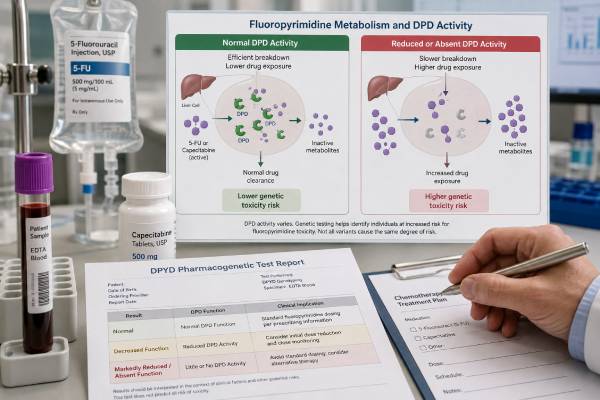
A fluoropyrimidine pharmacogenetic test is a pre-treatment safety assessment for people who may receive intravenous 5-fluorouracil or oral capecitabine. It usually examines DPYD, the gene that affects activity of dihydropyrimidine dehydrogenase, the enzyme responsible for clearing most fluorouracil. Reduced function can cause drug exposure to rise sharply after an ordinary dose, leading to severe diarrhea, mouth inflammation, low blood counts, infection, neurologic problems, and occasionally death. The test can identify many patients who need a lower first dose or should avoid fluoropyrimidines, but it cannot detect every cause of toxicity. The result must be available early enough to influence the first cycle, translated into an activity score, and connected to a written dosing and monitoring plan. Updated U.S. labeling in February 2026 advises DPYD testing before capecitabine or 5-FU unless treatment cannot wait.
- The test usually centers on DPYD variants that lower or eliminate DPD enzyme activity.
- A normal result supports standard starting-dose consideration but does not guarantee that treatment will be tolerated.
- Partial DPD deficiency commonly leads to a reduced first dose followed by careful titration.
- Complete or near-complete deficiency usually leads clinicians to select a non-fluoropyrimidine treatment when possible.
- Testing requires no fasting and can use blood, saliva, or a cheek-swab sample.
- Early severe diarrhea, mouth sores, fever, vomiting, confusion, or extreme weakness during treatment is an urgent oncology problem.
Table of Contents
- What the Test Is Designed to Prevent
- Preparing for the First Treatment Cycle
- Result Pathways From Normal to Deficient
- How 5-FU and Capecitabine Plans Differ
- Genotyping, Phenotyping, and Drug Monitoring
- Toxicity Signs and Emergency Response
- Limits, Equity, and Report Quality
- Using Results Throughout Cancer Care
What the Test Is Designed to Prevent
Fluoropyrimidines interfere with DNA and RNA production in rapidly dividing cells. That makes them effective against several cancers, but it also exposes the gastrointestinal lining, bone marrow, skin, nervous system, and heart to injury. Most of the administered fluorouracil is normally inactivated by DPD before it can cause prolonged exposure.
DPYD variants can reduce DPD activity from birth. A person with partial deficiency may look and feel entirely healthy until receiving 5-FU or capecitabine. A person with complete deficiency may have a far more dangerous reaction because the normal elimination pathway is nearly absent. The pharmacogenetic test seeks to identify that inherited vulnerability before a full dose reaches the patient.
The test does not estimate cancer aggressiveness, choose among all chemotherapy regimens, or show whether a tumor carries a treatment target. It addresses host metabolism. Tumor testing answers different questions, such as whether a colorectal cancer has a RAS mutation or mismatch-repair deficiency. A chemotherapy pharmacogenetic panel may assess several host genes, but each result applies only to drugs with a supported gene–drug relationship.
Preventing severe toxicity requires more than ordering a test. The laboratory must cover clinically important variants, the report must return before treatment, the oncology team must translate it correctly, and the patient must know which symptoms require an immediate call. A result that arrives after the first cycle or sits unreviewed in the chart has little preventive value.
Genotype-guided dosing reduces serious toxicity at the population level without clear evidence that it weakens tumor response when reduced doses are selected for variant carriers. The explanation is pharmacologic: a patient who clears fluorouracil slowly may reach an appropriate exposure from a smaller dose. Dose reduction is intended to normalize exposure, not to undertreat the cancer.
Even a well-run program cannot prevent every adverse effect. Most patients who develop common hand-foot syndrome, nausea, fatigue, or blood-count changes do not carry one of the routinely tested high-risk variants. Pharmacogenetics narrows one major source of preventable harm while ordinary oncology monitoring remains necessary for everyone.
Preparing for the First Treatment Cycle
The ideal workflow begins when a fluoropyrimidine-containing regimen is first considered. The oncology order identifies the planned drug and schedule, a sample is collected, and the result is reviewed before the prescription is finalized. For a patient awaiting surgery or completing staging, testing can often occur while other treatment decisions are still being made.
No fasting or medication interruption is usually required because DNA does not change with food or current treatment. Blood, saliva, and buccal cells can all provide inherited DNA. A cheek-swab kit may require avoiding food, drink, smoking, gum, or tooth brushing for a short period before collection.
Turnaround time matters more than convenience. A targeted assay may return within several days, while broader sequencing can take longer. If treatment is urgent, the team should explicitly decide whether to use rapid testing, delay briefly, select another regimen, or proceed with a carefully documented interim plan. “Pending” should never be interpreted as “normal.”
Before cycle 1, clinicians also review kidney and liver function, blood counts, performance status, nutrition, bowel habits, infection, cardiac history, and all medicines. Capecitabine requires particular attention to kidney function because renal impairment can increase exposure to its metabolites. Combination drugs create their own toxicity risks that a DPYD result does not address.
Patient education should name the fluoropyrimidine component. In FOLFOX, FOLFIRI, or chemoradiation, several drugs may be given together. The patient should know whether the genotype changed 5-FU or capecitabine, whether later escalation is planned, and which effects may come from another agent.
The first-cycle plan should include an after-hours telephone number, instructions for oral doses during illness, and a clear threshold for contacting the team. A person taking capecitabine at home needs to know whether to hold tablets after significant diarrhea or mouth sores while awaiting advice. They should not continue simply because the treatment calendar says doses remain.
A previous fluoropyrimidine course should be documented in detail: drug, dose, schedule, number of cycles, interruptions, and toxicities. Prior tolerance can inform care but does not substitute for a new result when the next regimen has greater systemic exposure or when kidney function and overall health have changed.
Result Pathways From Normal to Deficient
Laboratories usually translate DPYD alleles into an activity score. Each normal-function allele contributes 1, decreased-function alleles often contribute 0.5, and no-function alleles contribute 0. The two values are added.
| DPYD activity score | Predicted DPD status | Typical first-step response |
|---|---|---|
| 2 | Normal metabolizer | Consider the usual regimen dose, with routine monitoring. |
| 1.5 | Intermediate metabolizer | Use a major starting-dose reduction, then titrate from observed tolerance. |
| 1 | Intermediate metabolizer | Use a major starting-dose reduction and close early surveillance. |
| 0.5 | Poor metabolizer | Avoid when possible; specialist use requires extreme reduction and early exposure assessment. |
| 0 | Poor metabolizer | Avoid systemic 5-FU and capecitabine because no standard dose is proven safe. |
The common core variants include DPYD2A, DPYD13, c.2846A>T, and HapB3-associated changes. A clinically designed assay may add c.557A>G and other variants relevant to more diverse populations. The exact variant and its function matter; a generic “DPYD positive” label is not enough for a dose calculation.
For activity scores of 1 and 1.5, widely used guidance starts at approximately 50% of the conventional fluoropyrimidine dose, followed by adjustment. The selected dose can differ by variant, regimen, treatment intent, institutional protocol, and whether 5-FU therapeutic drug monitoring is available. The prescriber should record the actual calculation rather than relying on a color category.
Dose escalation is an active part of genotype-guided care. If the patient recovers well, has acceptable blood counts, and shows no important gastrointestinal, skin, neurologic, or cardiac toxicity, the team may increase later doses in controlled steps. Leaving every intermediate metabolizer indefinitely at the first reduced dose can create avoidable underexposure.
A normal-metabolizer result is not permission to ignore symptoms. Targeted panels miss rare harmful variants, and non-genetic factors can cause severe reactions. A normal result supports the standard starting framework only when kidney function, liver function, age, comorbidities, and the rest of the regimen also support it.
A variant of uncertain significance requires a different response. It has not been proven normal or damaging. The team may request expert laboratory interpretation, functional evidence, a DPD phenotype test, or broader review. Computer predictions alone should not be converted into a precise percentage reduction.
How 5-FU and Capecitabine Plans Differ
Intravenous 5-FU can be given as a rapid bolus, a prolonged infusion, or both. Bolus schedules tend to produce more bone-marrow suppression, while continuous infusion is often associated with mucositis and hand-foot syndrome. DPD deficiency can intensify either pattern. The genotype-based reduction applies to the fluorouracil amount within the specific protocol, not to an abstract daily dose.
Continuous-infusion 5-FU offers an additional tool: measured drug exposure. Some centers obtain a sample during infusion and calculate an area under the concentration-time curve. Later doses can be adjusted toward an exposure target. This can help distinguish a cautious first dose that was too low from one that produced adequate exposure in a slow metabolizer.
Capecitabine is taken by mouth and converted into fluorouracil through a series of enzymatic steps. Oral administration does not make DPD deficiency safer. Because exposure continues across repeated home doses, an early symptom can worsen if the patient keeps taking tablets. Written hold instructions and rapid access to the oncology team are essential.
Kidney impairment is particularly relevant to capecitabine. The prescriber follows renal dosing rules in addition to DPYD guidance. A patient can require both a pharmacogenetic reduction and a renal adjustment; the team should clarify whether percentages are applied sequentially or through a protocol-specific final dose.
Radiation sensitization often uses lower-dose capecitabine or infusional 5-FU. Lower intensity reduces exposure but does not eliminate inherited risk. Severe deficiency remains clinically important. A person who tolerated a short radiation course may not tolerate a later full systemic course at the same apparent genotype status.
Regimens may use leucovorin to enhance 5-FU activity. Leucovorin is not an antidote and does not correct DPD deficiency. Oxaliplatin, irinotecan, and targeted or immune therapies have separate dosing and adverse-effect profiles. Reducing fluorouracil does not automatically require reducing every combination partner.
Topical 5-FU generally produces much lower systemic exposure than cancer chemotherapy. Routine DPYD testing is not usually performed before a small-area dermatologic course, but a known severe deficiency, extensive application, damaged skin, or prior systemic reaction should be discussed with the prescriber. The article’s dosing framework applies to systemic oncology treatment, not self-adjustment of topical therapy.
Genotyping, Phenotyping, and Drug Monitoring
Genotyping searches for inherited DNA variants with established or suspected effects on DPD. A targeted panel is fast and has clear interpretation for included alleles. Its weakness is incomplete coverage. Full-gene sequencing detects more rare variants but also produces findings whose function is uncertain. Copy-number analysis may identify deletions or duplications that sequencing alone can miss.
Phenotyping estimates current DPD activity. Plasma uracil is used in some health systems because reduced DPD can cause uracil to rise. Other methods include the dihydrouracil-to-uracil ratio and direct enzyme activity in peripheral blood cells. Phenotype results can be influenced by kidney function, illness, sample timing, handling, and assay method.
Genotype and phenotype are complementary rather than interchangeable. Genotype is stable and identifies a specific inherited explanation. Phenotyping can detect reduced function from untested or non-genetic causes, but it may vary. Some programs use both to improve sensitivity, while others prioritize a standardized genotype panel because of accessibility and reproducibility.
Therapeutic drug monitoring comes after exposure. It is most established for continuous-infusion 5-FU and measures the concentration achieved by the actual dose. It can support later titration, but it is not a substitute for screening before the first dose. A profoundly deficient patient may become critically ill before a routine monitoring cycle can protect them.
Assay selection should reflect ancestry without relying on racial categories as a proxy for genotype. Early panels were built largely from variants studied in European populations. Harmful alleles found more often in people with African, Asian, Indigenous, or admixed ancestry may be missed if laboratories use a narrow list. Consensus recommendations encourage broader, standardized clinical coverage.
A result from a direct-to-consumer platform may contain one DPYD single-nucleotide variant without validated star-allele interpretation. Oncology decisions require a clinical laboratory report that confirms identity, specimen quality, allele coverage, function, activity score, and limitations.
Toxicity Signs and Emergency Response
Fluoropyrimidine toxicity deserves urgent attention when it begins during the first days, progresses quickly, or is much more severe than expected. Frequent watery stools, painful mouth ulcers, inability to swallow, persistent vomiting, fever, shaking chills, profound weakness, confusion, unsteady gait, slurred speech, chest pain, shortness of breath, or reduced urine output can signal a serious reaction.
Neutropenia and infection may develop before a patient realizes blood counts have fallen. Fever during chemotherapy should be handled according to the center’s emergency instructions. Anti-diarrheal medicine, mouth rinses, or hydration advice may be part of treatment, but they should not replace contacting the oncology team when symptoms are escalating.
Oral capecitabine users should follow the prescribed hold plan. Taking “just one more dose” while waiting for a routine callback can increase exposure. Patients should not restart after a hold until a clinician confirms the timing and dose.
Uridine triacetate is an emergency antidote for fluorouracil or capecitabine overdose and for certain cases of early severe or life-threatening toxicity. Benefit is greatest when treatment begins promptly, generally within 96 hours after fluoropyrimidine exposure ends. Emergency staff need the exact drug, last dose or infusion time, and oncology contact. Genetic testing should never delay antidote evaluation.
Supportive care can require hospitalization, intravenous fluids, electrolyte replacement, antibiotics, blood-product support, cardiac assessment, neurologic evaluation, nutrition, and intensive care. Symptoms may continue to worsen after the last dose because tissue injury is already underway.
After recovery, the team should determine whether the event reflected DPD deficiency, renal impairment, a dosing error, an interaction, infection, or several factors. Re-exposure may be avoided, substantially reduced, paired with pharmacokinetic monitoring, or replaced with another regimen. A prior severe reaction should be visible in the allergy or adverse-drug-reaction section of the record even if the genotype was normal.
Limits, Equity, and Report Quality
A pharmacogenetic test can be technically correct and still provide incomplete protection. Severe toxicity may occur in a person with no tested variant, while some carriers tolerate treatment because they received a lower exposure or other factors reduced risk. Results express probability, not certainty.
Variant coverage is a major limitation. The laboratory should list every interrogated allele and explain whether it used targeted genotyping, sequencing, and copy-number analysis. “Negative” is meaningful only in relation to that list. A report that omits coverage prevents clinicians from judging residual risk.
Equitable testing requires more than offering the same narrow panel to everyone. Variant selection, reference populations, interpretation databases, insurance coverage, language access, and turnaround time can all create disparities. A delayed result is especially likely to be ignored when treatment schedules are already difficult to coordinate.
The report should include the DPYD genotype, function assigned to each allele, activity score, predicted phenotype, dose guidance source, date of interpretation, and limitations. It should avoid unqualified labels such as “high risk” without explaining the treatment consequence.
Electronic decision support should fire before the first prescription, not repeatedly after a stable patient has completed therapy. Alerts should distinguish an untreated intermediate metabolizer from someone whose dose has already been individualized through several cycles. The raw genotype should remain accessible because dosing recommendations may evolve.
Cost-effectiveness depends on avoiding hospitalizations and life-threatening events while maintaining treatment efficacy. Implementation studies show that the operational details—rapid ordering, automatic pharmacist review, and clear dose documentation—often determine whether testing produces its intended value.
Using Results Throughout Cancer Care
A fluoropyrimidine pharmacogenetic result remains relevant for life. If a patient changes cancer centers, develops a new cancer, or receives treatment years later, the genotype should travel with the medication history. Repeating collection is unnecessary unless the original assay was incomplete, identity is uncertain, or interpretation requires broader coverage.
The patient should keep a copy that includes the actual variants and activity score, not only a summary letter. Pharmacists can help place the result in a structured field so it appears during future prescribing. A DPYD genetic result can also help relatives decide whether to discuss targeted testing, although relatives should not assume they share it.
At each cycle, the current clinical picture takes precedence over the original prediction. Weight, kidney function, liver function, blood counts, bowel symptoms, infection, nutrition, and combination therapies may change. A genotype never justifies continuing a dose that is causing unacceptable toxicity.
Patients can ask three concrete questions: What did my test detect? How did it change my first dose? What symptoms should make me stop oral treatment or call immediately? Those answers turn a laboratory result into a usable safety plan.
Oncology teams should also document escalation. When a variant carrier tolerates a reduced starting dose and later receives more, the record should show why. This protects against accidental return to the original full dose after a hospitalization or transfer while preserving the ability to maintain effective exposure.
The most successful programs treat testing as a clinical pathway rather than a single laboratory event. Ordering, interpretation, pharmacy verification, patient education, symptom response, and dose titration must connect. The test lowers inherited risk most effectively when every part of that pathway is ready before the first fluoropyrimidine dose.
References
- Safety labeling update for capecitabine and fluorouracil (5-FU) on risks associated with dihydropyrimidine dehydrogenase (DPD) deficiency 2026 (Official Safety Update)
- DPYD Genotyping, Fluoropyrimidine Dosage and Toxicity: An Umbrella Review 2025 (Umbrella Review)
- A Guide for Implementing DPYD Genotyping for Systemic Fluoropyrimidines into Clinical Practice 2025 (Implementation Guide)
- Real-World Impact of an In-House Dihydropyrimidine Dehydrogenase Pharmacogenetic Testing Program on Fluoropyrimidine-Related Toxicity 2024 (Implementation Study)
- Dihydropyrimidine dehydrogenase gene variants for predicting grade 4-5 fluoropyrimidine-induced toxicity: FUSAFE individual patient data meta-analysis 2024 (Meta-Analysis)
- A systematic review and meta-analysis of toxicity and treatment outcomes with pharmacogenetic-guided dosing compared to standard of care BSA-based fluoropyrimidine dosing 2022 (Systematic Review)
Disclaimer
Fluoropyrimidine pharmacogenetic results must be applied by an oncology team to the exact regimen, organ function, and treatment goals. Do not alter 5-FU or capecitabine doses or restart held tablets without direct instructions. Early severe gastrointestinal, infectious, neurologic, cardiac, or dehydration symptoms require urgent assessment.