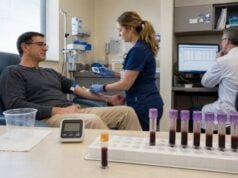
A growth failure hormone test panel evaluates whether a child’s slow height gain may involve the growth hormone–IGF-1 axis. The panel usually includes insulin-like growth factor 1, IGF-binding protein 3, thyroid and general health tests, and—only when the clinical pattern supports it—a supervised growth hormone stimulation test. No single blood result diagnoses growth hormone deficiency. Children grow at different rates according to age, family height, nutrition, chronic disease, and pubertal timing, and both IGF-1 and stimulated GH require age- and assay-specific interpretation. The strongest evaluation begins with accurate serial height measurements and growth velocity, then integrates body proportions, bone age, pubertal stage, medical history, laboratory findings, and pituitary imaging when indicated. Low IGF-1 may reflect growth hormone deficiency, but it can also result from undernutrition, hypothyroidism, liver disease, inflammation, or delayed puberty.
- Growth velocity and change in height percentile are more informative than one height measurement.
- Random GH is not useful for excluding deficiency because secretion is pulsatile.
- IGF-1 and IGFBP-3 are screening markers, not stand-alone diagnoses.
- Results must be converted to age-, sex-, and puberty-adjusted standard deviation scores.
- GH stimulation cutoffs vary by agent, assay, and clinical protocol.
- MRI and other pituitary tests are added when the pattern suggests an organic disorder.
Table of Contents
- How Growth Is Assessed
- What the Hormone Panel Includes
- When Testing Is Needed
- IGF-1 and IGFBP-3 Results
- Growth Hormone Stimulation Testing
- Interpreting Combined Patterns
- Next Steps, Treatment, and Questions
How Growth Is Assessed
Growth failure means a child is not growing as expected over time. Short stature and growth failure are related but not identical. A child can be short yet grow at a normal rate along a low percentile, as in familial short stature. Another child may still be within the population range but cross percentiles downward because growth has slowed.
Accurate measurement is the foundation. Infants are measured lying down on a length board; older children stand against a calibrated stadiometer with shoes removed and head positioned correctly. Small errors can create a false impression of acceleration or decline. Measurements several months apart are needed to calculate annualized height velocity.
Typical prepubertal growth is approximately 5 to 6 centimeters per year after the rapid toddler period, but age, sex, and pubertal stage matter. Puberty normally accelerates growth. A child who enters puberty late may appear to fall behind peers before a later growth spurt, while a child with early puberty may grow rapidly and then stop earlier.
Clinicians plot height, weight, body mass index, and head circumference when age-appropriate on a validated growth chart. They also compare projected height with the family target. A commonly used midparental estimate averages parental heights after a sex adjustment, but it is only a range, not a promise.
Body proportions and physical findings can redirect testing. Disproportionate short stature may suggest skeletal dysplasia. Low weight relative to height raises nutrition, malabsorption, or systemic disease. Preserved or increased weight with slow linear growth can occur in endocrine disorders such as hypothyroidism, glucocorticoid excess, or growth hormone deficiency.
Bone age is assessed from a left hand and wrist radiograph. A delayed bone age can occur in constitutional delay, growth hormone deficiency, hypothyroidism, chronic illness, and undernutrition. A normal bone age may fit familial short stature. Bone age helps estimate remaining growth but is method-dependent and less reliable in some disorders.
Before focusing on hormones, the history reviews birth size, pregnancy, neonatal hypoglycemia or jaundice, feeding, chronic symptoms, medications, sleep, headaches, vision, smell, puberty, family growth patterns, and psychosocial conditions. Growth is a whole-child outcome, not a laboratory number.
What the Hormone Panel Includes
The panel is assembled in stages. Screening tests look for common and treatable causes before a dynamic pituitary test is considered.
| Test | Purpose in growth evaluation |
|---|---|
| IGF-1 | Reflects integrated GH action and nutritional status |
| IGFBP-3 | Major binding protein; useful especially in younger children |
| TSH and free T4 | Detect primary or central hypothyroidism |
| Complete blood count and metabolic panel | Screen for anemia, kidney, liver, and systemic disease |
| ESR or CRP | Look for inflammation when clinically indicated |
| Celiac testing | Detect malabsorption that may present mainly as poor growth |
| Calcium, phosphorus, alkaline phosphatase | Assess bone and mineral disorders when relevant |
| Karyotype or genetic testing | Evaluate Turner syndrome or other genetic growth disorders |
| GH stimulation test | Assess pituitary GH reserve in selected children |
IGF-1 is produced mainly by the liver in response to GH and also acts locally in growth plates. It circulates bound to IGFBPs, especially IGFBP-3 and the acid-labile subunit. Its concentration is steadier than GH, making it practical for screening.
IGFBP-3 is also GH-dependent and varies less with meals than IGF-1. It may be helpful in young children, whose normal IGF-1 levels are naturally low and close to assay detection limits. Neither marker is specific for growth hormone deficiency.
Random GH is usually not part of a meaningful deficiency panel. GH is released in pulses, with much secretion occurring during sleep. A healthy child may have an undetectable daytime level, while stress, exercise, fasting, or illness can cause a transient peak. A single low value is expected and cannot diagnose deficiency.
Thyroid testing is essential because hypothyroidism can slow height velocity and lower IGF-1. In possible pituitary disease, free T4 deserves particular attention because TSH may be low, normal, or mildly elevated in central hypothyroidism.
The panel may include morning cortisol and other pituitary hormones when there are headaches, visual symptoms, neonatal signs, midline defects, micropenis, delayed puberty, or known hypothalamic-pituitary disease. A broad hypopituitarism blood test panel is safer than assessing GH in isolation when multiple deficits are possible.
Genetic testing has an increasing role. Variants affecting GH production, the GH receptor, IGF-1, IGF-1 receptor, pituitary development, SHOX, and many growth-plate pathways can produce distinctive patterns. Testing is guided by phenotype rather than used as a universal first step.
When Testing Is Needed
Referral or endocrine testing is considered when growth data suggest more than normal variation. Concerning patterns include height below approximately −2 standard deviations, growth velocity below the expected range, crossing two major percentile lines, or height far below the genetic target.
Testing may be appropriate even before severe short stature develops when a child has:
- a known brain or pituitary lesion;
- prior cranial radiation;
- pituitary surgery or significant head injury;
- multiple pituitary hormone abnormalities;
- neonatal hypoglycemia, prolonged jaundice, micropenis, or midline defects;
- symptoms of raised intracranial pressure;
- a genetic condition associated with GH deficiency;
- an unexpectedly poor pubertal growth spurt.
Growth hormone deficiency often causes proportionate short stature, reduced growth velocity, delayed bone age, and relatively preserved weight. Some children have a younger facial appearance or increased truncal fat, but these features are not required. Severe congenital deficiency may present with neonatal hypoglycemia and, in boys, micropenis.
Common alternatives must be evaluated first. Familial short stature, constitutional delay of growth and puberty, small size for gestational age without catch-up, celiac disease, inflammatory bowel disease, kidney disease, heart or lung disease, undernutrition, psychosocial deprivation, hypothyroidism, glucocorticoid excess, and genetic syndromes are all more common or equally important.
Medication history matters. Chronic systemic glucocorticoids, high-dose inhaled steroids, stimulants that suppress appetite, some anticonvulsants, and chemotherapy can affect growth. Poor sleep and obstructive sleep apnea can also impair health and growth.
Testing should not be driven by parental comparison with classmates alone. School-age children within a normal growth channel usually do not need repeated hormone panels. Conversely, a “normal” height should not reassure when velocity has fallen substantially.
Pubertal timing can create diagnostic uncertainty. A child with constitutional delay may have low-normal IGF-1 and a subnormal unprimed GH stimulation peak. Some centers use brief sex-steroid priming before stimulation in older prepubertal children to reduce false-positive diagnoses. Practice varies, and priming can also mask a subtle defect.
A careful decision to test prevents two harms: missing a treatable pituitary disorder and labeling a healthy short child with growth hormone deficiency based on nonspecific laboratory results.
IGF-1 and IGFBP-3 Results
IGF-1 and IGFBP-3 should be reported against age- and sex-specific reference data. Because puberty has a major effect, pubertal stage or bone age may also need consideration. Many laboratories provide a standard deviation score, or SDS, showing how far the result lies from the population mean.
An IGF-1 around or below −2 SDS is often considered low. This finding increases suspicion when growth velocity is poor and other causes are excluded, but sensitivity is limited. Children with confirmed growth hormone deficiency can have IGF-1 above −2 SDS, particularly with partial deficiency, young age, obesity, or assay variation.
Low IGF-1 can result from:
- inadequate calorie or protein intake;
- celiac disease or other malabsorption;
- chronic liver disease;
- uncontrolled hypothyroidism;
- inflammatory disease;
- poorly controlled diabetes mellitus;
- severe systemic illness;
- delayed puberty;
- growth hormone deficiency;
- GH resistance or primary IGF-1 deficiency.
IGFBP-3 may be low in severe GH deficiency, undernutrition, liver disease, and chronic illness. It can be more informative than IGF-1 in very young children, but its sensitivity and specificity are also imperfect. A normal IGFBP-3 does not exclude deficiency.
Interpretation improves when both markers and growth data agree. Low IGF-1 and low IGFBP-3 in a child with clearly reduced velocity, delayed bone age, and pituitary risk factors support further GH evaluation. Normal markers with normal growth velocity make severe deficiency less likely. Discordant results require attention to nutrition, puberty, assay, and the broader diagnosis.
A high IGF-1 result is uncommon in untreated growth failure. It may reflect puberty, obesity, assay differences, or exogenous GH. Persistently high IGF-1 with short stature can suggest impaired IGF-1 receptor action, although phenotype and genetic assessment are required.
The IGF-1 test is not a direct measurement of growth hormone secretion. GH resistance can produce normal or high GH with low IGF-1, while liver or nutritional disease can reduce IGF-1 despite adequate pituitary GH.
Repeat testing may be appropriate after nutritional rehabilitation, thyroid treatment, recovery from illness, or progression into puberty. A change should be interpreted using the same assay and SDS system whenever possible.
Growth Hormone Stimulation Testing
A GH stimulation test measures the pituitary’s ability to release GH after a pharmacologic stimulus. Agents include clonidine, arginine, glucagon, insulin-induced hypoglycemia, and others. Protocols vary by country, age, safety profile, and center.
The child usually fasts overnight. An intravenous line is placed, baseline samples are obtained, and the stimulating agent is given. GH is measured repeatedly over two to four hours, depending on the protocol. Glucose, blood pressure, heart rate, and symptoms may be monitored.
Side effects depend on the agent. Clonidine can cause drowsiness and low blood pressure. Arginine can cause nausea or infusion reactions. Glucagon may cause nausea, vomiting, or late hypoglycemia. The insulin tolerance test deliberately causes hypoglycemia and requires experienced supervision; it is avoided in children with seizure disorders or other contraindications.
The highest measured GH concentration is the peak. Historically, cutoffs such as 10 ng/mL were widely used. Modern monoclonal assays often read lower, and many centers use thresholds around 7 ng/mL or lower depending on the test and assay. There is no universal cutoff that can be transferred across methods.
A growth hormone stimulation test has important limitations:
- GH secretion is continuous and probabilistic, not truly pass-fail.
- Results have imperfect reproducibility.
- Different stimuli produce different peaks.
- Body mass index, puberty, nutrition, sleep, and recent illness affect response.
- Assays measure GH isoforms differently.
- A healthy prepubertal child may have a low unprimed peak.
Some guidelines or payers require two failed stimulation tests for idiopathic isolated deficiency. One test may be sufficient when there is a known structural lesion, multiple pituitary deficits, a genetic diagnosis, or strong neonatal and imaging evidence. Local diagnostic criteria should be explicit.
GH stimulation testing can sometimes be avoided in a child with a classic organic presentation, such as a hypothalamic-pituitary defect plus another pituitary hormone deficiency and poor growth. This is a specialist decision. Avoiding an unnecessary test is different from diagnosing from IGF-1 alone.
Interpreting Combined Patterns
The final interpretation combines auxology, screening markers, dynamic testing, imaging, and alternative diagnoses.
| Pattern | Likely interpretation |
|---|---|
| Poor velocity, low IGF-1/IGFBP-3, low stimulated peak, pituitary abnormality | Strong evidence for GH deficiency |
| Poor velocity, low IGF-1, normal or high GH peak | Nutrition, chronic disease, GH resistance, or assay/timing issue |
| Poor velocity, normal IGF-1, low GH peak | Possible partial GHD, false-positive stimulation test, obesity, or delayed puberty |
| Normal velocity, low IGF-1 | Often nutrition, constitutional delay, young age, or nonspecific finding |
| Short stature, normal velocity, normal panel | Familial short stature or another non-GH cause |
| Severe short stature, low IGF-1, normal/high endogenous GH | Primary IGF-1 deficiency or GH resistance should be considered |
Pituitary MRI is usually obtained after biochemical and clinical evidence supports GH deficiency or earlier when neurologic symptoms or multiple deficits are present. Imaging assesses the pituitary size, stalk, posterior pituitary, hypothalamus, tumors, and congenital abnormalities. An incidental small pituitary does not establish deficiency without the clinical pattern.
Other pituitary hormones must be considered before treatment. ACTH deficiency can be life-threatening and should be treated before thyroid or GH replacement when present. Central hypothyroidism can reduce growth and IGF-1. Gonadotropin deficiency may become apparent only at pubertal age.
Obesity deserves special caution. Children with higher body mass index may have lower stimulated GH peaks despite normal IGF-1 and normal linear growth. Applying an unadjusted cutoff can overdiagnose deficiency. Underweight children may have low IGF-1 because of nutrition while showing preserved or high GH secretion.
Constitutional delay commonly produces delayed bone age, delayed puberty, family history of late maturation, and temporarily low IGF-1 for chronological age. Interpretation against bone age or pubertal stage may be more appropriate. Longitudinal observation can be more informative than immediate labeling.
GH insensitivity produces low IGF-1 despite normal or high GH secretion. Severe forms can include distinctive facial features, very short stature, and low IGFBP-3. Genetic testing and specialist assessment distinguish receptor, signaling, acid-labile subunit, and IGF pathway disorders.
A diagnosis should explain the entire phenotype. If the laboratory pattern does not fit growth velocity, nutrition, puberty, or imaging, the conclusion should remain provisional.
Rechecking Growth Before a Final Label
When the evidence is borderline, a planned observation period can be diagnostically valuable. Height is remeasured with the same technique after enough time to calculate a reliable velocity, often six months in a stable school-age child. Nutrition, thyroid disease, celiac disease, chronic inflammation, sleep, and medication effects are addressed during that interval. Pubertal progression is documented rather than assumed.
Repeat IGF-1 should use the same laboratory when possible and be interpreted as an SDS. A small numerical change may simply reflect age advancement or assay variation, while a meaningful rise after improved nutrition or thyroid treatment may explain the original low value. Repeating an identical stimulation test without correcting confounders is less useful.
The threshold for observation is lower when the child is otherwise well, growing near the family pattern, and has no neurologic or pituitary warning signs. Observation is not appropriate when growth is rapidly deteriorating, multiple pituitary hormones are deficient, hypoglycemia is recurrent, or headache and visual symptoms suggest a mass. In those settings, imaging and broader endocrine evaluation should proceed promptly.
A written diagnostic summary should state what supports GH deficiency, what argues against it, which alternatives were excluded, and which findings remain uncertain. This prevents a borderline peak from becoming a permanent label detached from the original growth data.
Next Steps, Treatment, and Questions
When GH deficiency is confirmed, recombinant human growth hormone may be offered. Dosing is individualized by diagnosis, weight or body surface area, growth response, puberty, and IGF-1. Treatment usually involves regular subcutaneous injections, with long-acting preparations available in some settings.
Monitoring includes height velocity, weight, pubertal development, adherence, injection technique, IGF-1, thyroid function, and adverse effects. The strongest response is often seen in the first year. A poor response prompts review of diagnosis, dose, adherence, nutrition, thyroid status, chronic disease, and antibodies or rare resistance.
Potential adverse effects include headache from intracranial hypertension, edema, joint symptoms, glucose intolerance, slipped capital femoral epiphysis, and progression of scoliosis during rapid growth. Severe headache, vomiting, visual change, or new hip or knee pain requires prompt assessment.
Growth hormone does not correct all short stature, and treatment goals should be realistic. In a child with another diagnosis, treating celiac disease, hypothyroidism, inflammation, undernutrition, or glucocorticoid excess may restore growth without GH.
Children with organic or genetic GH deficiency may need long-term follow-up for other pituitary deficits. Those with isolated idiopathic childhood deficiency are often retested after linear growth is complete because some have normal adult GH reserve. Persistent severe deficiency can affect body composition, bone, lipids, and quality of life.
Questions for the pediatric endocrinologist include:
- Is growth velocity truly low for age and pubertal stage?
- How far is height from the family target range?
- Were IGF-1 and IGFBP-3 converted to reliable SDS values?
- Could nutrition, celiac disease, thyroid disease, inflammation, liver disease, or delayed puberty explain low markers?
- Which stimulation agent and assay were used, and what cutoff is validated?
- Was sex-steroid priming considered, and why or why not?
- Is one failed test enough in this clinical setting?
- Do MRI findings and other pituitary hormones support the diagnosis?
- What growth response and IGF-1 target will be used during treatment?
- Will retesting be needed at final height?
Urgent care is warranted for growth concerns accompanied by severe headache, repeated vomiting, visual loss, excessive thirst and urination, seizures, fainting, or signs of adrenal insufficiency. These symptoms suggest a broader pituitary or neurologic problem rather than uncomplicated short stature.
A high-quality growth failure panel does not ask only whether a GH peak crosses a cutoff. It asks whether the child’s measured growth, IGF system, pituitary reserve, imaging, nutrition, puberty, and overall health form one consistent diagnosis.
References
- Disorders of Growth Hormone in Childhood 2022 (Clinical Review)
- Diagnosis of GH Deficiency Without GH Stimulation Tests 2022 (Review)
- Establishment of IGF-1 and IGFBP-3 continuous reference intervals in healthy children and adolescents 2024 (Research Article)
- Pediatric Growth Hormone Deficiency Workup 2024 (Clinical Reference)
- Genetic basis of growth hormone deficiency: An update for pediatric endocrinologists 2025 (Review)
- Growth Hormone Deficiency in Children 2026 (Clinical Reference)
Disclaimer
This article provides general education and cannot diagnose growth hormone deficiency or determine whether a child should receive treatment. Growth testing requires accurate serial measurements, pediatric reference intervals, exclusion of other illnesses, and specialist interpretation of dynamic tests. Seek prompt medical care for severe headache, visual change, vomiting, hypoglycemia, or other signs of a broader pituitary disorder.