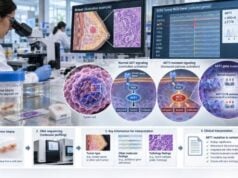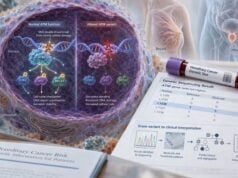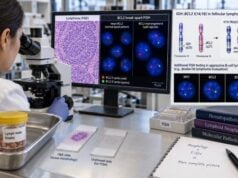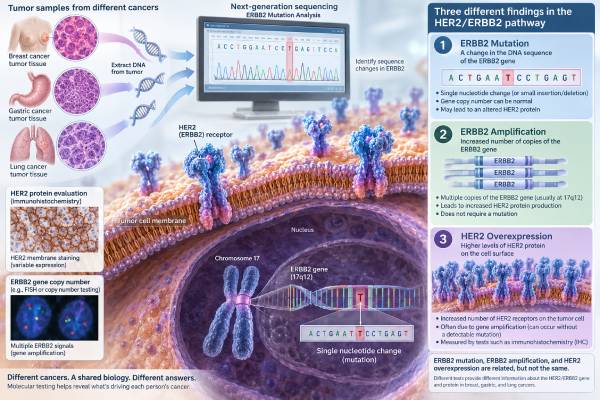
A HER2/ERBB2 mutation test looks for DNA changes in the ERBB2 gene, which encodes the HER2 receptor. The result is not the same as a standard HER2 immunohistochemistry (IHC) or in situ hybridization (ISH) result. A tumor can have an activating ERBB2 mutation without HER2 protein overexpression or gene amplification, and it can be HER2-positive by IHC/ISH without having an ERBB2 mutation.
That distinction matters because HER2 biomarkers guide treatment differently across cancers. In non-small cell lung cancer, activating ERBB2 mutations are established treatment biomarkers and now have multiple mutation-directed FDA-approved options in defined settings. In breast cancer, ERBB2 mutations can be actionable in selected advanced cancers even when conventional HER2 testing is negative, but the treatment framework differs from classic HER2-positive disease. In gastric cancer, routine HER2-directed treatment is still primarily based on protein expression and/or amplification rather than mutation status alone. The report must therefore be interpreted by tumor type, exact variant, and testing method.
- An ERBB2 mutation is a DNA sequence change in the HER2 gene; it is not the same as HER2 amplification or IHC protein overexpression.
- Activating ERBB2 mutations are established treatment biomarkers in non-squamous non-small cell lung cancer.
- In breast cancer, some HER2-mutant tumors are HER2-negative by standard IHC/ISH but may have mutation-directed treatment options in advanced disease.
- In gastric cancer, an ERBB2 mutation alone does not automatically make the tumor “HER2-positive” for standard HER2-directed treatment.
- There is no normal numeric range; results usually identify a specific pathogenic, likely pathogenic, uncertain, or absent ERBB2 variant.
Table of Contents
- What HER2/ERBB2 mutation testing measures
- Mutation vs amplification vs protein expression
- ERBB2 mutations in lung, breast, and gastric cancer
- How the test is performed
- How to interpret an ERBB2 mutation result
- Treatment meaning and current clinical use
- Limitations and questions to ask
What HER2/ERBB2 mutation testing measures
ERBB2 is the official gene name for the receptor commonly called HER2. It encodes a transmembrane receptor tyrosine kinase that signals through pathways controlling cell growth and survival. Certain acquired mutations can make HER2 signaling abnormally active and contribute to cancer growth.
A mutation test examines the ERBB2 DNA sequence for specific alterations. Depending on the assay, it may detect:
- Single-nucleotide variants, such as S310F or L755S.
- Small insertions or deletions, including exon 20 insertions.
- Other activating kinase-domain changes.
- Additional ERBB2 variants whose significance is uncertain.
The most important question is not simply whether any ERBB2 change exists. The laboratory must determine whether the exact variant is activating and clinically relevant. Some changes are recognized oncogenic drivers, while others are benign, likely benign, or variants of uncertain significance.
ERBB2 mutations are usually somatic tumor changes. They can be found through a cancer gene mutation panel or broad tumor profiling rather than through a stand-alone HER2 mutation assay. A positive somatic result does not by itself imply an inherited cancer syndrome.
The report may include the variant name, exon, protein change, variant allele frequency, classification, and evidence for treatment relevance. Variant allele frequency is the percentage of sequencing reads carrying the alteration; it is affected by tumor purity, copy number, and tumor biology, so it is not a direct measure of how aggressive the cancer is.
Mutation vs amplification vs protein expression
The term “HER2-positive” can be confusing because several different tests examine different forms of HER2 abnormality.
| HER2 biomarker | What it measures | Common testing method | Why it matters |
|---|---|---|---|
| ERBB2 mutation | DNA sequence change in the HER2 gene | NGS, PCR, or another molecular assay | Can be a mutation-specific treatment biomarker, especially in lung cancer |
| ERBB2 amplification | Extra copies of the ERBB2 gene | ISH or NGS copy-number analysis | Major basis of classic HER2-positive classification in breast and gastric cancer |
| HER2 protein expression | Amount and pattern of HER2 protein on tumor cells | IHC | Guides several HER2-directed treatments and categories such as IHC 3+, HER2-low, or HER2-ultralow in specific settings |
These abnormalities can overlap, but they do not have to. A breast tumor can be HER2-negative by IHC/ISH and still contain an activating ERBB2 mutation. Conversely, a breast or gastric tumor can have strong HER2 protein expression because of amplification without carrying an activating point mutation.
This distinction prevents a common interpretation error: a positive ERBB2 mutation test should not automatically be translated into “HER2-positive” in the conventional breast or gastric pathology sense. The treatment indication may require a particular mutation, a particular IHC score, amplification, or a combination of tumor and clinical criteria.
A standard HER2 pathology test also cannot substitute for sequencing when a mutation-specific therapy requires an activating ERBB2 variant. Likewise, sequencing alone cannot establish an IHC 3+ indication when the therapy requires protein expression.
When several HER2 tests appear in the same chart, they should be read as complementary rather than contradictory. Each is measuring a different biological feature.
ERBB2 mutations in lung, breast, and gastric cancer
The meaning of an ERBB2 mutation changes substantially by cancer type.
Non-small cell lung cancer
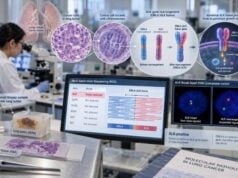
ERBB2 mutations are an established oncogenic driver in a small subset of non-small cell lung cancers, most often non-squamous adenocarcinomas. Exon 20 insertions in the tyrosine kinase domain are among the best-known alterations, although other activating kinase-domain variants occur.
This is a disease in which mutation testing has direct treatment consequences. Current FDA indications include HER2-directed antibody-drug conjugate therapy for previously treated HER2-mutant metastatic NSCLC and mutation-selective tyrosine kinase inhibitors for tumors with qualifying ERBB2 tyrosine kinase domain mutations. As the approvals differ in prior-treatment requirements and variant eligibility, the exact mutation and current label matter.
Comprehensive solid tumor NGS is often used because a newly diagnosed advanced lung cancer may need evaluation of multiple actionable drivers, not ERBB2 alone.
Breast cancer
In breast cancer, classic HER2-positive status has traditionally been defined by HER2 protein overexpression and/or ERBB2 amplification. ERBB2 mutations are a separate molecular subgroup. They occur in a minority of breast cancers and can be enriched in certain hormone-receptor-positive metastatic tumors, including cancers that are HER2-negative by conventional testing.
Clinical studies have shown activity from mutation-directed HER2 therapy in selected HER2-mutant breast cancers. For example, combinations built around the HER2 tyrosine kinase inhibitor neratinib have produced responses in hormone-receptor-positive, HER2-negative, HER2-mutant metastatic disease. This makes an ERBB2 mutation potentially actionable, but it does not erase the need to interpret estrogen receptor status, prior endocrine therapy, standard HER2 IHC/ISH findings, co-mutations, and current treatment guidance.
Because breast cancer can also contain endocrine-resistance alterations, ERBB2 mutation results may be interpreted alongside markers such as ESR1 mutations or PIK3CA mutations when broad profiling is performed.
Gastric and gastroesophageal cancers
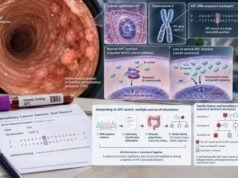
HER2 is an important treatment biomarker in gastric and gastroesophageal adenocarcinoma, but the routine clinical framework is primarily based on HER2 protein expression and ERBB2 amplification. Activating ERBB2 mutations can occur, yet a mutation alone should not be assumed to satisfy the standard definition of HER2-positive gastric cancer.
This is especially important when a broad NGS panel reports an ERBB2 variant in a tumor with negative or low HER2 IHC. The mutation may be biologically interesting and could have trial or emerging therapeutic relevance, but treatment decisions should follow the biomarker required for the specific regimen.
How the test is performed
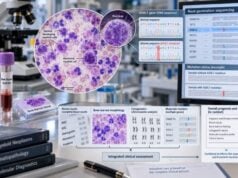
ERBB2 mutation testing is usually performed on tumor DNA from a biopsy or surgical specimen. Many laboratories use targeted NGS panels that analyze ERBB2 along with dozens or hundreds of other cancer genes.
The basic workflow is:
- A pathologist confirms the diagnosis and selects tissue containing viable tumor.
- DNA is extracted from formalin-fixed, paraffin-embedded tissue or another validated specimen.
- The assay sequences ERBB2 regions included in its design.
- Bioinformatics identifies variants and estimates allele frequency.
- The laboratory classifies each alteration and adds disease-specific interpretation when evidence is available.
A blood-based circulating tumor DNA test can also detect ERBB2 mutations in some advanced cancers. Liquid biopsy can be useful when tissue is unavailable or when rapid profiling is needed. However, a negative blood result can occur simply because the tumor is not shedding enough DNA into the circulation. Tissue testing may therefore be appropriate after an uninformative liquid biopsy if the result could change care.
Assay coverage matters. A test must reliably detect the types of changes relevant to the clinical question, including small insertions such as exon 20 insertions when lung cancer is being evaluated. Companion diagnostic requirements may specify an FDA-authorized assay for a particular drug indication.
No special fasting or medication preparation is needed for the molecular analysis itself. Preparation depends on how the tissue or blood sample is collected. For archived tumor tissue, the main practical issue is whether enough suitable material remains for testing.
How to interpret an ERBB2 mutation result
A useful interpretation starts with the exact variant classification.
Pathogenic or activating mutation detected
An established activating ERBB2 mutation means the tumor contains a HER2 alteration capable of driving abnormal signaling. The next question is whether that mutation has clinical actionability in this cancer type and treatment setting.
In lung cancer, qualifying activating mutations can directly determine eligibility for mutation-directed therapy. In breast cancer, the finding may support a targeted strategy in selected advanced disease, often after standard biomarker and treatment factors are considered. In gastric cancer, mutation status generally should not replace routine HER2 IHC/ISH criteria.
Variant of uncertain significance
A variant of uncertain significance, or VUS, means there is not enough evidence to classify the change as a cancer-driving or treatment-predictive mutation. A VUS should generally not be treated as an actionable HER2 mutation unless additional evidence or expert review changes its classification.
No ERBB2 mutation detected
A negative result means no reportable mutation was found within the assay’s validated coverage. It does not mean HER2 biology is normal in every sense. The tumor could still have ERBB2 amplification or HER2 protein overexpression, which require the appropriate copy-number or IHC/ISH assessment.
A negative result can also be limited by low tumor content, poor DNA quality, insufficient coverage, or a liquid-biopsy sample with low circulating tumor DNA. The quality-control section of the report helps determine how reassuring a negative result is.
Variant allele frequency
The report may show a variant allele frequency such as 5%, 20%, or 40%. This number is not a universal “mutation level” with a normal or dangerous cutoff. It reflects the fraction of sequencing reads carrying the variant and can be influenced by tumor purity, copy-number changes, clonal structure, and specimen type. Treatment eligibility usually depends on the identity and classification of the mutation, not on trying to maximize or minimize the allele frequency.
Treatment meaning and current clinical use
The treatment impact of an ERBB2 mutation is now clearest in non-squamous NSCLC. Trastuzumab deruxtecan established substantial activity in previously treated HER2-mutant metastatic NSCLC. More recently, mutation-selective HER2 tyrosine kinase inhibitors have expanded the treatment landscape for tumors with ERBB2 tyrosine kinase domain mutations.
As of 2026, FDA approvals include zongertinib for unresectable or metastatic non-squamous NSCLC with qualifying HER2 tyrosine kinase domain activating mutations; the indication was expanded in February 2026 to include patients who had not received systemic therapy for advanced disease. Sevabertinib also has an accelerated approval for previously treated locally advanced or metastatic non-squamous NSCLC with qualifying HER2 tyrosine kinase domain activating mutations. Eligibility depends on the current drug label and an appropriate companion diagnostic.
This evolving landscape is a good example of why the exact mutation should remain in the medical record. “HER2 mutation positive” may be too broad when a therapy is specifically approved for tyrosine kinase domain activating mutations.
In breast cancer, mutation-directed treatment has supporting clinical evidence, particularly in advanced hormone-receptor-positive, conventionally HER2-negative disease. However, standard HER2-directed treatment decisions also depend on IHC/ISH categories that are independent of mutation status. A patient may therefore have more than one relevant HER2-related biomarker.
In gastric cancer, the established HER2 treatment pathway continues to rely heavily on HER2 protein expression and amplification. The existence of an ERBB2 mutation should prompt disease-specific interpretation rather than automatic use of a breast- or lung-cancer treatment rule.
The 2024 tumor-agnostic accelerated approval of trastuzumab deruxtecan is another important distinction: that indication is for previously treated unresectable or metastatic HER2-positive IHC 3+ solid tumors, not for every tumor carrying an ERBB2 mutation. A mutation report alone does not establish IHC 3+ status.
Limitations and questions to ask
ERBB2 testing can be confusing because the same HER2 name appears on several different laboratory reports. Before acting on a result, clarify which biomarker was actually measured.
Useful questions include:
- Was this test sequencing ERBB2, measuring HER2 protein by IHC, or measuring amplification by ISH?
- What exact ERBB2 mutation was found? The exon and protein change can affect treatment relevance.
- Is the variant classified as activating/pathogenic or as uncertain? A VUS is not equivalent to an actionable driver.
- Does the treatment evidence apply to this cancer type? Lung, breast, and gastric cancers use HER2 biomarkers differently.
- Does a drug require a specific companion diagnostic? Regulatory labels can specify how patients should be selected.
- If the mutation test is negative, have HER2 expression and amplification been assessed when clinically relevant? These are separate biomarkers.
- Was the sample adequate? Low tumor fraction or low circulating tumor DNA can cause false-negative results.
- Has the result been reviewed against current approvals and guidelines? HER2-directed treatment options have changed rapidly.
The most accurate way to summarize the result is usually more specific than “HER2 positive” or “HER2 negative.” Phrases such as “ERBB2 exon 20 activating mutation detected, HER2 IHC 0” or “HER2 IHC 3+ with ERBB2 amplification” preserve the biological distinction and make later treatment decisions clearer.
Another useful point is that HER2 biomarkers can change across the course of cancer. A metastatic biopsy may not perfectly match the original tumor because treatment can select different clones and tumors can be heterogeneous. When a new result would materially change therapy, clinicians may consider testing a current metastatic sample or circulating tumor DNA rather than relying only on an old specimen. That decision depends on tissue availability, prior results, disease pace, and the clinical question.
For the same reason, the date of the molecular report matters. A variant classified as uncertain several years ago may later gain stronger evidence, while treatment indications can expand or narrow. Keeping the complete original report allows the oncology team to reinterpret the exact ERBB2 variant against current knowledge instead of repeating a vague label such as “HER2 abnormal.”
This distinction is especially important when records move between specialties. A lung oncologist may use “HER2-positive” to refer to an activating ERBB2 mutation, while a breast or gastric oncology report may use the same words for IHC or amplification status. The safest handoff is to carry the actual result—such as the ERBB2 protein change, IHC score, and ISH result—rather than only the shorthand label.
References
- A review of HER2 overexpression and somatic mutations in cancers 2023 (Review)
- Trastuzumab Deruxtecan in Patients With HER2-Mutant Metastatic Non-Small-Cell Lung Cancer: Primary Results From the Randomized, Phase II DESTINY-Lung02 Trial 2023
- Neratinib + fulvestrant + trastuzumab for HR-positive, HER2-negative, HER2-mutant metastatic breast cancer: outcomes and biomarker analysis from the SUMMIT trial 2023
- FDA grants accelerated approval to zongertinib for unresectable or metastatic non-squamous non-small cell lung cancer 2026
- FDA grants accelerated approval to sevabertinib for non-squamous non-small cell lung cancer 2025
Disclaimer
This article is for general education and does not replace individualized oncology or pathology advice. ERBB2 mutation, HER2 amplification, and HER2 protein expression are different biomarkers, and treatment eligibility depends on the exact cancer, alteration, assay, disease setting, and current drug label or guideline. A qualified oncology team should interpret the complete report before treatment decisions are made.