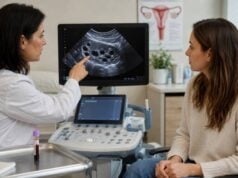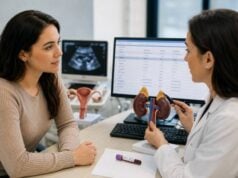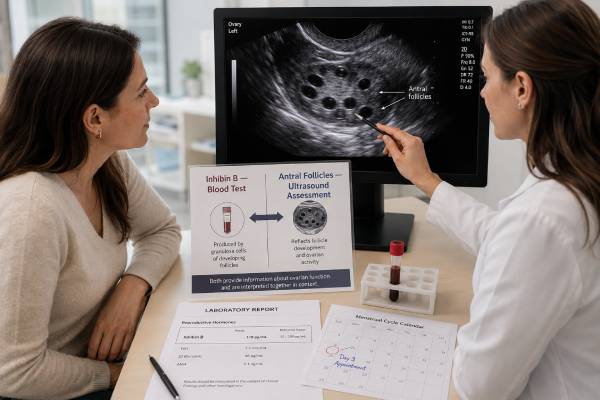
An inhibin B test measures a hormone released mainly by small, developing ovarian follicles. Because inhibin B reflects activity in the follicle pool, it can provide information about ovarian function, especially when measured early in the menstrual cycle. However, it is not the preferred stand-alone ovarian reserve test in most fertility clinics. Anti-Müllerian hormone and antral follicle count are usually more useful for predicting response to ovarian stimulation, while age remains the strongest general predictor of egg quality and reproductive potential. Inhibin B levels change across the cycle, decline with reproductive aging, and become very low after menopause. They can also rise with some ovarian tumors. A result therefore needs to be interpreted with cycle day, age, menstrual pattern, other hormone tests, ultrasound findings, and the reason the test was ordered.
- Inhibin B is made mainly by granulosa cells in small growing follicles and helps suppress pituitary FSH.
- Early-follicular testing, often around cycle day 2 or 3, is the most common timing for ovarian reserve assessment.
- A low result may support diminished ovarian reserve, but it cannot measure egg quality or prove infertility.
- AMH and antral follicle count generally predict ovarian stimulation response better than inhibin B alone.
- High inhibin B can occur with active follicle development, fertility medication, or an inhibin-producing ovarian tumor.
- Postmenopausal inhibin B is normally very low; an unexpected elevation may require pelvic imaging and specialist review.
Table of Contents
- What Inhibin B Does
- Why Inhibin B Is Tested
- Inhibin B and Ovarian Reserve
- Normal Ranges and Cycle Timing
- High Inhibin B Results
- Low Inhibin B Results
- Preparation and Testing Process
- How Results Guide Next Steps
What Inhibin B Does
Inhibin B is a glycoprotein hormone formed from an alpha subunit and a beta-B subunit. In women, it is produced mainly by granulosa cells in preantral and small antral follicles. These follicles contain immature eggs and grow under the influence of follicle-stimulating hormone, or FSH.
One of inhibin B’s main jobs is negative feedback. As developing follicles release inhibin B, the hormone travels to the pituitary gland and helps reduce FSH secretion. That feedback supports selection and development of the follicle group during the first part of the menstrual cycle.
Inhibin B does not remain stable throughout the month. It usually rises in the early follicular phase, reaches a peak as a group of follicles develops, then falls later in the follicular phase. A smaller rise may occur shortly after the midcycle LH surge. Levels are generally low during the luteal phase.
This pattern differs from inhibin A. Inhibin A is more strongly associated with the dominant follicle, corpus luteum, and placenta during pregnancy. The inhibin A test in women is therefore more familiar in pregnancy screening and selected tumor-marker use, while inhibin B is more closely tied to the early growing follicle pool.
As ovarian follicles decline with age, inhibin B production tends to decrease. Lower inhibin B means less suppression of FSH, so FSH may rise earlier in the cycle. This relationship is part of the reproductive-aging process, but both hormones fluctuate and should not be reduced to a single universal cutoff.
Inhibin B is also produced by some ovarian sex cord-stromal tumors, particularly granulosa cell tumors. In that context, the test is used as a tumor marker rather than an ovarian reserve test.
Why Inhibin B Is Tested
An inhibin B test is most useful when it addresses a defined question. The common indications are assessment of follicle activity, selected fertility evaluation, prediction of ovarian response, and evaluation or monitoring of an ovarian tumor.
Ovarian reserve and fertility treatment
Ovarian reserve refers mainly to the number of remaining follicles, not the quality of every egg. Inhibin B can be measured early in the cycle as one marker of the responsive follicle pool. A lower value may occur when fewer follicles are available to produce the hormone.
Fertility clinics may consider inhibin B when other results are unclear, when a broader ovarian reserve assessment is needed, or in research and specialized protocols. In current practice, however, AMH and ultrasound antral follicle count are generally more accurate and easier to use for predicting the number of eggs likely to be retrieved during in vitro fertilization.
Testing may be considered before controlled ovarian stimulation, after ovarian surgery, following chemotherapy or radiation, or when there are risk factors for diminished reserve. It may also be ordered in an ovarian reserve test panel together with AMH, FSH, estradiol, and ultrasound.
Irregular periods or suspected ovarian dysfunction
Inhibin B may add context when periods are irregular or absent, but it is not a first-line test for most menstrual disorders. Pregnancy testing, TSH, prolactin, FSH, LH, and estradiol are often more directly useful. A low inhibin B result may support reduced follicle activity, but it does not identify the cause.
Women with hypothalamic amenorrhea, premature ovarian insufficiency, perimenopause, or recent ovarian suppression can have low levels for different reasons. A result must therefore be interpreted with the broader endocrine pattern.
Ovarian tumor evaluation
Granulosa cell tumors can release inhibin B, inhibin A, estradiol, and sometimes anti-Müllerian hormone. Inhibin B is often more sensitive than inhibin A for these tumors, although neither marker identifies every case.
A clinician may order inhibin B when pelvic imaging shows an ovarian mass, especially if there is abnormal uterine bleeding, endometrial thickening, estrogen-related symptoms, or a history of granulosa cell tumor. If the level is elevated before treatment and falls afterward, it may be useful in long-term surveillance.
Inhibin B and Ovarian Reserve
Inhibin B reflects the activity of small growing follicles, so it has a logical biological relationship with ovarian reserve. The clinical question is not whether the relationship exists, but how accurately one blood test predicts outcomes that matter.
A low early-follicular inhibin B value may be associated with fewer recruitable follicles and a lower response to fertility medication. It can also be associated with higher FSH because less inhibin feedback reaches the pituitary. However, the test has significant overlap between women with different ovarian responses. Extreme values may be informative, while midrange values are often less decisive.
AMH is generally more stable across the cycle and tends to decline before FSH rises. Antral follicle count directly counts visible small follicles by transvaginal ultrasound. These features make AMH and antral follicle count the preferred tools in many clinics. The AMH test in women still cannot measure egg quality or guarantee pregnancy, but it is more standardized for predicting stimulation response than inhibin B.
Ovarian reserve results are most useful for treatment planning. They can help estimate whether a person may need a higher or lower gonadotropin dose, whether a low or excessive response is more likely, and how many eggs might be retrieved. They are less reliable for predicting spontaneous conception over the next several months.
A woman can have a low ovarian reserve marker and still ovulate and conceive naturally. Conversely, a normal reserve result does not rule out infertility caused by tubal disease, endometriosis, sperm factors, age-related egg quality decline, or other conditions.
Reserve is not the same as egg quality
Egg quality refers mainly to the likelihood that an egg has normal chromosomes and can produce a viable embryo. Age is more strongly related to this issue than inhibin B. Two women can have similar inhibin B levels but very different reproductive prospects if their ages differ substantially.
The test also cannot count primordial follicles directly. It measures hormone production from a subset of growing follicles at that moment. Illness, cycle variability, ovarian suppression, and assay differences can alter the observed value.
Reserve is not a menopause countdown
Declining inhibin B is part of reproductive aging, but one result cannot predict the exact age of menopause. Menopause timing is influenced by genetics, smoking, ovarian surgery, chemotherapy, autoimmune disease, and other factors. Even combinations of AMH, FSH, and inhibin B provide probability estimates rather than a calendar date.
For suspected primary ovarian insufficiency, diagnosis depends on menstrual history and repeated elevated FSH in the appropriate clinical setting. Inhibin B may be low, but it is not the diagnostic test.
How inhibin B compares with other reserve markers
Each ovarian reserve marker describes a different part of follicle biology. AMH is produced by very small growing follicles and is relatively stable across the cycle. Antral follicle count measures visible follicles, usually 2 to 10 mm in diameter, by ultrasound. Early-cycle FSH reflects pituitary output after ovarian feedback has been considered, while estradiol helps show whether FSH may be artificially suppressed. Inhibin B sits between these approaches because it is a direct follicle product but changes quickly as follicles respond to FSH.
No marker provides a direct count of all remaining eggs. The primordial follicles that make up most of the true reserve are microscopic and do not release enough hormone to be counted one by one through a blood test. Reserve testing therefore estimates the behavior of the available follicle pool rather than measuring it exactly.
A single result can also be misleading after temporary ovarian suppression. Hormonal contraception, breastfeeding, recent pregnancy, severe illness, weight loss, and some medications may reduce follicular activity without proving permanent loss. Repeating the test after the relevant condition has resolved may give a different result, although repeat testing should be ordered only when it could change care.
For women considering egg freezing or IVF, the practical use of reserve testing is to estimate treatment response and plan medication. It cannot predict whether a specific retrieved egg will fertilize, develop into a chromosomally normal embryo, implant, or lead to a live birth. Those outcomes depend on age, sperm, embryo biology, uterine factors, laboratory performance, and chance.
Normal Ranges and Cycle Timing
There is no single inhibin B range that applies to every laboratory, age, or cycle phase. Assays differ, and some reports provide only an upper limit rather than a full expected interval.
Examples from large laboratory reference systems illustrate the variation. One commonly used assay lists an early-follicular range of approximately 8 to 223 pg/mL for regularly cycling women ages 13 to 41, an upper limit near 107 pg/mL for ages 42 to 51, and a postmenopausal upper limit around 11 pg/mL. Another laboratory may use different cutoffs.
These numbers should not be treated as universal fertility targets. A value near the lower end can still occur in a person who responds to stimulation, and a value within range does not guarantee a normal response. The laboratory’s own reference interval and the test indication should guide interpretation.
Best timing for ovarian reserve questions
For ovarian reserve assessment, inhibin B is usually measured during the early follicular phase, commonly cycle day 2, 3, or 4. Day 1 is the first day of full menstrual flow, not light spotting.
Early-cycle timing reduces some of the natural fluctuation and allows comparison with FSH and estradiol drawn at the same time. If the cycle is irregular or absent, the clinician may choose a random test and interpret it cautiously or use AMH and ultrasound instead.
Fertility medications can increase follicle activity and change inhibin B markedly. Testing during stimulation is used for different purposes than a baseline reserve test. Hormonal contraceptives, recent pregnancy, breastfeeding, and ovarian suppression may also reduce or alter ovarian markers.
| Timing or setting | Typical pattern | Interpretive point |
|---|---|---|
| Early follicular phase | Rises as small follicles develop | Preferred baseline timing for ovarian reserve questions |
| Late follicular phase | Often declines | Not directly comparable with a day-3 result |
| Shortly after LH surge | May show a brief second peak | Can appear higher because of normal cycle physiology |
| Luteal phase | Usually low | A low result is not necessarily abnormal |
| Postmenopause | Very low or undetectable | Unexpected elevation may require tumor evaluation |
High Inhibin B Results
A high inhibin B result can reflect normal or stimulated follicle activity, but it can also function as a tumor marker. Context separates these possibilities.
Possible causes include:
- a relatively larger cohort of active small follicles;
- polycystic ovarian morphology or another state with increased follicle number;
- ovarian stimulation with gonadotropins;
- an ovarian granulosa cell tumor;
- some other sex cord-stromal or mucinous ovarian tumors;
- laboratory variation or an incorrect reference comparison.
A high result in a young, regularly cycling woman during the follicular phase may fall within expected physiology. It does not automatically mean polycystic ovary syndrome. PCOS is diagnosed from menstrual or ovulatory dysfunction, clinical or biochemical androgen excess, and ovarian morphology or AMH-based criteria where accepted, after excluding other causes. The PCOS blood test panel addresses a broader set of possibilities.
During fertility treatment, rising inhibin B can reflect the number and activity of developing follicles. Ultrasound and estradiol are usually more directly used to monitor stimulation, and inhibin B is not required in every protocol.
When a high result raises concern for a tumor
Concern is greater when inhibin B is clearly elevated after menopause, when a pelvic mass is present, or when the person has a history of granulosa cell tumor. Symptoms may include irregular or postmenopausal bleeding, pelvic pressure, abdominal enlargement, pain, or signs of excess estrogen.
Inhibin B cannot prove that a mass is malignant. Benign ovarian conditions may also alter markers, and some tumors do not release inhibin B. Pelvic ultrasound or other imaging, gynecologic assessment, and sometimes surgery with pathology are needed for diagnosis.
If a known tumor produced inhibin B before treatment, serial measurements can be useful. A persistent fall may support response, while a rising trend can prompt imaging. Trends are more informative when the same assay is used each time.
Low Inhibin B Results
A low early-follicular inhibin B result may indicate a smaller active follicle pool, but it does not establish infertility. It may also reflect cycle timing, age, hormonal suppression, or temporary ovarian inactivity.
Possible explanations include:
- normal late follicular or luteal timing;
- reproductive aging or diminished ovarian reserve;
- perimenopause or menopause;
- primary ovarian insufficiency;
- hypothalamic suppression from low energy intake, intense exercise, stress, or illness;
- recent chemotherapy, pelvic radiation, or ovarian surgery;
- use of hormonal contraception or ovarian-suppressing medication;
- assay variability.
Low inhibin B often appears with higher early-cycle FSH because less negative feedback is present. A FSH test in women should be interpreted with estradiol, because an elevated estradiol level can suppress FSH and make it appear reassuring.
A low result cannot show whether a person ovulates every month. Ovulation is better assessed through menstrual pattern, urine LH testing, ultrasound, or a correctly timed progesterone measurement when needed. It also cannot distinguish reduced follicle quantity from age-related egg quality changes.
What a low result means for fertility treatment
A low baseline result may suggest a lower egg yield with stimulation, but treatment response varies. Clinicians consider age, AMH, antral follicle count, prior stimulation response, diagnosis, body size, and treatment goals.
The result may support counseling about expectations, medication dosing, or the possibility that more than one retrieval could be needed. It should not be used as a reason to deny treatment without considering the full clinical picture.
Preparation and Testing Process
The test requires a standard blood sample from a vein. Fasting is usually unnecessary unless other tests ordered at the same time require it.
For a baseline ovarian reserve test:
- Identify cycle day 1 as the first day of full flow.
- Schedule the draw for day 2, 3, or 4 if instructed.
- Tell the clinician about hormonal contraception, fertility drugs, recent pregnancy, breastfeeding, or irregular cycles.
- Record recent ovarian surgery, chemotherapy, radiation, or serious illness.
- Use the same laboratory for repeat testing when possible.
High-dose biotin can interfere with some immunoassays. Report supplements and medications to the laboratory. Do not stop prescribed biotin or other treatment without professional advice.
The blood draw itself carries little risk beyond brief pain, bruising, or lightheadedness. Results may take longer than common hormone tests because inhibin B is a specialized assay.
How Results Guide Next Steps
Inhibin B should rarely be the only result guiding care. The next step depends on whether the question involves fertility, menstrual function, or a possible ovarian tumor.
For fertility assessment, clinicians commonly combine:
- age and reproductive history;
- cycle regularity and ovulation history;
- AMH;
- early-cycle FSH and estradiol;
- antral follicle count;
- semen analysis where relevant;
- tubal and uterine evaluation when indicated.
The fertility hormone test panel is only one part of a complete infertility evaluation. A low reserve marker does not explain blocked tubes or sperm problems, and a normal marker does not rule them out.
When the result is unexpectedly low, repeating it at the correct cycle time may be reasonable. A clinician may favor AMH and ultrasound rather than repeated inhibin B testing, especially when the first result would not change management.
When the result is unexpectedly high outside fertility treatment, the clinician should review menstrual phase, medications, pregnancy status, and symptoms. Persistent elevation after menopause or elevation with a pelvic mass generally warrants pelvic imaging and gynecologic review.
Urgent care is not usually needed for an isolated inhibin B result. Seek prompt assessment for severe pelvic pain, fainting, rapidly increasing abdominal swelling, heavy bleeding, or postmenopausal bleeding. These symptoms need evaluation regardless of the marker level.
The most accurate interpretation is modest: inhibin B provides information about active follicles and selected ovarian tumors, but it is neither a fertility verdict nor a complete ovarian health assessment. Its value comes from combining the number with timing, age, ultrasound, other hormones, and the clinical reason for testing.
When treatment decisions are time-sensitive, a reproductive specialist can explain which additional tests are likely to meaningfully change the plan and which would only repeat information already available.
References
- Fertility evaluation of infertile women: a committee opinion 2021 (Guideline)
- Can Inhibin B Reflect Ovarian Reserve of Healthy Reproductive Age Women Effectively? 2021 (Cohort Study)
- Ovarian Reserve Testing 2022 (Clinical Review)
- Potential factors result in diminished ovarian reserve 2023 (Review)
- INHB – Overview: Inhibin B, Serum 2026 (Official Laboratory Reference)
- Advanced Granulosa Cell Tumors of the Ovary: A Review with a Focus on Current and Novel Therapeutic Approaches 2024 (Review)
Disclaimer
This article provides general information and cannot determine ovarian reserve, fertility potential, or the cause of an abnormal inhibin B result for an individual. Results should be reviewed with a reproductive endocrinologist, gynecologist, or oncologist when appropriate. Severe pelvic pain, heavy bleeding, fainting, rapidly increasing abdominal swelling, or postmenopausal bleeding needs prompt medical evaluation.