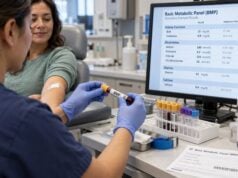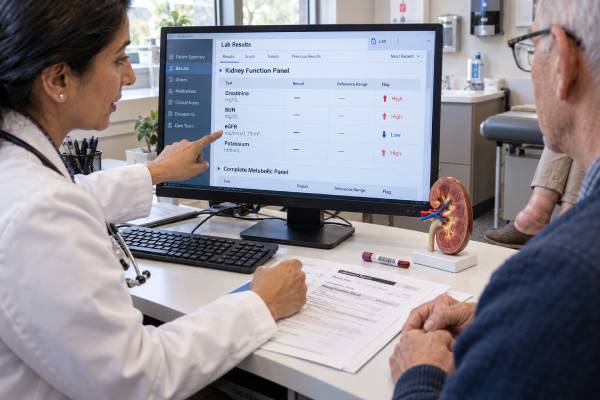
A kidney failure blood test panel is not one single standardized test. It is a practical group of blood measurements used to determine how severely kidney function is reduced and whether dangerous complications are developing. The core results usually include creatinine, estimated glomerular filtration rate (eGFR), blood urea nitrogen (BUN), potassium, bicarbonate, sodium, and other electrolytes; calcium, phosphorus, blood count, and additional tests may be added. An eGFR below 15 mL/min/1.73 m² falls in the G5 kidney-failure category, but one low result does not by itself show whether the problem is acute, chronic, reversible, or an indication for dialysis. Clinicians also look for potassium abnormalities, acid buildup, fluid overload, uremic symptoms, urine output, and the speed of change. Kidney failure can become an emergency when filtration falls rapidly or when complications affect the heart, lungs, brain, or circulation.
- An eGFR below 15 mL/min/1.73 m² is the G5 kidney-failure category, but chronic kidney failure requires persistent disease or other evidence of chronicity.
- Creatinine and BUN show waste accumulation, but neither value alone determines whether dialysis is needed.
- High potassium is one of the most urgent blood-test complications because severe hyperkalemia can cause life-threatening heart rhythm problems.
- Low bicarbonate may indicate metabolic acidosis, while sodium, calcium, and phosphorus abnormalities can provide additional clues and complications.
- Emergency symptoms include severe shortness of breath, chest symptoms, confusion, fainting, profound weakness, persistent vomiting, rapidly worsening swelling, or very low urine output.
Table of Contents
- What a Kidney Failure Panel Includes
- Creatinine, BUN, and eGFR
- Potassium and Other Electrolytes
- Acute vs. Chronic Kidney Failure
- Warning Signs and Emergencies
- Does a Blood Test Decide When Dialysis Starts?
- Follow-Up and Next Tests
What a Kidney Failure Panel Includes
There is no universal laboratory order named “kidney failure blood test panel.” Hospitals and clinics assemble tests based on the clinical situation. A typical evaluation includes markers of filtration, waste products, electrolytes, acid-base balance, and complications.
| Test | Why it matters in severe kidney dysfunction |
|---|---|
| Creatinine | Rises as kidney clearance falls and is used to calculate eGFR |
| eGFR | Estimates filtration and places chronic kidney function into G1–G5 categories |
| BUN | Reflects urea nitrogen accumulation but is also affected by protein intake, bleeding, hydration, and catabolic illness |
| Potassium | Can become dangerously high when kidney excretion is impaired |
| Bicarbonate/CO2 | Helps identify metabolic acidosis from impaired acid excretion |
| Sodium and chloride | Help assess water, electrolyte, and acid-base balance |
| Calcium and phosphorus | May become abnormal in advanced CKD and CKD-mineral and bone disorder |
| Albumin | Provides information about nutrition, inflammation, liver synthesis, and protein loss |
A kidney function blood test panel may be enough for stable outpatient monitoring. When kidney failure is suspected, clinicians often add a complete blood count, urinalysis, urine albumin or protein, magnesium, phosphorus, blood gas testing, electrocardiogram, and imaging depending on symptoms and severity.
The purpose is not merely to label kidney function. It is to identify complications that require immediate treatment and to determine whether the dysfunction is acute, chronic, or a combination of both.
Creatinine, BUN, and eGFR
Creatinine is the main blood marker used to estimate filtration. When filtration drops, creatinine generally rises. The absolute number must be compared with the person’s baseline because a rapid increase can represent acute kidney injury even when the value is not extremely high.
The eGFR result translates creatinine, and sometimes cystatin C, into a filtration estimate. For chronic kidney disease, G4 is 15–29 mL/min/1.73 m² and G5 is below 15. G5 is often called the kidney-failure category.
An eGFR below 15 does not automatically mean a person needs dialysis that day. Some people have stable advanced CKD with few symptoms and are managed closely while preparing for kidney replacement therapy. Others need urgent dialysis at a higher eGFR because of uncontrolled potassium, acid-base problems, fluid overload, or uremic complications.
BUN measures urea nitrogen, a waste product of protein metabolism. BUN often rises as kidney clearance falls, but it is less specific than creatinine. Dehydration, gastrointestinal bleeding, corticosteroid treatment, high protein intake, severe infection, and tissue breakdown can raise BUN. Liver disease or low protein intake can lower it.
The BUN test therefore helps describe the overall picture but is not a dialysis trigger. There is no single BUN threshold that determines kidney replacement therapy for every patient.
Potassium and Other Electrolytes
Potassium is one of the most important results in severe kidney dysfunction. The kidneys normally remove excess potassium. When filtration and tubular secretion are impaired, potassium can accumulate, especially in people taking ACE inhibitors, ARBs, mineralocorticoid receptor antagonists, potassium supplements, or other medicines that increase potassium.
A common laboratory reference range is around 3.5–5.0 mmol/L, but exact limits vary. Hyperkalemia is often considered clinically significant above approximately 5.0–5.5 mmol/L. Values around 6.0 mmol/L or higher are more concerning, and potassium around 6.5 mmol/L or above is often treated as severe, particularly when electrocardiogram changes, weakness, or rapid rises are present. The urgency is determined by the full clinical picture, not a number alone.
The potassium blood test in kidney disease can also be falsely high if red blood cells rupture during collection. When a high result is unexpected and the patient is stable, clinicians may repeat the sample promptly while assessing risk.
Bicarbonate is another key result. Healthy kidneys regenerate bicarbonate and excrete acid. Advanced kidney dysfunction can cause metabolic acidosis, often seen as a low serum bicarbonate or total CO2. Acidosis can contribute to rapid breathing, weakness, bone and muscle effects, and worsening illness.
Sodium reflects water balance as much as sodium balance. Severe kidney dysfunction can cause dilutional low sodium when water accumulates, although many other conditions can do the same. Calcium and phosphorus abnormalities are more typical of advanced chronic disease than sudden acute kidney injury and can contribute to bone and vascular complications over time.
Acute vs. Chronic Kidney Failure
A severe blood-test abnormality does not automatically tell whether kidney failure is acute or chronic. The distinction matters because acute kidney injury may be reversible, while chronic kidney disease reflects persistent structural or functional damage.
Acute kidney injury develops over hours to days. Common causes include severe dehydration, infection or sepsis, low blood pressure, heart failure, medication toxicity, urinary obstruction, inflammation, and major surgery. Creatinine can rise quickly, urine output may fall, and electrolytes can change rapidly. An acute kidney injury blood test panel focuses on change from baseline and urgent complications.
Chronic kidney disease requires abnormalities present for at least three months. Clues to chronicity include previous low eGFR values, longstanding albuminuria, small echogenic kidneys on imaging, chronic anemia, mineral-bone abnormalities, and a known history of diabetic, hypertensive, genetic, or glomerular kidney disease.
A person can have acute kidney injury on top of chronic kidney disease. In that situation, creatinine may rise sharply above an already abnormal baseline. Recovery may return kidney function near the prior baseline without restoring normal filtration.
Because eGFR equations assume a relatively steady filtration marker, eGFR is less precise when creatinine is changing rapidly. In acute illness, the trend in creatinine, urine output, and complications often matters more than the calculated eGFR itself.
Warning Signs and Emergencies
Severe kidney dysfunction can be present with few symptoms, especially when it develops slowly. When symptoms appear, they may reflect fluid overload, uremia, electrolyte abnormalities, anemia, or the underlying illness.
Concerning symptoms include:
- very low urine output or no urine;
- rapidly worsening swelling of the legs, face, or abdomen;
- severe shortness of breath, especially at rest or when lying flat;
- chest pain, palpitations, fainting, or severe weakness;
- confusion, extreme drowsiness, seizures, or major changes in alertness;
- persistent nausea or vomiting with inability to keep fluids down;
- severe itching, loss of appetite, or progressive weight loss in advanced chronic disease;
- uncontrolled bleeding or symptoms related to severe systemic illness.
Seek emergency care for chest symptoms, fainting, severe breathing difficulty, seizures, new confusion, profound weakness, or a laboratory-reported critical potassium result. These problems can become life-threatening regardless of the exact eGFR.
A person with stable advanced CKD may not need emergency treatment simply because eGFR is below 15, but they do need close nephrology care and a plan for complications and kidney replacement therapy if needed.
Does a Blood Test Decide When Dialysis Starts?
No single blood-test number determines when dialysis begins. Modern kidney care starts dialysis for clinical indications rather than an isolated creatinine, BUN, or eGFR threshold.
Common reasons include refractory hyperkalemia, severe metabolic acidosis that does not respond to medical treatment, fluid overload causing pulmonary edema, certain toxin exposures, or symptoms and complications of uremia such as encephalopathy, pericarditis, severe persistent nausea, or progressive nutritional deterioration.
In chronic kidney failure, planning usually starts before dialysis is absolutely necessary. That may include education about hemodialysis, peritoneal dialysis, conservative kidney management, transplantation, vascular access, or peritoneal catheter placement. Starting planning early reduces the chance of needing emergency dialysis through a temporary catheter.
An eGFR in the single digits increases the likelihood that kidney replacement therapy will soon be needed, but symptom burden and complications vary. Two people with the same eGFR can have different treatment timelines.
The same principle applies to BUN. A very high BUN can support the diagnosis of severe azotemia, but there is no universal value at which every patient should begin dialysis. The cause, trend, symptoms, and other blood tests are essential.
Follow-Up and Next Tests
When a kidney failure panel is abnormal, clinicians usually repeat or expand testing quickly. Follow-up may include urinalysis, urine albumin or protein, blood count, phosphorus, magnesium, calcium, parathyroid hormone, iron studies, and acid-base assessment. An electrocardiogram is important when potassium is significantly abnormal.
Kidney ultrasound can identify obstruction, kidney size, and structural clues. If urinary obstruction is causing kidney failure, relieving the blockage may improve function. Other causes may require infection treatment, medication changes, fluids, diuretics, immunologic testing, biopsy, or other targeted care.
For chronic kidney failure, serial trends guide planning. The CKD blood test panel helps monitor filtration and complications, while urine albumin and blood pressure help assess ongoing kidney damage and risk.
Medication review is critical because many drugs require dose adjustment as kidney function falls. Nonsteroidal anti-inflammatory drugs and some other medicines can worsen kidney injury in susceptible people. Potassium-raising medicines may need careful monitoring rather than automatic discontinuation, because some also provide important kidney and heart benefits.
The most useful question after an abnormal panel is not “Which number is kidney failure?” but “Is kidney function acutely changing, what complications are present, what is causing the problem, and what treatment is needed now?”
How clinicians judge urgency from the whole panel
The urgency of kidney failure is determined by the combination of laboratory results and symptoms. A person with eGFR 12 who is stable, eating, breathing comfortably, making urine, and maintaining safe potassium and bicarbonate levels may be managed differently from someone with eGFR 22 who has severe pulmonary edema and refractory hyperkalemia.
Potassium is often prioritized because dangerous elevations can affect the heart within a short time. Bicarbonate and blood pH matter because severe acidosis can impair cardiovascular function and indicate that the kidneys cannot maintain acid-base balance. Fluid status matters because excess fluid can accumulate in the lungs even before waste-product numbers reach an extreme value.
Clinicians also consider whether the problem can be reversed quickly. Obstruction, severe dehydration, medication toxicity, or infection may improve with targeted treatment. In those situations, temporary dialysis may be needed for complications even if long-term dialysis is not expected.
Why symptoms can be mild despite very abnormal numbers
When kidney function declines slowly, the body can partially adapt to rising waste products and changing electrolytes. This is why some people with advanced CKD report surprisingly few symptoms until late in the disease. The absence of dramatic symptoms does not mean the blood tests can be ignored.
Conversely, severe symptoms may come from a complication rather than the waste-product level itself. Shortness of breath can reflect fluid overload, profound weakness can reflect potassium abnormalities or acidosis, and confusion can reflect uremia, infection, medications, or other metabolic problems. The symptom tells clinicians where to look, but blood tests help identify the mechanism.
Uremia refers to the clinical syndrome caused by advanced kidney failure and retained toxins, not simply a high BUN. Symptoms can include nausea, poor appetite, itching, sleep disturbance, cognitive changes, pericarditis, and neuropathy. Because uremia is a clinical diagnosis, no single BUN concentration defines it.
Planning before an emergency develops
For people with progressive G4 or G5 CKD, planning is part of treatment. Nephrology teams estimate the risk and pace of progression, discuss transplantation and dialysis options, and review whether conservative kidney management is appropriate. This preparation can include vascular mapping for a fistula, peritoneal dialysis education, transplant evaluation, vaccination, nutrition counseling, and medication adjustment.
The purpose is to avoid waiting for a crisis such as severe hyperkalemia, pulmonary edema, or uremic encephalopathy. Planned kidney replacement therapy is generally safer and gives patients more choice than an emergency start.
Blood-test trends help with timing, but they are only one part of the decision. Functional status, symptoms, nutritional decline, cardiovascular health, personal goals, and the feasibility of each treatment option also matter.
Other blood abnormalities in advanced kidney disease
Kidney failure affects more than creatinine, BUN, and potassium. Chronic loss of kidney function can reduce erythropoietin production and contribute to anemia. A complete blood count may therefore show a low hemoglobin, although iron deficiency, bleeding, inflammation, and other causes must also be considered.
Phosphorus can rise as kidney excretion falls. At the same time, vitamin D activation decreases and parathyroid hormone may rise, creating chronic kidney disease-mineral and bone disorder. Calcium can be low, normal, or occasionally high depending on the stage, treatment, albumin, and parathyroid activity. These abnormalities matter over months and years because they affect bone health and vascular calcification; they are not usually the first emergency signal in an acute kidney crisis.
Albumin can be low because of inflammation, malnutrition, liver disease, or heavy protein loss in urine. A falling albumin in advanced CKD may indicate nutritional or inflammatory stress and can influence prognosis and treatment planning.
These additional tests help distinguish a stable advanced chronic pattern from a sudden acute event. Longstanding anemia and mineral-bone abnormalities can support chronicity, while a rapid creatinine rise with previously normal blood counts and mineral values may fit acute kidney injury more closely. None of these clues is definitive by itself, but together they help establish the timeline and complications.
What to bring to an urgent kidney evaluation
If you are being evaluated for a sudden kidney-function decline, bring a complete medication and supplement list, recent laboratory reports if available, and information about recent vomiting, diarrhea, fever, infections, urinary symptoms, contrast imaging, surgery, or changes in blood pressure. Note any reduction in urine output and approximately when it started. This information can identify reversible causes quickly and helps clinicians interpret whether the laboratory pattern is new or chronic.
References
- KDIGO 2024 Clinical Practice Guideline for the Evaluation and Management of Chronic Kidney Disease 2024 (Guideline)
- Estimated Glomerular Filtration Rate (eGFR) 2026
- Potassium Blood Test 2024
- BUN (Blood Urea Nitrogen) 2024
- Utilization of Potassium Binders for the Management of Hyperkalemia in Chronic Kidney Disease: A Position Statement by US Nephrologists 2024 (Position Statement)
Disclaimer
Kidney failure cannot be diagnosed or treated from one blood value alone, and dialysis decisions depend on symptoms, complications, trend, and the underlying cause. Severe potassium abnormalities, breathing difficulty, chest symptoms, confusion, seizures, fainting, or very low urine output require prompt medical assessment. If a laboratory reports a critical result, follow the clinical team’s urgent instructions.