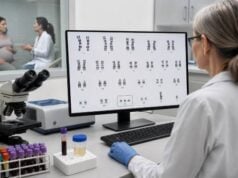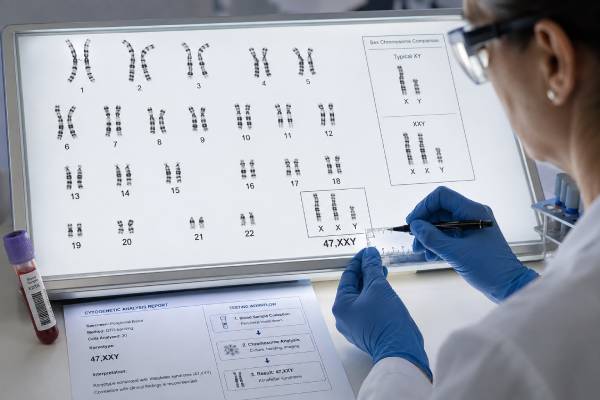
Klinefelter syndrome is a chromosome condition most often caused by an extra X chromosome in a person who also has a Y chromosome. The usual result is written 47,XXY. Some people are diagnosed before birth, while others are tested because of delayed puberty, small testes, low testosterone, learning or language concerns, or infertility. Many have mild features and remain undiagnosed for years. A genetic test can confirm the chromosome finding, but it cannot predict exactly how a person will grow, learn, feel, or respond to treatment. Results need to be interpreted alongside age, symptoms, hormone levels, development, and reproductive goals. This guide explains when testing is used, how karyotype reports are read, what mosaic results mean, which health checks may follow, and how an XXY diagnosis can affect fertility planning.
- The defining test result is usually 47,XXY, showing 47 chromosomes with two X chromosomes and one Y chromosome.
- A blood karyotype is the standard confirmatory test after birth; prenatal diagnosis uses cells from chorionic villus sampling or amniocentesis.
- A positive cfDNA or NIPT result is screening, not diagnosis, and should be confirmed before irreversible pregnancy decisions.
- Mosaic 46,XY/47,XXY results can be associated with milder features, but the percentage in blood does not perfectly predict the whole body.
- Hormone tests and semen analysis guide care but do not replace chromosome testing.
- Fertility and testosterone plans should be coordinated, because starting testosterone can complicate attempts to retrieve sperm in some situations.
Table of Contents
- What an XXY Chromosome Result Means
- When Klinefelter Syndrome Testing Is Considered
- Tests That Confirm or Support the Diagnosis
- How to Read Klinefelter Genetic Test Results
- Health and Development After an XXY Diagnosis
- Fertility Testing and Family-Building Options
- Inheritance, Recurrence, and Pregnancy Decisions
- Practical Next Steps After Results
What an XXY Chromosome Result Means
Most human cells contain 46 chromosomes arranged in 23 pairs. Two are sex chromosomes. A typical male chromosome pattern is 46,XY, while a typical female pattern is 46,XX. In Klinefelter syndrome, cells usually contain one extra X chromosome, producing a total of 47 chromosomes: 47,XXY.
People with 47,XXY are usually assigned male at birth, but a karyotype does not determine gender identity. Care should respect the person’s identity while addressing anatomy and hormone-related needs accurately.
The extra X changes gene dosage because some X-linked genes remain active despite X inactivation. Effects can involve testicular function, growth, language, bone health, and metabolism, but the result cannot predict intelligence, personality, fertility, or quality of life.
Classic, mosaic, and higher-grade chromosome patterns
The most common result is nonmosaic 47,XXY, meaning the extra X chromosome was seen in all cells examined. A mosaic result, such as 46,XY/47,XXY, means the laboratory found at least two cell lines: some cells had 46,XY and others had 47,XXY. Mosaicism usually arises from a cell-division error after conception.
Mosaic individuals may have fewer or milder features and may be more likely to produce sperm, but this is not guaranteed. Blood is only one tissue. A report showing 20% XXY cells in blood does not prove that 20% of testicular, brain, or other cells are XXY. The number of cells counted, the tissue tested, age, and laboratory method all matter.
Patterns such as 48,XXXY, 48,XXYY, and 49,XXXXY are generally treated as distinct sex chromosome conditions. They require condition-specific counseling because their developmental and medical profiles differ from classic 47,XXY.
Klinefelter syndrome is often missed because presentation ranges from subtle childhood language concerns to adult low testosterone or infertility. Testing decisions therefore depend on the whole clinical picture.
When Klinefelter Syndrome Testing Is Considered
Testing may begin before birth, in childhood, around puberty, or during adulthood. No one feature proves Klinefelter syndrome, and many features have more common explanations. A clinician considers the combination, timing, and severity of findings.
During pregnancy
A prenatal screening test may report an increased chance of XXY. Cell-free DNA screening, also called NIPT, studies small DNA fragments in maternal blood, most of which come from the placenta. Some panels screen for sex chromosome aneuploidies, including XXY. Screening can identify pregnancies that deserve further evaluation, but it cannot establish that the fetus has 47,XXY.
A positive screen may reflect the fetus, placenta, pregnant person, a vanished twin, or a technical limitation. Confirmatory testing and counseling are therefore important. Diagnosis can use chorionic villus sampling or amniocentesis, depending on gestational age.
An ultrasound usually cannot diagnose XXY. Many affected fetuses have no distinctive structural finding. A normal ultrasound therefore does not cancel a positive screening result, and an abnormal ultrasound does not establish XXY without chromosome testing.
Infancy and childhood
Testing may be considered when a child has a combination of findings such as undescended testes, unusually small genital measurements, low muscle tone, delayed motor milestones, speech-language delay, reading difficulty, or social and attention concerns. Most children with one of these findings do not have Klinefelter syndrome. Testing becomes more reasonable when several features cluster or when a clinician recognizes a pattern.
Early diagnosis allows monitoring and timely speech, school, physical, or occupational support when a need appears.
Puberty and adulthood
Puberty often starts at the expected age. Concern may arise when testicular growth is limited, the testes become small and firm, facial or body hair is sparse, muscle development is reduced, breast tissue enlarges, or energy and sexual function are affected. Hormone testing may show high luteinizing hormone and follicle-stimulating hormone with low or low-normal testosterone, a pattern called hypergonadotropic hypogonadism.
In adults, common reasons for testing include azoospermia, very low sperm count, unexplained infertility, low testosterone, osteoporosis at a young age, or a characteristic combination of tall stature and small testes. A karyotype for infertility is recommended in selected men with azoospermia or severe sperm-production problems because chromosome findings can change reproductive counseling and treatment.
Because these features have many causes, testing should follow a clinical evaluation rather than any single trait.
Tests That Confirm or Support the Diagnosis
A diagnosis requires evidence of the chromosome pattern. Hormone levels, physical findings, and fertility tests can support the evaluation and guide treatment, but they are not substitutes for chromosome analysis.
Karyotype after birth
A conventional blood karyotype is the standard confirmatory test. White blood cells are cultured, chromosomes are photographed during cell division, and a laboratory specialist counts and examines them. The test can identify 47,XXY, common mosaic patterns, and larger chromosome rearrangements.
The report usually states how many cells were analyzed. A routine study may examine about 20 cells, though laboratories vary. If low-level mosaicism is suspected, the laboratory may count more cells or add another method. A normal blood karyotype makes classic Klinefelter syndrome unlikely, but very low-level or tissue-limited mosaicism can occasionally escape detection.
A blood karyotype usually needs no special preparation and may take longer than routine testing because cells often must grow in culture.
FISH, chromosome microarray, and other genetic methods
Fluorescence in situ hybridization, or FISH, uses probes that bind to selected chromosome regions. It can count X and Y signals quickly in many cells and may help investigate mosaicism. Because it looks only at the regions targeted by the probes, it is usually an adjunct rather than a complete replacement for karyotyping.
Chromosome microarray can detect an extra X and smaller DNA gains or losses, but it may not show chromosome structure as clearly as a karyotype. Gene panels and exome sequencing are not usual first-line tests for suspected XXY.
Prenatal diagnostic testing
CVS samples placental tissue, generally in the first trimester. Amniocentesis samples amniotic fluid, usually from 15 weeks onward. Both can provide cells for karyotype, FISH, or microarray. CVS can occasionally show confined placental mosaicism, in which the placenta and fetus differ. An amniocentesis may then be recommended to clarify the fetal chromosome pattern.
A cfDNA result should be described as “screen positive,” “high chance,” or similar wording rather than “the baby has Klinefelter syndrome.” The distinction between prenatal chromosome screening and diagnostic testing is central to informed decision-making.
Tests that guide care after diagnosis
Once XXY is confirmed, other tests answer different questions:
| Test | What it helps assess | What it cannot do |
|---|---|---|
| LH, FSH, testosterone | Testicular hormone function and timing of endocrine care | Confirm XXY by itself |
| Semen analysis | Whether sperm are present and in what concentration | Predict surgical sperm retrieval with certainty |
| Bone-density scan | Bone mineral density and fracture risk | Measure chromosome mosaicism |
| Glucose, lipids, blood pressure | Metabolic and cardiovascular risk | Explain every symptom |
| Developmental or educational assessment | Language, learning, attention, motor, or social support needs | Determine ability from a chromosome result alone |
These evaluations should be individualized. A person with no symptoms does not need every possible test immediately, while a person with specific concerns may need prompt assessment.
How to Read Klinefelter Genetic Test Results
Cytogenetic notation looks compact, but each part carries information. Ask for the complete laboratory report rather than relying on a brief portal message.
47,XXY
A report beginning 47,XXY means the cells examined had 47 chromosomes, including two X chromosomes and one Y chromosome. If all counted cells showed this pattern, the report may read something like 47,XXY[20]. The number in brackets indicates the number of cells with that result, not the severity of the condition.
This result confirms Klinefelter syndrome in the tested tissue. It does not tell whether the person will need testosterone, whether sperm can be retrieved, or whether learning supports will be needed. Those questions require age-appropriate clinical evaluation.
46,XY/47,XXY mosaicism
A mosaic report may look like mos 47,XXY[6]/46,XY[24]. This example means six cells had 47,XXY and 24 had 46,XY. The order and exact formatting may differ by laboratory.
The observed proportion is a sample estimate. It can be influenced by which tissue was tested, how cells grew in culture, and how many cells were counted. Mosaicism may help explain a milder presentation, but it should not be converted into a precise prediction. If the result is unexpected or borderline, the laboratory may recommend additional cell counts, FISH, or testing another tissue such as a cheek sample.
Prenatal mosaic or uncertain results
Mosaicism detected by CVS requires special caution because the sample is placental. A result may represent the fetus, the placenta only, or both. Genetic counseling should address which placental cell layer was tested, whether direct and cultured preparations agree, the ultrasound findings, and whether amniocentesis would provide useful clarification.
An uncertain or partial X-chromosome gain is not automatically classic Klinefelter syndrome; its size, genes, mosaic level, and laboratory classification require review.
A normal result
A result of 46,XY means the cells analyzed had the expected number of chromosomes with one X and one Y. This rules out nonmosaic 47,XXY in that sample. It does not rule out all causes of infertility, hypogonadism, developmental differences, or very low-level tissue-limited mosaicism.
Persistent clinical concern may justify review of the cell count, test quality, or another tissue, but added testing should answer a specific question.
An unexpected or complex result
A karyotype may identify another sex chromosome pattern, a structural change, or an acquired blood-cell finding. The laboratory interpretation determines whether confirmation or condition-specific follow-up is needed.
Before acting on any result, clarify:
- Was the result screening or diagnostic?
- Which tissue was tested?
- How many cells were examined?
- Was mosaicism reported?
- Is the finding constitutional, meaning present from early development, or possibly acquired?
- Does the laboratory recommend confirmation?
- Which findings are known, and which remain uncertain?
Health and Development After an XXY Diagnosis
Care focuses on the person, not just the chromosome count. Many people with 47,XXY attend mainstream schools, work, form relationships, and live independently. Some need targeted medical, educational, or psychological support. Screening should be proactive without treating every possible association as inevitable.
Hormones and puberty
The testes may produce less testosterone over time even when puberty begins normally. An endocrinologist can assess growth, pubertal stage, symptoms, LH, FSH, and testosterone. Testosterone treatment may be considered for delayed or incomplete puberty or confirmed hypogonadism. Potential benefits can include support for muscle mass, bone density, body hair, sexual function, and well-being.
Treatment is not prescribed from the karyotype alone. Dose, timing, fertility goals, and safety monitoring matter. Testosterone does not restore sperm production, so fertility should be discussed first when practical.
Speech, learning, movement, and emotional health
Some children have expressive-language, reading, writing, executive-function, motor-coordination, attention, or social-communication difficulties. Intellectual disability is uncommon in classic 47,XXY. A child should not receive a fixed prediction based on prenatal or newborn diagnosis.
Supports may include speech-language or motor therapy, reading intervention, extra processing time, organizational coaching, or an individualized school plan, based on assessed needs.
Adolescents and adults may experience anxiety, low mood, attention difficulties, social stress, body-image concerns, or distress about infertility. Mental health support should be offered when symptoms or personal preferences indicate it, not because a chromosome result automatically implies a psychiatric disorder.
Bone, metabolic, and cardiovascular health
Low testosterone and other factors can contribute to low bone density. Fracture-risk review, individualized bone-density testing, weight-bearing activity, adequate calcium and vitamin D, and indicated hormone treatment support bone health.
People with Klinefelter syndrome have increased rates of abdominal obesity, insulin resistance, type 2 diabetes, abnormal cholesterol, and high blood pressure. Regular measurement of weight or waist size, blood pressure, glucose or HbA1c, and lipids helps detect treatable risk early. Healthy sleep, activity, nutrition, and access to preventive care remain important whether or not testosterone is used.
Venous blood clots occur more often than in the general male population. A clinician should know about prior clots, strong family history, smoking, immobility, surgery, long travel, and other risk factors. Sudden leg swelling, chest pain, shortness of breath, or coughing blood requires urgent medical assessment.
Breast tissue enlargement is common, and breast cancer risk is higher than in typical 46,XY men, though the absolute risk remains far lower than in women. Persistent breast lumps, nipple changes, skin dimpling, or one-sided enlargement should be examined. Routine imaging is individualized rather than automatically copied from population screening for women.
Primary care can address other reported associations according to symptoms rather than through broad, automatic testing.
Fertility Testing and Family-Building Options
Infertility is a major reason Klinefelter syndrome is diagnosed. Most nonmosaic adults have azoospermia, meaning no sperm are seen in the ejaculate, because sperm-producing tissue is greatly reduced. Azoospermia on one sample should generally be confirmed according to male-infertility guidance before major decisions are made.
Semen analysis and sperm storage
A semen analysis looks for sperm, concentration, movement, and other features. A small minority of individuals with XXY have sperm in the ejaculate, particularly with mosaicism. When usable sperm are found, cryopreservation may protect future options because sperm production can decline and future samples may differ.
Adolescents should not be pushed into fertility procedures before they can understand and participate in the decision. Counseling should consider maturity, privacy, emotional impact, cost, likelihood of finding sperm, and the fact that evidence does not prove that very early invasive retrieval is best for everyone.
Surgical sperm retrieval
When no sperm are present in semen, testicular sperm extraction may sometimes find small areas of sperm production. Microdissection TESE, or micro-TESE, uses an operating microscope to identify more promising seminiferous tubules while limiting tissue removal. Retrieved sperm may be frozen or used with intracytoplasmic sperm injection, in which one sperm is injected into an egg.
Success is not guaranteed. Outcomes depend on the surgical center, laboratory, age, prior treatment, testicular function, and how success is defined. Published retrieval rates cannot predict an individual result. Consultation with a reproductive urologist and an experienced IVF laboratory is important before surgery.
If sperm are retrieved, embryo genetic testing may be discussed, but it is not mandatory and does not eliminate the option of prenatal screening or diagnosis. Couples should understand what a proposed PGT method can detect, whether it has been validated for their situation, and what confirmatory testing may still be offered in pregnancy.
Testosterone and fertility timing
Exogenous testosterone can lower pituitary gonadotropins and suppress sperm production. For someone considering semen cryopreservation or TESE, the fertility specialist and endocrinologist should coordinate timing. Do not stop prescribed testosterone abruptly without medical advice; symptoms and bone health may worsen, and the evidence about how long to stop before retrieval is incomplete.
Hormonal preparation before sperm retrieval varies and should be individualized by specialists.
Other family-building paths
Options may include donor sperm, donor embryos, adoption, foster parenting, or choosing not to parent. Availability, cost, legal rules, values, and emotional preferences differ; fertility counseling can support these decisions.
The goal is informed choice without pressure toward or away from invasive treatment.
Inheritance, Recurrence, and Pregnancy Decisions
Classic 47,XXY is usually caused by a random nondisjunction event when an egg or sperm forms. The X chromosomes fail to separate as expected, leaving a reproductive cell with an extra X. Mosaic 46,XY/47,XXY generally results from a random cell-division error after fertilization. Klinefelter syndrome is therefore usually not inherited in the way a single-gene condition may pass through generations.
Parents did not cause the chromosome change through food, activity, stress, medication taken as directed, or anything they did during pregnancy. Maternal age is associated with a modest increase in some sex chromosome aneuploidies, but most pregnancies with XXY do not arise because of a known preventable factor.
For parents of a child with 47,XXY, the chance of the same finding in a later pregnancy is usually low and is assessed largely from general age-related risk rather than a strong family recurrence pattern. A genetic counselor can review whether the report contains an unusual structural chromosome change that would alter that conclusion.
A person with Klinefelter syndrome who has sperm retrieved may ask whether a child is likely to have a chromosome condition. Available experience with assisted reproduction is reassuring overall, but the exact risk depends on the sperm source, laboratory findings, partner factors, and maternal age. Options may include prenatal screening, diagnostic testing, or PGT during IVF. No test guarantees a child without all genetic or developmental conditions.
After a prenatal diagnosis, families deserve balanced information. A consultation may include maternal-fetal medicine, clinical genetics, pediatric endocrinology, and families or adults with lived experience. Discussion should cover the broad variability of 47,XXY, common supports, uncertainty about individual outcome, pregnancy continuation, adoption planning where relevant, and termination where legal and desired. Counseling should avoid portraying either a uniformly mild or uniformly severe future.
The distinction between a screening result and a confirmed diagnosis remains essential. Irreversible decisions should not be based only on cfDNA when diagnostic testing is available and consistent with the pregnant patient’s preferences.
Practical Next Steps After Results
The following steps help turn a chromosome report into an individualized plan.
- Obtain the complete report. Confirm the exact notation, tissue tested, number of cells counted, and whether mosaicism or another chromosome change was found.
- Meet with a genetics professional. Review what the result does and does not predict, implications for relatives and future pregnancies, and whether any confirmatory testing is needed.
- Choose age-appropriate specialists. A child may benefit from pediatrics, developmental services, or pediatric endocrinology. An adult may need endocrinology, reproductive urology, fertility care, and primary-care coordination.
- Address fertility before testosterone when possible. Ask whether semen analysis or cryopreservation is appropriate and how hormone treatment may affect planned sperm retrieval.
- Screen by need and life stage. Track puberty, testosterone symptoms, bone health, blood pressure, glucose, lipids, breast changes, and clot risk without assuming every complication will occur.
- Support learning and emotional well-being. Request evaluation when speech, reading, attention, coordination, anxiety, mood, or social communication interferes with daily life.
- Plan transitions. Adolescents need a clear handoff from pediatric to adult hormone, fertility, and preventive care.
Questions to bring to an appointment include:
- Is this result diagnostic, and was it found in blood, placenta, or amniotic fluid?
- Does the report show classic 47,XXY, mosaicism, or another sex chromosome pattern?
- Are hormone tests appropriate now, or should they be repeated at a specific stage of puberty?
- What signs would suggest testosterone treatment is needed?
- Should fertility preservation be discussed before hormone therapy?
- Which health checks are recommended at this age, and which are optional?
- Does a child need a baseline speech, learning, or motor assessment?
- What symptoms require urgent care, and how will privacy and future reproductive counseling be handled?
Follow-up changes with life stage: a prenatally diagnosed child may need observation, while an adult diagnosed during infertility care may need immediate reproductive and endocrine decisions.
References
- Klinefelter syndrome — 2023, MedlinePlus Genetics.
- Klinefelter syndrome — Diagnosis and treatment — 2024, Mayo Clinic.
- Karyotype Genetic Test — 2025, MedlinePlus Medical Test.
- Diagnosis and Treatment of Infertility in Men: AUA/ASRM Guideline — 2024, clinical guideline.
- European academy of andrology guidelines on Klinefelter Syndrome: Endorsing Organization: European Society of Endocrinology — 2020, clinical guideline.
- Update on Physical, Psychological, and Quality of Life Management in Klinefelter Syndrome — 2025, peer-reviewed review.
Disclaimer
This article provides general education about Klinefelter syndrome testing and does not replace genetic counseling, endocrine care, fertility evaluation, or prenatal diagnosis. Test interpretation depends on the specimen, laboratory method, age, symptoms, and reproductive goals. Do not start, stop, or change testosterone or fertility medication without guidance from the clinicians coordinating your care.