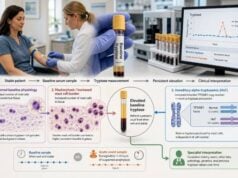
An N-methylhistamine urine test measures the main urinary metabolite produced when the body breaks down histamine. Because histamine itself disappears quickly from blood, its metabolite can provide a longer window for detecting increased histamine production during an allergic reaction, mast cell activation episode, or mast cell disorder. The test may use a random urine sample collected within a few hours of symptoms or a complete 24-hour collection. Results are usually adjusted for urine creatinine and interpreted with age-specific laboratory ranges. A high value supports increased histamine turnover, but it does not identify the source, prove mast cell activation syndrome, or show which allergen caused a reaction. Diet, medicines, age, collection quality, and conditions other than mast cell disease can affect the result. A normal value also cannot exclude a short or mediator-specific episode, especially when collection is delayed. Interpretation is strongest when an event sample is compared with a stable baseline and reviewed beside tryptase, symptoms, and other urine mediators.
- N-methylhistamine is a stable breakdown product of histamine, so urine testing has a longer collection window than plasma histamine.
- Adult reference ranges commonly fall near 30–200 mcg/g creatinine, but children have higher age-specific ranges and the report’s range must be used.
- A high result indicates increased histamine production or metabolism, not a stand-alone diagnosis of MCAS or mastocytosis.
- Random urine is often collected within several hours of a flare, while a 24-hour sample is useful for persistent or intermittent elevation.
- Monoamine oxidase inhibitors, aminoguanidine, very histamine-rich meals, and collection errors can alter interpretation.
- Emergency allergic symptoms require prompt treatment; do not delay epinephrine or emergency care to collect urine.
Table of Contents
- How Histamine Becomes N-Methylhistamine
- Why the Test Is Used
- Random Versus 24-Hour Collection
- Reference Ranges and Result Meaning
- N-Methylhistamine in MCAS and Mastocytosis
- Interferences, Medicines, and Limitations
- Follow-Up After Testing
How Histamine Becomes N-Methylhistamine
Histamine is a small signaling molecule stored in mast cells and basophils and produced in other tissues. When mast cells activate, histamine can widen blood vessels, make them leak fluid, stimulate nerves, increase stomach acid, tighten airways, and change intestinal movement. These effects help explain flushing, itching, hives, swelling, nasal symptoms, abdominal cramps, diarrhea, wheezing, dizziness, and low blood pressure.
Histamine is difficult to use as a routine marker because it is cleared rapidly. In tissues, the enzyme histamine N-methyltransferase adds a methyl group to histamine, producing N-methylhistamine, also called Nτ-methylhistamine or 1-methylhistamine. The metabolite is excreted in urine and can be measured by methods such as liquid chromatography–tandem mass spectrometry.
Urinary N-methylhistamine therefore reflects histamine production over a broader period than one plasma sample. It does not measure the intensity of symptoms directly. The body may produce histamine in localized tissues without generating a dramatic urine rise, and a urinary elevation can persist beyond the peak of symptoms.
Mast cells are an important source, but they are not the only factor. Basophils and other histamine-containing cells contribute. Diet can add histamine, and individual differences in metabolism can alter how much N-methylhistamine appears. A rare or common genetic variation in histamine N-methyltransferase activity may lower metabolite formation even when histamine production is present.
Most random and 24-hour results are divided by urine creatinine and reported as micrograms per gram of creatinine. Creatinine correction reduces the effect of urine concentration, although it introduces its own limitations in people with very low muscle mass, unusual kidney function, or extremely dilute specimens.
The test does not measure an allergen-specific antibody. It cannot tell whether peanuts, a medicine, heat, exercise, or another trigger caused histamine release. Targeted allergy testing and the event history answer that separate question.
Why the Test Is Used
Clinicians use urinary N-methylhistamine when they need objective evidence of increased histamine turnover over several hours or a full day. It is usually one part of a broader evaluation rather than an isolated screening test.
Possible indications include:
- recurrent episodes of flushing, hives, swelling, wheezing, abdominal cramping, diarrhea, dizziness, or fainting;
- suspected systemic mast cell activation when acute tryptase was normal, missed, or collected too late;
- known or suspected systemic mastocytosis;
- unexplained anaphylaxis or severe allergic reactions;
- monitoring selected patients with persistent mast cell mediator symptoms;
- comparing values during symptoms and at baseline;
- supplementing urinary prostaglandin and leukotriene measurements.
The test can be useful when symptom episodes last long enough to collect urine but blood sampling during the narrow plasma histamine window is impractical. A person may be able to collect a random sample at home or arrive at a laboratory within a few hours, while immediate blood processing for plasma histamine may not be available.
Testing should begin with a defined symptom pattern. Chronic fatigue, headache, bloating, or brain fog alone are not specific enough to make an abnormal metabolite diagnostic. Many disorders cause similar complaints, and random testing can identify a mildly high value that does not explain them.
A clinician may order N-methylhistamine as part of a mast cell activation test panel. The panel can include serum tryptase, urinary leukotriene E4, and a prostaglandin D2 metabolite. Each marker samples a different biochemical pathway. One can be high while another is normal, but no requirement says that ordering more markers automatically improves diagnostic accuracy.
The test may also support systemic mastocytosis evaluation, yet it cannot replace bone marrow, KIT mutation, skin, or other diagnostic studies. Mastocytosis involves abnormal mast cell accumulation; N-methylhistamine reflects mediator production. A high level may occur in both clonal and nonclonal conditions.
Screening healthy people or testing broad populations with no episodic symptoms is unlikely to help. The best use is to answer a focused question: did histamine production increase during a representative event, and does that finding fit the rest of the evaluation?
Random Versus 24-Hour Collection
Random and 24-hour urine tests measure the same metabolite but answer slightly different questions. Selecting the specimen type before symptoms occur prevents missed opportunities.
Random urine
A random sample is a snapshot. Many laboratories recommend collecting it within a few hours of symptom onset, often around three to six hours when feasible. The result is adjusted for creatinine and can be compared with a separate baseline spot sample collected when the person is well.
Advantages include speed, convenience, and better targeting of a short episode. Disadvantages include normal biological variability and sensitivity to a recent histamine-rich meal. Some laboratory guidance notes that random urinary excretion can vary by roughly 25%, making borderline values harder to interpret.
A practical random-sample plan may include a laboratory-approved container, a standing order, written storage instructions, and a symptom log. The sample time should be recorded precisely. If the patient requires emergency care, treatment always comes first.
Twenty-four-hour urine
A 24-hour collection averages histamine metabolism across an entire day. It may be preferred when mediator production is chronic, symptoms come and go through the day, or a random result is borderline. A full-day specimen is less dominated by one meal but can dilute a very brief event.
Typical collection steps are:
- Empty the bladder at the starting time and discard that urine.
- Record the start time.
- Collect every urine passed for the next 24 hours.
- Include the final void at the same time the next day.
- Keep the container refrigerated or stored exactly as directed.
- Record total volume and collection interval.
- Mix and aliquot only if the laboratory instructs you to do so.
Missing one void, stopping early, collecting beyond 24 hours, using the wrong container, or leaving the specimen warm can reduce validity. Some laboratories require at least 300 mL total volume for a timed collection; low-volume collections may be converted to random testing.
| Feature | Random urine | 24-hour urine |
|---|---|---|
| Best fit | A distinct short flare | Persistent, intermittent, or borderline patterns |
| Timing | Usually within hours of symptoms | Complete day, sometimes started near symptoms |
| Main strength | Can capture an event-related rise | Averages production and reduces spot variability |
| Main weakness | More affected by dilution and recent meals | Easy to collect incompletely; brief peaks may be averaged down |
Do not compare the numerical values from different specimen formats unless the units and calculation are equivalent. A random creatinine-adjusted result is not interchangeable with a total amount excreted per 24 hours.
A collection diary improves the value of either format. Note the start and end of symptoms, the time each rescue medicine was taken, suspected exposures, meals, exercise, and whether the episode was typical. For a 24-hour collection, also note any missed or spilled urine. A laboratory result may look technically complete even when one void was omitted, so honest documentation helps the clinician decide whether to repeat it.
If a flare happens overnight or when the laboratory is closed, follow the storage instructions supplied in advance. Some assays accept refrigerated urine, while others require freezing after collection. Transferring urine into a household jar, adding ice directly to the specimen, or using an unapproved preservative can contaminate or alter the sample. Keep the original labeled container and transport it within the stated stability window.
Hydration should remain ordinary. Deliberately drinking several liters of water can lower creatinine and create an unusually dilute specimen. Restricting fluids can do the opposite and may be unsafe. A result generated under normal hydration is usually easier to compare with a later baseline. For children, caregivers should ask the laboratory how to collect from a toilet-trained child or whether a pediatric collection device is acceptable; cotton balls, diapers, and nonlaboratory collection bags can absorb or contaminate analytes. The laboratory should also confirm the minimum volume required before collection starts.
Reference Ranges and Result Meaning
N-methylhistamine changes with age. Children normally excrete more relative to creatinine than adults, so an adult range should never be applied to a young child.
One commonly used LC-MS/MS reference set is:
- Age 0–5 years: 120–510 mcg/g creatinine
- Age 6–16 years: 70–330 mcg/g creatinine
- Older than 16 years: 30–200 mcg/g creatinine
These numbers are examples from a specific laboratory method. The actual patient report is authoritative because another laboratory may use a different method, unit, age grouping, or reference population.
A value above the range supports increased histamine production or turnover. It can occur during anaphylaxis, other allergic reactions, mast cell activation, and mastocytosis. Mild elevation has less diagnostic weight than a large event-related rise with compatible symptoms. Some studies have examined acute-to-baseline ratios; a higher event sample compared with the person’s own stable value may be more persuasive than one isolated result.
A normal result means excess N-methylhistamine was not detected during the collection. Possible reasons include:
- no major histamine release occurred;
- the episode used different mediators;
- the sample was collected too late;
- treatment reduced mediator production;
- the flare was localized rather than systemic;
- the urine collection was incomplete or mishandled;
- individual metabolism produced less N-methylhistamine.
A high result does not grade reaction severity. A person can have anaphylaxis without a large urinary elevation, and another can have a high metabolite level without life-threatening symptoms. Treatment decisions follow symptoms, not the urine number.
Trend interpretation requires consistency. Use the same laboratory, specimen type, storage method, and similar medication conditions when possible. A decrease after switching from a 24-hour collection to a random specimen may be methodological rather than biological.
Creatinine should be reviewed with the result. Very concentrated urine can elevate raw metabolite concentration, while very dilute urine can lower it. Creatinine correction helps but may be less reliable at extremes. If a result is unexpected, the clinician may ask whether the sample was technically suitable before assigning a disease meaning.
N-Methylhistamine in MCAS and Mastocytosis
Urinary N-methylhistamine is supportive, not definitive, in mast cell activation syndrome. Consensus-oriented evaluation requires recurrent systemic symptoms, objective mediator elevation associated with an episode, and improvement with mediator-targeted therapy, while excluding better explanations.
Serum tryptase remains the most validated event marker. The commonly used acute threshold is a value above baseline × 1.2 + 2 ng/mL. A tryptase blood test should be drawn promptly after a severe episode and compared with a later baseline. N-methylhistamine can add evidence when tryptase timing was missed or when the event appears more histamine-dominant, but it does not replace the tryptase formula.
Mast cell activation may be:
- secondary, caused by allergy, infection, a medication, or another recognized trigger;
- primary or clonal, associated with abnormal mast cells, as in systemic mastocytosis or monoclonal mast cell activation;
- idiopathic, when accepted criteria are met but no cause is found.
A high N-methylhistamine value does not distinguish these categories. The trigger history, baseline tryptase, skin findings, KIT D816V testing, blood counts, bone health, organ findings, and sometimes bone marrow evaluation help determine classification.
Systemic mastocytosis often produces persistent mediator elevations because mast cell burden is increased. Still, urinary N-methylhistamine sensitivity is incomplete. A normal result does not rule out mastocytosis, and a high result cannot establish it. Definitive diagnosis uses formal pathologic and molecular criteria.
A pattern may be more informative than one marker. For example:
- acute tryptase rise plus high event N-methylhistamine strongly supports systemic mediator release;
- normal tryptase with a substantial event-to-baseline urine rise may provide supportive evidence but needs careful review;
- chronically high N-methylhistamine and baseline tryptase may raise concern for persistent mast cell burden;
- one mildly high urine value without attacks is nonspecific.
Overdiagnosis occurs when any elevated metabolite is called MCAS. Underdiagnosis occurs when a normal late tryptase ends the evaluation despite a strong recurrent pattern and no event urine plan. Preplanned paired sampling improves both sensitivity and specificity.
Interferences, Medicines, and Limitations
N-methylhistamine results are vulnerable to biological and preanalytical influences. The laboratory’s current preparation instructions should be followed exactly.
Medicines
Monoamine oxidase inhibitors and aminoguanidine can increase N-methylhistamine and may make results difficult or impossible to interpret. Some laboratories advise stopping these drugs for several weeks only if medically feasible and approved by the prescriber. Never stop a psychiatric, neurologic, blood-pressure, or other medicine solely for a test without direct medical guidance.
Other medicines may alter the clinical episode or histamine release, including antihistamines, corticosteroids, mast cell stabilizers, biologic therapies, and epinephrine. Their effect on interpretation varies. Record names, doses, and timing rather than assuming every drug must be stopped.
High-dose N-acetylcysteine used as an antidote for acetaminophen overdose can interfere with some creatinine methods, potentially distorting the metabolite-to-creatinine ratio. This is a specialized but important example of why clinical context belongs on the laboratory request.
Diet
An average diet usually has little effect, but a very histamine-rich meal may cause a mild increase, particularly in a random sample collected soon afterward. Foods often described as histamine-rich include aged or fermented products, cured meats, certain fish, alcohol, and some leftovers. Laboratories differ in whether they request dietary restriction. Use their list, not a universal online diet.
Extreme restriction for days can create unnecessary burden and may not improve accuracy. A documented ordinary diet may be preferable when the purpose is to understand symptoms in normal life.
Other limitations
The metabolite is not specific to mast cells. Histamine can come from basophils and other sources. Kidney handling, urine dilution, age, muscle mass, and metabolic genetics affect the value. A 24-hour collection can be incomplete without looking obviously wrong.
Reference ranges are not diagnostic thresholds for MCAS. Being one unit above the upper limit does not separate disease from health with certainty. Laboratories generally derive ranges from population distributions, while clinical diagnosis asks whether an episode produced a meaningful change in one person.
The test also does not diagnose “histamine intolerance.” That term is used inconsistently for symptoms attributed to dietary histamine or impaired breakdown, and there is no single validated urinary N-methylhistamine cutoff that confirms it. A high result after symptoms may reflect several pathways and requires broader assessment.
Follow-Up After Testing
Follow-up begins by checking whether the specimen was capable of answering the question. Confirm the collection type, timing relative to symptoms, total volume for a 24-hour test, storage conditions, creatinine value, medicines, and recent diet.
When the result is elevated, a clinician may:
- Compare it with a stable baseline sample.
- Review event timing and organ systems involved.
- Check acute and baseline tryptase.
- Review urinary prostaglandin and leukotriene results.
- Evaluate for IgE-mediated allergy, asthma, AERD, chronic urticaria, infection, or medication reactions.
- Investigate persistent baseline tryptase or other signs of clonal mast cell disease.
- Decide whether repeat sampling during a better-defined episode is useful.
When the result is normal but suspicion remains high, repeating the identical test without changing timing may not help. A better plan might use a random specimen collected earlier, a complete 24-hour collection, acute tryptase, or a different mediator. The next test should correct a known weakness in the first one.
Questions to ask include:
- Was my value compared with the correct age range?
- Was this a random or 24-hour result, and is it creatinine-adjusted?
- How many hours after symptoms was the sample collected?
- Could a medicine or recent meal have affected it?
- Is the elevation large enough to be clinically meaningful?
- Do I need an event-to-baseline comparison?
- What diagnosis is being considered, and what other evidence is required?
- How will the result change treatment or emergency planning?
Management targets the diagnosed condition. Antihistamines, mast cell stabilizers, leukotriene modifiers, trigger avoidance, asthma treatment, or other therapies may be appropriate, but response alone does not prove MCAS. People with previous anaphylaxis should have an action plan and epinephrine when prescribed.
During a severe reaction, use epinephrine promptly according to the emergency plan and call emergency services. Collect blood or urine only after immediate care is underway and only when it is safe. A perfect specimen is never more important than breathing and circulation.
References
- Biomarkers in the diagnosis of mast cell activation 2024 (Review)
- Acute/baseline ratios of all 3 mast cell mediator metabolites can be used for diagnosis of mast cell activation syndrome 2024
- Mast cell activation syndrome: Current understanding and research needs 2024 (Review)
- Using the Right Criteria for MCAS 2024 (Review)
- Secretory and Membrane-Associated Biomarkers of Mast Cell Activation and Their Role in Clinical Practice 2023 (Review)
- NMH24 – Overview: N-Methylhistamine, 24 Hour, Urine 2026
Disclaimer
This article is general education and does not diagnose MCAS, mastocytosis, allergy, or histamine intolerance. Use the performing laboratory’s collection instructions and age-specific reference range, and review results with a qualified clinician. Do not delay emergency treatment to collect a sample during a severe reaction.