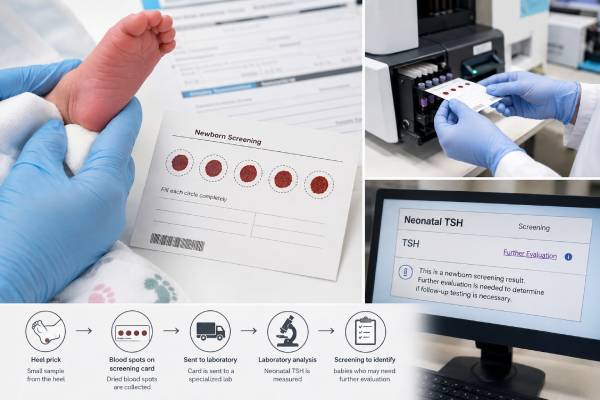
A neonatal TSH test is part of newborn screening for congenital hypothyroidism, a condition in which a baby is born without enough thyroid hormone. Most affected newborns look healthy at first, yet untreated hormone deficiency can impair brain development and growth. Screening usually uses a few drops of blood collected from the heel onto filter paper. The preferred collection time in many programs is about 24 to 72 hours after birth, after the normal TSH surge immediately following delivery has begun to settle. An abnormal screen is not a diagnosis. It requires prompt follow-up with a serum TSH and free T4, because cutoffs, units, specimen timing, and recall rules differ by screening program. Premature, low-birth-weight, critically ill, and transfused infants may need a second specimen because their first result can be misleading. When congenital hypothyroidism is confirmed, levothyroxine should begin quickly. Early, adequate treatment usually allows normal or near-normal development.
- Newborn TSH screening looks for primary congenital hypothyroidism before symptoms become obvious.
- A high blood-spot TSH triggers urgent confirmatory serum TSH and free T4 testing; it does not by itself prove the diagnosis.
- Sampling too early can cause a false-positive TSH elevation because every newborn has a normal post-birth TSH surge.
- Premature, very-low-birth-weight, sick, and multiple-birth infants may show delayed TSH elevation and often need repeat screening.
- Confirmed congenital hypothyroidism is treated promptly with levothyroxine, ideally within the first two weeks of life.
- Parents should respond to a screening recall immediately, even when the baby appears well.
Table of Contents
- What the Neonatal TSH Test Measures
- How Newborn Thyroid Screening Is Performed
- High, Borderline, and Normal Results
- Causes of Congenital Hypothyroidism
- Premature, Sick, and High-Risk Newborns
- Treatment and Follow-Up After Diagnosis
- What Parents Should Do After a Recall
What the Neonatal TSH Test Measures
TSH, or thyroid-stimulating hormone, is made by the pituitary gland. It tells the thyroid to produce thyroxine (T4) and triiodothyronine (T3). When a newborn’s thyroid cannot make enough hormone, the pituitary usually increases TSH. Screening programs use this response to find primary congenital hypothyroidism during the first days of life.
Thyroid hormone is essential for early brain maturation, hearing, bone growth, body temperature, feeding, and metabolism. The first months are especially sensitive because the brain depends heavily on an adequate hormone supply. Waiting for symptoms would miss the safest treatment window. Classic signs such as prolonged jaundice, poor feeding, sleepiness, constipation, a large tongue, weak muscle tone, cool skin, a hoarse cry, or an umbilical hernia may be subtle or absent in the newborn period.
Blood-spot TSH versus serum TSH
The screening test usually measures TSH in dried whole blood. A heel-prick specimen is placed on a special card, dried, and sent to a regional laboratory. The result is designed for population screening, not for direct comparison with a standard venous serum TSH.
If the blood-spot result is above the program’s action level, a venous sample measures serum TSH and free T4. The serum TSH test confirms whether pituitary stimulation remains high, while free T4 shows whether circulating thyroid hormone is low. Treatment decisions rely on the confirmatory pattern and the baby’s age, not on a screening card alone.
Primary screening strategies
Programs use one of several approaches:
- Primary TSH screening: TSH is measured first. This is highly effective for primary congenital hypothyroidism but may miss central hypothyroidism and delayed TSH rise.
- Primary T4 with reflex TSH: T4 is measured first, followed by TSH in low-T4 samples. This can detect some central cases but creates more recalls from low binding proteins, prematurity, and illness.
- Combined TSH and T4: Both are measured initially. It provides broader detection but costs more and still requires careful age-specific interpretation.
No single strategy captures every thyroid disorder. A normal newborn screen does not rule out central hypothyroidism, later-acquired disease, or every mild case.
The normal TSH surge after birth
TSH rises sharply within minutes after delivery, stimulating T4 and T3 production as the infant adapts to life outside the uterus. TSH can briefly reach values far above adult ranges, then falls over the next one to three days. This physiologic surge is why adult reference intervals must never be applied to newborn samples.
Collection before 24 hours increases false-positive results. When early discharge requires an early specimen, many programs request another sample at the recommended age. Local rules should be followed exactly because specimen timing is built into each laboratory’s cutoff.
How Newborn Thyroid Screening Is Performed
Newborn screening is a coordinated public-health process. It includes correct collection, rapid transport, laboratory analysis, prompt reporting, confirmatory testing, treatment, and long-term follow-up.
Heel-prick collection
A trained clinician warms and cleans the heel, then uses a sterile lancet to obtain blood. Drops soak through preprinted circles on filter paper. The card must contain enough blood, penetrate the paper evenly, and avoid layering multiple partial drops. An inadequate specimen can delay diagnosis because the laboratory must request a repeat.
Many U.S. and international recommendations prefer collection between 24 and 72 hours of age; the American Academy of Pediatrics identifies 48 to 72 hours as preferred when feasible. Some national programs collect on day 5, and some jurisdictions routinely use two screens. The correct schedule is the one specified by the baby’s screening authority.
Why timing and clinical details matter
The card records age at collection, birth weight, gestational age, feeding status, transfusions, medications, and neonatal intensive care information. These details affect interpretation. For example, a specimen obtained at 12 hours cannot use the same cutoff as one obtained on day 3. Prematurity and dopamine treatment can suppress TSH, while iodine exposure can alter thyroid function.
Screening is not the same as diagnosis
A screen is designed to be sensitive, so it intentionally identifies some babies who do not have permanent disease. A “positive,” “out-of-range,” or “urgent” screen means the probability is high enough to justify immediate follow-up. It does not mean a child will definitely need lifelong treatment.
Likewise, a borderline screen should not be ignored. Mild congenital hypothyroidism may produce only a modest TSH elevation, and TSH can rise later in premature infants. The program may request a second filter-paper specimen or immediate venous testing depending on the value and age.
Confirmatory serum tests
Confirmatory testing should occur as soon as possible after notification. It usually includes:
- Serum TSH
- Serum free T4, or sometimes total T4 with an age-appropriate interpretation
- Clinical examination and birth history review
A high serum TSH with low free T4 confirms primary congenital hypothyroidism. A high TSH with normal free T4 may represent mild primary disease, transient hyperthyrotropinemia, or an evolving abnormality. Persistent serum TSH elevation requires pediatric endocrine guidance.
Low free T4 with a low, normal, or only slightly elevated TSH suggests central congenital hypothyroidism, severe illness, prematurity, or drug effects rather than classic primary disease. Central cases require evaluation of other pituitary hormones, especially cortisol, before or alongside thyroid treatment.
High, Borderline, and Normal Results
Screening cutoffs vary widely, so a number cannot be interpreted safely without the program’s age, specimen type, and action category. Dried-blood-spot TSH may be reported in mIU/L of whole blood or converted to serum-equivalent units. These are not interchangeable.
High or urgent TSH
A markedly elevated blood-spot TSH makes primary congenital hypothyroidism likely. Programs may refer the infant immediately for serum testing and specialist care. When confirmatory free T4 is clearly low or serum TSH is strongly elevated, treatment may start without waiting for imaging or repeat results.
The 2020–2021 international consensus recommends starting treatment immediately when serum free T4 is below the age-specific range and TSH is clearly elevated. It also recommends treatment when confirmatory serum TSH is above 20 mU/L around the second week of life, even if free T4 is normal. Exact thresholds are applied by the treating pediatric endocrinologist and may vary with age and guidelines.
Borderline TSH
A borderline elevation is common after early sampling, illness, iodine exposure, or prematurity. It can also be the first sign of genuine mild congenital hypothyroidism. The screening laboratory may request:
- A repeat dried blood spot within a specified number of days
- Immediate serum TSH and free T4
- Both repeat screening and serum confirmation
The response should be timely. Delaying for weeks to “see whether symptoms appear” is unsafe because affected babies often remain outwardly well.
Normal screen
A normal result means the marker was below the program’s recall threshold at that time. It greatly lowers the likelihood of primary congenital hypothyroidism but does not guarantee normal thyroid function in all circumstances. TSH-only programs may miss central disease. Premature infants can develop delayed TSH elevation. A newborn may also acquire hypothyroidism later from thyroiditis, medication, surgery, or other illness.
Clinicians should order diagnostic serum tests despite a normal screen when there are concerning signs, midline defects, prolonged hypoglycemia, micropenis in a male infant, persistent jaundice, poor growth, unexplained low temperature, or a known family/genetic risk for pituitary disease.
False-positive and false-negative results
False positives can occur because of:
- Collection during the normal early TSH surge
- Inadequate or contaminated blood spots
- Temporary iodine excess or deficiency
- Maternal antibodies or medicines
- Prematurity and perinatal stress
- Laboratory or clerical error
False negatives can occur with delayed TSH rise, central hypothyroidism, twin-to-twin blood mixing, transfusion, dopamine or steroid treatment, and extremely early collection. A screening program may use repeat testing in high-risk groups to reduce these gaps.
Causes of Congenital Hypothyroidism
Congenital hypothyroidism can be permanent or transient. Determining the cause helps predict long-term treatment, recurrence risk in future pregnancies, and whether genetic counseling is useful.
Thyroid dysgenesis
Thyroid dysgenesis means the gland is absent, underdeveloped, or located outside its normal position. An ectopic thyroid is often found at the base of the tongue or along the path the gland normally travels during fetal development. Dysgenesis accounts for many permanent primary cases and usually occurs sporadically.
Ultrasound and radionuclide imaging can show whether thyroid tissue is present and where it is located. Imaging should never delay levothyroxine. A baby can be treated first and imaged promptly afterward.
Dyshormonogenesis
In dyshormonogenesis, the gland is present but an inherited defect prevents normal hormone synthesis. The thyroid may enlarge because high TSH continually stimulates it. Causes involve iodine transport, thyroid peroxidase, thyroglobulin, hydrogen peroxide generation, and other steps.
These disorders are more likely to recur in siblings because many follow autosomal recessive inheritance. Genetic testing may clarify the diagnosis and inform family counseling.
Central congenital hypothyroidism
Central disease results from insufficient pituitary TSH drive. Serum free T4 is low, but TSH is not appropriately high. It may occur alone or with deficiencies of cortisol, growth hormone, and reproductive hormones. Babies may have hypoglycemia, prolonged jaundice, poor feeding, midline facial abnormalities, or micropenis, but signs can be subtle.
TSH-only newborn programs are not designed to detect central hypothyroidism. Clinical suspicion remains important. Because cortisol deficiency can be dangerous, pediatric endocrinology assessment should include adrenal function.
Transient hypothyroidism
Temporary thyroid dysfunction can result from maternal antithyroid drugs, maternal blocking TRAb, iodine deficiency, iodine excess, prematurity, or severe illness. Maternal antibodies can cross the placenta and suppress the infant’s thyroid for weeks or months. Antithyroid medicines used for maternal Graves disease can also lower newborn hormone production.
Transient disease still needs treatment when hormone levels are inadequate during the critical developmental period. Whether it is permanent is often assessed later, not assumed at birth.
Maternal and environmental factors
Iodine-containing antiseptics, contrast agents, and certain medications can disrupt neonatal thyroid function. Premature infants are particularly vulnerable because their iodine stores and regulatory systems are immature. A detailed history should include maternal thyroid disease, medications, radioactive iodine history, supplements, and neonatal iodine exposure.
The related thyroid antibody panel is relevant when maternal Graves disease or autoimmune thyroiditis may affect the newborn, although infant function is still determined by TSH and free T4.
Premature, Sick, and High-Risk Newborns
Standard screening is less reliable in some newborns. Repeat protocols are designed to catch delayed or masked abnormalities.
Premature and low-birth-weight infants
Preterm infants often have a smaller TSH surge, lower T4, immature hormone production, and reduced conversion of T4 to T3. Illness and medications add further suppression. Some develop delayed TSH elevation at two to six weeks, after the first screen appeared normal.
Guidelines commonly recommend a second screen for premature, low-birth-weight, or very-low-birth-weight infants. Timing may be around two weeks of age, two to four weeks after the first sample, or at discharge, depending on the program. Very premature infants may need more than one repeat.
Low T4 without high TSH is common in prematurity and is called hypothyroxinemia of prematurity. It does not automatically prove central hypothyroidism or mean every infant benefits from levothyroxine. Gestational age, illness severity, repeat trends, serum values, and pituitary risk guide management.
Critically ill newborns
Dopamine, glucocorticoids, severe respiratory disease, surgery, and systemic illness can suppress TSH and lower thyroid hormones. This “non-thyroidal illness” pattern can hide primary disease or mimic central hypothyroidism. Repeat testing after stabilization is often needed.
A baby in intensive care should still have screening collected on schedule when possible, with repeat testing according to local NICU policy. Discharge should not occur without ensuring pending screening and recalls will be followed.
Twins and multiple births
Blood exchange between twins can dilute an abnormal result. Same-sex twins, especially monozygotic twins, may need repeat screening even if the first result is normal. Programs vary in their specific rules.
Transfusion and extracorporeal support
Red-cell transfusion can alter some newborn screening tests and dilute hormone markers. A pretransfusion specimen should be collected when possible, followed by the program’s required repeat. Extracorporeal membrane oxygenation and other intensive support can also affect thyroid physiology and sampling.
Maternal Graves disease
A newborn of a mother with current or past Graves disease can develop hyperthyroidism or hypothyroidism because TRAb crosses the placenta. Risk persists even if the mother no longer has a thyroid after surgery or radioactive iodine. Maternal TRAb measurement during pregnancy and targeted newborn TSH/free T4 testing are often needed beyond routine screening.
Treatment and Follow-Up After Diagnosis
Levothyroxine provides the T4 the infant cannot make. Treatment should begin rapidly because developmental outcome depends on both timing and adequacy.
Starting levothyroxine
Consensus guidance generally recommends an initial dose of 10 to 15 mcg/kg per day, with the higher end used for severe disease. Tablets are preferred in many settings because compounded liquids may vary in concentration unless a stable licensed formulation is available. The tablet can be crushed and mixed with a small amount of water, breast milk, or formula and given by spoon or syringe.
Do not mix the dose into a full bottle, because the infant may not finish it. Soy formula, iron, and calcium can reduce absorption and should be separated according to the care team’s instructions. Parents should use the same method consistently and report vomiting or missed doses.
Biochemical targets
Free T4 should rise quickly into the upper part of the age-specific range, while TSH may take longer to normalize. Monitoring is frequent at first: often one to two weeks after treatment begins, every two weeks until TSH normalizes, then every one to three months during infancy. Exact schedules vary by guideline and clinical stability.
The dose changes as the baby gains weight. A fixed dose that was adequate at birth can become too low within weeks. Frequent growth measurements and blood tests prevent undertreatment.
Avoiding under- and overtreatment
Persistently high TSH or low free T4 can reflect an inadequate dose, missed medicine, poor administration, malabsorption, or rapid weight gain. Excessively high free T4 with suppressed TSH may indicate overtreatment. Both prolonged deficiency and substantial excess can affect development, sleep, behavior, growth, and bone maturation.
The usual free T4 test must be interpreted with infant-specific ranges. Adult ranges are not appropriate.
Developmental follow-up
Care includes hearing, vision, growth, motor development, language, school performance, and adherence support. Severe hypothyroidism at diagnosis, delayed treatment, or difficulty maintaining target levels increases the need for close developmental surveillance.
Determining permanence
When the cause is clearly permanent—such as absent thyroid tissue—treatment continues lifelong. If the gland is present and the cause may be transient, a supervised trial off levothyroxine is often considered around age 2 to 3 years, when early brain development is less vulnerable. The clinician stops or reduces treatment under a protocol and rechecks TSH and free T4. Parents should never attempt this without pediatric endocrine supervision.
What Parents Should Do After a Recall
A newborn-screening recall is time-sensitive, but it is also common for recalled babies to have normal confirmatory tests. Fast follow-up protects the children who do have congenital hypothyroidism without assuming the worst.
- Respond the same day. Contact the baby’s clinician or screening program and arrange the requested blood draw.
- Ask which test was abnormal. Find out whether the result was high TSH, low T4, an inadequate specimen, or a timing-related repeat.
- Share important history. Mention prematurity, NICU care, transfusions, maternal thyroid disease, antithyroid medication, iodine exposure, and twin status.
- Do not wait for symptoms. Most affected newborns appear normal at first.
- Keep every appointment. Confirmatory testing, prescription teaching, and early repeat labs are essential.
- Give levothyroxine exactly as directed. Ask for a demonstration of crushing, mixing, and administering the dose.
- Track results and doses. Keep a written record of TSH, free T4, weight, dose changes, and missed or vomited doses.
Seek urgent care if a newborn is difficult to wake, feeds very poorly, has breathing pauses, becomes unusually cold, develops repeated vomiting, or shows signs of severe illness. These findings are not specific to thyroid disease, but newborn deterioration always deserves immediate assessment.
Newborn screening works because collection, laboratory reporting, family response, and treatment happen as one continuous process. An abnormal TSH result is the beginning of that process, not a final label.
References
– Congenital Hypothyroidism: Screening and Management 2023 (Guideline) – Congenital Hypothyroidism: A 2020–2021 Consensus Guidelines Update—An ENDO-European Reference Network Initiative Endorsed by the European Society for Pediatric Endocrinology and the European Society for Endocrinology 2021 (Guideline) – Guidelines for Newborn Screening of Congenital Hypothyroidism (2021 Revision) 2023 (Guideline) – Congenital Hypothyroidism 2026 – Recommended Uniform Screening Panel 2024 – Newborn screening for congenital hypothyroidism and phenylketonuria—Beyond cost savings 2023
Disclaimer
This article provides general education about newborn thyroid screening and cannot interpret an individual infant’s result. Screening thresholds, repeat schedules, and treatment protocols vary by jurisdiction and gestational age. Follow every recall promptly with the baby’s clinician or screening program.