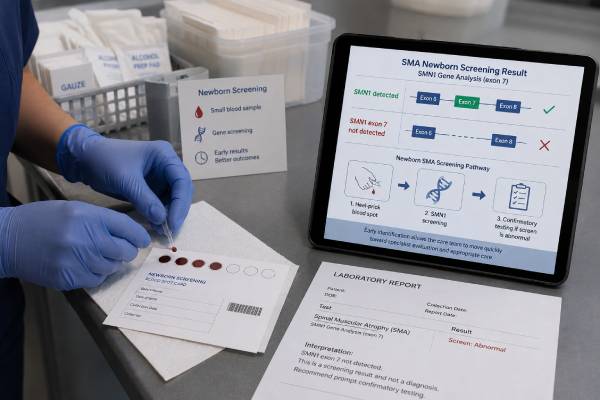
Newborn screening for spinal muscular atrophy (SMA) can identify many affected babies before weakness is visible. The test uses the routine heel-prick blood spot to look for a common disease-causing change in the SMN1 gene. It is a screening test, not the final diagnosis, but an abnormal result is treated as urgent because motor nerve cells can be lost before a baby appears ill. Rapid confirmatory testing measures SMN1 and usually the related SMN2 gene, while a pediatric neuromuscular team evaluates the infant and discusses treatment. Early disease-modifying therapy can greatly change the expected course, especially when started before symptoms. A normal screen is reassuring but does not exclude every genetic form of SMA. Families should understand exactly what the screen detects, what its result categories mean, and why follow-up should proceed quickly without waiting for weakness, feeding trouble, or breathing problems.
- Main target: Most programs screen for absence of exon 7 in both copies of SMN1.
- Abnormal is not final: A positive blood-spot result requires urgent diagnostic confirmation.
- Time matters: Treatment is most effective before substantial motor neuron loss has occurred.
- SMN2 helps estimate risk: Copy number informs urgency and likely severity but cannot predict an exact outcome.
- Normal is not absolute: Some SMN1 variants and non-5q motor neuron disorders are not detected.
- Family testing follows: A confirmed diagnosis has implications for parents, siblings, and future pregnancies.
Table of Contents
- Why Newborn Screening Changes SMA Outcomes
- What the SMN1 Blood-Spot Test Detects
- Understanding Possible Screen Results
- Confirmatory SMN1 and SMN2 Testing
- SMN2 Copy Number and Prognosis Limits
- Treatment Decisions Before Symptoms
- Negative Screens and Conditions Missed
- Family Testing and Next-Pregnancy Planning
Why Newborn Screening Changes SMA Outcomes
Spinal muscular atrophy is a genetic neuromuscular disorder in which lower motor neurons gradually stop functioning and are lost. These nerve cells carry signals from the spinal cord and brain stem to muscles used for movement, posture, swallowing, coughing, and breathing. When the body cannot make enough survival motor neuron protein, muscles become weak because they are not receiving normal nerve input.
The weakness of 5q SMA is usually symmetrical and affects muscles near the center of the body more than the hands and feet. In an untreated infant with a severe form, early signs may include poor head control, reduced leg movement, low muscle tone, a weak cry, feeding difficulty, or a bell-shaped chest with abdominal breathing. However, a baby may look completely healthy during the first days or weeks after birth. That symptom-free period is exactly why screening matters.
Motor neuron damage begins before many families or clinicians can recognize weakness. Once a motor neuron is lost, current therapies cannot simply rebuild the entire nerve-muscle system that has already disappeared. Disease-modifying treatments can increase functional SMN protein or provide a working SMN1 gene, but their benefit is greatest when treatment starts while more motor neurons remain. Newborn screening moves diagnosis from a response to symptoms to a preventive window.
The test is usually part of a broader newborn screening program. A few drops of blood are collected on filter paper, most often from the heel, and sent to a public health laboratory. Collection timing, reporting pathways, and the exact follow-up system differ by country, state, or region. Parents may receive the first call from the birth hospital, primary care clinician, newborn screening program, genetic specialist, or neuromuscular center.
An abnormal SMA screen is time-critical, but it does not mean that the baby is in immediate danger at that moment. It means the chance of 5q SMA is high enough that diagnostic testing and specialist care should be organized without delay. Families should not wait for a routine well-baby appointment or for visible symptoms. They should also avoid interpreting a vigorous appearance as proof that the screen was wrong.
Newborn screening has changed the language used around SMA. Older clinical “types” were assigned mainly by the age when weakness began and the highest motor milestone achieved without modern therapy. A baby diagnosed and treated before symptoms may not follow those historical categories. Clinicians therefore combine the genetic result, examination, SMN2 copy number, treatment history, and ongoing development rather than promising a fixed course based on a type label alone.
What the SMN1 Blood-Spot Test Detects
Most newborn SMA screening assays look for homozygous absence of exon 7 in the SMN1 gene. “Homozygous absence” means that the key exon 7 sequence is not detected on either inherited copy of SMN1. This finding accounts for approximately 95% of people with 5q SMA and is therefore an efficient population-screening target.
SMN1 is located in the 5q region of chromosome 5. It normally produces most of the full-length survival motor neuron protein needed by motor neurons. Nearby is SMN2, a highly similar backup gene. A small sequence difference causes most SMN2 transcripts to skip exon 7, so each SMN2 copy usually produces only a limited amount of full-length protein. That partial backup explains why SMN2 copy number influences the clinical picture but does not replace SMN1 completely.
The laboratory does not usually sequence every letter of SMN1 from the dried blood spot. Instead, it uses a targeted molecular method designed to detect the common exon 7 deletion pattern quickly and accurately. Because the assay is narrow by design, it has important boundaries:
- It detects the common biallelic SMN1 exon 7 deletion that causes most 5q SMA.
- It generally does not identify babies who have one deleted SMN1 copy and a different pathogenic sequence variant in the other copy.
- It does not screen comprehensively for rare non-5q forms of SMA caused by other genes.
- It is not designed as a complete carrier test for the newborn.
- It may not provide SMN2 copy number until confirmatory testing is performed.
A screening laboratory may use polymerase chain reaction, real-time PCR, digital PCR, or another validated method. The central point is the target: the test asks whether SMN1 exon 7 is missing from both gene copies. It is not a broad neuromuscular gene panel.
The dried blood spot may also be unsatisfactory because too little blood was collected, the circles were not filled correctly, the specimen was contaminated, or transport conditions were poor. In that situation, the laboratory may request another specimen rather than report the result as positive or negative. A repeat request should be completed promptly, but it does not by itself indicate that SMA is suspected.
A targeted screening result should not be confused with a chromosome test. SMA is caused by changes within a gene region, not by an extra or missing whole chromosome. Standard karyotyping would not be expected to find the usual SMN1 exon 7 deletion. Diagnostic laboratories instead use methods that measure SMN1 copy number, detect the exon 7 deletion, and, when needed, sequence the gene for less common variants.
Understanding Possible Screen Results
Newborn screening reports use different terms, but most results fall into four practical categories: screen negative, screen positive or abnormal, borderline or indeterminate, and unsatisfactory. The exact wording and next step should be taken from the issuing program rather than from a generic online range.
| Result category | What it usually means | Usual next action |
|---|---|---|
| Screen negative | The common homozygous SMN1 exon 7 deletion was not detected. | Routine care, while evaluating any future weakness or feeding and breathing symptoms clinically. |
| Screen positive or abnormal | The assay did not detect SMN1 exon 7 on either copy, creating a high suspicion for 5q SMA. | Urgent referral, fresh-blood diagnostic testing, SMN2 copy number, and specialist assessment. |
| Borderline or indeterminate | The assay signal was unclear, near a laboratory threshold, or technically inconsistent. | Repeat or confirmatory testing according to the program’s protocol. |
| Unsatisfactory specimen | The blood spot could not be interpreted reliably. | Collect a replacement specimen as soon as instructed. |
A positive result has a much stronger connection to disease than many biochemical newborn screens because it targets the common causal genetic change. Even so, it remains a screen. Confirmation from a new sample protects against specimen mix-up, rare technical error, or an unusual gene configuration and provides information that the first-tier assay may not include.
The newborn screening team may use phrases such as “presumptive positive,” “out-of-range,” or “critical result.” These terms do not describe how sick the baby is. They communicate that the result requires a defined rapid response. Parents should write down who called, which laboratory issued the report, whether a diagnostic sample has already been ordered, and which specialist will coordinate care.
An indeterminate result can be emotionally difficult because it provides neither reassurance nor a diagnosis. The uncertainty is usually resolved by another blood sample or a diagnostic assay. Families should not assume that “borderline” means a mild form of SMA; screening signal strength is not a reliable severity scale.
A negative result means the program did not find its target. It does not guarantee that the child will never develop weakness or another neuromuscular condition. Any infant with concerning clinical signs needs evaluation regardless of the screen. The result should support clinical reasoning, not replace it.
Confirmatory SMN1 and SMN2 Testing
After an abnormal screen, the medical team should arrange confirmatory testing on a fresh blood sample and an urgent visit with a pediatric neurologist or neuromuscular specialist. Current best-practice recommendations call for rapid access to an SMA specialty center because diagnostic confirmation, treatment selection, insurance authorization, baseline testing, and family education may all need to occur in parallel.
The core diagnostic test confirms whether the baby has zero functional copies of SMN1 exon 7. Laboratories commonly use multiplex ligation-dependent probe amplification, quantitative PCR, digital PCR, or another copy-number method. Many assays also assess exon 8 and distinguish SMN1 from SMN2. The report should state the method, the number of SMN1 copies detected, the SMN2 copy number if measured, and any limitation caused by complex hybrid genes or sequence variation.
If the result shows no SMN1 exon 7 copies, the diagnosis of 5q SMA is usually established in the context of the positive screen. If one SMN1 copy is detected despite a strong clinical suspicion, sequencing may be required to look for a pathogenic variant in the remaining copy. Deletion analysis alone cannot find every small sequence change.
Confirmatory work should include several connected steps:
- Verify the molecular diagnosis. Test a new specimen and document SMN1 copy number or biallelic pathogenic variants.
- Measure SMN2 copy number. This helps guide urgency and counseling, although it is not a perfect forecast.
- Examine the baby. The specialist checks tone, movement, reflexes, breathing pattern, swallowing, and early motor function.
- Prepare for treatment. Therapy-specific laboratory tests, antibody testing, liver assessment, platelet count, or other studies may be needed.
- Assess supportive needs. Respiratory, nutrition, feeding, physical therapy, and genetic counseling teams may participate even when no symptoms are obvious.
Electromyography and muscle biopsy were historically important in diagnosing unexplained weakness. They are usually unnecessary when molecular testing clearly confirms 5q SMA. Avoiding invasive or slow testing helps preserve the treatment window.
Parents should ask for a copy of the diagnostic laboratory report rather than relying only on a telephone summary. Useful details include the exact SMN1 finding, SMN2 copy number, whether sequencing was performed, and whether the laboratory identified any uncertainty. These details affect treatment discussions and future family testing.
Testing both parents is usually recommended after the child’s result is established. Parental studies can confirm that each parent carries an SMN1-related change, clarify unusual findings, and improve recurrence counseling. However, treatment of the newborn should not wait for parental results.
SMN2 Copy Number and Prognosis Limits
SMN2 copy number is one of the most useful modifiers available soon after an SMA diagnosis. In broad terms, more SMN2 copies tend to produce more full-length SMN protein and are associated with later onset or a less severe untreated course. Babies with two copies have historically had a high risk of early severe disease, while three or more copies have often been associated with a wider range of presentations.
That relationship is real but incomplete. Two children with the same SMN2 copy number can develop differently. Sequence variants within SMN2, hybrid SMN1-SMN2 genes, other genetic modifiers, treatment timing, treatment response, respiratory illness, nutrition, and access to multidisciplinary care can all influence outcomes. Copy-number methods may also disagree when complex gene arrangements are present.
For this reason, an SMN2 result should answer “how urgently should the team act and what range should be discussed?” rather than “exactly what will this child be able to do?” It cannot reliably predict a specific age of sitting, walking, need for respiratory support, or life expectancy for an individual baby treated in the modern era.
The report may state two, three, four, or more copies. Families should confirm whether the laboratory counted total SMN2 copies and whether the method can detect known modifying variants. A specialist may request repeat testing at an experienced laboratory if the copy number does not fit other findings or if the result will materially influence treatment planning.
Clinical monitoring remains essential even after presymptomatic treatment. Teams follow motor development, muscle strength, breathing, cough, swallowing, growth, spine and joint health, and treatment-specific safety measures. A favorable early examination does not eliminate the need for follow-up, and a lower SMN2 count does not mean that meaningful improvement is impossible.
Historical SMA types can still help explain untreated natural history, but they have become less reliable as predictions. A screened infant who receives therapy before weakness may gain milestones that would not have been expected in older untreated cohorts. Counseling should therefore use ranges, acknowledge uncertainty, and update expectations as the child grows.
Treatment Decisions Before Symptoms
A confirmed newborn diagnosis creates an unusual medical situation: treatment may be recommended for a baby who appears well. The reason is biological rather than precautionary. SMA is active before obvious weakness, and measurable motor neuron loss can occur early. Waiting for symptoms may sacrifice function that treatment could have preserved.
Disease-modifying therapies use different strategies. Nusinersen is an antisense oligonucleotide that changes SMN2 RNA splicing so the gene produces more full-length protein. Risdiplam is an oral small molecule that also modifies SMN2 splicing. Onasemnogene abeparvovec delivers a working SMN1 gene using a viral vector. Availability, regulatory approval, age or weight criteria, route of administration, previous therapy, organ function, antibody status, and local funding rules all affect the choice.
The decision is not simply “which drug is strongest.” The clinical team discusses the evidence for presymptomatic treatment, practical administration, known risks, monitoring burden, durability of benefit, and uncertainties about switching or combining therapies. Some treatments require repeated dosing; gene replacement is designed as a one-time infusion but requires intensive safety monitoring. Families should receive product-specific counseling from clinicians experienced in SMA rather than relying on comparisons from social media.
Baseline assessment may include:
- a detailed neurologic and motor examination;
- respiratory evaluation and oxygen or carbon dioxide measurements when indicated;
- feeding and swallowing assessment;
- liver enzymes, bilirubin, platelet count, cardiac markers, or other therapy-specific laboratory studies;
- testing for antibodies to the viral vector when gene replacement is being considered; and
- review of vaccines, infections, medications, and the baby’s overall stability.
Supportive care remains important even with disease-modifying therapy. Physical and occupational therapists can guide safe positioning and development. Nutrition teams monitor growth and swallowing. Respiratory specialists assess cough strength, secretion clearance, and sleep-related breathing. These services are not evidence that treatment has failed; they are part of protecting function and recognizing problems early.
Parents may face administrative delays involving referral, confirmatory reports, insurance approval, travel, or drug access. The specialty center and newborn screening program should coordinate urgently because a well-appearing infant still has a time-sensitive condition. Families can help by keeping contact information current, answering calls, and completing requested tests promptly.
Treatment can transform outcomes, but it is not accurate to promise a cure or a completely typical course. Some children have residual weakness, fatigue, feeding or respiratory needs, orthopedic concerns, or delayed milestones despite early therapy. The most useful counseling balances hope with continued surveillance and avoids comparing one child’s outcome with another child’s online story.
Negative Screens and Conditions Missed
A negative SMA newborn screen substantially lowers the likelihood of the common homozygous SMN1 exon 7 deletion. It does not exclude every form of 5q SMA. About 5% of affected individuals have a deletion in one SMN1 copy and a pathogenic sequence variant in the other, or another uncommon molecular pattern that a deletion-only screen may miss.
The screen also does not rule out congenital myopathies, muscular dystrophies, peripheral neuropathies, metabolic disorders, brain or spinal cord conditions, or rare non-5q spinal muscular atrophies caused by other genes. Those conditions can produce overlapping signs but require different testing and management.
Clinical warning signs deserve assessment even after a reported negative screen. Parents and clinicians should seek prompt evaluation for:
- markedly low muscle tone or a “floppy” appearance;
- less spontaneous movement, especially in the legs;
- difficulty lifting or controlling the head;
- a weak cry, weak cough, or trouble clearing secretions;
- poor sucking, choking, prolonged feeds, or inadequate weight gain;
- rapid or labored breathing, a bell-shaped chest, or inward chest movement with outward abdominal movement; or
- tongue twitching, absent reflexes, or loss of a skill previously demonstrated.
SMA usually affects movement rather than understanding. Alertness, social engagement, and cognition may be preserved even when muscle weakness is severe. A baby who watches faces and responds socially can still have a serious motor neuron disorder.
False-negative results are uncommon but possible through biology, assay design, specimen problems, or administrative error. A clinician evaluating concerning symptoms should order diagnostic SMN1 testing directly rather than repeat a population screen. Depending on the findings, the next test may include SMN1 deletion and sequencing analysis, a neuromuscular gene panel, chromosomal microarray, metabolic studies, or exome/genome sequencing.
A normal screen also should not be used to decide whether parents are SMA carriers. Carrier testing has a different purpose and method. It measures SMN1 copy number and may include markers that refine the chance of two copies being located on one chromosome. Newborn screening is designed to find affected infants quickly, not to provide complete reproductive information for the family.
Family Testing and Next-Pregnancy Planning
Most 5q SMA is inherited in an autosomal recessive pattern. A child is affected after inheriting a nonworking SMN1 copy from each parent. The parents usually have one working copy and one altered copy and do not have SMA themselves.
When both parents are confirmed carriers, each pregnancy has an independent 25% chance of SMA, a 50% chance that the child will be an unaffected carrier, and a 25% chance that the child will inherit neither familial change. These probabilities reset with every pregnancy.
Carrier testing requires careful interpretation because SMN1 copy number can be arranged in different ways. A person with two total SMN1 copies may have one on each chromosome, which usually lowers carrier risk, or both on the same chromosome and none on the other. This “2+0” silent-carrier arrangement can be missed by copy-number testing alone. Linked markers can refine risk in some ancestry groups, but they do not eliminate uncertainty. Sequence variants also require methods beyond basic copy counting.
After a newborn’s diagnosis, a genetic counselor can coordinate testing for parents and discuss whether older siblings should be evaluated. A sibling who appears healthy may still require prompt testing, particularly if very young, because presymptomatic diagnosis can affect treatment. Adult relatives may choose carrier testing after the familial variant is documented.
Reproductive options for a future pregnancy may include natural conception with diagnostic testing, in vitro fertilization with preimplantation genetic testing for a monogenic condition, use of donor egg or sperm, adoption, or conception without testing. No option is medically or morally required; the role of counseling is to explain accuracy, timing, cost, limitations, and possible decisions without directing the family toward one choice.
When the familial SMN1 changes are known, prenatal diagnosis can be performed using chorionic villus sampling earlier in pregnancy or amniocentesis later. These are diagnostic procedures because fetal or placental cells are tested directly for the familial variants. Routine cell-free DNA screening does not generally diagnose SMA.
Families should retain the affected child’s molecular report, parental reports, and the laboratory’s variant descriptions. Future prenatal or embryo testing is most reliable when the laboratory knows the exact familial findings and has enough time to design or validate the assay. Planning before pregnancy can prevent avoidable delays.
A confirmed SMA result can feel overwhelming, especially when the baby seems healthy. The practical priorities are straightforward: verify the diagnosis quickly, obtain SMN2 information, meet an experienced neuromuscular team, discuss treatment without waiting for symptoms, and arrange genetic counseling for the family. Screening creates the opportunity to act early; coordinated follow-up is what turns that opportunity into better care.
References
- Health Resources and Services Administration: Spinal Muscular Atrophy (2026)
- American College of Medical Genetics and Genomics: Newborn Screening ACT Sheets and Algorithms (2024)
- GeneReviews: Spinal Muscular Atrophy (2024)
- Spinal Muscular Atrophy Update in Best Practices: Recommendations for Diagnosis Considerations (2024)
- European Consensus Statement on Gene Therapy for Spinal Muscular Atrophy (2024)
Disclaimer
This article provides general education about newborn SMA screening and does not replace an infant’s laboratory report or advice from the newborn screening program and neuromuscular team. An abnormal screen requires urgent diagnostic follow-up even when the baby appears healthy, while concerning weakness, feeding difficulty, or breathing symptoms need prompt medical assessment despite a negative screen. Treatment eligibility and monitoring differ by location, product, and individual medical findings.