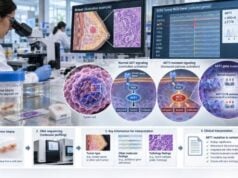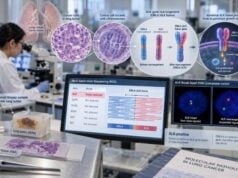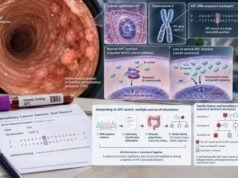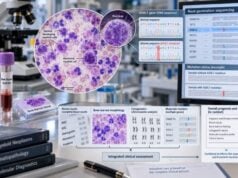
A PALB2 mutation test looks for harmful variants in a DNA-repair gene that works closely with BRCA1 and BRCA2. A germline pathogenic or likely pathogenic PALB2 variant can increase lifetime risks of female breast cancer and, to a lesser degree, pancreatic and ovarian cancer; it may also raise male breast cancer risk. The result can affect screening, risk-reducing options, family testing, and sometimes cancer treatment. The most important distinction is between a pathogenic variant, which has evidence of disease risk, and a variant of uncertain significance (VUS), which should not be managed as though it were harmful. It also matters whether the finding came from inherited-DNA testing or from tumor-only sequencing. A tumor result can suggest a hereditary variant but cannot always prove one. PALB2 risk is not identical for every carrier because age, sex, family history, reproductive factors, and other genetic influences can change an individual’s absolute risk.
- A germline pathogenic or likely pathogenic PALB2 variant increases hereditary breast cancer risk and also raises pancreatic and ovarian cancer risk to a smaller degree.
- A PALB2 VUS is not a positive hereditary cancer diagnosis and should not by itself trigger preventive surgery or predictive testing of relatives.
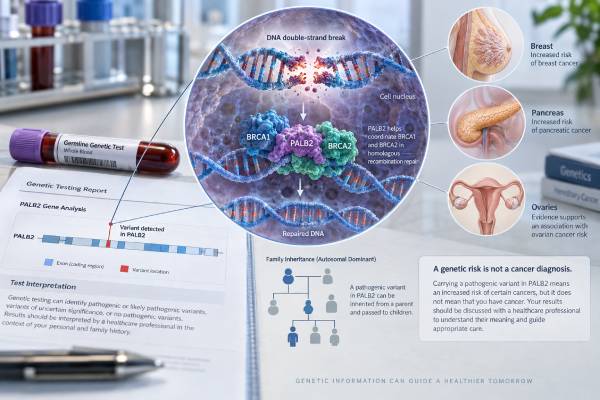
- PALB2 works in homologous recombination DNA repair with BRCA1, BRCA2, and RAD51, so loss of function can make cells less able to repair double-strand DNA damage accurately.
- A PALB2 variant found on tumor sequencing may be inherited or tumor-acquired; confirmatory germline testing is often needed when hereditary risk is possible.
- Close relatives of a confirmed germline carrier may be offered targeted testing for the known family variant after genetic counseling.
Table of Contents
- What PALB2 Does in DNA Repair
- Who May Have PALB2 Testing
- Breast, Pancreatic, Ovarian, and Other Cancer Risks
- How to Interpret PALB2 Variant Results
- Screening and Risk-Reduction After a Positive Result
- PALB2 and Cancer Treatment
- Family Testing and Practical Next Steps
What PALB2 Does in DNA Repair
PALB2 stands for “partner and localizer of BRCA2.” Its protein helps bring BRCA1, BRCA2, and RAD51 together at sites of DNA damage. This complex is central to homologous recombination, a high-fidelity pathway that repairs double-strand DNA breaks by using an intact DNA copy as a template.
When one inherited PALB2 copy carries a loss-of-function pathogenic variant, a cell still has another working copy. Cancer can develop if the remaining normal copy is later lost or disabled in a particular cell, weakening homologous recombination and allowing genomic damage to accumulate. This tumor-suppressor mechanism is similar in broad terms to BRCA1- and BRCA2-associated cancer biology.
Most people discussed in hereditary cancer clinics are heterozygous carriers, meaning one of their two PALB2 copies has a pathogenic variant. Rarely, a child inherits harmful PALB2 variants from both parents. Biallelic PALB2 variants cause a form of Fanconi anemia, a serious recessive disorder with developmental abnormalities, bone-marrow failure, and cancer susceptibility. That situation is biologically and clinically different from the usual adult hereditary-cancer context.
PALB2 can be tested by itself, but it is now commonly included on a multigene hereditary breast cancer panel. Sequencing looks for small DNA changes, while deletion/duplication analysis can detect loss or gain of larger gene segments. A complete germline assay should generally be capable of detecting both relevant sequence variants and copy-number changes.
The DNA-repair role also explains why PALB2 can matter after cancer develops. Tumors with PALB2 loss may show homologous recombination deficiency and can be sensitive to DNA-damaging therapies in some settings. That treatment question, however, is separate from the inherited-risk question and depends on cancer type and current clinical evidence.
Who May Have PALB2 Testing
PALB2 testing is most often ordered as part of hereditary cancer evaluation rather than because a person has a specific symptom. Current testing criteria have broadened as multigene panels have become common and as germline results can affect both prevention and treatment.
Testing may be considered in people with breast cancer at a young age, triple-negative breast cancer, bilateral or multiple primary breast cancers, male breast cancer, pancreatic cancer, ovarian cancer, or a family pattern that suggests inherited susceptibility. Exact criteria vary by country and guideline, and clinicians also consider ancestry, tumor features, previous genetic testing, and whether an affected relative is available to test first.
When possible, testing an affected family member first is often the most informative approach. If that person carries a pathogenic PALB2 variant, unaffected relatives can have focused testing for the exact familial change. A negative targeted test in a relative then has a clear meaning: that person did not inherit the known family variant.
By contrast, when an unaffected person with a strong family history has a negative broad panel but no affected relative was tested, the result may be uninformative rather than fully reassuring. The family’s cancer clustering could be caused by a variant the test cannot detect, a gene not yet known, polygenic risk, shared environmental factors, or chance.
Tumor sequencing creates another pathway to PALB2 testing. A pathogenic PALB2 alteration identified in a breast, pancreatic, ovarian, prostate, or other tumor may prompt germline confirmation. Tumor-only testing cannot always distinguish an inherited variant from one acquired only in the cancer. The laboratory’s variant allele fraction can provide clues, but it is not reliable enough by itself to prove germline status.
A PALB2 result in breast cancer may therefore serve two roles at once: it can reveal hereditary risk for the patient and relatives, and it may add information relevant to the tumor’s DNA-repair biology.
Breast, Pancreatic, Ovarian, and Other Cancer Risks
A germline PALB2 pathogenic variant is a high-risk breast cancer susceptibility finding, but risk estimates are not a single fixed percentage. Studies differ in family selection, age distribution, ancestry, and modeling methods. Family history can also shift risk substantially.
A 2024 meta-analysis estimated female breast cancer risk at about 13% by age 50 and about 48% by age 80 across pooled data, with wide uncertainty intervals. Earlier large family studies produced estimates in a similar broad range and showed that women from families with more breast cancer can have higher absolute risk. This is why genetic counseling often uses personalized risk models rather than quoting one universal lifetime number.
PALB2 also increases the risk of pancreatic cancer, although the absolute risk is much lower than the breast cancer risk. Large family data support a several-fold relative increase compared with the general population. Whether pancreatic screening is recommended depends on age, family history, guideline, and availability of experienced high-risk programs. A dedicated PALB2 pancreatic cancer risk evaluation may consider MRI/MRCP and endoscopic ultrasound in selected carriers.
Evidence also supports a moderately increased ovarian cancer risk. The increase is much smaller than the ovarian risk associated with BRCA1 and generally lower than that associated with BRCA2. Because the absolute risk rises with age, recommendations about risk-reducing salpingo-oophorectomy are individualized and often focus on later adulthood rather than the earlier ages used for BRCA1 carriers.
Male breast cancer risk appears increased as well, although the absolute risk remains low and estimates are less precise because relatively few male carriers have been studied. Some studies have explored associations with prostate and other cancers, but evidence is not as established as it is for breast, pancreatic, ovarian, and male breast cancer.
| Cancer | What a germline PALB2 pathogenic variant means | Practical implication |
|---|---|---|
| Female breast | Substantially increased lifetime risk | Enhanced breast surveillance and discussion of individualized risk reduction |
| Pancreatic | Increased risk, but much lower absolute risk than breast cancer | Consider high-risk surveillance when current criteria are met |
| Ovarian | Moderately increased risk | Discuss age-appropriate risk-reduction options; routine screening has important limitations |
| Male breast | Risk is increased, though uncommon in absolute terms | Breast awareness and individualized clinical screening discussion |
These numbers describe populations, not destiny. A pathogenic variant raises probability; it does not mean cancer is inevitable. Likewise, absence of a PALB2 variant does not eliminate ordinary population cancer risk or risk caused by other genes.
How to Interpret PALB2 Variant Results
The classification printed next to the variant is usually more important than the mere presence of a DNA change. Human genes naturally contain many variants, and most are harmless.
Pathogenic or likely pathogenic
A pathogenic or likely pathogenic germline PALB2 variant is considered medically actionable. Common harmful mechanisms include nonsense variants, frameshift variants, canonical splice-site changes, and larger deletions that disrupt protein function. Some missense variants can also be pathogenic, but they require strong evidence because a single amino-acid substitution does not automatically destroy function.
“Likely pathogenic” does not mean “probably nothing.” Clinical genetics laboratories use that term when the evidence strongly supports disease causation but does not meet the threshold for the highest certainty category. In hereditary cancer management, pathogenic and likely pathogenic variants are generally handled similarly.
Variant of uncertain significance
A VUS means current evidence is insufficient to decide whether the change increases cancer risk. A VUS should not be used as the reason for preventive mastectomy, ovary removal, or predictive testing of healthy relatives. Management should instead be based on personal and family history until the variant is reclassified.
VUS results can change over time as laboratories collect population, functional, segregation, and clinical data. Most reclassifications of hereditary-cancer VUS findings move toward benign rather than pathogenic, which is another reason not to act on uncertainty prematurely.
Benign or likely benign
Benign and likely benign variants are not considered disease-causing. They do not explain a hereditary cancer pattern and should not change management.
A report can also be negative, meaning no pathogenic or likely pathogenic variant was detected in the genes tested. The significance of that negative result depends on why testing was done. A person who tests negative for a known family PALB2 variant has a true negative for that familial risk. A person from an unexplained high-risk family may still need enhanced screening based on family history.
Screening and Risk-Reduction After a Positive Result
For women with a germline PALB2 pathogenic variant, breast surveillance is generally more intensive than population screening. Major professional guidance has recommended surveillance comparable in intensity to that used for BRCA1/2 carriers, commonly incorporating annual breast MRI and mammography beginning in young-to-mid adulthood, with exact starting ages and sequencing determined by the current guideline and family history.
Risk-reducing bilateral mastectomy can substantially reduce future breast cancer incidence, but it is not mandatory simply because PALB2 is positive. The decision depends on estimated lifetime risk, age, previous breast cancer, family history, breast imaging history, competing health risks, body image, reproductive plans, and personal preferences. Personalized risk estimates are especially useful because PALB2 penetrance varies between families.
Ovarian cancer is more difficult to screen effectively. Routine CA-125 and transvaginal ultrasound have not been shown to provide the kind of reliable early detection that would replace preventive surgery in high-risk syndromes. For PALB2 carriers, the timing and value of risk-reducing salpingo-oophorectomy are less clear-cut than for BRCA1. Recent consensus recommendations support individualized discussion, usually with particular attention to risk after age 50 and the consequences of surgical menopause.
Pancreatic surveillance should be done in experienced programs when a carrier meets current criteria. Approaches generally use MRI/MRCP and/or endoscopic ultrasound rather than routine abdominal ultrasound or blood tumor markers. Some guidelines historically required a close family history of pancreatic cancer for PALB2 carriers, while recommendations have continued to evolve. The current local guideline should therefore be checked before deciding whether and when to start surveillance.
Screening plans are not static. A carrier’s plan may change as they age, develop a new family history, receive a cancer diagnosis, or as guidelines are updated. Genetics follow-up is useful precisely because PALB2 evidence is still maturing.
PALB2 and Cancer Treatment
A PALB2 finding can matter after cancer is diagnosed because PALB2-deficient tumors may have impaired homologous recombination. This creates a biological rationale for sensitivity to platinum chemotherapy and PARP inhibition, similar to the vulnerability exploited in BRCA1/2-deficient cancers.
The strength of clinical evidence and regulatory approval is not identical across genes and tumor types. PARP inhibitors have well-established indications tied to BRCA1/2 and homologous-recombination-related biomarkers in several cancers, while PALB2-specific evidence comes from smaller prospective studies, subgroup analyses, and evolving trial data. Some studies in metastatic breast cancer have shown notable responses in patients with germline PALB2 variants, but a PALB2 result should not be translated into an off-label drug decision without checking the current indication and guideline.
In pancreatic cancer, germline PALB2 can influence consideration of platinum-containing regimens and clinical trials focused on homologous recombination deficiency. It also has hereditary implications for relatives. A broader pancreatic cancer biomarker profile may include tumor and germline findings that answer different treatment and risk questions.
The source of the variant matters. A germline PALB2 pathogenic variant is present throughout the body and has hereditary implications. A somatic-only PALB2 alteration is confined to the tumor and may be relevant to tumor biology but does not automatically create inherited cancer risk for relatives. Some tumors also contain only one altered PALB2 copy without true functional loss of the second copy, which may affect how strongly the tumor behaves as homologous-recombination deficient.
For this reason, oncology treatment decisions often incorporate the complete genomic context, evidence of biallelic loss, cancer type, prior treatments, and trial eligibility rather than using the gene name alone.
Family Testing and Practical Next Steps
A confirmed germline pathogenic PALB2 variant is inherited in an autosomal dominant pattern for adult cancer susceptibility. Each biological child of a heterozygous carrier has a 50% chance of inheriting that variant, and siblings may also be at risk depending on which parent carried it.
Cascade testing is usually targeted to the exact known family variant. This is simpler and more informative than ordering a broad panel for every relative. Adult relatives who test positive can then receive age-appropriate risk counseling and surveillance; those who test negative for the familial variant generally do not carry the PALB2-related family risk, although their ordinary population risk and risk from the other side of the family remain.
Reproductive counseling can be relevant when both partners may carry pathogenic PALB2 variants because biallelic PALB2 causes Fanconi anemia. This circumstance is rare, but carrier testing or reproductive options may be discussed when family history, ancestry, or personal preference makes it important.
After a positive result, practical questions to bring to a genetics or oncology visit include:
- Is this variant classified as pathogenic/likely pathogenic, or is it a VUS?
- Was the finding confirmed in a germline sample such as blood or saliva?
- What is my personalized breast cancer risk based on age and family history?
- When should breast MRI and mammography start or continue?
- Should risk-reducing mastectomy be discussed in my situation?
- What is my ovarian cancer risk, and at what age should surgery be discussed, if at all?
- Do I meet current criteria for pancreatic surveillance?
- Could this result affect treatment for a cancer I already have?
- Which relatives should be offered targeted testing for this family variant?
The clearest way to use a PALB2 result is to separate three questions: Is the variant truly pathogenic? Is it germline or tumor-only? What action is supported for this specific person? That approach prevents a VUS from being overtreated, ensures hereditary findings reach relatives who may benefit, and keeps screening and treatment aligned with current evidence.
References
- UK consensus recommendations for clinical management of cancer risk for women with germline pathogenic variants in cancer predisposition genes: RAD51C, RAD51D, BRIP1 and PALB2 2023 (Consensus)
- Meta-analysis of breast cancer risk for individuals with PALB2 pathogenic variants 2024 (Meta-analysis)
- Prevention, diagnosis and clinical management of hereditary breast cancer beyond BRCA1/2 genes 2024 (Review)
- Identification of high-risk germline variants for the development of pancreatic cancer: Common characteristics and potential guidance to screening guidelines 2022 (Review)
- PALB2: Cancer Risks and Management (PDQ®) 2025 (Review)
- Cancer Risks Associated With Germline PALB2 Pathogenic Variants: An International Study of 524 Families 2020
Disclaimer
PALB2 results should be interpreted with a genetics professional or clinician who can confirm the variant classification, whether it is germline, and how current guidelines apply to the individual and family. Cancer-risk estimates and screening recommendations change as evidence develops, and a VUS should not be treated as a pathogenic result. This article is for general education and does not replace personalized genetic counseling or medical care.