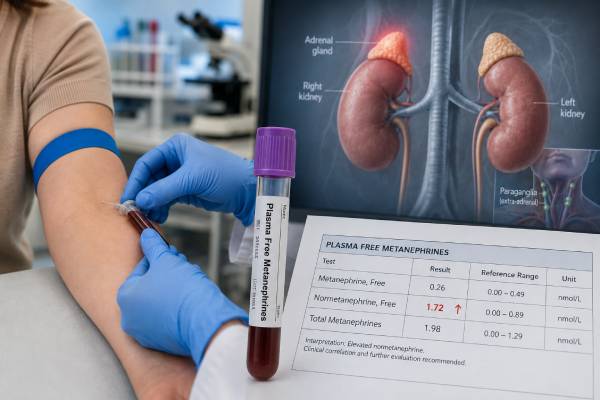
A plasma free metanephrines test measures metanephrine and normetanephrine in blood to screen for pheochromocytoma and paraganglioma. These rare tumors arise from chromaffin tissue and may release epinephrine, norepinephrine, or dopamine. Metanephrines are preferred over direct catecholamines because tumor cells form them continuously, including between sudden attacks of headache, sweating, palpitations, or high blood pressure. The test is highly sensitive when the sample is collected correctly. Its main challenge is false-positive elevation, especially when blood is drawn while seated, immediately after activity, during pain or illness, or while taking medicines that increase sympathetic activity. Lying quietly for 20–30 minutes before collection, using posture-specific reference intervals, and reviewing medicines greatly improve interpretation. A level several times the upper limit is more concerning than a small rise. Borderline results are usually repeated under controlled conditions before imaging is ordered.
- The panel measures plasma free metanephrine and normetanephrine, the main metabolites of epinephrine and norepinephrine.
- A correctly collected normal result makes a secretory pheochromocytoma or paraganglioma unlikely.
- Supine rest for 20–30 minutes before the blood draw improves specificity, especially for normetanephrine.
- Results more than about three times the upper limit strongly raise concern, while mild elevations often reflect stress, posture, medicine, or illness.
- Imaging usually follows convincing biochemical evidence, not a single borderline value.
Table of Contents
- What Plasma Free Metanephrines Measure
- When the Test Is Recommended
- How to Prepare for the Blood Draw
- Normal, Borderline, and Markedly High Results
- Metanephrine and Normetanephrine Patterns
- Medicines and Conditions That Cause False Positives
- Repeat Testing, Clonidine, and Imaging
- Genetics, Treatment, and Long-Term Follow-Up
What Plasma Free Metanephrines Measure
Epinephrine and norepinephrine are short-lived catecholamines. Enzymes convert epinephrine to metanephrine and norepinephrine to normetanephrine. In ordinary physiology, much of this conversion occurs after catecholamines are released. In a chromaffin tumor, conversion also happens continuously inside tumor cells.
This continuous production explains why metanephrines are more sensitive tumor markers than direct plasma catecholamines. A person can have a normal epinephrine or norepinephrine level between spells while metanephrine or normetanephrine remains elevated.
“Free” means the laboratory measures unconjugated metanephrines circulating in plasma. This is different from some urine methods that may report free, deconjugated, or total fractions. Numeric values from plasma and urine cannot be compared directly.
Most panels include:
- Metanephrine, mainly reflecting epinephrine metabolism.
- Normetanephrine, mainly reflecting norepinephrine metabolism.
- 3-methoxytyramine in selected laboratories, reflecting dopamine metabolism.
The test does not measure cortisol, aldosterone, or adrenal androgens. An adrenal mass may require separate evaluation for those hormones. Likewise, a normal metanephrine panel does not prove that every adrenal lesion is benign.
LC-MS/MS is commonly preferred because it separates analytes with high specificity. Immunoassays are available in some settings, but the reference interval must match the method. Age-adjusted normetanephrine ranges may improve specificity in older adults.
Pheochromocytomas arise in the adrenal medulla. Paragangliomas arise outside the adrenal glands. Sympathetic paragangliomas in the chest, abdomen, or pelvis are more likely to secrete catecholamines than many head-and-neck paragangliomas, which can be biochemically silent.
When the Test Is Recommended
Testing is appropriate when symptoms, imaging, or inherited risk create a meaningful possibility of pheochromocytoma or paraganglioma. Classic episodes include pounding headache, sweating, palpitations, tremor, pallor, anxiety, chest discomfort, and sudden blood pressure elevation. The spells may be spontaneous or triggered by exercise, anesthesia, surgery, certain medicines, abdominal pressure, or urination in a bladder paraganglioma.
Not every patient has episodic symptoms. Some have sustained or resistant hypertension, unexplained cardiomyopathy, orthostatic dizziness, high glucose, weight loss, or an adrenal mass found on imaging. Others are tested because of a known hereditary syndrome or previous tumor.
Common indications include:
- An adrenal lesion that is not clearly a benign lipid-rich adenoma.
- Suggestive spells with marked or variable hypertension.
- A previous pheochromocytoma or paraganglioma.
- A pathogenic variant associated with PPGL.
- A close relative with hereditary PPGL.
- A head-and-neck paraganglioma requiring biochemical characterization.
- An unexplained severe reaction during anesthesia or surgery.
The test should not be used indiscriminately for common anxiety, occasional palpitations, or mild hypertension. In low-risk populations, false positives greatly outnumber tumors.
Plasma testing is often favored in high-risk patients, children, people with hereditary syndromes, and those who cannot complete a reliable 24-hour urine collection. A 24-hour urine metanephrines test is a strong alternative when a controlled supine blood draw is not practical.
Emergency symptoms are handled clinically. Severe hypertension with chest pain, neurologic deficits, pulmonary edema, shock, or dangerous arrhythmia requires urgent treatment rather than waiting for an outpatient test.
How to Prepare for the Blood Draw
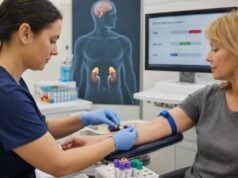
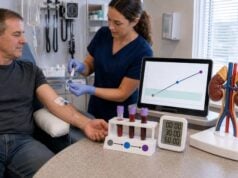
Collection quality has a major effect on specificity. The preferred approach is to arrive fasting if instructed, have an intravenous catheter placed, and lie quietly for 20–30 minutes before blood is drawn. The patient should remain supine during collection, and the laboratory should apply a supine reference interval.
A seated sample can be used when that is the laboratory’s validated protocol, but normetanephrine is more likely to be mildly high. Comparing a seated specimen with a supine cutoff creates avoidable false positives.
Common preparation instructions include avoiding vigorous exercise, nicotine, caffeine, and alcohol for a defined period. The laboratory may require overnight fasting, especially if 3-methoxytyramine is included. Stressful travel, pain, and lack of sleep should be documented.
Medication review is essential. Important examples include:
- Tricyclic antidepressants.
- Serotonin-norepinephrine reuptake inhibitors.
- Stimulants and sympathomimetic decongestants.
- Monoamine oxidase inhibitors.
- Levodopa and dopamine-related medicines.
- Clonidine and withdrawal from clonidine.
- Some antipsychotics and other psychiatric medicines.
- Withdrawal from alcohol, benzodiazepines, or opioids.
Do not stop these medicines without medical supervision. Abrupt withdrawal can be harmful and can raise sympathetic activity. The clinician may continue treatment and interpret cautiously, choose urine testing, or arrange a safe medication strategy.
Acute illness, pain, hypoglycemia, heart failure, severe anxiety, and untreated obstructive sleep apnea can raise normetanephrine. Nonurgent testing is often delayed until the person is stable. A restful collection environment is not a cosmetic detail; it is part of the test method.
The tube type, temperature, processing time, and transport requirements must match laboratory instructions. Specialized analytes can be unreliable if the sample is mishandled.
Normal, Borderline, and Markedly High Results
A normal result on a high-quality plasma free metanephrine test makes a catecholamine-secreting PPGL unlikely. The reassurance is strongest when the patient was rested supine, the assay was sensitive, and the clinical question concerns a secretory tumor.
A small elevation is common and often non-tumor-related. Results between one and two times the upper limit frequently reflect posture, stress, medicines, sleep apnea, illness, or age. The response is usually to review conditions and repeat the test properly rather than proceed directly to imaging.
A value more than three times the upper reference limit is much less likely to result from ordinary stress and strongly raises concern. The pattern and the patient’s risk still matter, but prompt endocrine evaluation and imaging are usually appropriate after the biochemical result is confirmed as technically valid.
| Result magnitude | General interpretation | Typical next step |
|---|---|---|
| Within range | Secretory PPGL unlikely | Reassess only if imaging or inherited risk remains strong |
| Up to about 2 times upper limit | Borderline; false positive common | Repeat under optimized conditions |
| About 2–3 times upper limit | Increasing concern | Specialist review, confirm conditions, consider imaging |
| More than about 3 times upper limit | Strong biochemical concern | Prompt localization and specialist management |
These categories are guides, not universal rules. Some medicines can produce large elevations, and very small tumors can produce only mild ones. Results should be expressed as a multiple of that laboratory’s upper limit rather than compared with a number from another lab.
False-negative tests are uncommon but can occur with very small tumors, nonsecretory head-and-neck paragangliomas, and dopamine-predominant tumors when 3-methoxytyramine is not measured. Strong hereditary or imaging evidence can justify further evaluation despite normal standard analytes.
Metanephrine and Normetanephrine Patterns
Predominant metanephrine elevation suggests epinephrine production. Epinephrine-producing tumors are usually located in the adrenal medulla because local cortisol exposure supports the enzyme that converts norepinephrine to epinephrine.
Predominant normetanephrine elevation suggests norepinephrine production. This pattern can occur in adrenal pheochromocytomas or extra-adrenal sympathetic paragangliomas. Mild isolated normetanephrine elevation is also the pattern most often caused by posture, stress, sleep apnea, or norepinephrine reuptake-blocking medicines.
3-methoxytyramine can indicate dopamine metabolism. It may be useful in selected head-and-neck tumors, SDHx-related disease, or suspected metastatic PPGL. Fasting and levodopa review are particularly important.
| Pattern | Possible implication | Caution |
|---|---|---|
| Metanephrine dominant | Epinephrine-secreting adrenal tumor | Confirm no analytical or medication issue |
| Normetanephrine dominant | Norepinephrine-secreting adrenal or extra-adrenal tumor | Mild rises are stress-sensitive |
| Both markedly elevated | Mixed catecholamine phenotype | Prompt localization generally needed |
| 3-methoxytyramine elevated | Dopamine-related phenotype | Diet, fasting, and levodopa matter |
The biochemical phenotype can guide imaging and genetic interpretation, but it does not prove tumor location. Imaging is still required after convincing biochemical evidence.
Medicines and Conditions That Cause False Positives
False positives arise through two routes: real sympathetic activation and analytical interference. Real activation increases norepinephrine turnover and therefore normetanephrine. Analytical interference causes a laboratory signal unrelated to the true concentration and is less common with modern LC-MS/MS methods.
Tricyclic antidepressants and serotonin-norepinephrine reuptake inhibitors are important because they block norepinephrine reuptake. Stimulants, amphetamines, cocaine, and sympathomimetic decongestants can also raise results. Levodopa can affect dopamine-related analytes.
Clinical conditions that increase sympathetic tone include obstructive sleep apnea, heart failure, acute pain, panic, hypoglycemia, severe illness, and withdrawal states. A difficult blood draw after walking or standing can create the same mild pattern.
Acetaminophen and other medicines interfered with some older assays; the relevance depends on the current method. The laboratory or endocrinologist should review method-specific interference rather than using a generic list.
A medication cannot be blamed automatically. The magnitude, pattern, and persistence matter. A high-risk patient with values several times the upper limit still needs prompt evaluation even when taking a potentially interfering drug.
The safest correction is planned. Treat sleep apnea, recover from acute illness, optimize posture, and change medicines only when medically safe. Repeating the same test under unchanged confounded conditions usually reproduces the same uncertainty.
Repeat Testing, Clonidine, and Imaging
A borderline result is often repeated after an overnight fast and 20–30 minutes of supine rest. Using LC-MS/MS and a posture-appropriate reference interval improves confidence. A 24-hour urine fractionated metanephrine test can provide an independent specimen when plasma collection remains difficult.
For persistent isolated mild normetanephrine elevation, a specialist may use a clonidine suppression test. Clonidine reduces normal sympathetic norepinephrine release. In people without a tumor, normetanephrine should fall appropriately; autonomous tumor production may remain elevated. The test is not used for metanephrine elevation, has blood-pressure and medication limitations, and requires supervision.
Once biochemical evidence is convincing, CT or MRI is used to locate the tumor. The abdomen and pelvis are common starting regions. MRI may be preferred in children, pregnancy, or when radiation reduction is important.
Functional imaging may be selected according to tumor location, biochemical phenotype, genetic background, and metastatic risk. Options target somatostatin receptors, norepinephrine transport, or glucose metabolism.
Imaging before biochemical confirmation often finds incidental adrenal nodules. These are common and may be unrelated to symptoms. A needle biopsy should not be performed until pheochromocytoma has been biochemically excluded because biopsy can provoke a dangerous catecholamine crisis.
The plasma normetanephrine test deserves especially careful repeat collection because it is the analyte most affected by posture and sympathetic activation.
Genetics, Treatment, and Long-Term Follow-Up
A substantial proportion of PPGLs are hereditary. Confirmed patients are commonly offered genetic counseling and germline testing, even without a family history. Results influence family screening, surveillance, functional imaging, and assessment of metastatic risk.
Before surgery, a functional tumor usually requires alpha-adrenergic blockade, restoration of salt and fluid balance when appropriate, and coordinated endocrine, surgical, and anesthesia care. Beta-blockers may be added for tachycardia only after adequate alpha blockade. Giving a beta-blocker first can worsen vasoconstriction and severe hypertension.
After removal, metanephrines are repeated to document biochemical response. A new postoperative baseline supports future surveillance. Persistent elevation may indicate residual tumor, another lesion, metastatic disease, or an unresolved false-positive factor.
Long-term follow-up is often lifelong. Recurrence can occur years later, particularly in hereditary disease, younger patients, large tumors, and extra-adrenal tumors. The schedule is individualized by genetics, location, size, pathology, and preoperative marker pattern.
Special situations require tailored care. Children need pediatric ranges and calm collection. Pregnancy requires a multidisciplinary team and imaging choices that limit fetal radiation. Kidney failure can make urine testing less reliable and may alter plasma interpretation because chronic illness raises sympathetic tone.
Questions to ask after the result include:
- Was the sample collected supine after adequate rest?
- Which analyte was high, and how many times above its limit?
- Could a medicine, sleep apnea, illness, or withdrawal state explain it?
- Should the test be repeated or confirmed with urine?
- Is imaging appropriate now?
- When should genetic counseling be arranged?
The test’s high sensitivity is most useful when preparation is rigorous. Controlled collection prevents a mildly abnormal number from launching an unnecessary imaging cascade while allowing strongly positive results to move quickly toward treatment.
Special situations that modify the testing pathway
Hereditary surveillance differs from low-risk symptom testing. A person with an SDHB, VHL, RET, or other susceptibility variant may be screened at regular intervals even without symptoms. Very small tumors can produce only slight elevations, so a borderline result may carry more weight than it would in a low-risk patient. Imaging schedules and the use of 3-methoxytyramine are tailored to the gene and previous tumor history.
Children need pediatric reference intervals and a collection environment that minimizes fear. A preplaced intravenous catheter, caregiver presence, and quiet supine rest can reduce stress-related normetanephrine. A confirmed childhood PPGL should trigger genetic counseling because the hereditary proportion is high.
Pregnancy is uncommon but high stakes. Pheochromocytoma can resemble preeclampsia, panic, or ordinary pregnancy symptoms, yet uncontrolled catecholamine release threatens both mother and fetus. Plasma metanephrines can support diagnosis, followed by radiation-conscious imaging and multidisciplinary planning.
Reduced kidney function often favors plasma over urine because 24-hour excretion is difficult to interpret. Chronic kidney disease and dialysis can increase sympathetic activity, however, so mild normetanephrine elevations remain challenging. Controlled sampling, LC-MS/MS, and specialist interpretation are especially important.
A normal panel does not exclude every paraganglioma. Head-and-neck lesions are frequently nonsecretory, and dopamine-predominant tumors may require 3-methoxytyramine. A very small hereditary lesion may also fall below routine detection. Imaging and genetic context can justify continued surveillance despite normal metanephrine and normetanephrine.
Conversely, an adrenal incidentaloma does not make a mild positive result true. Nonfunctioning adenomas are common. The biochemical evidence should be strong enough that the imaging finding and laboratory pattern plausibly belong together.
Sample handling can be as important as patient preparation. Blood may need rapid separation and freezing according to the assay. The laboratory should document whether the specimen was supine or seated. A posture mismatch between collection and reference interval can change a result from normal to abnormal without any change in biology.
After a tumor is removed, the expected marker should normalize. Testing too soon can be affected by surgical stress, pain, and medicines. The treating center establishes a postoperative baseline after recovery and then repeats testing at intervals based on genetic risk, tumor location, size, and pathology.
PPGL pathology cannot always predict future metastatic behavior. Long-term biochemical surveillance remains important even after an apparently complete operation. New symptoms, rising markers, or a hereditary syndrome may prompt functional imaging.
Patients should carry the diagnosis into future anesthesia and procedure planning until the tumor has been fully treated and follow-up confirms control. An unrecognized functional tumor can create extreme blood-pressure instability during surgery. Clear communication among endocrinology, surgery, anesthesia, genetics, and primary care is part of safe testing and treatment.
The pretest setting affects how a normal result is used. In a low-risk person with nonspecific symptoms, normal plasma metanephrines usually end the tumor workup. In a patient with a pathogenic susceptibility variant or a clearly suspicious mass, normal routine analytes may lead to additional imaging, repeat surveillance, or dopamine-related testing rather than complete dismissal.
Reference intervals should be matched to posture and analytical method. A result from one laboratory cannot be reclassified safely by entering it into another laboratory’s online range. This is particularly important near the upper limit, where small method differences can change a flag.
Patients sometimes ask whether testing should be performed during a spell. Metanephrines do not require catching an attack because they are formed continuously. Attempting to trigger symptoms with exercise, caffeine, fasting, or decongestants is unsafe and can add false-positive sympathetic activation.
When a marked result is found, the clinician also assesses immediate complications such as severe hypertension, arrhythmia, cardiomyopathy, glucose elevation, and volume contraction. Biochemical localization and medical stabilization may proceed together. The test begins a care pathway; it is not merely a report to watch without action.
A patient should receive clear instructions about what happens after a positive result. Prompt specialist contact, blood-pressure assessment, and planned imaging are more appropriate than independently searching for a tumor or changing medicines.
A high result should be communicated with its collection conditions. “Normetanephrine 1.3 times high after a seated draw” conveys different risk from “normetanephrine 5 times high after fasting supine rest.” Clear reporting helps the next clinician choose repetition or imaging without recreating the entire history.
References
- Diagnosis and Management of Pheochromocytomas and Paragangliomas: A Guide for the Clinician 2023 (Review)
- Pheochromocytoma: an updated scoping review from clinical presentation to management and treatment 2024 (Review)
- Japan Endocrine Society Clinical Practice Guideline for the Diagnosis and Management of Pheochromocytoma and Paraganglioma 2025 2026 (Guideline)
- International consensus statement on the diagnosis and management of phaeochromocytoma and paraganglioma in children and adolescents 2024 (Guideline)
- Biochemical Diagnosis of Phaeochromocytoma and Paraganglioma in Children and Adolescents: A Retrospective Cohort Study 2025
- Pheochromocytoma and Paraganglioma: An Endocrine Society Clinical Practice Guideline 2014 (Guideline)
Disclaimer
This article is for general education and cannot diagnose or exclude pheochromocytoma or paraganglioma in an individual. Plasma metanephrine results depend on posture, rest, medicines, illness, assay, and the magnitude of elevation. Severe hypertension, chest pain, neurologic symptoms, fainting, or breathing difficulty requires urgent medical care.