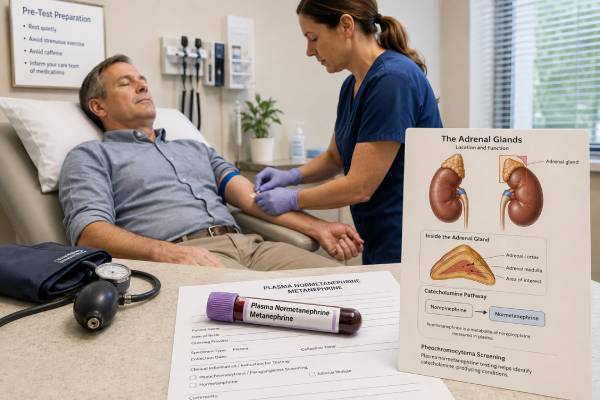
A plasma normetanephrine test measures a stable metabolite of norepinephrine and is used mainly to screen for pheochromocytoma and sympathetic paraganglioma. These tumors can make norepinephrine continuously or in bursts, while normetanephrine is formed within tumor cells even between symptomatic episodes. This makes normetanephrine more sensitive than a single plasma norepinephrine measurement. The test is also one of the easiest PPGL markers to elevate falsely. Standing, walking, pain, anxiety, sleep apnea, acute illness, nicotine, caffeine, and medicines that increase norepinephrine can all raise it. For the most specific result, blood is usually drawn after 20–30 minutes of quiet supine rest and interpreted with a posture-appropriate reference interval. A mild isolated elevation often needs controlled repeat testing. A result several times the upper limit, especially with matching symptoms or an adrenal mass, requires prompt specialist evaluation and imaging after biochemical confirmation.
- Normetanephrine is the main metabolite of norepinephrine and is a sensitive marker for norepinephrine-producing PPGL.
- Mild isolated elevation is commonly caused by posture, stress, sleep apnea, or medication, not automatically by a tumor.
- Supine rest for 20–30 minutes before collection reduces false positives.
- A level more than about three times the upper limit is strongly concerning, while values near the cutoff usually need repetition.
- A clonidine suppression test may help with persistent mild isolated elevation, but only under specialist supervision.
Table of Contents
- What Normetanephrine Is
- Why the Test Is Ordered
- Supine Sampling and Test Preparation
- Normal, Borderline, and High Results
- Common Causes of High Normetanephrine
- Clonidine Suppression and Repeat Testing
- Normetanephrine With Other PPGL Markers
- Imaging, Treatment, and Follow-Up
What Normetanephrine Is
Norepinephrine is a catecholamine released mainly from sympathetic nerve endings and from some adrenal or extra-adrenal chromaffin tumors. The enzyme catechol-O-methyltransferase converts norepinephrine to normetanephrine. A tumor can carry out this conversion continuously inside its cells, even when it is not releasing a large pulse of norepinephrine into blood.
That continuous formation is why plasma free normetanephrine is a preferred tumor-screening marker. Direct norepinephrine changes within minutes and can be normal between attacks. Normetanephrine is more stable and better reflects ongoing metabolism.
The assay is usually paired with metanephrine, the metabolite of epinephrine. Some centers also measure 3-methoxytyramine, the metabolite of dopamine. Together, these analytes provide a biochemical phenotype that can suggest—but not prove—tumor location and biology.
Normetanephrine is not specific to tumors. Ordinary sympathetic nerves produce norepinephrine throughout the body, and increased nerve activity raises normetanephrine. Standing, pain, cold, fear, low blood glucose, heart failure, sleep apnea, and illness can all create a real biological rise.
The laboratory may report pg/mL, nmol/L, or another unit. Age and posture influence reference intervals. Older adults often have a higher upper limit, and a seated sample may require a different range from a supine sample. A number should never be compared with an online cutoff without confirming the unit and protocol.
LC-MS/MS is generally favored because it separates related compounds specifically. Even an excellent assay cannot compensate for a rushed collection, incorrect posture, or strong sympathetic activation.
Why the Test Is Ordered
The test is ordered when pheochromocytoma or sympathetic paraganglioma is possible. Symptoms may include sudden pounding headache, sweating, palpitations, tremor, pallor, anxiety, chest discomfort, and episodes of very high blood pressure. Some patients have sustained hypertension, orthostatic symptoms, cardiomyopathy, high glucose, or an adrenal mass without classic spells.
Testing is also used for surveillance in people with a previous PPGL or a hereditary susceptibility variant. Conditions involving SDHx genes, VHL, RET, NF1, MAX, TMEM127, and other genes can increase risk. Family history may be absent even when a germline variant is present.
Normetanephrine is particularly relevant when a tumor is expected to produce norepinephrine. Extra-adrenal sympathetic paragangliomas often have a normetanephrine-dominant pattern. Adrenal pheochromocytomas can produce normetanephrine, metanephrine, or both.
Common reasons for testing include:
- An adrenal mass that is not clearly benign on imaging.
- Recurrent hyperadrenergic spells with marked blood pressure changes.
- Resistant or unusually labile hypertension with suggestive symptoms.
- A known hereditary PPGL syndrome.
- Follow-up after prior tumor treatment.
- A paraganglioma found in the chest, abdomen, pelvis, or head and neck.
Routine testing for common anxiety or mild hypertension is not recommended. Because mild normetanephrine elevation is common, low-risk testing can lead to repeated blood draws and incidental imaging without finding a tumor.
A normal high-quality result generally makes a norepinephrine-secreting PPGL unlikely. Exceptions include very small lesions, nonsecretory head-and-neck paragangliomas, and dopamine-predominant tumors.
Supine Sampling and Test Preparation
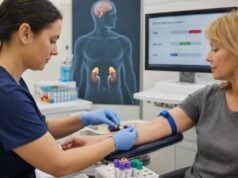
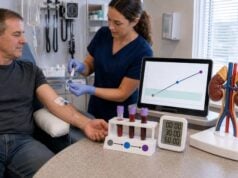
Posture is one of the strongest controllable influences. Standing activates sympathetic nerves to maintain blood pressure and increases norepinephrine turnover. For a resting baseline, the preferred protocol has the patient lie down quietly for 20–30 minutes before collection and remain supine during the draw.
An intravenous catheter may be placed before the rest period so that the needle insertion does not trigger the value being measured. The room should be calm and comfortable. Talking, using a stressful phone app, walking immediately beforehand, or experiencing pain can increase results.
Fasting overnight may be requested, especially when 3-methoxytyramine is measured. Laboratories often advise avoiding vigorous exercise, nicotine, caffeine, and alcohol for a defined period. Follow the specific instructions rather than a generic list.
Medicines that can raise normetanephrine or sympathetic tone include:
- Tricyclic antidepressants.
- Serotonin-norepinephrine reuptake inhibitors.
- Stimulants and amphetamine-type medicines.
- Sympathomimetic decongestants.
- Monoamine oxidase inhibitors.
- Some antipsychotics and other psychiatric drugs.
- Clonidine withdrawal.
- Withdrawal from alcohol, opioids, or benzodiazepines.
Do not stop prescription medicine without the prescriber’s plan. Withdrawal can be dangerous and can create an even larger false-positive result. The clinician may choose to test while the medicine is continued, use another method, or make a supervised change.
Acute illness, severe pain, heart failure, panic, hypoglycemia, and untreated obstructive sleep apnea can elevate normetanephrine. Nonurgent testing is often postponed until these conditions are stable. If testing proceeds, the report should document the confounder.
The reference interval must match the collection. A seated sample should not be judged against a supine cutoff unless the laboratory specifically supports that comparison.
Normal, Borderline, and High Results
A normal normetanephrine result on a properly collected plasma panel is reassuring. When metanephrine is also normal, a secretory PPGL is unlikely in most symptomatic patients.
Borderline elevation is usually defined by degree rather than a universal number. A result less than about twice the upper limit is often caused by posture, stress, medicine, age, or sleep apnea. It should be expressed as a multiple of the laboratory’s upper reference limit.
Values between two and three times the upper limit increase concern. Results more than about three times the upper limit are rarely explained by ordinary posture alone and strongly support a tumor, especially when repeated or accompanied by an adrenal or paraganglial mass.
| Result pattern | General interpretation | Usual response |
|---|---|---|
| Within the reference interval | Norepinephrine-secreting PPGL unlikely | Further testing only if hereditary or imaging risk remains high |
| Up to about 2 times upper limit | Borderline; false positive common | Review posture, medicines, illness, and repeat supine |
| About 2–3 times upper limit | Intermediate-to-high concern | Endocrine review and biochemical confirmation |
| More than about 3 times upper limit | Strong concern for PPGL | Prompt localization after validating the sample |
No multiple is absolute. A norepinephrine reuptake-blocking drug can sometimes cause substantial elevation, while a very small hereditary tumor may cause only a slight rise. Clinical probability changes interpretation.
A low normetanephrine result is usually not clinically important. It does not diagnose autonomic failure or adrenal insufficiency. Those questions require different protocols and companion tests.
Common Causes of High Normetanephrine
Pheochromocytoma and sympathetic paraganglioma are the important tumor causes. They may produce sustained or episodic norepinephrine. A matching high plasma norepinephrine can support the phenotype, but normetanephrine is the more sensitive marker.
Non-tumor causes are far more common when elevation is mild. Standing or sitting before the draw is a leading cause. Untreated obstructive sleep apnea repeatedly activates sympathetic nerves during sleep and can create persistent mild elevation. Heart failure, acute illness, pain, panic, low blood glucose, and strenuous exercise can do the same.
Medication-related elevation often reflects increased norepinephrine at nerve endings. Tricyclics and serotonin-norepinephrine reuptake inhibitors are notable examples. Stimulants, decongestants, cocaine, and amphetamines also raise concern.
Withdrawal states can be dramatic. Abruptly stopping clonidine removes central sympathetic suppression. Alcohol, sedative, or opioid withdrawal also activates the nervous system. The treatment history and timing should be reviewed before a tumor conclusion is drawn.
Kidney failure and chronic illness can complicate interpretation. Urine testing may be unreliable, while plasma normetanephrine can be elevated from sympathetic activation. A specialist may use carefully controlled plasma collection and method-specific ranges.
False elevation can also arise from analytical interference, although modern LC-MS/MS reduces many older problems. When the clinical picture and result are incompatible, repeating with a more specific method is reasonable.
The plasma catecholamines test may show whether norepinephrine itself is high, but it is even more sensitive to stress and should not replace optimized metanephrine testing.
Clonidine Suppression and Repeat Testing
The first response to a borderline result is usually optimization, not clonidine. The test is repeated after overnight fasting when appropriate, quiet supine rest, avoidance of nicotine and strenuous exercise, and review of medicines and illness. A 24-hour urine fractionated metanephrine collection can provide an independent comparison.
If isolated normetanephrine remains mildly elevated under good conditions, a specialist may consider clonidine suppression. Clonidine reduces sympathetic nerve activity. In people without a tumor, norepinephrine and normetanephrine should fall; a tumor may continue producing normetanephrine autonomously.
The protocol requires careful blood-pressure monitoring and medication review. Clonidine can cause hypotension, sedation, and dizziness. The test is not suitable for every patient and should not be used to evaluate isolated metanephrine elevation.
The result is interpreted according to both the absolute post-clonidine value and the percentage change, using the center’s validated criteria. A failed suppression result supports PPGL but still needs imaging and clinical integration.
Repeat testing should have a purpose. Repeating a seated sample while the same confounding medicine and untreated sleep apnea remain present is unlikely to clarify anything. Correcting the most likely false-positive factor makes the repeat meaningful.
Normetanephrine With Other PPGL Markers
Normetanephrine is usually interpreted with metanephrine. A normetanephrine-dominant pattern suggests norepinephrine biology, while metanephrine dominance suggests epinephrine production and often an adrenal source. Both can be elevated in an adrenal pheochromocytoma.
3-methoxytyramine may be added for dopamine-producing tumors, some head-and-neck paragangliomas, SDHx-related disease, or suspected metastatic PPGL. Levodopa and food effects require careful preparation.
| Marker pattern | Possible meaning | Limitation |
|---|---|---|
| Normetanephrine only | Norepinephrine phenotype or sympathetic activation | Mild elevation is nonspecific |
| Metanephrine dominant | Epinephrine-secreting adrenal tumor more likely | Location still requires imaging |
| Both markedly high | Mixed secretory PPGL | Validate sample and proceed promptly |
| 3-methoxytyramine high | Dopamine-related tumor phenotype | Fasting and drug effects matter |
A plasma free metanephrines panel is more informative than ordering normetanephrine in isolation because a tumor’s phenotype may be mixed or unexpected.
Imaging, Treatment, and Follow-Up
Imaging usually begins after convincing biochemical evidence. CT or MRI can locate adrenal and extra-adrenal tumors. Functional imaging is selected by tumor location, genetics, biochemical phenotype, and metastatic risk.
Imaging first can mislead because adrenal nodules are common. A borderline false-positive normetanephrine result plus an incidental adenoma may create an incorrect diagnosis. Biochemistry should establish the reason to localize.
Biopsy of a suspected adrenal or paraganglial lesion should not occur until pheochromocytoma is excluded. Needle manipulation can release catecholamines and trigger severe hypertension, arrhythmia, stroke, or shock.
Confirmed functional tumors are usually prepared for surgery with alpha-adrenergic blockade, salt and fluid restoration when appropriate, and coordinated anesthesia care. A beta-blocker may be added for tachycardia only after adequate alpha blockade.
Genetic counseling is broadly recommended because hereditary variants are common and affect family screening and surveillance. After surgery, normetanephrine is repeated to document biochemical response and establish a new baseline.
Long-term follow-up may be lifelong. Recurrence can occur years later, particularly with hereditary disease, younger age, large tumors, or extra-adrenal location. Surveillance follows the marker that was elevated before treatment.
Questions to ask after a high result include:
- Was I supine and rested before the draw?
- Is the reference interval age- and posture-appropriate?
- How many times above the upper limit is the value?
- Could sleep apnea, illness, pain, or medicine explain it?
- Should I repeat plasma testing, collect urine, or have clonidine suppression?
- Is biochemical evidence strong enough for imaging?
A high normetanephrine result is most meaningful when its magnitude, collection quality, and clinical context point in the same direction.
Special populations and longitudinal interpretation
Age-adjusted interpretation is particularly important for normetanephrine. Sympathetic tone and baseline concentrations tend to rise with age, so a single fixed upper limit can create false positives in older adults. Laboratories that use age-specific ranges may improve specificity without sacrificing much sensitivity. The report’s own age band should be used.
Children often have strong stress responses to venipuncture. A preplaced catheter, quiet room, caregiver support, and adequate supine rest can reduce this effect. Pediatric reference intervals are required. Because hereditary PPGL is relatively common in children and adolescents with a confirmed tumor, genetic counseling is an early part of the pathway.
Obstructive sleep apnea is a major practical confounder. Repeated oxygen drops and arousals activate sympathetic nerves and can cause persistent mild normetanephrine elevation. When the tumor probability is otherwise low, documenting effective sleep-apnea treatment and then repeating a controlled test can prevent unnecessary imaging. Marked elevations or a suspicious mass should not be dismissed solely because sleep apnea is present.
Kidney failure creates a similar challenge. Urine excretion becomes unreliable, while plasma normetanephrine can rise through chronic sympathetic activation. A carefully rested plasma sample, a high-specificity assay, and kidney-appropriate interpretive experience are valuable. The magnitude of elevation and other analytes become especially important.
Pregnancy requires specialist care. Normal cardiovascular and hormonal adaptation, nausea, anxiety, and pregnancy hypertension can overlap with tumor symptoms. A true PPGL carries serious risk during labor, anesthesia, and delivery. Plasma metanephrines can be used, but imaging and treatment decisions should involve endocrinology, maternal-fetal medicine, anesthesia, and surgery.
Head-and-neck paragangliomas may have normal normetanephrine because many are parasympathetic and nonsecretory. Some produce dopamine-related 3-methoxytyramine instead. A normal normetanephrine result therefore cannot dismiss a radiologically established head-and-neck lesion.
Sampling through an indwelling catheter can reduce the needle-stress effect, but the catheter itself should be placed before the rest period. Drawing immediately after insertion defeats the purpose. The patient should remain warm because cold exposure increases sympathetic tone.
Serial values should be compared using the same posture and assay when possible. A shift from supine LC-MS/MS to seated immunoassay can appear like biological progression. After surgery, a new baseline should be obtained after acute recovery. Rising values over time may indicate recurrence, a new tumor, or a changing confounder and deserve structured review.
The biochemical phenotype can also evolve. A hereditary patient may develop a new lesion with a different marker pattern from the original tumor. Surveillance panels therefore often include metanephrine and, when indicated, 3-methoxytyramine rather than measuring only the previously abnormal analyte forever.
Symptoms and magnitude remain central. A barely high isolated result in a rested, asymptomatic patient should lead to methodical confirmation. A rapidly rising value several times the limit with weight loss, spells, or a suspicious mass deserves prompt localization. The same “high” flag can represent very different risk.
Another important distinction is between an analyte concentration and a clinical emergency. A very high normetanephrine result can identify substantial tumor metabolism even when blood pressure is normal at the appointment. Some tumors produce continuous metabolites but release catecholamines unpredictably. Conversely, a patient can have a dangerous spell before a laboratory result is available. Chest pain, neurologic deficits, severe shortness of breath, fainting, or extreme blood pressure requires emergency assessment regardless of the last test.
Diet usually has less effect on normetanephrine than on dopamine-related markers, but fasting can standardize the panel and is required by some laboratories. Caffeine and nicotine matter mainly through sympathetic stimulation. A patient should follow the laboratory’s exact restrictions rather than add unnecessary food avoidance that could cause hypoglycemia and raise catecholamines.
An imaging lesion should be interpreted with the biochemical phenotype. An adrenal mass plus marked metanephrine elevation suggests epinephrine-producing pheochromocytoma, while isolated normetanephrine could fit an adrenal or extra-adrenal source. If abdominal imaging is negative despite strong biochemistry, the search may extend to the chest, pelvis, head, and neck using anatomical and functional methods chosen by a specialist.
The purpose of controlled repeat testing is not to make a true tumor disappear. It is to remove avoidable sympathetic noise so that persistent autonomous production becomes clearer. A result that remains elevated under ideal conditions carries more weight than the same value from a rushed seated draw.
The safest interpretation reports both the absolute concentration and the multiple of the age- and posture-specific upper limit. That wording makes the degree of abnormality clear and prevents a small flag from being treated like a several-fold elevation.
Patients should also know that a biochemical diagnosis does not establish whether a tumor is benign or metastatic. That assessment depends on location, imaging, pathology, genetics, and evidence of spread. The laboratory result identifies catecholamine metabolism and guides safe localization; it does not predict the entire clinical course.
Careful preparation turns a nonspecific stress-sensitive marker into a highly useful test for autonomous norepinephrine metabolism and safe tumor localization.
References
- Diagnosis and Management of Pheochromocytomas and Paragangliomas: A Guide for the Clinician 2023 (Review)
- Pheochromocytoma: an updated scoping review from clinical presentation to management and treatment 2024 (Review)
- Japan Endocrine Society Clinical Practice Guideline for the Diagnosis and Management of Pheochromocytoma and Paraganglioma 2025 2026 (Guideline)
- International consensus statement on the diagnosis and management of phaeochromocytoma and paraganglioma in children and adolescents 2024 (Guideline)
- Pheochromocytoma and Paraganglioma: An Endocrine Society Clinical Practice Guideline 2014 (Guideline)
Disclaimer
This article provides general education and cannot diagnose or exclude pheochromocytoma or paraganglioma. Normetanephrine is strongly affected by posture, sympathetic activation, medicines, illness, age, and assay method. Severe hypertension, chest pain, neurologic symptoms, fainting, or breathing difficulty requires urgent medical care.