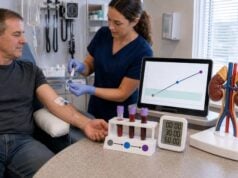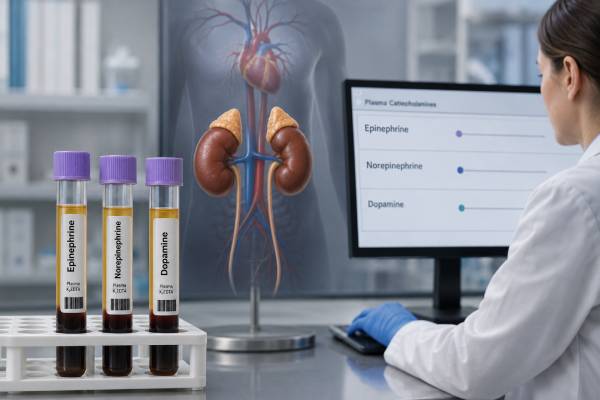
A plasma catecholamines test measures epinephrine, norepinephrine, and dopamine in a blood sample. These fast-acting chemicals help control heart rate, blood pressure, blood flow, alertness, and the response to stress. The test can support evaluation of catecholamine-producing tumors, autonomic disorders, severe blood pressure episodes, or selected dopamine-related conditions, but it is highly sensitive to posture, pain, anxiety, exercise, nicotine, caffeine, medicines, and the blood draw itself. For pheochromocytoma and paraganglioma screening, plasma free metanephrines or 24-hour urine fractionated metanephrines are generally preferred because tumor cells produce those metabolites continuously. Catecholamines rise and fall within minutes and may be normal between attacks. A high result therefore requires careful review of collection conditions and the pattern of individual analytes. Low catecholamine values usually have limited meaning unless the test was ordered for a specific autonomic question.
- The test measures epinephrine, norepinephrine, and dopamine at one moment in time.
- Plasma metanephrines are usually more sensitive for pheochromocytoma screening because catecholamine secretion can be intermittent.
- Supine rest for 20–30 minutes before collection reduces posture- and stress-related elevation.
- A high norepinephrine result is commonly caused by sympathetic activation, not automatically by a tumor.
- Results must be interpreted with symptoms, medicines, collection posture, and related metanephrine testing.
Table of Contents
- What Plasma Catecholamines Measure
- Why the Test May Be Ordered
- Collection, Posture, and Preparation
- Epinephrine, Norepinephrine, and Dopamine Patterns
- High Plasma Catecholamine Results
- Low Results and Autonomic Testing
- Catecholamines Versus Metanephrines
- Repeat Testing and Next Steps
What Plasma Catecholamines Measure
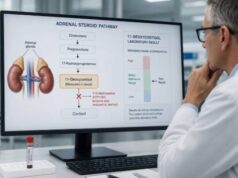
Catecholamines are derived from the amino acid tyrosine. Dopamine is converted to norepinephrine, and norepinephrine can be converted to epinephrine. Most circulating norepinephrine comes from sympathetic nerve endings, while much of circulating epinephrine comes from the adrenal medulla. Dopamine has several sources and acts as a neurotransmitter and precursor.
These chemicals act quickly and are cleared quickly. Physical activity, standing, pain, fear, low blood glucose, cold exposure, and even conversation can change concentrations within minutes. A plasma sample therefore captures a moment rather than average daily output.
The laboratory may report each analyte in pg/mL, pmol/L, or another unit. Reference intervals depend on posture, age, method, and whether the person was fasting. A seated range should not be compared with a supine sample or vice versa without understanding how the laboratory validated the test.
Catecholamines are metabolized to metanephrine, normetanephrine, and 3-methoxytyramine, then to other compounds. A tumor can continuously generate these metabolites inside its cells even when it releases little catecholamine into the circulation. This is why direct catecholamine testing is less sensitive for small or intermittently secretory pheochromocytomas and paragangliomas.
Plasma catecholamines should not be used as a general measure of stress, anxiety severity, or “adrenaline balance.” High values may simply reflect the conditions of collection, while normal values do not prove that a person’s symptoms are psychological. The result answers a narrow biochemical question and needs a defined reason for testing.
LC-based methods can separate the analytes more specifically than older techniques, but no analytical method removes physiologic variability. Careful collection remains the most important quality step.
Why the Test May Be Ordered
A clinician may order plasma catecholamines when evaluating sudden spells of headache, sweating, palpitations, tremor, pallor, chest discomfort, or severe blood pressure elevation. However, metanephrines are usually the preferred first biochemical screen for a catecholamine-producing tumor.
Catecholamines can add information when symptoms occur during supervised sampling, when a tumor is known to secrete a particular analyte, or when the biochemical phenotype needs characterization. They may also be used in specialized autonomic testing, where norepinephrine response to lying, standing, or tilt helps assess sympathetic nerve function.
Other selected uses include:
- Evaluating a suspected dopamine-secreting tumor when dopamine or 3-methoxytyramine is relevant.
- Characterizing secretion before or after treatment of a known pheochromocytoma or paraganglioma.
- Investigating unusual hyperadrenergic states under specialist supervision.
- Supporting assessment of autonomic failure, orthostatic intolerance, or baroreflex disorders.
- Documenting a catecholamine surge during a monitored symptomatic episode.
The test is not ideal for routine screening in people with common anxiety or occasional palpitations. The false-positive rate can be high because ordinary sympathetic activation raises catecholamines. A normal result obtained between episodes also may not exclude intermittent secretion.
Testing is more appropriate when symptoms are severe, recurrent, associated with marked blood pressure changes, or accompanied by an adrenal mass or inherited risk. The pheochromocytoma and paraganglioma panel provides a broader framework for choosing analytes.
Collection, Posture, and Preparation
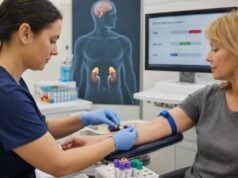
The best plasma catecholamine collection is controlled. The patient often fasts overnight, avoids vigorous exercise, nicotine, caffeine, and alcohol for a specified interval, and rests quietly before blood is drawn. Exact instructions vary, and the laboratory order should be followed.
Posture has a large effect on norepinephrine. Standing activates sympathetic nerves to maintain blood pressure and can raise the level substantially. If the test is meant to establish a resting baseline, the patient usually lies supine for 20–30 minutes before collection. A catheter may be inserted before the rest period so that the needle stick itself does not create the measurement.
The room should be comfortable and quiet. Talking, texting about stressful matters, walking from the waiting room, pain, or a difficult venipuncture can increase values. A sample drawn immediately after arrival is not equivalent to a rested supine sample.
Medication review is essential. Potential influences include:
- Stimulants and attention-deficit medicines.
- Decongestants and other sympathomimetics.
- Tricyclic antidepressants and serotonin-norepinephrine reuptake inhibitors.
- Monoamine oxidase inhibitors.
- Levodopa and dopamine-related medicines.
- Clonidine and withdrawal from clonidine.
- Beta-blockers, alpha-blockers, and several antihypertensive drugs.
- Caffeine, nicotine, and some supplements.
- Withdrawal from alcohol, opioids, or sedatives.
Do not stop prescription medicines without medical guidance. Abrupt withdrawal can be dangerous and may raise catecholamines more than continued therapy. The clinician may select another test, interpret with the medication present, or plan a safe temporary change.
Acute illness, fever, severe pain, hypoglycemia, heart failure, sleep apnea, and hospitalization can produce substantial elevation. Nonurgent testing is often postponed until the patient is stable.
For posture-comparison autonomic testing, the protocol may intentionally collect one sample supine and another after standing or tilt. In that setting, the change between positions is the point of the test. The timing must be recorded precisely.
Epinephrine, Norepinephrine, and Dopamine Patterns
Epinephrine is produced mainly by the adrenal medulla. It rises during hypoglycemia, fear, acute stress, exercise, and some adrenal pheochromocytomas. A tumor that makes epinephrine often also produces metanephrine.
Norepinephrine in plasma comes largely from sympathetic nerves spilling transmitter into the blood. It rises with standing, pain, cold, dehydration, heart failure, sleep apnea, and many medicines. Norepinephrine-producing tumors can occur in the adrenal glands or in extra-adrenal sympathetic paraganglia, and they often raise normetanephrine.
Dopamine is usually present at low concentrations. A high value can reflect levodopa treatment, dietary or collection factors, analytical interference, or a rare dopamine-producing tumor. Measuring 3-methoxytyramine may provide a more stable marker of tumor dopamine metabolism.
| Analyte | Main physiologic source | Common reasons for elevation |
|---|---|---|
| Epinephrine | Adrenal medulla | Acute stress, hypoglycemia, exercise, adrenal tumor |
| Norepinephrine | Sympathetic nerve endings | Standing, pain, illness, sleep apnea, drugs, PPGL |
| Dopamine | Nervous system and precursor pathways | Levodopa, rare tumor, analytical or dietary effects |
A mixed elevation can occur during a strong stress response or with an adrenal pheochromocytoma. The pattern is interpreted alongside metanephrines because metabolites better reflect sustained tumor production.
The absolute result matters less than the degree above a posture-appropriate upper limit and the quality of collection. A small norepinephrine elevation after a rushed seated draw is common. A marked, reproducible catecholamine pattern with matching metanephrine elevation is more concerning.
High Plasma Catecholamine Results
High catecholamines can be physiologic, medication-related, or tumor-related. The most common explanation for a mild elevation is sympathetic activation during collection. This is especially true for norepinephrine.
Non-tumor causes include pain, panic, exercise, low blood glucose, dehydration, nicotine, caffeine, acute illness, heart failure, obstructive sleep apnea, and drug withdrawal. Severe stress can produce values that overlap with tumor ranges, so context remains important even when the number is substantial.
Pheochromocytoma and sympathetic paraganglioma should be considered when elevations are reproducible, symptoms are characteristic, or an adrenal or paraganglial mass is present. Yet direct catecholamines alone are not the preferred proof. The plasma free metanephrines test or 24-hour urine fractionated metanephrines usually provides stronger evidence.
An epinephrine-predominant pattern can suggest an adrenal source. Norepinephrine-predominant secretion can arise from adrenal or extra-adrenal tumors. Dopamine-predominant tumors may cause fewer classic hypertensive spells and can be associated with particular hereditary backgrounds.
The clinician should review whether the patient was symptomatic during the draw. A normal result during an asymptomatic interval and a high result during a spell may be informative, but symptom-triggered blood collection is difficult to standardize. Metanephrines reduce dependence on catching an episode.
Imaging should not automatically follow one mild high catecholamine result. Adrenal nodules are common, and finding an incidental lesion can create confusion. Biochemical confirmation under controlled conditions generally comes first.
A hypertensive crisis, chest pain, neurologic deficit, pulmonary edema, or severe arrhythmia requires emergency care. Outpatient repeat testing is not appropriate during an acute dangerous episode.
Low Results and Autonomic Testing
Low plasma catecholamine values are usually not used to diagnose adrenal insufficiency. The adrenal cortex makes cortisol and aldosterone, while catecholamines come from the adrenal medulla and sympathetic nerves. A low epinephrine result does not establish cortisol deficiency.
In specialized autonomic laboratories, low supine norepinephrine or a blunted increase on standing can support sympathetic autonomic failure. Interpretation depends on the protocol, blood pressure and heart-rate response, age, medicines, and other autonomic tests. A single routine sample without posture data is inadequate.
People with pure autonomic failure, multiple system atrophy, Parkinson-related autonomic dysfunction, diabetic autonomic neuropathy, or other neurologic conditions may show altered norepinephrine responses. Some forms of orthostatic intolerance show high standing norepinephrine rather than low values.
Low dopamine is generally not clinically meaningful in routine plasma testing. Dopamine function in the brain cannot be inferred from a blood concentration because the blood-brain barrier and local neurotransmitter handling separate the two compartments.
A result marked “low” by the laboratory may reflect fasting, rest, posture, or a broad reference interval. It should only be pursued when the ordering question specifically concerns autonomic physiology or a known catecholamine-producing tumor after treatment.
Catecholamines Versus Metanephrines
Metanephrines are produced continuously within chromaffin tumor cells. Catecholamines may be released in bursts. This difference gives plasma free or urine fractionated metanephrines higher sensitivity for tumor detection.
| Feature | Plasma catecholamines | Plasma free metanephrines |
|---|---|---|
| Biology | Short-lived secreted hormones | Continuously formed metabolites |
| Response to stress | Very high | Normetanephrine still affected, but generally more stable |
| Tumor screening sensitivity | Lower | Higher |
| Special uses | Autonomic protocols and secretion characterization | Primary PPGL biochemical screen |
A normal plasma catecholamine test does not reliably exclude PPGL. A normal, correctly collected metanephrine panel is more reassuring. Conversely, mildly high catecholamines with normal metanephrines often point toward ordinary sympathetic activation rather than a tumor.
Urine catecholamines integrate secretion over 24 hours but still generally perform less well than urine fractionated metanephrines. They may be included as adjuncts when a laboratory panel or specialist protocol calls for them.
The best test depends on the question. Tumor detection calls for metanephrines. Autonomic response to posture may call for catecholamines. A known tumor’s biochemical phenotype may justify both.
Repeat Testing and Next Steps
After an unexpected high result, review posture, rest time, symptoms during collection, caffeine, nicotine, exercise, acute illness, sleep apnea, and medicines. Repeating the sample after proper supine rest may normalize a mild norepinephrine elevation.
If PPGL remains a concern, measure plasma free or 24-hour urine fractionated metanephrines under controlled conditions. A result several times the upper limit, especially with a matching pattern and symptoms, warrants prompt endocrine referral and imaging.
Persistent isolated dopamine elevation may lead to medication review and 3-methoxytyramine testing. Persistent posture-related abnormalities may lead to formal autonomic testing rather than tumor imaging.
Questions to ask include:
- Was the reference range appropriate for my posture?
- Did I rest quietly before the draw?
- Which catecholamine was high and by how much?
- Could a medicine, withdrawal state, sleep apnea, pain, or illness explain it?
- Were plasma or urine metanephrines measured?
- Is the next step repeat collection, autonomic testing, or imaging?
After removal of a catecholamine-producing tumor, biochemical follow-up usually relies on the markers that were elevated before surgery. Long-term surveillance may be needed because recurrence can occur years later.
Plasma catecholamines are useful when the collection and clinical question are precise. Without controlled conditions, the test often measures the stress of the moment more than an underlying tumor.
Several clinical scenarios need more nuance. In obstructive sleep apnea, repeated nighttime oxygen drops trigger sympathetic activity. Daytime norepinephrine and normetanephrine can remain mildly elevated, especially when apnea is severe or untreated. Treating the sleep disorder and repeating testing may prevent unnecessary tumor imaging, provided the original results and symptoms do not indicate urgent risk.
In heart failure, the sympathetic nervous system remains activated to support circulation. Norepinephrine can be elevated and may relate to disease severity, but routine catecholamine testing is not needed to manage most patients. The value should not be interpreted with a PPGL threshold without considering the cardiovascular condition.
Low blood glucose can produce a strong epinephrine response. A person who fasts longer than instructed, uses insulin or a sulfonylurea, or develops hypoglycemia during collection may have high epinephrine with sweating, tremor, and palpitations. Recording a simultaneous glucose can clarify this pattern. Recurrent hypoglycemia deserves its own evaluation.
Autonomic testing uses a different logic from tumor screening. A laboratory may collect samples after at least 20 minutes supine and again after a defined period of standing. In healthy physiology, norepinephrine rises to maintain vascular tone. A small increase can support sympathetic denervation, while an excessive rise with a large heart-rate increase may occur in hyperadrenergic postural tachycardia. These diagnoses require blood-pressure and heart-rate criteria, symptoms, and often additional testing; the catecholamine number alone is insufficient.
Age affects results. Infants and children require pediatric ranges, and the distress of venipuncture can produce a dramatic surge. An experienced pediatric team may use a preplaced catheter and a quiet rest period. Older adults may have higher resting sympathetic tone and more medicines that influence the result.
Kidney and liver disease can alter catecholamine clearance and the overall stress state. Dialysis, fluid shifts, anemia, and chronic illness may raise sympathetic activity. A specialist may favor plasma metanephrines and an assay-specific interpretive approach if PPGL is a serious concern.
The sample tube and processing time matter because catecholamines are unstable. Blood may need to be collected into a chilled tube, kept on ice, centrifuged promptly, and frozen according to laboratory protocol. A delayed or warm specimen can produce unreliable values. The phlebotomy site should know that this is a specialized test rather than treating it like an ordinary chemistry panel.
Diet has less influence on plasma norepinephrine and epinephrine than posture and medicines, but fasting is often used to standardize conditions and is more important when dopamine or 3-methoxytyramine is included. Bananas, chocolate, vanilla, and other foods have historically been restricted for some urine assays; current instructions depend on the analytical method. Follow the laboratory’s list rather than using a generic internet diet.
A result can be expressed as an absolute concentration or as a response to a stimulus. In research or specialized endocrine testing, insulin-induced hypoglycemia, exercise, or pharmacologic agents may provoke catecholamine release. Those protocols have their own reference responses and safety requirements and should not be compared with a resting outpatient range.
Patients with a known PPGL should not try to trigger a spell before testing. Exercise, skipped meals, decongestants, or intentional stress can provoke dangerous hypertension or arrhythmia. Metanephrine testing is designed to detect tumor metabolism without forcing a catecholamine surge.
When a result is high, the report should be read analyte by analyte. A mild isolated norepinephrine rise with normal epinephrine, dopamine, and metanephrines is a different pattern from simultaneous marked norepinephrine and normetanephrine elevation. Looking only at a panel flag can obscure that distinction.
After surgery, a previously high catecholamine may fall quickly, but immediate postoperative stress can still raise levels. Follow-up timing is chosen by the treating center. A new baseline after recovery, paired with metanephrines, is more useful for long-term surveillance than a sample drawn during acute postoperative pain.
Interpreting trends rather than isolated surges
Serial catecholamine testing should use the same posture, rest period, fasting state, and laboratory method. A higher value after a seated draw cannot be called progression when the earlier sample was supine. Symptom timing should also be recorded because a spell during one collection and a calm period during another can explain large differences.
For autonomic disorders, the change from supine to standing is often more informative than the absolute value. Blood pressure and heart rate must be measured at the same time. A laboratory flag based on a resting range may be expected after standing and should not be mistaken for tumor evidence.
After a confirmed PPGL is treated, metanephrines usually remain the preferred surveillance markers. Catecholamines can be followed when they were clearly elevated before surgery, but postoperative pain, hypoglycemia, and hemodynamic stress can distort early samples. A stable outpatient baseline is more useful.
The collection record should state whether the patient was supine, seated, standing, symptomatic, fasting, and resting before the draw.
References
- Diagnosis and Management of Pheochromocytomas and Paragangliomas: A Guide for the Clinician 2023 (Review)
- Pheochromocytoma: an updated scoping review from clinical presentation to management and treatment 2024 (Review)
- Japan Endocrine Society Clinical Practice Guideline for the Diagnosis and Management of Pheochromocytoma and Paraganglioma 2025 2026 (Guideline)
- International consensus statement on the diagnosis and management of phaeochromocytoma and paraganglioma in children and adolescents 2024 (Guideline)
- Pheochromocytoma and Paraganglioma: An Endocrine Society Clinical Practice Guideline 2014 (Guideline)
Disclaimer
This article is educational and cannot diagnose a catecholamine-producing tumor or autonomic disorder. Plasma catecholamines are strongly affected by posture, stress, medicines, illness, and collection technique. Severe hypertension, chest pain, fainting, neurologic symptoms, or breathing difficulty requires urgent medical care.