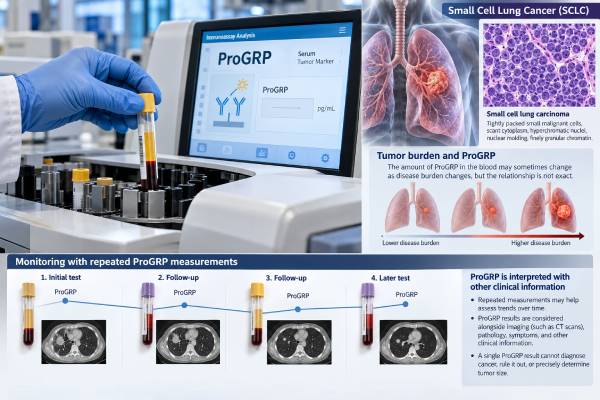
The ProGRP test measures pro-gastrin-releasing peptide in blood and is most useful as a circulating marker for small cell lung cancer. Small cell tumors often have neuroendocrine features and can release ProGRP, so concentrations are frequently higher in SCLC than in non-small cell lung cancer or benign lung disease. The test can support the clinical picture, provide a pretreatment baseline, and help follow changes during therapy when the marker is elevated at diagnosis. It cannot confirm SCLC by itself, replace a biopsy, or determine stage from one number. Results also require careful interpretation because kidney dysfunction can raise ProGRP even without cancer, and laboratories use different assays and reference limits. For monitoring, the patient’s own trend is usually more informative than a universal cutoff: a substantial fall can support treatment response, while a persistent or renewed rise may prompt closer evaluation with imaging and clinical assessment.
- What it measures: ProGRP is a stable precursor fragment related to gastrin-releasing peptide and is strongly associated with the neuroendocrine biology of small cell lung cancer.
- What a high result may mean: Marked elevation supports SCLC in the right clinical setting but can also occur with impaired kidney function and some other neuroendocrine tumors.
- Typical reference limits: Cutoffs are assay-specific and are often in the roughly 50–80 pg/mL range; the laboratory’s own reference interval should be used.
- Best monitoring use: ProGRP is most informative when elevated before treatment and then followed with the same assay alongside imaging and symptoms.
- Important limitation: A normal ProGRP result does not rule out SCLC, and an elevated result does not replace tissue diagnosis.
Table of Contents
- What ProGRP Is and Why SCLC Can Raise It
- When the ProGRP Test Is Used
- Understanding ProGRP Results
- Kidney Function and Other Causes of High ProGRP
- Tumor Burden and Treatment Monitoring
- ProGRP Versus NSE and Other Lung Cancer Markers
- Practical Testing and Follow-Up
What ProGRP Is and Why SCLC Can Raise It
ProGRP stands for pro-gastrin-releasing peptide. It is a precursor molecule related to gastrin-releasing peptide, a neuropeptide involved in signaling in the nervous, gastrointestinal, and respiratory systems. Measuring the precursor is useful because ProGRP is more stable in blood than gastrin-releasing peptide itself.
Small cell lung cancer is a high-grade neuroendocrine carcinoma. Its tumor cells can express neuroendocrine programs and release peptide-related products into the circulation. ProGRP is one of the blood markers that best reflects this biology and is generally more specific for SCLC than many traditional lung cancer serum markers.
The test is performed on serum or plasma, depending on the laboratory method. Modern automated immunoassays report a concentration, usually in picograms per milliliter (pg/mL). There is no single universal cutoff because platforms differ in calibration, antibodies, specimen requirements, and reference populations.
Many laboratories use an upper reference limit somewhere around 50–80 pg/mL, but this is only an orientation. A patient should use the exact interval printed on the report. Results from different laboratories may not be directly interchangeable, which matters when serial measurements are used for monitoring.
ProGRP is a circulating protein marker, not a genetic test. It does not identify a mutation or gene fusion and does not directly select a targeted drug. It is also not a pathology stain. SCLC diagnosis still depends on tumor morphology and appropriate immunohistochemistry from tissue or cytology.
That difference affects how clinicians use the number. Molecular biomarkers can sometimes determine whether a specific drug target is present, while ProGRP mainly reflects a biologic phenotype and, in some patients, the changing amount of active disease. A tumor can remain the same histologic type even when ProGRP falls after treatment, and a later rise does not reveal which resistance mechanism has developed. If progression occurs, imaging and, when clinically appropriate, repeat tissue or molecular testing may be needed to answer questions that a serum peptide marker cannot. ProGRP is therefore best used for longitudinal context rather than as a complete description of the cancer.
The marker can be elevated in other pulmonary neuroendocrine neoplasms and some non-pulmonary neuroendocrine cancers, so even a striking elevation is not anatomically specific. The strongest interpretation comes when the blood result agrees with a lung mass, compatible pathology, and the rest of the clinical picture.
When the ProGRP Test Is Used
ProGRP is most useful as an adjunct in suspected or confirmed small cell lung cancer. It can contribute at diagnosis, establish a baseline, and provide a longitudinal signal during treatment or follow-up.
In a patient with a suspicious lung lesion, a high ProGRP can increase suspicion for SCLC, especially when the result is much more elevated than markers typically associated with NSCLC. However, it cannot substitute for biopsy because no blood cutoff provides perfect sensitivity and specificity.
Once SCLC is pathologically confirmed, a pretreatment ProGRP value can be useful for a different reason: it shows whether this particular tumor releases a measurable amount of the marker. If the baseline is clearly elevated, later changes may become clinically informative.
The test can be used to:
- support differential assessment between SCLC and other lung cancer types;
- establish a baseline before chemotherapy, immunotherapy, radiation, or combined treatment;
- follow biochemical response during treatment;
- provide an additional signal during surveillance for progression or relapse;
- help interpret difficult cases when pathology, imaging, and serum markers appear discordant.
The small cell lung cancer biomarker panel context is important because ProGRP is only one layer of information. NSE, tissue neuroendocrine markers, emerging molecular subtypes, and DLL3 expression can each answer different questions.
ProGRP is not recommended as a population screening test for lung cancer. A screening marker must perform extremely well in people who do not yet have a diagnosis. ProGRP is not sensitive enough to rule out early SCLC and can be falsely elevated for non-cancer reasons, especially reduced kidney function.
Understanding ProGRP Results
A ProGRP result should be interpreted in three steps: compare it with the laboratory reference range, assess whether kidney function could affect it, and compare it with prior values from the same patient.
A result within the reference interval does not exclude SCLC. Some tumors release little ProGRP, and sensitivity is not 100%. If imaging and pathology strongly support small cell carcinoma, a normal ProGRP should not create doubt about an otherwise convincing diagnosis.
A mild elevation is often less specific than a marked elevation. Small changes around the upper reference limit can result from biologic variation, renal impairment, assay variation, or another neuroendocrine condition. A very high value in a patient with a suspicious lung mass is more supportive of SCLC, but even then histologic confirmation remains necessary.
| Result pattern | What it may mean | How it is usually handled |
|---|---|---|
| Within reference range | SCLC is still possible; the tumor may not secrete much ProGRP | Rely on pathology, imaging, and other markers |
| Mildly elevated | Could reflect SCLC, reduced kidney clearance, another neuroendocrine tumor, or variation | Review renal function and clinical context |
| Clearly elevated before treatment | Supports a ProGRP-producing neuroendocrine tumor and provides a useful baseline | Consider serial monitoring with the same assay |
| Falls substantially during treatment | Can be consistent with decreasing tumor activity or burden | Confirm response with clinical assessment and imaging |
| Rises again after prior decline | May signal progression or relapse but is not proof | Evaluate trend, renal function, symptoms, and imaging |
A ProGRP value cannot be converted directly into tumor size or stage. A level of 1,000 pg/mL does not mean the cancer is a specific number of centimeters or automatically indicate extensive-stage disease. Higher concentrations often correlate with greater disease burden across patient groups, but there is substantial overlap between limited- and extensive-stage disease.
For this reason, staging remains based on imaging and the established SCLC staging framework, not serum markers.
Kidney Function and Other Causes of High ProGRP
Kidney function is one of the most important non-cancer factors in ProGRP interpretation. Reduced renal clearance can raise ProGRP concentrations, sometimes substantially. A high result in someone with chronic kidney disease therefore deserves careful review before it is attributed to tumor progression.
The laboratory report may not automatically adjust ProGRP for estimated glomerular filtration rate. Clinicians commonly look at creatinine and eGFR measured around the same time, especially when the marker rises unexpectedly while imaging and symptoms remain stable.
Other neuroendocrine neoplasms can also increase ProGRP. Recent reviews describe elevations in pulmonary carcinoids, large-cell neuroendocrine carcinoma, medullary thyroid carcinoma, high-grade neuroendocrine carcinomas from other organs, and some cancers that acquire neuroendocrine differentiation.
This means ProGRP is neuroendocrine-associated, not SCLC-exclusive. The probability that a high value represents SCLC depends heavily on the patient’s known diagnosis and clinical setting.
Technical factors also matter. Serum and plasma assays may not behave identically, and specimen stability can vary by platform. When a patient is being monitored, it is best to use the same specimen type, laboratory, and assay whenever practical.
A sudden isolated increase should be interpreted cautiously. Before assuming progression, clinicians may repeat the marker and review renal function, hydration, recent illness, specimen handling, and imaging. The principle is the same as with other tumor markers: a reproducible pattern is more trustworthy than one surprising data point.
Tumor Burden and Treatment Monitoring
ProGRP often rises with increasing SCLC burden, which is why it can be useful for monitoring. The relationship is strongest at the population level and in patients whose tumors produce the marker consistently.
A good monitoring strategy begins with a pretreatment value. If the level is already normal at diagnosis, serial ProGRP measurements may have little value. If the level is markedly elevated, it can serve as a personalized biochemical baseline.
During effective treatment, ProGRP often falls. The speed and magnitude of decline can support a treatment response, but no universal percentage decrease has been validated as a stand-alone definition of response across all assays and treatment settings. Imaging remains the standard way to evaluate measurable tumor changes.
Monitoring is most useful when several signals move together:
- symptoms improve or worsen;
- imaging shows response or progression;
- ProGRP changes in the same direction;
- kidney function remains stable enough that renal clearance is not confusing the trend.
A marker that falls dramatically while scans improve adds confidence that treatment is working. A rising ProGRP while scans remain stable is more ambiguous. It may precede visible progression in some patients, but it can also reflect renal change or variation. Repeating the test and reviewing the clinical picture is usually more appropriate than changing treatment because of one value.
After an initial response, renewed elevation can be an early warning signal. Older follow-up studies found that ProGRP sometimes increased before clinically recognized relapse, and newer reviews continue to support its potential longitudinal value. However, standardized surveillance schedules and action thresholds remain less established than for imaging.
This is why ProGRP is best viewed as a trend amplifier. It can make an emerging pattern easier to see, but it does not replace the primary evidence used to diagnose progression.
ProGRP Versus NSE and Other Lung Cancer Markers
ProGRP and neuron-specific enolase are the two classic circulating markers most closely associated with SCLC. They are complementary rather than interchangeable.
The NSE test for lung cancer measures a glycolytic enzyme found in neurons and neuroendocrine cells. NSE can rise in SCLC, but it is more vulnerable to false elevation from hemolysis because red blood cells and platelets contain enolase. ProGRP generally has better specificity for SCLC but is more strongly affected by impaired kidney function.
These different limitations can make the two markers useful together. A high ProGRP with normal renal function and elevated NSE in a non-hemolyzed specimen can strengthen the biochemical pattern of SCLC. Discordant values can direct attention to specimen quality or non-cancer confounders.
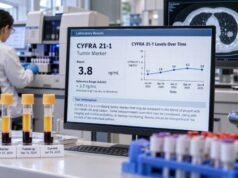
Other blood markers serve different roles. CEA is more often associated with adenocarcinoma, while CYFRA 21-1 and SCC antigen are more frequently used in NSCLC contexts. A 2022 study comparing several serum markers found the highest ProGRP and NSE concentrations in SCLC, while SCC antigen was most elevated in squamous lung cancer.
The distinction between serum markers and tissue markers is also important. Synaptophysin, chromogranin, INSM1, and other immunohistochemical stains help establish neuroendocrine differentiation in tumor tissue. ProGRP cannot replace those pathology tools.
Likewise, DLL3 is a cell-surface protein expressed in many SCLCs and is increasingly relevant as a therapeutic biomarker. It is not measured by the same blood assay and should not be inferred from a ProGRP concentration.
Practical Testing and Follow-Up
The ProGRP test requires a standard blood sample. Fasting is usually unnecessary unless other ordered tests require it. Patients should not alter food, fluid intake, or medications simply to change the tumor-marker result unless their clinician gives specific instructions.
For a useful baseline, the blood sample should ideally be collected before treatment or at a clearly documented point in the treatment cycle. Subsequent measurements are easier to interpret when timing and assay method are consistent.
When reviewing a report, ask:
- What is the laboratory’s upper reference limit?
- Was serum or plasma used, and is this the same method as prior tests?
- What was the ProGRP level before treatment?
- Has kidney function changed since the previous measurement?
- Does the trend agree with symptoms and imaging?
- Is NSE available as a complementary marker, and was the specimen hemolyzed?
If a ProGRP result is unexpectedly high in a person without a confirmed cancer diagnosis, the next step is not to assume SCLC. The clinician may repeat the test, assess kidney function, review imaging, and pursue tissue diagnosis when indicated.
If a patient with established SCLC develops new symptoms such as worsening shortness of breath, coughing up blood, severe headache, new weakness, confusion, or rapidly declining function, medical evaluation should not wait for a tumor-marker result. A normal ProGRP cannot safely exclude progression or an urgent complication.
The test is most valuable when its role is kept narrow and practical. ProGRP can support SCLC assessment, provide a personal baseline, and add a convenient signal during treatment and surveillance. It is not a stand-alone diagnostic test, and it is not a substitute for scans. Used as part of a consistent monitoring plan—especially with stable kidney function—it can provide clinically useful information about how a ProGRP-producing small cell tumor is changing over time.
References
- [Clinical significance and key points for interpreting progastrin-releasing peptide and neuron-specific enolase in chemoradiotherapy for limited-stage small cell lung cancer] 2026 (Review)
- Progastrin-Releasing Peptide As a Diagnostic Biomarker of Pulmonary and Non-Pulmonary Neuroendocrine Neoplasms 2024 (Review)
- Circulating lung cancer biomarkers: From translational research to clinical practice 2024 (Review)
- Pro-Gastrin-Releasing Peptide as a Biomarker in Lung Neuroendocrine Neoplasm 2023 (Review)
- Plasma Progastrin-Releasing Peptide and Chromogranin A Assays for Diagnosing and Monitoring Lung Well-Differentiated Neuroendocrine Tumors: A Brief Report 2023
- Diagnostic value of serum tumor markers CEA, CYFRA21-1, SCCAg, NSE and ProGRP for lung cancers of different pathological types 2022
Disclaimer
ProGRP is an adjunctive blood biomarker and cannot diagnose, stage, or rule out small cell lung cancer by itself. Results should be interpreted with kidney function, pathology, imaging, symptoms, and other relevant biomarkers. Do not change treatment or delay evaluation of concerning symptoms based on a ProGRP value alone.