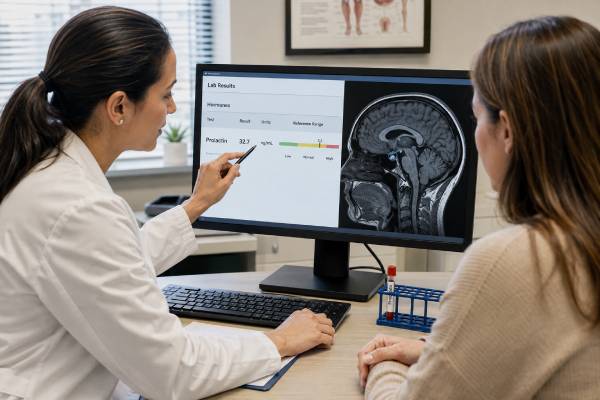
A prolactin blood test measures a hormone made mainly by the pituitary gland. Prolactin supports breast development and milk production, but it also affects ovulation, menstrual cycles, testosterone production, sexual function, and fertility. A high result is common and does not automatically mean a pituitary tumor. Pregnancy, breastfeeding, stress, sleep, exercise, medicines, hypothyroidism, kidney disease, and a harmless large form called macroprolactin can all raise the measured level. A low result is less common and usually becomes important when milk production is poor after childbirth or when several pituitary hormones are low. Because prolactin changes during the day and responds quickly to physical and emotional stress, one unexpected result often needs confirmation under calmer, standardized conditions. Interpretation depends on symptoms, sex, pregnancy or lactation status, medicines, the laboratory method, and other hormone tests. Very high or persistently abnormal results may lead to repeat testing, macroprolactin analysis, thyroid and kidney tests, or pituitary MRI.
- A high prolactin result has many possible causes: medicines and normal physiologic states are more common than a prolactinoma.
- Reference ranges vary by laboratory: pregnancy and breastfeeding require completely different interpretation from nonpregnant adults.
- Mild elevation often needs a repeat sample: rest before collection and review stress, exercise, sex, nipple stimulation, and medicines.
- Macroprolactin can create a misleading high total: laboratories may use polyethylene glycol treatment to estimate biologically active monomeric prolactin.
- Very high prolactin plus a pituitary mass raises concern for a prolactinoma: an unexpectedly modest result with a large mass may require sample dilution to exclude the hook effect.
- Low prolactin may suggest pituitary damage: it is most useful when lactation fails or other pituitary hormones are also deficient.
Table of Contents
- What the prolactin blood test measures
- Why the test is ordered
- Preparation and sample collection
- Normal ranges and result patterns
- Causes of high prolactin
- Low prolactin results
- Pituitary tumors and special laboratory problems
- Follow-up, treatment, and urgent symptoms
What the prolactin blood test measures
Prolactin is a peptide hormone produced by lactotroph cells in the anterior pituitary. Its best-known role is to initiate and maintain milk production after delivery. It also communicates with the hypothalamus, ovaries, testes, and reproductive hormone system. When prolactin stays high, it can suppress pulsatile gonadotropin-releasing hormone. That lowers luteinizing hormone and follicle-stimulating hormone signaling, which may reduce estrogen or testosterone and interfere with ovulation and sperm production.
Unlike many pituitary hormones, prolactin is held down mainly by dopamine from the hypothalamus. Anything that blocks dopamine action, interrupts the pituitary stalk, or reduces dopamine delivery can allow prolactin to rise. This explains why antipsychotic medicines, some nausea medicines, and non-prolactin-secreting masses near the pituitary stalk may cause hyperprolactinemia.
A standard assay usually reports total immunoreactive prolactin. That total may include several molecular forms:
- Monomeric prolactin is the smaller, biologically active form that usually causes symptoms when elevated.
- Big prolactin is a less common intermediate form.
- Macroprolactin, sometimes called big-big prolactin, is often prolactin bound to an antibody. It clears slowly from blood and may increase the reported total while causing few or no classic symptoms.
The test therefore measures concentration, not pituitary structure and not biological activity directly. A result cannot by itself prove or exclude a tumor. It must be interpreted with symptoms, medicines, pregnancy status, thyroid function, kidney function, and—when needed—pituitary imaging.
Prolactin also rises temporarily during sleep, emotional stress, pain, vigorous exercise, sexual activity, nipple stimulation, and after some meals. A short-lived rise is a normal response. Persistent elevation on properly collected samples is the pattern that requires explanation.
Why the test is ordered
Clinicians order prolactin when symptoms suggest excess prolactin, pituitary dysfunction, or impaired lactation. The same result can produce different symptoms depending on age, reproductive stage, and how long the elevation has been present.
Common reasons for testing include:
- Unexpected breast milk production when a person is not pregnant or breastfeeding
- Absent, irregular, or infrequent menstrual periods
- Infertility or lack of ovulation
- Low libido, erectile dysfunction, reduced morning erections, or low testosterone
- Reduced sperm count
- Breast tenderness or enlargement
- Delayed or interrupted puberty
- Headache, peripheral vision loss, double vision, or another sign of a sellar mass
- Follow-up of a known prolactinoma or another pituitary tumor
- Monitoring treatment with a dopamine agonist such as cabergoline or bromocriptine
- Poor milk supply after delivery, especially after severe postpartum bleeding or other evidence of pituitary injury
A high prolactin result may be discovered during a broader pituitary hormone panel. In that setting, the surrounding hormone pattern is essential. For example, low estradiol or testosterone with low or inappropriately normal LH and FSH supports central reproductive suppression. Low free T4 with a low or normal TSH may point to broader pituitary disease rather than an isolated prolactin problem.
Testing may also help distinguish medication effects from a pituitary disorder. A person taking a dopamine-blocking drug may have a mild or moderate elevation, but the exact concentration cannot reliably identify the cause. The prescriber should decide whether a medicine can be changed or paused; stopping psychiatric, nausea, blood pressure, or hormone medicines without guidance can be unsafe.
Prolactin is not a general cancer screening test. It is also not a reliable way to diagnose stress, explain every fertility problem, or assess milk supply without clinical context. A normal result does not rule out all pituitary disease, and a high result does not establish that symptoms come from prolactin.
Preparation and sample collection
Most prolactin tests require a routine blood draw from a vein. Fasting is not always necessary, but the ordering clinician or laboratory may request it, especially when other tests are collected at the same time. Follow the written instructions because laboratories differ.
Prolactin begins rising during sleep and can remain higher soon after waking. Many clinicians prefer collection at least two to three hours after awakening, often during the morning. The aim is not to find one universally perfect clock time; it is to reduce avoidable variation and make repeat samples comparable.
For a repeat test after a mild unexpected elevation, these steps can improve reliability:
- Avoid strenuous exercise before the draw.
- Avoid breast or nipple stimulation for the period recommended by the clinician.
- Avoid sexual activity shortly before testing if instructed.
- Arrive early enough to sit quietly for about 15 to 30 minutes.
- Tell the phlebotomist if the needle procedure causes marked anxiety, pain, faintness, or distress.
- Bring a complete list of prescriptions, over-the-counter medicines, supplements, hormone products, and recreational substances.
Venipuncture stress can raise prolactin in some people. When a result is only mildly high and the clinical picture does not fit, a clinician may repeat the test after quiet rest. In selected cases, samples may be collected through an indwelling catheter after a longer rest period to determine whether the elevation settles.
Medicines commonly associated with higher prolactin include many antipsychotics, metoclopramide and domperidone, some antidepressants, opioids, verapamil, methyldopa, and estrogen-containing therapies. The effect varies widely by drug and dose. Some medicines produce marked elevation, while others cause little change. Do not stop a prescribed medicine solely to “clean up” a laboratory result. The risks of withdrawal or relapse may be greater than the benefit of retesting.
Pregnancy status should be documented. Prolactin rises substantially during pregnancy and stays elevated during breastfeeding, so a nonpregnant reference interval is inappropriate. Recent seizures, chest injury, surgery, severe illness, and sleep disruption are also relevant.
Biotin is a known source of interference in several hormone immunoassays, although the direction and size of its effect depend on the specific platform. Tell the laboratory about high-dose biotin or hair-and-nail supplements. The laboratory can advise whether a temporary pause is needed.
Normal ranges and result patterns
There is no single prolactin range that applies to every laboratory, sex, age, pregnancy stage, or assay. Results are commonly reported in nanograms per milliliter (ng/mL) or milli-international units per liter (mIU/L). The conversion is assay dependent, so online conversion factors should not replace the laboratory report.
Many laboratories use an upper limit around the high teens to mid-20s ng/mL for nonpregnant adults, sometimes with sex-specific ranges. That is only a broad orientation. The printed reference interval beside the result is the correct starting point. A value one unit above a cutoff should not be interpreted the same way as a result several times the upper limit.
| Pattern | Possible meaning | Typical next step |
|---|---|---|
| Mild elevation on one sample | Stress, sleep timing, exercise, medicine effect, early pregnancy, laboratory variation, or persistent disease | Review context and often repeat under standardized conditions |
| Persistent elevation with few symptoms | Macroprolactin, medicine effect, mild hypothyroidism, kidney disease, stalk effect, or a small prolactinoma | Check macroprolactin and secondary causes |
| Marked elevation with reproductive symptoms | Prolactinoma is more likely, although some medicines and physiologic states can also produce high values | Endocrine evaluation and often pituitary MRI after common causes are excluded |
| Large pituitary mass with only modest prolactin | Stalk compression, a nonfunctioning tumor, or falsely low measurement from the hook effect | Ask the laboratory to repeat the assay with serial dilution |
| Low prolactin plus several low pituitary hormones | Extensive pituitary injury, surgery, radiation, infarction, or another cause of hypopituitarism | Evaluate the complete pituitary axes |
The degree of elevation helps guide the evaluation but is not an absolute tumor-size calculator. Very high concentrations are strongly associated with prolactin secretion, especially after pregnancy, medicines, hypothyroidism, renal failure, and assay artifacts have been considered. Smaller elevations overlap among many causes.
A changing trend is often more useful than one isolated number. During treatment of a prolactinoma, a falling concentration usually suggests biochemical response. A rising result may reflect missed doses, a drug interaction, pregnancy, assay differences, or tumor activity. Results should ideally be compared through the same laboratory and assay when possible.
Causes of high prolactin
Hyperprolactinemia means prolactin remains above the appropriate reference interval. The first task is to separate normal physiologic elevation and reversible causes from pituitary disease.
Normal physiologic causes
Pregnancy and breastfeeding are the most important normal causes. Prolactin also rises with sleep, stress, exercise, sexual activity, nipple stimulation, and sometimes after eating. These increases may be brief and do not indicate a disorder.
Medicines and substances
Dopamine restrains prolactin release, so dopamine-blocking medicines frequently raise it. Antipsychotics are a major example, but individual drugs differ substantially. Metoclopramide and domperidone can also increase prolactin. Opioids, some antidepressants, verapamil, methyldopa, estrogens, and other agents may contribute.
Medication-related symptoms can include menstrual changes, galactorrhea, sexual dysfunction, infertility, gynecomastia, and reduced bone density when low sex hormones persist. Management may involve observation, dose adjustment, substitution, or specialist treatment, but the original prescriber should direct changes.
Thyroid, kidney, liver, and chest-wall disorders
Primary hypothyroidism can raise thyrotropin-releasing hormone and stimulate prolactin. A TSH and free T4 are therefore common follow-up tests. Treating the thyroid disorder often normalizes prolactin. Chronic kidney disease can increase prolactin because clearance falls and secretion may change. Severe liver disease can also contribute.
Chest-wall injury, burns, shingles, surgery, or repeated stimulation may activate neural pathways related to suckling and increase prolactin. Seizures can produce a temporary rise, making sample timing important.
Pituitary and hypothalamic causes
A prolactinoma is a pituitary neuroendocrine tumor that secretes prolactin. Microprolactinomas are smaller than 10 mm; macroprolactinomas are 10 mm or larger. Symptoms can come from hormone excess, tumor pressure, or both. Larger tumors may cause headache, loss of peripheral vision, eye-movement problems, or deficiencies of other pituitary hormones.
Other masses can raise prolactin without secreting it. A nonfunctioning pituitary tumor, craniopharyngioma, inflammatory lesion, or other sellar process may compress the pituitary stalk and reduce dopamine delivery. This “stalk effect” usually causes a smaller elevation than a large prolactinoma, but ranges overlap.
Hypothalamic disease, pituitary surgery, radiation, trauma, and infiltrative disorders can also disrupt dopamine pathways. A dedicated pituitary tumor hormone panel may show whether the lesion also affects cortisol, thyroid, growth, or reproductive axes.
Macroprolactin and unexplained elevation
Macroprolactinemia should be considered when total prolactin is high but expected symptoms are absent or mild. A macroprolactin test commonly uses polyethylene glycol precipitation. The laboratory reports the amount or percentage of prolactin remaining after treatment, but cutoffs and wording differ.
Some people have both macroprolactin and elevated monomeric prolactin. A positive macroprolactin screen therefore does not automatically end the evaluation. The post-treatment monomeric result must be compared with the assay-specific reference interval.
When no physiologic, medication, systemic, or structural cause is found, the elevation may be called idiopathic hyperprolactinemia. Follow-up depends on the concentration, symptoms, reproductive goals, and whether the result changes over time.
Low prolactin results
Low prolactin is much less commonly investigated than high prolactin. Laboratories may not even flag a low value because the clinical meaning outside lactation and pituitary disease is uncertain.
The clearest setting is failure to produce breast milk after delivery. When poor lactation follows severe postpartum hemorrhage, low blood pressure, shock, or a complicated delivery, clinicians may consider postpartum pituitary infarction, often called Sheehan syndrome. The evaluation should not stop with prolactin because ACTH-cortisol and thyroid deficiencies can be dangerous.
Other possible causes include:
- Extensive pituitary damage from a large tumor, surgery, radiation, trauma, inflammation, or infarction
- Dopamine agonist treatment, especially cabergoline or bromocriptine
- Rare genetic or developmental pituitary disorders
- Advanced hypopituitarism affecting several hormone-producing cell types
A low value by itself usually does not explain fatigue, infertility, low libido, or mood symptoms. Those complaints have many causes, and clinicians typically examine the associated hormones. Low prolactin with low ACTH-cortisol, free T4, LH/FSH, or IGF-1 is more informative than isolated low prolactin.
In a person taking a dopamine agonist for prolactinoma, a low prolactin concentration may simply show strong treatment effect. Dose decisions also consider tumor size, symptoms, pregnancy plans, sex-hormone recovery, side effects, and duration of control. The goal is not necessarily to push prolactin as low as possible.
There is no established “optimal” prolactin target for general wellness, sexual performance, metabolism, or longevity. Testing and treatment should address a defined clinical question.
Pituitary tumors and special laboratory problems
When persistent hyperprolactinemia remains unexplained, pituitary MRI with contrast is often the preferred imaging test. Imaging should follow thoughtful biochemical assessment because incidental pituitary lesions are common. Finding a small lesion does not prove that it caused a mild elevation.
Prolactin and tumor size usually have a broad relationship in untreated prolactinomas: larger secreting tumors tend to produce higher levels. Important exceptions make laboratory review essential.
The high-dose hook effect
Some two-site immunoassays can report a falsely low or modest prolactin result when the true concentration is extremely high. Excess hormone saturates assay antibodies and prevents the normal signal-forming “sandwich.” This is called the high-dose hook effect.
The classic warning is a very large pituitary mass with a prolactin result that seems too low for a macroprolactinoma. The laboratory can test serially diluted serum. Dilution may reveal the true, much higher concentration. Missing this problem can lead to an incorrect diagnosis of a nonfunctioning tumor and unnecessary surgery.
Stalk effect versus prolactinoma
A nonsecreting mass may elevate prolactin by interrupting dopamine delivery. Clinicians combine the prolactin concentration, tumor size and appearance, medication history, symptoms, and other pituitary results. No single cutoff perfectly separates stalk effect from prolactinoma across all assays and clinical situations.
This distinction affects treatment. Prolactinomas usually shrink and lower hormone levels with dopamine agonists, often avoiding surgery. Nonfunctioning masses may require observation, surgery, or other management based on size, growth, vision, and pituitary function.
Assay interference and inconsistent results
Heterophile antibodies, biotin, sample handling, and platform-specific interference can produce results that conflict with the clinical picture. Warning signs include a large change between laboratories, a result that does not dilute as expected, or persistent biochemical abnormality without compatible symptoms.
The laboratory may repeat the sample on another analyzer, perform dilution studies, use blocking reagents, or measure monomeric prolactin after macroprolactin removal. Patients should not pursue expensive imaging or long-term treatment until an implausible result has been checked.
Pregnancy and known prolactinoma
Prolactin rises normally during pregnancy, and serial concentrations do not reliably track tumor growth. Management relies more on symptoms and, when indicated, visual-field assessment or imaging. New severe headache or vision change during pregnancy needs prompt evaluation. Medication plans should be made with endocrinology and obstetric clinicians before conception whenever possible.
Follow-up, treatment, and urgent symptoms
Follow-up is tailored to the cause. A common sequence after an unexpected high result is:
- Confirm pregnancy or lactation status.
- Review medicines and recent stressors.
- Repeat prolactin under standardized conditions when the elevation is mild or discordant.
- Check TSH, free T4, kidney function, and sometimes liver tests.
- Screen for macroprolactin when appropriate.
- Assess gonadal hormones and other pituitary axes if symptoms or a mass suggest broader dysfunction.
- Obtain pituitary MRI when persistent elevation remains unexplained or a tumor is suspected.
Treatment targets the cause rather than the number alone. Hypothyroidism is treated with thyroid hormone. Medication-related elevation may improve after a supervised switch or dose change. Some asymptomatic people with macroprolactin need no treatment after active monomeric prolactin is shown to be normal.
Cabergoline is commonly preferred for prolactinomas because it is effective and generally well tolerated. Bromocriptine is another established option. Dopamine agonists can lower prolactin, restore reproductive function, and shrink tumors. Nausea, dizziness, low blood pressure, headache, and other adverse effects may occur. Higher cumulative doses used in other diseases have raised concerns about heart-valve effects; clinicians individualize monitoring according to dose and risk.
Surgery may be appropriate when a tumor threatens vision, does not respond adequately, cannot be treated because of severe medication intolerance, leaks cerebrospinal fluid after rapid shrinkage, or meets other specialist criteria. Radiation is uncommon and reserved for selected resistant or aggressive tumors.
During follow-up, clinicians monitor symptoms, prolactin trends, reproductive hormones, and MRI findings when needed. Restoration of ovulation can occur quickly after treatment, so contraception and pregnancy planning deserve early discussion. Long-standing hypogonadism may warrant evaluation of bone health.
Seek urgent medical care for sudden severe headache, new vision loss, double vision, drooping eyelid, confusion, fainting, vomiting, or marked weakness. These symptoms can occur with pituitary apoplexy, hemorrhage, or acute pressure on nearby structures. A person with known pituitary disease and possible cortisol deficiency may need emergency assessment because adrenal crisis can be life-threatening.
Prompt rather than emergency review is appropriate for persistent galactorrhea, missed periods, infertility, sexual dysfunction, or progressive headaches. Bring the complete report, reference range, medicine list, pregnancy status, and prior results. Those details often explain more than the isolated number.
References
- Diagnosis and management of prolactin-secreting pituitary adenomas: a Pituitary Society international Consensus Statement 2023 (Consensus Statement)
- Prolactinoma Management 2025 (Review)
- Prolactin Levels 2024 (Official Medical Test Guide)
- A Nuanced Approach to Prolactinoma Management 2024 (Review)
- Macroprolactinemia: a mini-review and update on clinical practice 2023 (Review)
- Hyperprolactinemia 2023 (Review)
Disclaimer
A prolactin result cannot diagnose a pituitary tumor or determine treatment by itself. Reference ranges, assay behavior, pregnancy status, medicines, and other hormone results can change its meaning. Discuss abnormal or unexpected results with a qualified clinician, and seek urgent care for sudden severe headache, vision loss, fainting, or other acute neurologic symptoms.