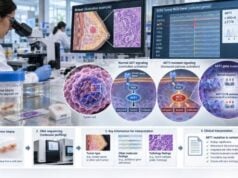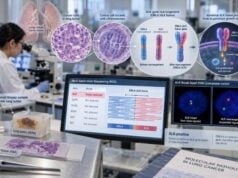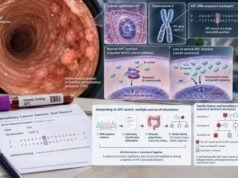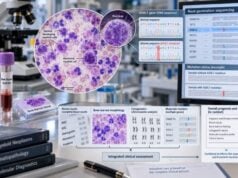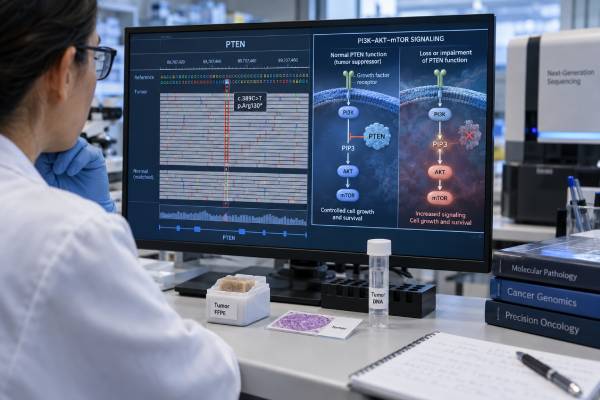
A PTEN mutation test looks for changes in the PTEN tumor suppressor gene, but the meaning depends strongly on what sample was tested. A pathogenic germline PTEN variant found in blood, saliva, or another non-tumor sample can establish PTEN hamartoma tumor syndrome (PHTS), an inherited condition associated with characteristic overgrowth findings and increased risks of several cancers. A PTEN alteration found only in a tumor is much more common and usually reflects an acquired event that helps the cancer grow by activating the PI3K-AKT-mTOR signaling pathway. Tumor reports may describe a mutation, deletion, copy-number loss, or loss of PTEN protein expression; these findings are related but not interchangeable. The result should therefore be read with the specimen type, variant classification, allele fraction, copy-number data, tumor type, and personal and family history. A PTEN result can be important for hereditary-risk assessment, tumor biology, prognosis in selected settings, and clinical-trial eligibility, but it is not a universal stand-alone treatment marker.
- A pathogenic germline PTEN variant supports a diagnosis of PTEN hamartoma tumor syndrome and has implications for relatives.
- A PTEN alteration found on tumor-only testing is not automatically inherited; confirmatory germline testing may be needed when hereditary risk is plausible.
- PTEN normally restrains PI3K-AKT-mTOR signaling, so loss of PTEN function can promote cell growth, survival, and cancer development.
- A PTEN variant of uncertain significance does not establish PHTS and should not be managed as a pathogenic result.
- PTEN loss may affect prognosis or therapy sensitivity in some cancers, but its predictive value is tumor- and treatment-specific.
Table of Contents
- What the PTEN Test Measures
- Germline Versus Somatic PTEN Testing
- How to Interpret PTEN Results
- PTEN Hamartoma Tumor Syndrome
- PTEN in Cancer and Treatment Decisions
- Testing Methods and Limitations
- What to Do After a PTEN Result
What the PTEN Test Measures
PTEN is a tumor suppressor gene on chromosome 10. Its best-known protein function is to remove a phosphate group from PIP3, opposing PI3K signaling and helping keep AKT and mTOR activity under control. In plain language, PTEN acts like a brake on signals that tell cells to grow and survive. When PTEN function is lost, that brake weakens.
Clinical testing can identify several types of PTEN abnormality:
- Single-nucleotide variants that change one DNA letter.
- Small insertions or deletions that disrupt the reading frame.
- Splice-site variants that alter RNA processing.
- Larger exon or whole-gene deletions or duplications.
- Copy-number loss in tumor tissue.
- Loss or reduction of PTEN protein by immunohistochemistry (IHC).
These findings do not all have the same significance. A known loss-of-function germline variant can cause PHTS. A tumor may lose PTEN through mutation, deletion, epigenetic regulation, or other mechanisms without the patient having an inherited syndrome.
PTEN also sits in a pathway that includes PIK3CA, AKT, and mTOR. For that reason, tumor reports often discuss PTEN alongside PIK3CA mutation status and other pathway alterations. The presence of a pathway abnormality does not mean all drugs targeting that pathway will work; predictive biomarkers must be validated for the specific cancer and therapy.
Germline Versus Somatic PTEN Testing
The first question to ask about any PTEN result is: What tissue was tested?
Germline testing usually uses blood, saliva, or cultured non-tumor cells. A pathogenic or likely pathogenic variant found in a true germline sample is generally present in most cells of the body and can be inherited. When the clinical picture fits, this establishes PHTS.
Somatic testing uses cancer tissue or circulating tumor DNA. A PTEN variant in a tumor may have arisen during cancer development and may exist only in the malignant cells. Somatic PTEN loss is seen across many cancer types, including prostate, endometrial, glioma, melanoma, and others.
Tumor-only testing creates a gray zone because the laboratory sees the tumor sequence without a matched normal comparison. Some variants in hereditary cancer genes can appear on a solid tumor NGS panel even when they are actually germline. Conversely, a tumor-only panel can miss germline variants that its design does not reliably detect.
For PTEN, referral for germline evaluation is especially important when the patient also has features suggestive of PHTS, such as macrocephaly, characteristic mucocutaneous lesions, multiple hamartomatous gastrointestinal polyps, early or multiple primary cancers, or a family history compatible with autosomal dominant inheritance. Age, tumor type, variant allele fraction, and the exact PTEN variant can help triage the question, but none of these replaces testing of non-tumor DNA when germline status matters.
Mosaicism adds another layer. A PTEN pathogenic variant can arise after conception and be present in only a fraction of cells. Depending on which tissues carry the variant, blood or saliva testing may show a lower allele fraction or may occasionally miss it. Genetics specialists may recommend testing another tissue when clinical suspicion remains strong.
How to Interpret PTEN Results
A germline report should clearly classify the variant. The five standard categories are pathogenic, likely pathogenic, variant of uncertain significance, likely benign, and benign.
Pathogenic or likely pathogenic
A pathogenic or likely pathogenic germline PTEN variant is considered disease-causing and supports PHTS. The result can change cancer surveillance and can be used for targeted family testing. The exact variant notation should be kept because relatives need testing for the same familial change.
On a tumor report, “pathogenic” means the variant is biologically important in cancer; it does not automatically mean it was inherited. The report may also assign an actionability tier based on whether the alteration is linked to an approved therapy, guideline recommendation, clinical trial, or biological evidence.
Variant of uncertain significance
A VUS is not a positive hereditary cancer result. It means evidence is insufficient to decide whether the change impairs PTEN function in a clinically meaningful way. Management should rely on personal and family history rather than treating a VUS like PHTS. Testing unaffected relatives solely to “track” a VUS is usually not clinically informative unless a genetics team is using segregation analysis as part of a formal reclassification effort.
Negative result
A negative germline PTEN result can be reassuring when a known familial variant was specifically excluded. In a person with strong PHTS-like features but no identified PTEN pathogenic variant, however, it may be an “uninformative negative.” Another gene, mosaicism, a structural variant, or a phenotype that overlaps PHTS may need consideration.
A negative tumor PTEN result simply means the assay did not detect a reportable alteration within its validated scope. It does not guarantee normal PTEN protein expression or normal PI3K pathway function.
PTEN Hamartoma Tumor Syndrome
PHTS is an autosomal dominant disorder that includes the historical clinical labels Cowden syndrome and Bannayan-Riley-Ruvalcaba syndrome, as well as other PTEN-related phenotypes. Modern practice increasingly uses the umbrella term PHTS because the features overlap and can change with age.
Common findings include macrocephaly, skin and oral mucosal lesions, gastrointestinal polyps, vascular or soft-tissue overgrowth, and neurodevelopmental features in some children. Adults have increased risks of breast, thyroid, endometrial, renal, and colorectal cancers, with additional cancer risks still being refined.
The practical value of a confirmed germline result is that surveillance can begin before symptoms develop. Recent international consensus guidance emphasizes multidisciplinary care. Screening plans may include breast surveillance, thyroid ultrasound, renal imaging, colonoscopy, dermatologic assessment, and individualized counseling about endometrial cancer. The exact ages and intervals can differ between professional guidelines and should be adapted to sex, anatomy, age, prior findings, family history, and local standards.
A parent with a heterozygous pathogenic PTEN variant has a 50% chance of passing it to each biological child. Because PHTS can have childhood manifestations, testing minors may be appropriate in families with a known pathogenic variant when the result will change pediatric surveillance or developmental care. This differs from many adult-only hereditary cancer syndromes where predictive testing is commonly deferred.
Cancer risk is not identical for every carrier. Even relatives with the same PTEN variant can have different clinical features, a concept called variable expressivity. A family member with few visible features can still carry the variant, and a striking family history is not required for diagnosis because de novo variants also occur.
PTEN in Cancer and Treatment Decisions
Somatic PTEN loss is a common mechanism of cancer progression. It can increase PI3K-AKT-mTOR signaling, alter cellular metabolism, affect genomic stability, and change interactions between tumor cells and the immune microenvironment. In some cancers, PTEN loss correlates with aggressive features or treatment resistance, but the strength of that association varies.
A frequent misunderstanding is that a PTEN mutation is a direct drug target in the same way as some activating kinase mutations or gene fusions. PTEN is a lost tumor suppressor, so there is usually no abnormal PTEN enzyme to inhibit. Treatment strategies instead attempt to target downstream pathway dependence or other vulnerabilities created by PTEN loss.
Clinical relevance is therefore context dependent. In prostate cancer, endometrial cancer, breast cancer, and other tumors, PTEN status may be studied alongside PI3K/AKT pathway drugs. Some trials enrich for PTEN loss or use it as a stratification biomarker. However, assay definitions differ: one trial may require PTEN protein loss by IHC, another a genomic alteration, and another a composite pathway signature. These are not automatically interchangeable.
PTEN status can also interact with other biomarkers. A tumor may carry PTEN loss plus PIK3CA, TP53, homologous-recombination, or receptor-tyrosine-kinase alterations. Treatment selection should prioritize biomarkers with established clinical validity for that tumor type rather than assuming the PTEN result overrides the rest of the molecular profile.
For this reason, a tumor report often uses terms such as “potential clinical significance,” “clinical trial,” or “investigational.” Those labels matter. They distinguish biological plausibility from a biomarker that is validated to select an approved therapy.
Testing Methods and Limitations
Next-generation sequencing is the most common DNA method, but panel design matters. Some assays detect small variants well but are less sensitive to exon-level deletions, complex rearrangements, low-level mosaicism, or low-frequency subclones. Germline PHTS testing should include deletion/duplication analysis unless the laboratory demonstrates equivalent copy-number detection within its sequencing assay.
Tumor purity can change the apparent variant allele fraction. A low-frequency PTEN variant may reflect a subclone, contamination by normal cells, low tumor content, or mosaicism. A high allele fraction can result from loss of the normal PTEN copy. Therefore, allele fraction alone cannot determine germline status.
IHC measures protein, not DNA. Complete PTEN protein loss can support functional inactivation even when no sequence variant is detected, while a DNA variant may not always produce complete protein loss. Preanalytic factors such as fixation, antibody performance, and internal controls also affect IHC.
Copy-number calls require caution because whole-chromosome or arm-level loss can include PTEN without proving that PTEN is the dominant driver. Conversely, a focal homozygous deletion is stronger evidence of direct PTEN inactivation. Laboratories should describe whether a call is single-copy loss, biallelic loss, or inferred from broader genomic loss.
Finally, variant classification changes over time. A VUS may later become benign or pathogenic as functional data, population frequencies, segregation evidence, and expert curation improve. Keeping the original report and checking for updates is useful, especially when the variant could affect family care.
What to Do After a PTEN Result
For a germline pathogenic or likely pathogenic result, the next step is a genetics visit or clinician review focused on PHTS. The goal is to translate a laboratory label into a practical plan: which organs require surveillance, when screening should start, whether current symptoms need evaluation, and which relatives should be offered targeted testing.
For a tumor-only PTEN alteration, ask three separate questions:
- Is this alteration clinically actionable for this cancer today? The oncology team should distinguish approved indications from investigational options.
- Could the finding be germline? Personal history, phenotype, family history, and the exact variant determine whether confirmatory testing is appropriate.
- Was PTEN status measured in the way relevant to the proposed therapy or trial? DNA mutation, copy-number loss, and IHC loss may not satisfy the same eligibility criteria.
For a VUS, avoid major preventive surgery or family predictive testing based solely on the uncertain result. For a negative result with strong clinical suspicion, review whether the assay included copy-number changes, whether mosaicism is possible, and whether a broader hereditary cancer or overgrowth panel would be more informative.
PTEN testing is most useful when the result is placed in the correct lane: germline PTEN answers hereditary-risk questions; somatic PTEN describes tumor biology; and neither should be substituted for the other without confirmation.
References
- PTEN Hamartoma Tumor Syndrome 2026 (Review)
- Cancer and Overgrowth Manifestations of PTEN Hamartoma Tumor Syndrome: Management Recommendations from the International PHTS Consensus Guidelines Working Group 2025 (Guideline)
- Neurodevelopmental and Neurologic Manifestations of PTEN Hamartoma Tumor Syndrome: Management Recommendations 2025 (Guideline)
- Decoding PTEN: from biological functions to signaling pathways in tumors 2024 (Review)
- Cancer Surveillance Guideline for individuals with PTEN hamartoma tumour syndrome 2020 (Guideline)
Disclaimer
PTEN results can affect inherited cancer surveillance, family testing, and oncology decisions, but the correct interpretation depends on the specimen and assay. A genetics professional, pathologist, or oncologist should review the actual report before medical or family decisions are made. This article is educational and is not a substitute for individualized care.