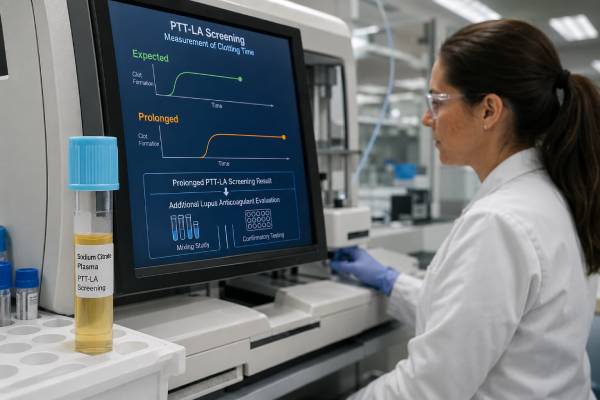
The PTT-LA test is an activated partial thromboplastin time designed to be sensitive to lupus anticoagulant. It measures how long plasma takes to clot after a low-phospholipid reagent activates the intrinsic coagulation pathway. A prolonged PTT-LA can be an important first clue, but it is not a positive lupus anticoagulant diagnosis by itself. Heparin, direct oral anticoagulants, warfarin-related factor reduction, clotting-factor deficiencies, specific factor inhibitors, inflammation, and sample problems can all lengthen the result. Laboratories therefore interpret an abnormal screen through additional steps, often including medication checks, a mixing study, and a phospholipid-rich confirmation test such as hexagonal phospholipid neutralization. The result matters most when it is part of a complete lupus anticoagulant panel and is considered alongside clotting or pregnancy history, anticardiolipin antibodies, and beta-2 glycoprotein I antibodies.
- PTT-LA is a lupus anticoagulant-sensitive screening test, not the same as every routine aPTT used in a hospital.
- A prolonged result means the clotting reaction was delayed, but it does not identify the cause.
- Failure to correct in a mixing study suggests an inhibitor, although weak lupus anticoagulants may appear to correct after dilution.
- Shortening with added phospholipid supports phospholipid dependence, a key feature of lupus anticoagulant.
- Anticoagulant medication is a major source of misleading results, so timing and drug information are essential.
- Persistent lupus anticoagulant positivity, not one abnormal PTT-LA, carries the clearest APS significance.
Table of Contents
- How the PTT-LA test works
- Why PTT-LA is ordered
- What a prolonged PTT-LA means
- How screen, mix, and confirmation results fit together
- Medication, illness, and sample effects
- What PTT-LA means for APS and clotting risk
- Next steps after the result
How the PTT-LA test works
PTT-LA belongs to the activated partial thromboplastin time family. In the laboratory, platelet-poor plasma is combined with an activator, phospholipid, and calcium. The instrument records the number of seconds until a fibrin clot forms. This reaction depends on several proteins in the intrinsic and common coagulation pathways, including factors XII, XI, IX, VIII, X, V, II, and fibrinogen.
The “LA” portion of the name refers to reagent design. PTT-LA reagents contain a phospholipid concentration and composition chosen to make the assay responsive to antibodies that interfere with phospholipid-dependent clotting reactions. A routine aPTT reagent may be relatively sensitive or insensitive to lupus anticoagulant depending on its formulation. That is why a normal hospital aPTT cannot reliably exclude lupus anticoagulant, and an isolated prolonged routine aPTT is not automatically equivalent to an abnormal PTT-LA.
Lupus anticoagulants are a diverse group of antiphospholipid antibodies. In the test tube, they bind to phospholipid-protein surfaces needed for coagulation and can delay clot formation. In the body, however, their major clinical association is thrombosis and certain pregnancy complications rather than spontaneous bleeding. The word “anticoagulant” describes the laboratory effect, not the patient’s usual clinical tendency.
Some laboratories report PTT-LA in seconds. Others calculate a ratio by dividing the patient’s clotting time by a laboratory reference value or pooled normal plasma result. A ratio helps reduce differences between reagent lots, instruments, and laboratories, but the cutoff remains method-specific. A result should always be compared with the reference interval printed on that report.
PTT-LA is usually paired with dilute Russell viper venom time because the two tests activate coagulation at different points. PTT-LA evaluates an aPTT-based pathway, while dRVVT testing activates factor X directly. No single assay detects every lupus anticoagulant. Using two mechanistically different systems improves the chance of finding clinically relevant antibodies while preserving specificity.
A normal PTT-LA therefore means only that this particular reagent system did not show significant prolongation. A lupus anticoagulant may still be detected by dRVVT, especially if the antibody does not strongly affect the aPTT-based method. Conversely, an abnormal PTT-LA with normal dRVVT may still be meaningful if follow-up testing demonstrates an inhibitor and phospholipid dependence.
Why PTT-LA is ordered
PTT-LA may be ordered when a clinician suspects lupus anticoagulant because of a patient’s medical history or because another coagulation test is unexpectedly prolonged. It is commonly included in a lupus anticoagulant reflex panel, where the laboratory automatically adds selected tests according to the screening result.
Clinical reasons for testing include:
- An unprovoked deep vein thrombosis or pulmonary embolism
- Ischemic stroke, transient ischemic attack, or another arterial thrombosis at an unusually young age
- Recurrent thrombosis or a clot in an unusual vascular location
- Recurrent pregnancy loss, fetal death, or severe placenta-mediated pregnancy complications
- Systemic lupus erythematosus with possible antiphospholipid syndrome
- An unexplained prolonged aPTT found before surgery or during another evaluation
- Thrombocytopenia or other findings that raise suspicion for an antiphospholipid antibody disorder
Testing is most useful when the pretest probability is meaningful. Broad screening of people without a compatible clinical history can produce confusing weak positives, especially during acute illness or anticoagulant treatment. A laboratory abnormality has a much lower chance of representing clinically important APS when testing was ordered without a focused reason.
PTT-LA can also help investigate an isolated prolonged aPTT. The differential diagnosis includes heparin contamination, direct thrombin inhibitors, factor VIII or IX deficiency, von Willebrand disease with low factor VIII, factor XI or XII deficiency, contact-factor deficiencies, acquired factor inhibitors, and lupus anticoagulant. The clinical pattern helps separate these possibilities. A person with severe factor VIII deficiency may have bleeding, whereas a person with lupus anticoagulant may have no bleeding and may instead have a clotting history. These patterns are helpful but not absolute.
The test is not a complete APS panel. APS laboratory evaluation also requires solid-phase antibody tests for anticardiolipin IgG and IgM and anti-beta-2 glycoprotein I IgG and IgM. A full antiphospholipid syndrome blood test panel integrates those antibody measurements with functional lupus anticoagulant assays.
Timing matters. Testing during the first days of an acute thrombosis can be difficult because inflammation, high factor VIII, anticoagulant treatment, and changes in coagulation proteins may alter results. In many situations, immediate treatment of the clot is more important than obtaining an ideal lupus anticoagulant sample. Testing can be planned later when it is clinically safe and likely to be interpretable.
What a prolonged PTT-LA means
A prolonged PTT-LA means the plasma took longer than the laboratory cutoff to form a clot in an LA-sensitive aPTT system. It does not say why. The result is a signal to investigate, not a final conclusion.
Possible explanations fall into four broad groups:
- A phospholipid-dependent inhibitor, including lupus anticoagulant
- An anticoagulant drug, such as unfractionated heparin, dabigatran, argatroban, or sometimes a factor Xa inhibitor
- A coagulation-factor deficiency, including deficiencies of factors VIII, IX, XI, or XII
- A specific inhibitor or other interference, such as an acquired factor VIII inhibitor, high C-reactive protein with some reagents, or a poor-quality sample
The degree of prolongation does not measure clot risk. A very long PTT-LA is not necessarily more dangerous than a mildly abnormal one. The time can be strongly affected by medication or a factor deficiency, while some clinically important lupus anticoagulants produce only a small elevation.
| PTT-LA screen | What it establishes | What it does not establish |
|---|---|---|
| Within reference range | No significant prolongation in this assay | Does not exclude lupus anticoagulant detected by another method |
| Slightly prolonged | A weak abnormality near the cutoff | Does not distinguish antibody, drug, factor deficiency, or variation |
| Clearly prolonged | A substantial delay in the assay | Does not prove lupus anticoagulant or indicate clot severity |
| Prolonged while anticoagulated | An abnormal clotting time in a drug-exposed sample | May be uninterpretable without drug-specific assessment |
A weak elevation deserves particular caution. Reference cutoffs are established statistically, so a small percentage of healthy samples may fall outside the range. Preanalytical variation can move a result across the threshold. Laboratories may repeat the measurement, review the curve, or calculate a normalized ratio before deciding whether reflex testing is warranted.
A normal result should also be interpreted narrowly. Increased factor VIII during stress, pregnancy, inflammation, or acute thrombosis can shorten an aPTT-based assay and potentially mask an inhibitor. The dRVVT component and clinical history remain important when suspicion is high.
Patients sometimes see the words “prolonged clotting time” and assume they are protected from clots or at high risk of bleeding. Neither conclusion follows from PTT-LA alone. The assay measures an artificial plasma reaction under standardized laboratory conditions. In lupus anticoagulant, the paradox is that delayed clotting in vitro can coexist with increased thrombosis risk in vivo.
How screen, mix, and confirmation results fit together
Lupus anticoagulant identification is based on a pattern rather than one number. The classic logic asks three questions:
- Is a phospholipid-dependent screening test prolonged?
- Does the abnormality behave like an inhibitor when patient plasma is mixed with normal plasma?
- Does extra phospholipid shorten the clotting time, supporting phospholipid dependence?
The exact order and calculations vary by laboratory, but the principles are similar.
Screening step: PTT-LA uses a phospholipid-sensitive reagent. If the screen is normal, an aPTT-based confirmation may not be performed. The laboratory may still assess dRVVT independently.
Mixing step: Patient plasma is often mixed in a 1:1 ratio with pooled normal plasma. Normal plasma supplies missing coagulation factors. If the prolonged time corrects substantially, a factor deficiency becomes more likely. If it remains prolonged, an inhibitor is more likely. Laboratories may judge correction with a mixing-test-specific cutoff, a normalized ratio, or an index of circulating anticoagulant.
Mixing studies are not perfect. Dilution can weaken a low-titer lupus anticoagulant enough to make the mixture appear normal. A result that corrects therefore does not always exclude lupus anticoagulant, particularly when the screen and confirmation show convincing phospholipid dependence. Conversely, some factor inhibitors can produce noncorrection and must be distinguished by factor assays, bleeding history, and other testing.
Confirmation step: An LA-insensitive or phospholipid-rich reagent is used to test whether added phospholipid neutralizes the inhibitor’s effect. In an aPTT-based system, this may be a hexagonal phospholipid neutralization test. The laboratory compares clotting with and without the extra phospholipid. Meaningful shortening supports a phospholipid-dependent inhibitor.
A simplified pattern table is useful, but the laboratory’s interpretive comment should take priority:
| Screen | Mix | Phospholipid confirmation | Likely direction |
|---|---|---|---|
| Prolonged | Does not correct | Corrects or shortens significantly | Supports lupus anticoagulant |
| Prolonged | Corrects | No significant phospholipid effect | Favors factor deficiency |
| Prolonged | Does not correct | No phospholipid correction | Consider drug or specific factor inhibitor |
| Normal | Not performed | Not performed | No LA signal in the PTT-LA system |
| Prolonged | Equivocal | Equivocal | Indeterminate; review drugs, sample, and other assay results |
The final report may use words such as “detected,” “not detected,” “indeterminate,” or “unable to interpret due to anticoagulant effect.” These conclusions incorporate more information than the PTT-LA screen alone. A patient should not interpret a flagged screening value without reading the final panel interpretation.
Medication, illness, and sample effects
Anticoagulants are the most important challenge in PTT-LA interpretation. They intentionally interfere with coagulation and can imitate or hide the laboratory pattern of lupus anticoagulant.
Unfractionated heparin commonly prolongs aPTT-based tests. Some lupus anticoagulant reagents contain heparin neutralizers, but those neutralizers work only up to a stated concentration. A sample drawn from a heparinized line may be contaminated even when the patient is not receiving systemic heparin.
Low-molecular-weight heparin usually has less effect on aPTT than unfractionated heparin, but interference depends on the drug, dose, sampling time, and reagent. Testing near the drug’s lowest concentration may reduce but not eliminate the problem.
Direct thrombin inhibitors, including dabigatran and argatroban, can markedly prolong PTT-LA and create false-positive inhibitor patterns. A thrombin time or drug-specific assay may help identify their presence.
Direct factor Xa inhibitors, including rivaroxaban, apixaban, and edoxaban, often affect dRVVT more strongly but can also influence aPTT-based tests. The amount of interference is reagent-dependent. A normal PTT-LA does not prove that the drug is absent.
Warfarin and other vitamin K antagonists reduce vitamin K-dependent clotting factors. This can prolong clotting assays and complicate mixing studies. Interpretation may require specialized strategies and should not rely on an improvised medication interruption.
Patients must not stop anticoagulation solely to improve a laboratory result. The risk of recurrent thrombosis may be substantial. The ordering clinician and laboratory may instead postpone testing, collect at a carefully selected time, measure drug activity, use validated neutralization or adsorption methods, or report the result as limited.
Acute illness creates additional problems. High factor VIII may shorten the assay and conceal lupus anticoagulant. Markedly elevated C-reactive protein can prolong some phospholipid-dependent tests. Pregnancy alters several coagulation proteins. Liver disease, disseminated intravascular coagulation, and severe systemic illness may produce complex patterns that do not fit a simple screen-mix-confirm model.
Sample quality matters as well. The blue-top citrate tube must be filled correctly because the blood-to-anticoagulant ratio affects clotting time. A very high hematocrit may require citrate adjustment. The plasma should be sufficiently platelet-poor because residual platelet phospholipid can neutralize lupus anticoagulant and cause a false-negative result. Delayed processing, clotted samples, and improper freezing or thawing can also distort results.
These limitations explain why a laboratory may issue an indeterminate interpretation rather than forcing a positive or negative label. An indeterminate result is not a failure; it can be the most accurate conclusion when drug or sample effects prevent confident interpretation.
What PTT-LA means for APS and clotting risk
PTT-LA is a component of lupus anticoagulant testing, and lupus anticoagulant is one of the standard laboratory markers used in APS classification. APS requires both a compatible clinical event and persistent antiphospholipid antibody evidence. A prolonged PTT-LA alone meets neither requirement.
A clinically meaningful lupus anticoagulant result generally requires:
- A compatible pattern across screening and confirmation assays
- Exclusion or explanation of anticoagulant and other interferences
- Interpretation with at least two test principles, commonly PTT-LA and dRVVT
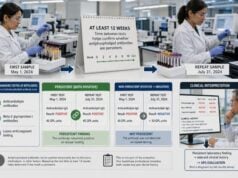
- Persistence when retested at least 12 weeks later
- A relevant clinical history if APS is being diagnosed
Among the standard antiphospholipid antibody profiles, persistent lupus anticoagulant is strongly associated with thrombosis. Risk is often higher when it occurs with anticardiolipin and anti-beta-2 glycoprotein I antibodies, especially in a conventional triple-positive profile. Yet the laboratory result does not determine an individual’s fate. Many people with an antibody never develop thrombosis, while conventional cardiovascular and temporary risks can strongly modify the chance of an event.
The clinical meaning of a positive lupus anticoagulant test differs according to history:
- No prior clot or APS-defined pregnancy event: The result may prompt repeat testing, risk-factor counseling, and planning for high-risk situations rather than automatic long-term anticoagulation.
- A prior unprovoked venous clot: Persistent positivity may influence the assessment of recurrence risk and duration of anticoagulation.
- An arterial event: The clinician must evaluate APS alongside atherosclerosis, cardiac embolism, vascular disease, and other causes.
- Pregnancy morbidity: The result is considered with the exact type and timing of loss or placental complication, plus other obstetric explanations.
- Bleeding symptoms: Alternative diagnoses such as factor deficiency or a specific factor inhibitor require attention because lupus anticoagulant itself usually does not explain major bleeding.
Repeat testing is crucial because lupus anticoagulant can be temporary after infection, inflammation, or medication exposure. The principles of 12-week antiphospholipid antibody confirmation prevent one transient abnormality from being mistaken for a persistent autoimmune marker.
Treatment should never be based on the PTT-LA seconds or ratio alone. Decisions about aspirin, heparin, warfarin, or other anticoagulation require a clinician to balance recurrent clot risk against bleeding risk and to account for pregnancy, kidney and liver function, other medications, and the type of prior event.
Next steps after the result
The most useful next step is to obtain the complete laboratory interpretation. Ask whether the PTT-LA was merely prolonged or whether the overall panel supported lupus anticoagulant after mixing and confirmation. Also check whether dRVVT, anticardiolipin, and anti-beta-2 glycoprotein I testing were completed.
After a normal PTT-LA, next steps may include:
- Reviewing the dRVVT result because lupus anticoagulant may be detected by only one system
- Completing solid-phase APS antibody testing when clinically indicated
- Looking for other causes of thrombosis, pregnancy complications, or abnormal coagulation tests
- Avoiding repeated testing when the clinical probability is low and the complete panel is negative
After a prolonged PTT-LA with no final interpretation, ask whether reflex tests are pending. A screen may be released before the mixing or confirmation results. It is premature to label the result positive while the panel is incomplete.
After a result favoring factor deficiency, additional testing may include factor VIII, IX, XI, or XII activity and, when appropriate, von Willebrand testing. Bleeding history helps prioritize these possibilities. Contact-factor deficiencies can produce a strikingly prolonged aPTT without clinical bleeding, whereas factor VIII or IX deficiency can be associated with significant bleeding.
After a result suggesting a specific inhibitor, urgent hematology assessment may be needed, especially when new bleeding accompanies a very low factor VIII activity. This pattern is clinically different from lupus anticoagulant even though both may cause a noncorrecting mix.
After an indeterminate result due to medication, the clinician may coordinate a safer testing strategy with the coagulation laboratory. The plan may involve a later sample, a trough-level draw, measurement of anticoagulant activity, or a validated drug-removal approach. Medication changes should be medically supervised.
After a lupus anticoagulant-positive interpretation, the next steps commonly include:
- Confirming whether the antibody was present on a previous sample at least 12 weeks earlier
- Repeating testing when persistence has not yet been established
- Reviewing the objective evidence for any clot or pregnancy complication
- Assessing other antiphospholipid antibodies and conventional vascular risks
- Discussing treatment only after the clinical and laboratory evidence has been integrated
Seek emergency care for sudden shortness of breath, chest pain, coughing blood, one-sided leg swelling, facial droop, new weakness, speech difficulty, sudden visual loss, or another possible clot symptom. An abnormal or normal PTT-LA should not change the urgency of those symptoms.
The central lesson is that PTT-LA is a sensitive question posed to the coagulation system, not a complete answer. Its value comes from the pattern created by the screen, mixing behavior, phospholipid confirmation, companion assays, and the patient’s history. Reading only the flagged clotting time removes the safeguards that make lupus anticoagulant testing clinically useful.
References
- An update on laboratory detection and interpretation of antiphospholipid antibodies for diagnosis of antiphospholipid syndrome: guidance from the ISTH-SSC Subcommittee on Lupus Anticoagulant/Antiphospholipid Antibodies. 2025. Guidance document.
- Update on the Laboratory Diagnosis of Lupus Anticoagulant. 2025. Review.
- Testing for the lupus anticoagulant: the good, the bad, and the ugly. 2024. Review.
- Lupus Anticoagulant Detection under the Magnifying Glass. 2023. Review.
- Analytical dilemmas in lupus anticoagulant detection. 2023. Review.
- Lupus Anticoagulant Reflex Panel. 2025. Laboratory test fact sheet.
Disclaimer
This article provides general education and is not a substitute for medical advice, diagnosis, or treatment. Lupus anticoagulant testing is technically complex and must be interpreted by qualified clinicians and laboratory professionals with medication and clinical context. Seek urgent care for symptoms of a possible clot, stroke, serious bleeding, or pregnancy emergency.