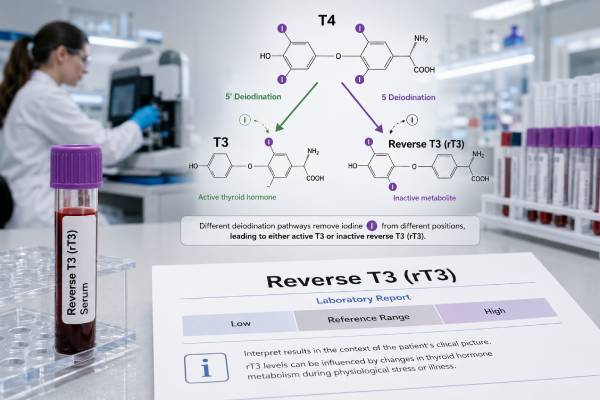
A reverse T3 test measures an inactive metabolite made when the body converts thyroxine (T4). Reverse T3, abbreviated rT3, often rises during severe illness, major surgery, starvation, or substantial calorie restriction because thyroid hormone metabolism shifts away from active T3. That change is part of non-thyroidal illness syndrome and does not automatically mean the thyroid gland is failing. In healthy, non-hospitalized adults, rT3 usually adds little to standard testing with thyroid-stimulating hormone (TSH) and free T4. It cannot reliably diagnose hypothyroidism, prove “poor conversion,” or determine whether someone needs T3 medication. Laboratories also use different methods and reference intervals, so there is no universal optimal rT3 value or accepted free-T3-to-rT3 ratio target. The test has limited specialist uses, including selected investigations of rare thyroid hormone metabolism disorders and unusual illness patterns. An unexpected result should be interpreted with TSH, free T4, T3, medication use, nutrition, liver and kidney function, and the reason the test was ordered.
- Reverse T3 is an inactive T4 metabolite, not a hormone that routinely measures thyroid gland output.
- High rT3 commonly occurs during critical illness, fasting, severe calorie restriction, trauma, and some medication exposures.
- A high rT3 result does not diagnose hypothyroidism or prove that T4 is being “blocked” from entering cells.
- Low rT3 is usually not clinically meaningful and is not an established treatment target.
- Reference ranges vary by assay; many laboratories report adult values in ng/dL or pg/mL with method-specific limits.
- TSH and free T4 remain the preferred first-line tests for suspected primary hypothyroidism.
Table of Contents
- What Reverse T3 Is and How It Is Made
- When a Reverse T3 Test Is Used
- Causes and Meaning of High Reverse T3
- Low Results, Normal Ranges, and Ratios
- Why rT3 Does Not Diagnose Poor Thyroid Conversion
- Preparation and Result Interpretation
- More Useful Tests and Next Steps
What Reverse T3 Is and How It Is Made
The thyroid gland releases mostly T4 and a smaller amount of T3. T4 acts partly as a circulating reserve. Enzymes called deiodinases remove one iodine atom from T4 and direct it down one of two main pathways:
- Removal from the outer ring forms active T3, which binds thyroid hormone receptors and affects metabolism, heart function, temperature regulation, growth, and many other processes.
- Removal from the inner ring forms reverse T3, or 3,3′,5′-triiodothyronine, which has little or no classic thyroid-hormone activity.
Reverse T3 is produced normally every day. It is not a toxin or an abnormal substance that must be “cleared” to restore metabolism. Another deiodinase rapidly converts rT3 into inactive metabolites, so the blood concentration reflects both production and breakdown.
Deiodinase control
Three deiodinase enzymes help regulate thyroid hormone locally:
- Type 1 deiodinase (D1) contributes to circulating T3 production and rT3 clearance, especially in the liver and kidney.
- Type 2 deiodinase (D2) produces T3 inside tissues such as the brain, pituitary, and skeletal muscle.
- Type 3 deiodinase (D3) inactivates T4 to rT3 and T3 to T2, protecting tissues from excessive stimulation.
Illness, inflammation, medications, nutrition, age, pregnancy, and organ function can change these enzymes. A serum rT3 value is therefore a snapshot of whole-body metabolism, not a direct measurement of what every tissue is doing.
How rT3 differs from T3
T3 is biologically active and is useful in evaluating suspected hyperthyroidism. Reverse T3 has the same number of iodine atoms but a different arrangement. It does not substitute for a free T3 test or total T3, and the two values should not be interpreted as equal competitors in a simple bloodstream ratio.
The idea that rT3 physically blocks T3 receptors throughout the body is not supported as a routine explanation for fatigue, weight gain, brain fog, or low body temperature. Those symptoms are real but nonspecific and require broader assessment.
When a Reverse T3 Test Is Used
Routine thyroid guidelines rarely recommend rT3 for outpatient screening. TSH and free T4 answer the central diagnostic questions more reliably and have standardized clinical decision pathways.
Situations where rT3 is usually unnecessary
Reverse T3 generally does not help with:
- Initial diagnosis of primary hypothyroidism
- Choosing a levothyroxine dose
- Deciding whether normal TSH symptoms require liothyronine
- Diagnosing Hashimoto thyroiditis
- Evaluating thyroid nodules
- Routine weight-loss assessment
- Monitoring pregnancy thyroid status
- Proving adrenal fatigue, chronic stress, or “metabolic shutdown”
A person can have confirmed hypothyroidism with a low, normal, or high rT3 depending on T4 concentration, illness, medication, and assay timing. A person without thyroid disease can have high rT3 during hospitalization. This overlap makes the test a poor discriminator.
Selected specialist applications
Specialists may use rT3 in narrow circumstances. One example is distinguishing rare inherited disorders of thyroid hormone metabolism. In consumptive hypothyroidism, tumors with very high D3 activity convert large amounts of T4 to rT3 and T3 to inactive products. This is uncommon and usually occurs with a striking clinical and laboratory picture.
The 2024 European Thyroid Association guideline on genetic disorders of thyroid hormone transport, metabolism, and action includes rT3 in selected diagnostic pathways. For example, serum rT3 and ratios involving T3 or T4 may contribute to evaluation of rare deiodinase or transporter disorders when interpreted by an endocrine genetics team. These uses should not be generalized to common fatigue or treated Hashimoto thyroiditis.
Reverse T3 has also been studied as a severity or prognosis marker in critical illness, heart failure, liver disease, kidney disease, and older adults. An association with poor outcome does not prove that rT3 causes the outcome or that lowering it improves survival.
Research versus clinical treatment
A biomarker can be biologically interesting without being a useful treatment target. Researchers measure rT3 to understand hormone metabolism and stress responses. Clinical usefulness requires evidence that a result changes a decision and improves outcomes. That evidence is lacking for routine rT3-guided thyroid treatment.
Causes and Meaning of High Reverse T3
A high rT3 result usually reflects altered T4 metabolism or reduced rT3 clearance. It does not identify one disease on its own.
Non-thyroidal illness syndrome
Severe illness can lower serum T3, leave TSH normal or low, and raise rT3. With increasing illness severity, T4 may also fall. This pattern is called non-thyroidal illness syndrome, low-T3 syndrome, or euthyroid sick syndrome.
Common settings include:
- Sepsis and major infection
- Heart attack, stroke, or severe heart failure
- Major surgery or trauma
- Respiratory failure and intensive care
- Advanced liver or kidney disease
- Cancer and severe inflammatory disease
- Burns and prolonged hospitalization
The changes involve deiodinase activity, cytokines, binding proteins, hypothalamic-pituitary signaling, drugs, and reduced nutrition. They may conserve energy or represent maladaptation; the balance can differ by illness stage. Most clinicians treat the underlying disease rather than treating an isolated rT3 value.
During recovery, TSH may temporarily rise and rT3 may change again. Testing thyroid markers too often in acute illness can create a confusing sequence of abnormalities. Unless thyroid disease is strongly suspected, repeat TSH and free T4 after recovery often provides a clearer answer.
Calorie restriction and starvation
Fasting and severe calorie restriction reduce T3 production and can increase rT3. This response lowers energy expenditure during limited fuel availability. It can occur during eating disorders, prolonged fasting, extreme dieting, or severe malnutrition.
A high rT3 in this setting should not be used as a reason to prescribe T3 while nutritional deficiency continues. Restoring adequate energy, protein, and micronutrient intake is central. Rapid or unsupervised refeeding can be dangerous in severe malnutrition and requires clinical care.
Medications
Several drugs can change conversion or thyroid-test interpretation:
- Amiodarone inhibits conversion of T4 to T3 and commonly raises rT3. It also contains iodine and can cause true hypothyroidism or thyrotoxicosis.
- Glucocorticoids reduce T4-to-T3 conversion at higher doses and suppress TSH.
- Propranolol at substantial doses can reduce peripheral conversion, although its main hyperthyroidism role is controlling heart rate and tremor.
- Iodinated contrast and high iodine exposure can alter thyroid physiology in susceptible people.
- Levothyroxine provides more T4 substrate, so treated patients may have higher rT3 than untreated people without proving tissue hypothyroidism.
A medication-related result should be discussed in light of the drug’s purpose and the full thyroid panel. Essential medicines should not be stopped to change rT3.
Liver and kidney function
The liver and kidneys participate in deiodination and clearance. Advanced organ dysfunction can alter rT3 along with T3, T4, binding proteins, albumin, and TSH. The test does not separate organ disease from thyroid disease reliably.
Older age and physiologic stress
Age, inflammation, injury, and major physiologic stress can shift hormone metabolism toward lower T3 and higher rT3. These changes are not equivalent to primary hypothyroidism, which is usually identified by elevated TSH and low free T4.
Low Results, Normal Ranges, and Ratios
Reverse T3 has no universally accepted “optimal” range. Laboratories establish their own intervals based on method, specimen type, calibration, and reference population.
Typical reporting units
Results may be reported in:
- ng/dL
- pg/mL
- ng/mL
- nmol/L
One laboratory may list an adult interval near 10 to 24 ng/dL, while another uses different boundaries. Converting units incorrectly can make a normal value look extreme. Use the range printed beside the result and confirm the unit before comparing information from another source.
Mass-spectrometry methods and immunoassays can produce different values. Age-specific intervals may be needed in infants and children, and pregnancy can alter thyroid hormone metabolism. A result near a cutoff should not be treated as a sharp biological divide.
What low rT3 means
A low result may occur when T4 is low, when conversion toward T3 is favored, or because of assay variation. It is expected in some people with untreated hypothyroidism because there is less T4 available to convert. It may also occur with hyperthyroidism, certain medications, or no clinically important disorder.
There is no established disease called “reverse T3 deficiency,” and no standard treatment aims to raise rT3. A low value does not prove unusually efficient metabolism or rule out thyroid disease.
Why a normal result is limited
A normal rT3 does not exclude hypothyroidism. Primary hypothyroidism can still be present when TSH is high and free T4 is low. Likewise, normal rT3 does not guarantee that fatigue, hair loss, constipation, depression, or weight change comes from the thyroid.
Free T3-to-rT3 ratio
Some practitioners calculate a free-T3-to-rT3 ratio or total-T3-to-rT3 ratio and assign a target such as greater than a specific number. No major endocrine guideline endorses a universal ratio for diagnosing hypothyroidism or selecting T3 therapy.
The ratio combines two measurements with separate assay errors, units, reference intervals, binding effects, and time-of-day variation. A ratio can change because T3 falls, rT3 rises, or both. It does not reveal receptor activity, intracellular T3 concentration, mitochondrial function, or symptoms in a validated way.
Ratios can have research value in defined diseases, but using them as universal outpatient treatment thresholds goes beyond the evidence.
Age, pregnancy, and newborn values
Reverse T3 is not constant across the lifespan. Newborns have rapid changes in TSH, T4, T3, and rT3 as they adapt after delivery, and pediatric reference data differ from adult intervals. A value from an adult commercial panel should not be used to judge an infant or child. Congenital hypothyroidism screening relies on neonatal TSH and, in some programs, T4—not routine rT3.
Pregnancy also changes thyroid-binding proteins, hormone production, placental deiodinase activity, and laboratory ranges. Placental D3 helps protect the fetus from excessive maternal thyroid hormone and contributes to inactive hormone metabolism. Even so, rT3 is not a standard test for diagnosing or monitoring maternal hypothyroidism. Trimester-specific TSH and free T4 guidance is more useful.
Biological and analytical variation
A person’s rT3 can vary with recent food intake, sleep disruption, illness stage, medication exposure, and the time since a thyroid hormone dose. Sample handling and assay calibration add analytical variation. Small changes within or near the reference interval may reflect this combined noise rather than a meaningful metabolic shift.
When a repeat is genuinely needed, it should use the same laboratory, the same units, similar medication timing, and a comparable state of health. Comparing one immunoassay result with a mass-spectrometry result from another laboratory can create an apparent trend that is actually a method difference.
Why rT3 Does Not Diagnose Poor Thyroid Conversion
“Poor conversion” is often used to suggest that a person makes excessive rT3 instead of active T3 despite normal TSH and free T4. Human thyroid physiology is more complex than a single split at T4.
Serum values do not map every tissue
Different organs express different deiodinases. The brain can maintain local T3 through D2 even when serum T3 changes. The liver contributes to circulating hormone patterns, while the pituitary senses thyroid hormone through its own local conversion. A blood rT3 concentration cannot quantify all these tissue-specific processes.
High rT3 is often an effect, not a cause
Critical illness, fasting, inflammation, and medications change rT3. Treating the number without correcting the trigger reverses cause and effect. Clinical trials have not established that lowering rT3 in otherwise stable outpatients improves fatigue, weight, cognition, or long-term outcomes.
Symptoms are nonspecific
Fatigue, brain fog, cold hands, low mood, weight difficulty, and reduced exercise tolerance occur with sleep apnea, anemia, iron deficiency, depression, menopause, chronic infection, heart disease, medication effects, low calorie intake, and many other conditions. Labeling normal-TSH symptoms as high-rT3 thyroid disease can delay a broader diagnosis.
TSH and free T4 have validated meaning
In primary hypothyroidism, high TSH reflects the pituitary’s response to insufficient thyroid hormone. Free T4 helps classify severity. These tests have outcome-based treatment pathways. The hypothyroidism blood test panel can add TPOAb when Hashimoto thyroiditis is suspected. rT3 has not shown comparable value for routine diagnosis.
Treated hypothyroidism
Levothyroxine-treated patients may have slightly higher T4, lower T3, and higher rT3 on average than untreated euthyroid controls. This biochemical difference does not prove that rT3 causes persistent symptoms. A 2025 observational study found higher rT3 in symptomatic patients taking T4-only therapy than in those taking T3-containing therapy, but the authors stated that causation cannot be concluded. Treatment groups differed, the study was not a randomized outcome trial, and symptoms can have many sources.
Medication changes based on rT3 alone can produce high T3 peaks, suppressed TSH, palpitations, bone loss, or arrhythmia. Any trial of combination therapy should follow specialist assessment and standard monitoring rather than a ratio target.
Preparation and Result Interpretation
No universal fasting rule exists for rT3, but standardized conditions improve repeatability. Follow the ordering laboratory’s instructions.
Before testing
Provide a full list of:
- Levothyroxine, liothyronine, or desiccated thyroid
- Amiodarone, steroids, beta blockers, and iodine-containing drugs
- Biotin and other supplements
- Recent surgery, hospitalization, infection, or trauma
- Major weight loss, fasting, restrictive dieting, or eating disorder symptoms
- Liver, kidney, heart, or pituitary disease
- Pregnancy status
Biotin can interfere with some thyroid immunoassays, although the direction depends on the platform. Many laboratories advise stopping non-prescription biotin for at least 48 hours. High-dose prescribed biotin requires clinician guidance.
Medication timing
T4 and T3 levels change after thyroid medicine. Taking levothyroxine before the draw can raise free T4; liothyronine produces a larger short-term T3 peak. If rT3 is repeated, use the same timing relative to medication and record it. Do not skip prescription medicine unless instructed.
Questions to ask about the result
A useful interpretation starts with:
- Why was rT3 ordered?
- Was the person acutely ill or restricting calories?
- What are TSH, free T4, and total or free T3?
- Which assay and reference interval were used?
- Are medications likely to change conversion?
- Would the rT3 result alter management after the standard tests are considered?
If the answer to the last question is no, repeating rT3 may add cost without improving care.
More Useful Tests and Next Steps
For most thyroid concerns, the next test should match the suspected condition rather than expand into every available marker.
Suspected primary hypothyroidism
Start with TSH, often using a TSH with reflex to free T4. High TSH with low free T4 confirms overt primary hypothyroidism. High TSH with normal free T4 suggests subclinical hypothyroidism and may need confirmation. TPOAb can support Hashimoto thyroiditis.
Suspected hyperthyroidism
Low TSH should be followed by free T4 and T3. T3 is especially important when free T4 is normal but symptoms and TSH suggest thyrotoxicosis. TRAb or TSI can identify Graves disease.
Severe illness
In hospitalized patients, thyroid testing is most useful when there is a specific reason to suspect true thyroid disease. If results show low T3 with normal or low TSH, clinicians consider non-thyroidal illness, medications, and prior thyroid history. Repeat testing after recovery is often more informative than rT3.
Persistent symptoms on levothyroxine
Review TSH, free T4, adherence, dose timing, drug interactions, absorption, sleep, anemia, mood, cardiopulmonary health, menopause, and nutrition. The levothyroxine monitoring panel focuses on validated dose markers and common reasons a previously stable TSH changes.
Rare metabolism disorders
When free T4, T3, and TSH form an unusual pattern that persists across reliable assays, endocrinology evaluation is appropriate. Specialized testing may include rT3, binding proteins, genetic studies, or hormone measurements by mass spectrometry. This is a different use from routine wellness panels.
An rT3 result can describe part of thyroid hormone metabolism, but it rarely supplies the missing diagnosis in a stable outpatient. Its safest use is narrow, question-driven, and subordinate to the clinical picture and standard thyroid tests.
References
– Thyroid Stimulating Hormone and Thyroid Hormones (Triiodothyronine and Thyroxine): An American Thyroid Association-Commissioned Review of Current Clinical and Laboratory Status 2023 (Review) – 2024 European Thyroid Association Guidelines on diagnosis and management of genetic disorders of thyroid hormone transport, metabolism and action 2024 (Guideline) – Reverse T3 in patients with hypothyroidism on different thyroid hormone replacement 2025 – The Role of Triiodothyronine (T3) in Thyroid Hormone Replacement Therapy: A Review of Current Evidence and Future Directions 2025 (Review) – Thyroid Function Tests 2023 – Thyroid Hormone Treatment 2023
Disclaimer
This information is educational and does not diagnose thyroid disease or recommend a medication change. Reverse T3 methods and ranges vary, and the result is especially difficult to interpret during illness. Review thyroid symptoms and all laboratory results with a qualified clinician.