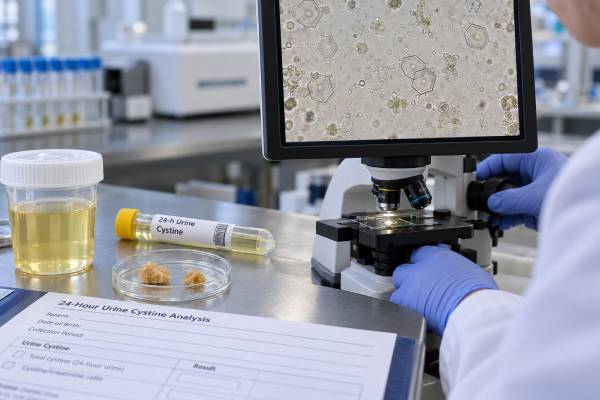
A urine cystine test looks for excess cystine, the poorly soluble amino acid responsible for stones in people with cystinuria. Cystinuria is an inherited kidney transport disorder involving SLC3A1 or SLC7A9 in most affected families. Because the kidneys do not reabsorb cystine normally, unusually large amounts enter the urine, where cystine can crystallize and form recurrent stones, often beginning in childhood, adolescence, or early adulthood. Testing may include a qualitative cystine screen, urine microscopy, quantitative 24-hour cystine excretion, and specialized measurements such as cystine supersaturation or cystine capacity. A high result supports cystinuria, but the practical risk of stone formation also depends on urine volume and pH because cystine becomes less concentrated with high fluid intake and more soluble as urine becomes alkaline. Results therefore guide both diagnosis and long-term prevention. Follow-up is especially important because cystinuria is lifelong and treatment targets can change when alkalinizing medicines or cystine-binding drugs are used.
- High urine cystine strongly suggests cystinuria: results should be interpreted with the assay method, stone analysis, urine volume, pH, and clinical history.
- Hexagonal urine crystals are a major clue: when seen on microscopy, they are highly characteristic of cystinuria and should prompt quantitative testing.
- Concentration matters, not just total daily excretion: high urine volume can lower cystine concentration and reduce crystallization risk even when genetic over-excretion persists.
- Urine alkalinization increases cystine solubility: potassium citrate is commonly used, but excessive alkalinization can increase calcium phosphate stone risk.
- Specialized monitoring may be needed on tiopronin or penicillamine: conventional cystine measurements can become difficult to interpret, so cystine capacity or other specialized assays may be more useful.
Table of Contents
- What urine cystine testing measures
- How cystinuria is diagnosed
- What high urine cystine means
- 24-hour collection and related stone tests
- Treatment targets for cystine stone prevention
- Monitoring on alkalinization and cystine-binding drugs
- Follow-up, family testing, and when to seek care
What urine cystine testing measures
Cystine is formed when two cysteine molecules are joined by a disulfide bond. In healthy kidneys, filtered cystine and the dibasic amino acids ornithine, lysine, and arginine are largely reabsorbed in the proximal tubule. In cystinuria, defects in the transporter formed by proteins encoded by SLC3A1 and SLC7A9 reduce that reabsorption. Cystine therefore reaches the urine in much larger amounts.
Cystine is different from most other urinary amino acids because it has relatively low solubility at ordinary urine pH. When its concentration exceeds what the urine can keep dissolved, crystals can form, enlarge, and aggregate into stones. This explains why cystinuria can produce repeated stone episodes even when kidney function is otherwise normal.
There is no single urine cystine test used in every situation. A routine stone evaluation may include a qualitative screen that simply reports whether excess cystine is detected. A dedicated cystinuria panel can measure total 24-hour cystine excretion and may also report cystine concentration, supersaturation, or cystine capacity, which estimates whether a urine sample tends to dissolve additional cystine or precipitate it.
A cystine capacity test is especially useful in some patients receiving cystine-binding thiol drugs because ordinary cystine assays can be confounded by drug-cystine complexes. A positive capacity generally indicates urine with greater ability to keep cystine dissolved, while a negative capacity indicates a more precipitation-prone environment. The exact target and method are laboratory specific.
Testing should answer two different questions. First, does the patient have cystinuria? Second, if cystinuria is established, is the current urine chemistry sufficiently protective to prevent new stones? The same laboratory measurement does not always answer both questions equally well.
How cystinuria is diagnosed
Cystinuria is often suspected when stones begin unusually early, recur frequently, occur in several family members, or have a known cystine composition. The strongest diagnostic evidence comes from stone analysis, characteristic urine findings, quantitative cystine testing, and, when appropriate, genetic testing.
Stone analysis
If a passed or surgically removed stone is available, laboratory analysis can identify cystine directly. Infrared spectroscopy or X-ray diffraction is preferred to visual inspection. Confirming composition matters because a person with cystinuria can occasionally form a non-cystine stone as well. A kidney stone analysis therefore remains useful even after the genetic disorder is known.
Urine microscopy
Flat, colorless, hexagonal crystals in urine sediment are highly characteristic of cystinuria. Their presence can establish a strong diagnostic clue, but their absence does not rule out the disorder. Crystals may not be visible in every urine sample, particularly when urine is dilute or treatment is effective.
Qualitative cystine screening
The cyanide-nitroprusside test is an older qualitative screening method that changes color when cystine concentration is sufficiently high. A positive screen should generally be followed by quantitative testing because it does not measure the amount excreted or the degree of current stone risk.
Quantitative 24-hour urine cystine
A 24-hour measurement is commonly used to confirm excessive excretion and establish a baseline. Thresholds differ among methods and publications. The current Litholink adult cystine panel lists **less than 75 mg/24 hours** as its reference range, while European guidance and older consensus documents use different decision thresholds. This is not a contradiction so much as a reminder that methods, populations, and clinical purposes differ. The number should be interpreted using the reference interval printed by the performing laboratory and the patient’s overall findings.
Genetic testing can identify pathogenic variants in SLC3A1 or SLC7A9 and may clarify inheritance or support family counseling. It is not required in every patient when cystine stones and clearly elevated urinary cystine already establish the diagnosis. The cystine stone and genetic-risk evaluation is most useful when the phenotype is uncertain, relatives need testing, or a specialist believes the result will change counseling or management.
What high urine cystine means
A high 24-hour cystine result means the kidneys are excreting more cystine than expected. In the right clinical setting, that supports cystinuria. It does not mean a stone is forming at that exact moment, and it does not by itself quantify the probability of a stone over the next day or month.
Stone formation depends strongly on concentration. A patient can excrete the same total amount of cystine on two different days but have different risk if urine volume changes. For example, 800 mg spread through more than 3 liters of urine is less concentrated than 800 mg in 1.5 liters. This is why high fluid intake is a central treatment even though it does not correct the inherited transport defect.
Urine pH is the other major determinant. Cystine becomes more soluble as urine becomes alkaline. At an acidic or neutral pH, a given cystine concentration is more likely to exceed its solubility limit. At a higher pH, more cystine can remain dissolved. A dedicated urine pH test therefore has a direct role in cystine stone prevention.
A single pH value can miss important variation. Cystine risk can rise overnight, when there is a long interval without drinking, and before the next dose of alkalinizing medicine. For that reason, specialists sometimes combine the 24-hour profile with fresh home pH measurements at several times of day. The pattern can show whether treatment is maintaining alkalinity throughout the dosing interval rather than only producing a good reading shortly after a dose.
Many specialists use a cystine concentration below roughly 250 mg/L as a practical goal when conventional measurement is reliable. This is a management target rather than a universal diagnostic cutoff. Concentration targets must be interpreted with pH, collection quality, treatment status, and the specific assay.
High cystine may coexist with ordinary metabolic stone risks such as high urine calcium, low citrate, high sodium, or low urine volume. Cystinuria does not protect against calcium oxalate or calcium phosphate stones. A comprehensive profile is valuable when a patient’s stone composition changes or stones continue despite apparently acceptable cystine control.
Why a “normal” number may not end the evaluation
An isolated value below a laboratory threshold does not necessarily exclude cystinuria when the pretest suspicion is high. Collection errors, unusually high fluid intake, medication effects, and methodological differences can affect the result. Conversely, mildly elevated cystine in some heterozygous carriers does not guarantee clinically significant stone disease. The diagnosis is strongest when laboratory findings, stone composition, history, and, when needed, genetics agree.
24-hour collection and related stone tests
A 24-hour urine test is most informative when it reflects ordinary eating, drinking, and activity. Unless the treating clinician gives different instructions, patients should avoid deliberately changing fluid or diet solely to make the result look better.
The usual collection begins by discarding the first urine at the chosen start time. Every urine void after that is saved, including the final void at the same clock time the next day. Missing even one substantial void can falsely lower total cystine, sodium, creatinine, and volume.
Creatinine is often used as a rough check on whether the collection is complete. A result that is unexpectedly low for the patient or markedly different from a prior sample can raise concern about undercollection. Timing also matters: a collection significantly shorter or longer than 24 hours may need laboratory adjustment or repetition.
For established cystinuria, a useful panel may include:
- 24-hour cystine excretion or a specialized cystine measurement;
- total urine volume;
- urine pH;
- sodium, because higher sodium intake can increase cystine excretion;
- creatinine, to help judge collection completeness;
- calcium and citrate, because non-cystine stone risks can coexist;
- cystine supersaturation or cystine capacity when available.
A recurrent kidney stone test panel may also include blood creatinine, electrolytes, bicarbonate, calcium, phosphate, and uric acid. These blood tests do not diagnose cystinuria directly, but they help identify kidney dysfunction, acid-base disorders, and other conditions relevant to treatment safety.
One collection can be clinically useful, but repeated collections often give a more dependable picture because diet, fluid intake, work schedules, exercise, illness, and adherence vary from day to day. High-risk stone guidelines commonly favor two baseline 24-hour collections when practical.
Treatment targets for cystine stone prevention
Cystinuria cannot usually be treated by normalizing the inherited cystine leak. Prevention instead focuses on keeping cystine sufficiently diluted and soluble that crystals are less likely to form.
Produce a large urine volume
Adults with cystinuria are commonly advised to produce **more than 3 liters of urine per day**, which often requires fluid intake above that amount. Fluid should be distributed throughout the day rather than consumed mainly at meals. Because crystals can form overnight, some patients need a planned evening or nighttime drinking strategy. The practical target is urine output, not an arbitrary number of glasses. A urine volume test shows whether the fluid plan is actually achieving the intended dilution.
Reduce sodium intake
Urinary cystine excretion tends to rise with urinary sodium. Guidelines therefore recommend sodium restriction as part of treatment. Exact dietary limits differ by source; commonly cited adult targets are around **2,000 to 2,500 mg of sodium per day**. The 24-hour urine sodium result helps show whether the dietary plan is being followed more objectively than a food recall alone.
Moderate animal protein
Large amounts of animal protein provide methionine, which can be metabolized to cysteine and cystine, and may increase dietary acid load. Moderate intake is generally advised. Extreme protein restriction is not appropriate, especially in growing children, pregnancy, frailty, or other situations in which nutritional needs are high. Individual dietitian guidance is preferable to rigid self-restriction.
Alkalinize the urine
Potassium citrate or potassium bicarbonate is commonly used to raise urine pH and increase cystine solubility. Published targets differ. A U.S. consensus statement recommended a pH around **7.0 to 7.5**, whereas European guidance may target above 7.5 in selected cystine stone formers. The safest target is individualized because very alkaline urine can increase calcium phosphate supersaturation. Home pH testing may be used between laboratory collections when a clinician recommends it.
Sodium bicarbonate and sodium citrate can also alkalinize urine but add sodium, which can increase cystine excretion. They are therefore usually not the first choice when potassium alkali is safe and tolerated.
Monitoring on alkalinization and cystine-binding drugs
If high fluid intake, sodium reduction, protein moderation, and alkalinization do not adequately control stones, a specialist may add a cystine-binding thiol drug, most commonly tiopronin or D-penicillamine. These medicines react with cystine to form more soluble compounds. They do not correct the genetic disorder, and they require ongoing safety and urine monitoring.
An important testing problem appears after a thiol drug is started: some conventional assays cannot reliably distinguish free cystine from soluble drug-cysteine complexes. A reported total cystine concentration can therefore become misleading. In that setting, cystine capacity or specialized chromatographic assays may be more informative than simply trying to drive the standard cystine number below a cutoff.
The 2020 consensus statement proposed aiming for positive cystine capacity, ideally above 50 mg/L, when that assay is used with cystine-binding therapy. The exact target should follow the performing laboratory and the treating specialist because capacity assays are not standardized across all laboratories.
Potassium citrate also requires monitoring. The clinician wants to confirm that pH has risen enough to improve cystine solubility without creating excessive calcium phosphate risk. Blood potassium and kidney function may need surveillance, especially in people with chronic kidney disease or medicines that raise serum potassium.
Tiopronin and D-penicillamine can cause important adverse effects. Monitoring may include urine protein or albumin, blood counts, kidney function, liver tests, and review for rash or other drug reactions, depending on the medicine and prescribing guidance. New swelling, unusual fatigue, rash, breathing symptoms, or other significant adverse effects should be reported promptly rather than managed by changing the dose independently.
Stone recurrence despite apparently good laboratory values should trigger reassessment. Possibilities include incomplete urine collections, poor overnight fluid coverage, pH variation between measurements, mixed stone composition, adherence problems, or a result that is unreliable because of thiol-drug interference.
Follow-up, family testing, and when to seek care
Cystinuria is lifelong, so follow-up does not end after a single favorable urine test. GeneReviews recommends 24-hour urine assessment of pH, volume, cystine, sodium, calcium, citrate, and creatinine every three to six months until treatment is stable and then about every six to 12 months. Imaging is also used periodically because stones can grow before symptoms appear. The exact schedule should reflect age, stone activity, kidney function, prior procedures, and treatment intensity.
Children and young adults deserve particularly consistent follow-up because decades of recurrent obstruction and procedures can damage the urinary tract. Maintaining prevention during school, travel, sports, shift work, and sleep is often harder than meeting the target during a controlled 24-hour collection, so practical routines matter.
Because cystinuria is inherited, first-degree relatives may benefit from evaluation, especially when they have a stone history or when a familial genetic variant is known. Testing may begin with a 24-hour urine cystine measurement and can include molecular testing when recommended by genetics or kidney-stone specialists. Inheritance is more complex than a single pattern in every family; both recessive and incompletely dominant presentations are recognized, so counseling is more reliable than assumptions based on whether a parent has had stones.
The urine cystine number should ultimately be judged by outcomes as well as laboratory targets. Effective prevention means fewer new or enlarging stones, acceptable urine chemistry, preserved kidney function, and a plan the patient can maintain. A value that improves on paper but is achieved only by an unsustainable regimen is unlikely to protect over decades.
Seek urgent medical care for a stone accompanied by fever or chills, inability to pass urine, persistent vomiting, fainting, severe uncontrolled pain, or symptoms suggesting infection with obstruction. Cystinuria itself is chronic, but an obstructed infected kidney is an emergency regardless of stone type.
References
- Cystinuria 2025 (GeneReviews)
- Cystinuria: a genetic and molecular view. What is known about animal models and cells 2025 (Review)
- A Summary of Current Guidelines and Future Directions for Medical Management and Monitoring of Patients with Cystinuria. 2023 (Review)
- Metabolic Evaluation and Recurrence Prevention – EAU Guidelines on Urolithiasis – Uroweb 2026 (Guideline)
- Metabolic evaluation for prevention of kidney stones – CARI Guidelines 2025 (Guideline)
- Evaluation and Medical Management of Patients with Cystine Nephrolithiasis: A Consensus Statement 2020 (Consensus Statement)
Disclaimer
This article is for general education and does not diagnose cystinuria or provide an individualized fluid, alkali, tiopronin, or penicillamine prescription. Urine cystine results must be interpreted with the assay method, urine volume, pH, kidney function, stone composition, medications, and clinical history. Seek urgent medical care for fever with a suspected stone, inability to urinate, severe uncontrolled pain, or persistent vomiting.