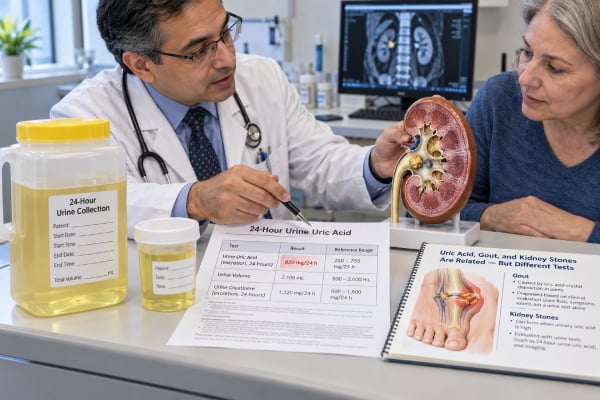
A urine uric acid test measures how much uric acid leaves the body in urine, most often during a 24-hour collection. Uric acid is the final product of purine breakdown. Purines come from normal cell turnover and from foods such as organ meats, some seafood, and other purine-rich foods. The kidneys filter urate from blood and then actively reabsorb and secrete much of it in the tubules, so urine uric acid reflects both uric acid production and kidney handling. The test can help evaluate recurrent kidney stones, unusually high or low uric acid excretion, and selected cases of gout or hyperuricemia. A high urine value may increase stone risk, but urine pH is often even more important for uric acid stones. A low value does not necessarily mean uric acid production is low; reduced kidney filtration or increased renal reabsorption can lower urinary excretion while serum uric acid remains high. Interpretation works best with serum uric acid, kidney function, urine pH, urine volume, medications, diet, and stone history.
- A 24-hour urine uric acid test measures total uric acid excretion and is especially useful in kidney stone evaluation.
- A major laboratory lists adult reference intervals of 200–1,000 mg/24 hours for men and 250–750 mg/24 hours for women, but laboratory ranges differ.
- High urine uric acid can reflect purine-rich intake, increased cell breakdown, gout-related metabolism, certain drugs, or renal urate wasting.
- Uric acid stones are strongly promoted by persistently acidic urine, often below pH 5.5, even when total uric acid excretion is not extremely high.
- Urine uric acid does not diagnose gout by itself; gout is assessed mainly with symptoms, serum urate, joint findings, and sometimes crystal analysis.
Table of Contents
- What urine uric acid measures
- Why the test is ordered
- Collection, reference ranges, and hyperuricosuria
- What high urine uric acid can mean
- What low urine uric acid can mean
- Gout, kidney stones, and urine pH
- How to interpret the result and what to do next
What urine uric acid measures
Uric acid is produced when the body breaks down purines, chemical building blocks found in DNA, RNA, and many foods. Humans do not have a functioning uricase enzyme to break uric acid down further, so uric acid must be eliminated mainly through the kidneys and, to a lesser extent, the intestine.
The kidney does much more than simply filter uric acid. Urate is freely filtered at the glomerulus, then most filtered urate is reabsorbed in the proximal tubule. Tubular transporters also secrete urate back into the urine, followed by additional reabsorption. The final amount excreted represents the net effect of all these processes.
This is why a urine uric acid number can tell a different story from a blood uric acid test. Serum uric acid reflects the concentration circulating in blood. Urine uric acid reflects the amount the kidneys excrete over a collection period. A person can have high serum urate because the kidneys retain too much urate, yet have a normal or relatively low 24-hour urinary excretion. Another person can have normal or low serum urate while excreting unusually large amounts because of increased renal urate loss.
Diet contributes to urinary uric acid, but so does normal cell turnover. Foods rich in purines can raise uric acid production, particularly organ meats, some red meats, anchovies, sardines, shellfish, and certain other seafood. Alcohol can affect urate handling and production in more than one way. Fructose metabolism can also increase purine degradation and uric acid generation.
The test therefore should not be treated as a simple “purine meter.” It is a combined signal from diet, endogenous production, kidney filtration, tubular transport, medications, hydration, and collection quality.
Why the test is ordered
The strongest everyday use of urine uric acid testing is in metabolic evaluation of kidney stones. Uric acid is one of the analytes commonly measured in a 24-hour stone-risk panel along with urine volume, pH, calcium, oxalate, citrate, sodium, and creatinine. Current urolithiasis guidance recommends detailed metabolic assessment for people at higher risk of recurrent stones.
The test can answer several useful questions. Is a stone former excreting an unusually large uric acid load? Is the main problem instead a very acidic urine? Does the pattern fit high purine intake, low urine volume, or another metabolic condition? If treatment is started, does repeat testing show that the targeted abnormality improved?
Urine uric acid is sometimes used in the evaluation of hyperuricemia and gout, but it is not required for every person with gout. Gout develops when monosodium urate crystals form in joints or other tissues, usually in the setting of sustained serum urate elevation. The 24-hour urine result may help in selected cases when a clinician wants to understand whether urate handling is dominated by high production, high renal excretion, or underexcretion.
That distinction can be more complicated than older “overproducer versus underexcretor” labels suggest. Modern research shows that renal urate transport involves multiple transporters and can vary with genetics, kidney disease, insulin resistance, medications, and other factors.
Urine uric acid may also be ordered when very high uric acid production is suspected, such as in some myeloproliferative disorders or during rapid cell breakdown. In cancer care, tumor lysis can sharply raise uric acid and can threaten kidney function, although acute management relies on blood chemistry and clinical monitoring rather than a routine outpatient 24-hour urine test.
In rare situations, urine uric acid helps evaluate renal hypouricemia, in which defects in urate reabsorption cause excessive urinary loss and very low serum uric acid. That is a different problem from ordinary gout or hyperuricemia.
Collection, reference ranges, and hyperuricosuria
A 24-hour collection is preferred when the goal is to measure total uric acid excretion. A spot urine concentration can vary widely depending on hydration and the time of day. Some laboratories can report a urine uric acid-to-creatinine ratio from a random sample, but timed collection is generally easier to interpret for adult stone evaluation.
For a typical 24-hour collection, discard the first urine at the chosen start time, collect all urine after that for the next 24 hours, and include one final specimen at the same time the next day. Follow the laboratory’s storage and preservative instructions exactly. Missing a void can falsely lower the result; collecting too long can falsely raise it.
Mayo Clinic Laboratories lists these adult 24-hour urine uric acid reference intervals:
| Group | Reference interval |
|---|---|
| Men age 18 and older | 200–1,000 mg/24 hours |
| Women age 18 and older | 250–750 mg/24 hours |
A laboratory reference interval is not identical to a stone-risk threshold. The European Association of Urology defines hyperuricosuria in its current stone guideline as more than 5 mmol/day in adult men and more than 4 mmol/day in adult women, equivalent to roughly 840 mg/day and 670 mg/day, respectively. Other clinical sources and laboratories use somewhat different cutoffs. That variation is one reason to interpret the actual report and the full stone profile rather than a single universal number.
Preparation matters. If the goal is to understand usual stone risk, the collection should usually represent ordinary eating and drinking rather than an unusually low-purine day unless the clinician gives different instructions. Report allopurinol, febuxostat, uricosuric medicines, diuretics, losartan, and other drugs that can change urate production or renal handling.
Collection completeness is also critical. A 24-hour urine creatinine value may help determine whether the collection seems plausible, though creatinine varies with age, sex, muscle mass, diet, and activity.
What high urine uric acid can mean
High urine uric acid, often called hyperuricosuria, means that an increased amount of uric acid is reaching the urine over the collection period. The most common explanations fall into three broad groups: increased purine load, increased uric acid production inside the body, or increased renal excretion.
A purine-rich diet can raise urinary uric acid. This is particularly relevant in stone formers because dietary patterns high in meat and certain seafood may also affect urine pH, sodium, sulfate, and other stone-risk factors. High intake does not guarantee stones, but it can add to risk when urine is concentrated or persistently acidic.
Increased cell turnover or breakdown can also raise uric acid production. Myeloproliferative diseases, some cancers, hemolysis, psoriasis with high cell turnover, and cytotoxic cancer treatment are examples. Severe catabolism can contribute as well. In these settings, the clinical context is usually more important than the urine number alone.
Gout can coexist with hyperuricosuria, but not everyone with gout excretes excessive uric acid. Many people with primary gout have impaired renal urate excretion as a major contributor to high serum urate. That can produce high blood uric acid without a markedly high 24-hour urine value.
Medications can change the pattern. Uricosuric drugs deliberately increase renal urate excretion. Losartan has a uricosuric effect, and some other medicines alter urate transport through different mechanisms. A high value while taking such treatment may therefore reflect the intended pharmacologic effect rather than increased production.
Rare inherited disorders can cause renal urate wasting. Defects affecting transporters such as URAT1 or GLUT9 can lead to very low serum uric acid with high fractional or absolute urinary urate loss. These conditions require specialist evaluation rather than dietary interpretation alone.
For kidney stones, high urine uric acid can promote uric acid stones and can also contribute to calcium oxalate crystallization in some people. But urine pH changes the meaning dramatically. A high uric acid load in urine with a pH above 6 behaves differently from a moderate uric acid load in persistently acidic urine.
What low urine uric acid can mean
Low urine uric acid means less uric acid was excreted during the collection. It can result from reduced uric acid production, reduced filtration, increased renal reabsorption, medication effects, or an incomplete collection.
A low-purine diet or reduced overall food intake can lower urinary uric acid. Xanthine oxidase inhibitors such as allopurinol and febuxostat reduce the formation of uric acid and often lower both serum urate and urinary uric acid. When used for a clear indication, that reduction is an expected treatment effect.
Reduced kidney filtration can also lower urinary excretion. As chronic kidney disease advances, the kidneys may eliminate less urate, contributing to higher serum uric acid. In that setting, low urine uric acid should not be interpreted as low total body urate production. Checking eGFR and serum uric acid provides important context.
A low 24-hour value can also simply mean that part of the urine collection was missed. If urine sodium, potassium, creatinine, urea nitrogen, and total volume are all unexpectedly low, collection completeness becomes especially important to review.
Some medications increase serum uric acid partly by reducing renal urate excretion. Certain diuretics are a common example. The exact effect depends on the drug, dose, kidney function, volume status, and competing transport mechanisms.
Low urine uric acid is usually not treated as an isolated abnormality. The question is why it is low and whether serum uric acid is high, normal, or low at the same time. A low urine value plus high serum urate suggests a different mechanism from a low urine value plus very low serum urate.
If the test was ordered for kidney stone risk, a low uric acid excretion can still coexist with uric acid stones when urine is persistently acidic and concentrated. This is one of the most important interpretation points: uric acid stone disease is not simply a disorder of “too much uric acid in urine.”
Gout, kidney stones, and urine pH
Gout and uric acid stones share urate biology, but the key measurements are different. Gout is driven mainly by serum urate and crystal deposition in tissues. Uric acid stone formation is strongly driven by urine pH, urine volume, and urinary uric acid concentration.
Uric acid has limited solubility in its protonated form. As urine becomes more acidic, a larger fraction of urate converts to poorly soluble uric acid. Persistently low urine pH therefore makes crystals more likely even when total 24-hour uric acid excretion is not extremely high. Current European stone guidance considers a 24-hour urine pH below about 5.5 hyperacidic and notes that low pH promotes uric acid crystallization.
This explains several common patterns:
| Pattern | What it may suggest |
|---|---|
| High urine uric acid + low urine pH | Strong biochemical environment for uric acid crystallization |
| Normal urine uric acid + persistently low pH | Uric acid stones can still occur because pH is a major driver |
| High urine uric acid + higher pH | Hyperuricosuria may still contribute to calcium oxalate risk, but pure uric acid precipitation is less favored |
| Low urine volume | Raises urinary concentration and stone supersaturation regardless of the daily uric acid total |
| High serum urate + low/normal urine uric acid | May fit reduced renal urate excretion rather than overproduction |
Low urine pH is common in insulin resistance and metabolic syndrome, partly because ammonium buffering and renal acid handling can be altered. Chronic diarrhea can also lower urine pH by causing gastrointestinal alkali loss. High animal-protein intake can increase dietary acid load. These mechanisms can overlap.
Treatment of proven uric acid stones often focuses heavily on urine alkalinization, commonly with prescribed alkaline citrate, because increasing urine pH raises uric acid solubility. Current urolithiasis guidelines also support allopurinol for hyperuricosuric urate stone formers. The target pH depends on whether the goal is prevention or active dissolution and should be set by a clinician; pushing urine pH too high can increase calcium phosphate stone risk.
For gout, by contrast, treatment targets serum urate and clinical disease. A 24-hour urine value may add mechanistic information but does not replace serum monitoring or joint evaluation.
How to interpret the result and what to do next
Start with the reason the test was ordered. A 24-hour urine uric acid result used for recurrent stones should be read differently from the same number obtained during a workup for unusual serum urate levels.
For stone evaluation, review at least urine pH, volume, uric acid, citrate, calcium, oxalate, sodium, and creatinine together. A full 24-hour urine stone risk profile is more informative than an isolated uric acid result because supersaturation depends on multiple factors at once.
If urine uric acid is high, useful next questions include whether the collection was complete, whether the diet that day was unusually rich in purines, whether a medication increases urate excretion, and whether there is a condition causing increased cell turnover. For recurrent stone formers, dietary changes often focus on adequate fluid, avoiding excessive purine-rich animal foods, moderating sodium, and keeping an appropriate overall protein intake rather than trying to eliminate purines completely.
If urine uric acid is low, compare it with serum uric acid and kidney function. Low urine excretion with elevated serum urate may support reduced renal elimination, while low urine and low serum urate can point toward reduced production, medication effect, or a different urate-handling pattern.
Do not start or stop allopurinol, febuxostat, uricosuric drugs, potassium citrate, or other prescription therapy based only on a home interpretation of the urine value. These medicines have specific indications, dosing considerations, interactions, and kidney-function requirements.
Repeat testing can be useful after a meaningful treatment or diet change, particularly in recurrent stone disease. Day-to-day variability is real, so clinicians sometimes use more than one 24-hour collection to avoid basing decisions on an unusual day.
Seek urgent care for severe flank pain with fever or chills, persistent vomiting, inability to urinate, or symptoms suggesting an obstructed infected kidney. Those situations are more important than the metabolic urine value and can require prompt imaging and treatment.
The most useful summary is simple: urine uric acid tells you how much uric acid the kidneys excreted; serum uric acid tells you what is circulating; urine pH tells you how favorable the urine is for uric acid to stay dissolved. Reading all three together gives a much clearer picture than any one number alone.
References
- Uric Acid, 24 Hour, Urine 2026
- Metabolic Evaluation and Recurrence Prevention for Urinary Stone Patients: An EAU Guidelines Update 2024 (Guideline)
- Uric acid in health and disease: From physiological functions to pathogenic mechanisms 2024 (Review)
- Back to the Physiology: Renal Tubular Handling of Uric Acid and Emerging Strategies for Managing Hyperuricemia 2025 (Review)
- Controversies and practical management of patients with gout and chronic kidney disease 2024 (Review)
- Hyperuricemia Subtypes Classified According to Renal Uric Acid Handling Manifesting Distinct Phenotypic and Genetic Profiles in People With Gout 2024
Disclaimer
Urine uric acid should be interpreted with serum urate, kidney function, urine pH, medications, diet, and the reason for testing. It does not diagnose gout or determine kidney stone treatment by itself. Seek medical care promptly for severe flank pain with fever, persistent vomiting, or inability to pass urine.