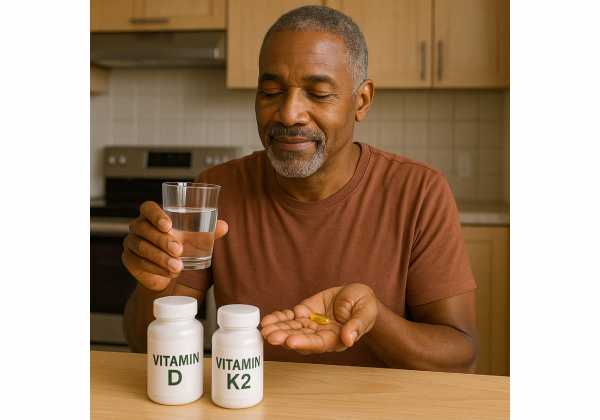
Vitamin D and vitamin K2 sit at the center of a simple aging question: how do you keep calcium working for bones without encouraging unwanted calcification in blood vessels? Vitamin D helps the gut absorb calcium and supports normal bone remodeling. Vitamin K2 helps activate proteins that bind calcium in bone and help regulate calcium in soft tissues. That pairing makes biological sense, but biology alone does not prove that every adult needs a combined supplement.
For healthy aging, the strongest case is targeted use. Vitamin D is most useful when intake is low, sun exposure is limited, bone risk is high, or blood testing shows low status. K2 is more promising than proven for cardiovascular protection, with better evidence for bone markers and some osteoporosis-related outcomes than for preventing heart attacks or strokes. The best results come from matching supplements to diet, labs, medications, kidney function, and fracture risk.
Table of Contents
- How Vitamin D and K2 Work Together
- Bone Health Evidence
- Cardiovascular Health Evidence
- Testing and Targets
- Food Sources and Supplement Forms
- Dosing, Safety, and Interactions
- Who Should Consider the Combination
- How to Build a Practical Plan
How Vitamin D and K2 Work Together
Vitamin D and K2 support different parts of calcium biology. Vitamin D improves calcium absorption from the intestine and helps maintain normal blood calcium and phosphate levels. The body needs those minerals to build and maintain the mineral matrix inside bone. Vitamin K2 helps activate vitamin K–dependent proteins, including osteocalcin in bone and matrix Gla protein in blood vessels and soft tissues.
This is why the combination gets attention in aging. Bone loss, fracture risk, arterial stiffness, and vascular calcification all become more common with age. Calcium balance matters in each area, but the solution is not simply “more calcium” or “more vitamin D.” The body needs enough calcium, enough vitamin D to absorb it, enough vitamin K to use calcium-dependent proteins correctly, and enough mechanical loading from resistance training and impact to signal bone maintenance.
Vitamin D is not one substance in practice. Supplements usually contain vitamin D3, called cholecalciferol, or vitamin D2, called ergocalciferol. Vitamin D3 is the form made in skin after ultraviolet B light exposure and is commonly used in daily supplements. The liver converts vitamin D into 25-hydroxyvitamin D, written as 25(OH)D, which is the main blood marker used for vitamin D status.
Vitamin K also comes in more than one form. Vitamin K1, or phylloquinone, comes mostly from leafy green vegetables. Vitamin K2 refers to menaquinones, especially MK-4 and MK-7. MK-4 is found in some animal foods and has been studied at high pharmacologic doses in osteoporosis research. MK-7 is found in fermented foods such as natto and is common in supplements because it has a longer half-life in the blood.
The “calcium traffic director” idea is useful but too simple. K2 does not pull calcium out of arteries like a drain cleaner. It supports the activation of proteins involved in mineral handling. Vitamin D does not automatically harden arteries when used at sensible doses. Problems arise when supplementation ignores context: very high vitamin D intake, excessive calcium supplementation, kidney disease, certain medications, or unmonitored use in people prone to high blood calcium.
Bone also needs more than these two vitamins. Protein intake, resistance training, balance work, calcium-rich foods, magnesium adequacy, sex hormones, thyroid status, kidney function, and fall prevention all influence fracture risk. A supplement stack without these basics gives a false sense of protection. For a broader nutrition approach, bone-focused meals that include protein, calcium, and vitamin K-rich foods fit well with bone-friendly eating for longevity.
Bone Health Evidence
Vitamin D has a clear role in preventing severe deficiency, osteomalacia, and poor mineralization. Osteomalacia is softening of bone caused by impaired mineralization, often linked to low vitamin D, low calcium or phosphate, malabsorption, or certain medical conditions. In that setting, vitamin D is not optional; it is part of correction.
The evidence looks different in generally healthy adults who already have reasonable vitamin D status. Large randomized trials have not shown that vitamin D alone reliably prevents fractures in community-dwelling adults who were not selected for deficiency, osteoporosis, or low bone mass. That finding matters because many adults take vitamin D as a general “bone insurance” supplement despite having no clear deficiency or fracture risk assessment.
Vitamin D works best as part of a full bone plan. In older adults with low intake, limited sun exposure, frailty, institutional living, malabsorption, or diagnosed osteoporosis, clinicians often assess vitamin D status and correct low levels before or during osteoporosis treatment. Vitamin D also helps ensure that calcium intake supports bone mineralization rather than leaving the body short of the raw materials needed for remodeling.
K2 evidence for bone health is interesting but uneven. Trials and meta-analyses suggest vitamin K2 supplementation improves carboxylation of osteocalcin, a marker tied to vitamin K’s role in bone. Some studies, especially in postmenopausal women with osteoporosis, report benefits for bone mineral density or fracture outcomes. However, results vary by population, dose, form of K2, background calcium and vitamin D intake, and study quality.
MK-4 deserves special attention. Some Japanese osteoporosis studies used 45 mg per day of MK-4, divided into three doses. That is a drug-like dose, not the same as a typical over-the-counter MK-7 supplement providing 90 to 180 mcg per day. People often compare these forms as though they are interchangeable, but they differ in dose, blood persistence, studied uses, and regulatory context.
For bone density tracking, DEXA remains the standard tool. A vitamin D or K2 supplement should not replace measurement when fracture risk is meaningful. Adults with height loss, fragility fracture, long-term steroid use, early menopause, low body weight, high fall risk, or strong family history deserve a structured evaluation. A scan explained in plain terms helps connect supplement decisions with measurable risk; DEXA scans for bone density are the usual starting point.
| Situation | Vitamin D | Vitamin K2 | Practical meaning |
|---|---|---|---|
| Clear vitamin D deficiency | Strong rationale for correction | Not the main treatment | Correct vitamin D first, then reassess calcium intake and bone risk. |
| Healthy adult with normal vitamin D status | Limited fracture-prevention evidence from vitamin D alone | Insufficient evidence for routine use | Food, training, fall prevention, and risk assessment matter more. |
| Postmenopausal osteoporosis | Commonly used to support osteoporosis care | Some supportive evidence, especially from K2 trials in postmenopausal women | K2 is an adjunct, not a replacement for osteoporosis medication when medication is indicated. |
| High fall risk or frailty | Useful when low status or poor intake is present | No direct fall-prevention role | Balance, strength, vision, footwear, medications, and home safety deserve priority. |
Aging bones respond strongly to loading. Strength training and carefully progressed impact exercise send signals that supplements never provide. Someone taking D3 and K2 while avoiding resistance training leaves a major bone-building pathway unused. A well-designed plan that includes squats, hinges, carries, step-ups, calf raises, and balance drills often does more for long-term function than supplements alone. For people ready to train with bone in mind, resistance and impact training for bone density adds the missing mechanical signal.
Cardiovascular Health Evidence
The cardiovascular case for K2 centers on matrix Gla protein. When vitamin K is available, the body carboxylates this protein so it works properly. Active matrix Gla protein helps inhibit inappropriate mineral deposition in blood vessels. When vitamin K status is poor, levels of inactive dephospho-uncarboxylated matrix Gla protein rise. Researchers use that marker to study vitamin K status in relation to vascular calcification.
This mechanism is plausible and important, but clinical proof remains incomplete. Some randomized trials and meta-analyses suggest vitamin K supplementation slows progression of vascular calcification measures, including coronary artery calcium in certain populations. The strongest signals often appear in people with high calcification burden, chronic kidney disease, or other high-risk states. Evidence for fewer heart attacks, strokes, procedures, or cardiovascular deaths is not established.
Coronary artery calcium, or CAC, measures calcified plaque in the coronary arteries. A rising CAC score reflects calcified atherosclerotic burden, but it is not the same as a heart attack risk score by itself. CAC interpretation depends on age, sex, baseline score, risk factors, and whether preventive treatment changes. People using K2 because of a CAC result should not let it distract from proven moves: lowering ApoB or non-HDL cholesterol, controlling blood pressure, stopping smoking, improving insulin sensitivity, and exercising consistently.
K2 also does not replace statins, blood pressure treatment, diabetes treatment, or smoking cessation. It belongs in a different category: a possible supportive nutrient for mineral-regulation pathways, not a primary cardiovascular therapy. The risk comes when a person with a high CAC score takes K2 but avoids stronger interventions that have outcome data.
Vitamin D’s cardiovascular story is also more limited than early observational research suggested. Low vitamin D status often travels with poor health, obesity, low outdoor activity, chronic illness, and aging. That does not mean low vitamin D causes cardiovascular disease in every case. Supplement trials have not supported vitamin D as a general heart-disease prevention supplement for vitamin D–replete adults.
The calcium question adds nuance. Food-based calcium appears safer and more physiologic than large calcium supplement doses taken without a clear reason. Calcium supplements are sometimes appropriate, especially when diet falls short and bone risk is high, but they deserve more caution in people with kidney stones, kidney disease, high blood calcium, or substantial vascular calcification. Total daily calcium from food plus supplements often lands near 1,000 to 1,200 mg for adults with bone-health goals, but individual targets should reflect diet and medical history.
For anyone using CAC to guide prevention, K2 is a side conversation, not the main plan. CAC results fit best inside a broader cardiometabolic assessment, including lipids, blood pressure, glucose markers, smoking status, family history, and symptoms. A deeper explanation of coronary artery calcium scoring helps place supplement decisions in the right risk framework.
Testing and Targets
The best vitamin D test is serum 25-hydroxyvitamin D. It reflects vitamin D from sunlight, food, and supplements. Results appear in ng/mL in the United States and nmol/L in many other countries. To convert ng/mL to nmol/L, multiply by 2.5. A level of 20 ng/mL equals 50 nmol/L.
There is no single perfect vitamin D target for every adult. The National Academies framework treats 20 ng/mL as sufficient for most people, while some bone specialists prefer at least 30 ng/mL in osteoporosis care. Very low levels, such as below 12 ng/mL, raise stronger concern for deficiency. Levels above 50 ng/mL deserve caution, especially when caused by high-dose supplements rather than supervised treatment.
The 2024 Endocrine Society guideline narrowed the case for routine vitamin D testing in generally healthy people. It suggests against routine 25(OH)D screening in broad populations without a clear indication because trials have not identified one universal blood level that prevents disease. That does not mean testing is useless. It means testing works best when the result changes management.
Testing is more reasonable in these situations:
- Osteoporosis, osteopenia, fragility fracture, or recurrent falls
- Symptoms or labs suggestive of osteomalacia, such as bone pain, muscle weakness, low calcium, low phosphate, or high alkaline phosphatase
- Malabsorption, bariatric surgery, inflammatory bowel disease, celiac disease, pancreatic insufficiency, or long-term bile-acid issues
- Chronic kidney disease, liver disease, hyperparathyroidism, or granulomatous diseases such as sarcoidosis
- Long-term use of medications that affect vitamin D metabolism, including some anticonvulsants, glucocorticoids, and certain HIV therapies
- Very limited sun exposure, full skin coverage outdoors, or consistently low vitamin D intake
- Monitoring after high-dose repletion or when prior levels were clearly low
A practical testing rhythm is simple. Test when risk is present, correct low status, then retest after about 8 to 12 weeks if the dose is intended to change blood levels. Once stable, frequent repeat testing rarely adds value unless health status, dose, weight, kidney function, medication use, or sun exposure changes. A focused guide to testing and interpreting vitamin D status helps prevent both under-treatment and over-testing.
K2 testing is not part of routine care for most adults. Research tests include undercarboxylated osteocalcin and dephospho-uncarboxylated matrix Gla protein, but these are not standard consumer decision tools. A person usually judges K2 needs by diet pattern, medication status, and clinical context rather than by routine blood testing.
Bone and cardiovascular testing should guide the bigger decision. Vitamin D and K2 are not substitutes for a DEXA scan, CAC scan when appropriate, lipid testing, kidney labs, or blood pressure monitoring. For heart risk, ApoB and non-HDL cholesterol often give more actionable information than supplement debates. For blood pressure, reliable home readings often reveal risk that office readings miss.
Food Sources and Supplement Forms
Food should carry as much of the plan as possible. Vitamin D is hard to get from food alone because few foods naturally contain much of it. Fatty fish such as salmon, trout, sardines, and mackerel contribute meaningful vitamin D. Egg yolks, liver, and some cheeses provide smaller amounts. Fortified milk, fortified plant milks, fortified yogurt, and fortified cereals help many adults reach baseline intake.
Sunlight adds another variable. Skin makes vitamin D when ultraviolet B light reaches it, but production changes with season, latitude, cloud cover, sunscreen use, age, skin pigmentation, clothing, air pollution, and time outdoors. Older skin produces less vitamin D than younger skin under the same conditions. Sun exposure also raises skin cancer risk, so using sunlight as a dosing tool is imprecise.
Vitamin K1 is abundant in leafy greens: kale, collards, spinach, Swiss chard, parsley, broccoli, Brussels sprouts, and cabbage. These foods also bring potassium, magnesium, nitrate, fiber, and polyphenols. K1 contributes to overall vitamin K status, especially for clotting proteins.
Vitamin K2 is more concentrated in certain fermented and animal foods. Natto, a fermented soybean food, is the richest common source of MK-7. Some cheeses contain K2, especially aged and fermented varieties. Egg yolks, chicken, butter, and liver provide smaller amounts, with content influenced by animal feed. A food-first approach to K2 is easier with a guide to vitamin K2-rich foods, especially for people who dislike natto or avoid dairy.
Supplements differ in meaningful ways:
| Nutrient | Common forms | Typical supplement range | Notes |
|---|---|---|---|
| Vitamin D | D3 cholecalciferol, D2 ergocalciferol | 800 to 2,000 IU daily for many adult supplement plans | D3 is common for daily use. Higher repletion doses need clinician guidance. |
| Vitamin K2 MK-7 | Menaquinone-7 | 90 to 180 mcg daily | Longer-lasting blood levels; common in D3/K2 combination products. |
| Vitamin K2 MK-4 | Menatetrenone | Microgram amounts in some supplements; 45 mg daily in some osteoporosis studies | High-dose MK-4 research should not be confused with typical low-dose supplements. |
| Calcium | Calcium citrate, calcium carbonate | Usually used only to close a dietary gap | Food-first calcium is preferred when feasible. Citrate is often easier with low stomach acid. |
Combination products are convenient but not always ideal. Many D3/K2 products contain fixed ratios, such as 1,000 to 5,000 IU vitamin D3 plus 90 to 200 mcg K2. That ratio does not fit everyone. A person with normal vitamin D status and low K2 food intake has different needs than someone with low vitamin D, high calcium intake, kidney stones, or warfarin use.
Take fat-soluble vitamins with a meal that contains fat. A meal with olive oil, eggs, yogurt, fish, nuts, avocado, or cheese improves absorption compared with taking them on an empty stomach. Consistency matters more than perfect timing for daily D3 and MK-7.
Dosing, Safety, and Interactions
Sensible dosing starts with the Recommended Dietary Allowance for vitamin D: 600 IU per day for adults through age 70 and 800 IU per day after age 70. Those amounts are designed for population needs, not aggressive repletion. Many adult supplement plans use 1,000 to 2,000 IU per day, especially during winter, with low sun exposure, or when dietary intake is low.
Higher vitamin D dosing should be targeted. A clinician might use a short repletion plan for a clearly low 25(OH)D level, then shift to a lower maintenance dose. Long-term high-dose use without testing raises the risk of overshooting. More is not better with vitamin D because toxicity comes from excessive supplement intake, not from normal food intake.
The adult tolerable upper intake level for vitamin D is 4,000 IU per day from all sources unless a clinician supervises a different plan. Toxicity usually involves high blood calcium, high urine calcium, nausea, vomiting, constipation, weakness, confusion, dehydration, kidney stones, kidney injury, abnormal heart rhythms, or soft-tissue calcification. Risk rises when high-dose vitamin D is combined with high calcium intake or used in people with medical conditions that raise calcium.
Avoid large intermittent bolus dosing unless specifically prescribed. Annual megadoses and some high-dose intermittent regimens have raised concern in fall and fracture studies. Daily or weekly dosing at reasonable levels produces steadier physiology and better matches current guidance for older adults who need supplementation.
K2 dosing is less standardized. MK-7 supplements commonly provide 90 to 180 mcg per day. Some products provide 200 mcg or more. These doses are much smaller than the 45 mg per day MK-4 doses used in some osteoporosis trials. Because K2 does not have a well-established routine blood target, dosing should stay conservative unless a clinician has a specific reason.
Warfarin is the major K2 interaction. Warfarin works by blocking vitamin K recycling. Sudden changes in vitamin K intake from supplements or large diet shifts alter INR control and bleeding or clotting risk. People taking warfarin should not start K2, stop K2, or sharply change leafy green intake without the prescribing clinician or anticoagulation clinic. Direct oral anticoagulants such as apixaban or rivaroxaban do not work through vitamin K in the same way, but supplement changes still deserve medication review.
Vitamin D also deserves caution with several conditions and drugs. People with sarcoidosis, tuberculosis-related granulomatous disease, lymphoma, primary hyperparathyroidism, kidney disease, recurrent kidney stones, or unexplained high calcium need medical guidance before supplementing. Thiazide diuretics, digoxin, some anticonvulsants, glucocorticoids, and weight-loss or fat-blocking medications also change the risk-benefit picture.
Supplement quality matters. Choose products that list the form and dose clearly, avoid unnecessary megadoses, and ideally use third-party testing. For D3/K2, the label should state whether K2 is MK-7 or MK-4 and how many mcg or mg it provides. “Proprietary blend” labels are a poor fit for fat-soluble vitamins.
Who Should Consider the Combination
A combined D3/K2 supplement makes the most sense when both sides of the calcium-handling picture are relevant: low vitamin D intake or status plus low K2 food intake, bone risk, or concern about vascular calcification. It is not a universal anti-aging requirement.
Adults most likely to benefit from discussing D3/K2 with a clinician include:
- Adults over 70 or 75 with low sun exposure, low vitamin D intake, or frailty
- People with osteopenia, osteoporosis, prior fragility fracture, or high fracture risk
- Postmenopausal women with low calcium or vitamin D intake and low K2-rich food intake
- Adults with limited diets, dairy avoidance, vegan diets, or very low fatty fish intake
- People with malabsorption or a history of bariatric surgery, with clinician monitoring
- Adults with a CAC score who already have a full prevention plan and want to discuss K2 as an adjunct
- People taking long-term glucocorticoids or other bone-affecting medications, under medical guidance
People less likely to need the combination include healthy adults under 75 with good vitamin D status, regular outdoor activity, strong diets, no bone-risk factors, and no reason to suspect low intake. For them, a supplement adds cost and complexity without clear outcome evidence.
Some people should be especially cautious. Warfarin users sit at the top of that list because K2 directly interferes with the medication strategy. People with high calcium, kidney stones, advanced kidney disease, sarcoidosis, active malignancy-related calcium problems, or unexplained abnormal kidney labs should not self-prescribe D3/K2.
A common mistake is treating K2 as permission to take high-dose vitamin D and high-dose calcium. K2 does not erase the risks of excessive vitamin D or unnecessary calcium pills. The safer approach is to estimate calcium from food, use vitamin D to correct a real gap, keep K2 conservative, and monitor when risk is present.
Another mistake is ignoring falls. Most hip fractures involve a fall. Supplements do not fix poor vision, sedating medications, weak hips, slow gait, cluttered floors, dizziness, or low reaction speed. Anyone serious about fracture prevention should treat balance and strength as core interventions, not optional extras.
How to Build a Practical Plan
Start with risk, not the supplement bottle. A healthy 45-year-old runner and a 76-year-old with osteopenia, low appetite, wintertime indoor living, and a prior wrist fracture need different plans. The right D3/K2 strategy comes from the person’s bone risk, diet, labs, medications, kidney function, and cardiovascular risk profile.
A practical sequence works well:
- Estimate intake. Track a normal week of vitamin D foods, calcium-rich foods, leafy greens, fermented foods, and fatty fish. Do not count supplements first.
- Check risk factors. Note fracture history, height loss, steroid use, menopause timing, falls, kidney stones, kidney disease, digestive disorders, and anticoagulant use.
- Test when it changes the plan. Use 25(OH)D testing for clear risk situations, not as a reflex every few months.
- Choose modest doses. If supplementation fits, many adults start with vitamin D3 in the 800 to 2,000 IU daily range and MK-7 around 90 to 180 mcg daily, unless medical factors require a different plan.
- Retest selectively. Retest vitamin D after 8 to 12 weeks when correcting a low level or using higher intake. Add calcium and kidney labs when risk calls for them.
- Measure outcomes that matter. Use DEXA for bone density, fall history and strength tests for function, and standard cardiometabolic markers for vascular risk.
Food upgrades often reduce the dose needed. A weekly pattern of fatty fish twice, eggs several times, fortified yogurt or milk, leafy greens most days, and fermented foods provides a stronger base than pills alone. People who avoid dairy need a deliberate calcium plan through fortified plant milks, calcium-set tofu, canned fish with bones, greens lower in oxalate, and sometimes a small calcium supplement. A food guide to calcium and vitamin D for aging bones helps close common gaps without overusing pills.
Build the cardiovascular plan separately. For arterial health, prioritize ApoB or non-HDL cholesterol, blood pressure, glucose control, waist circumference, smoking status, aerobic fitness, sleep apnea risk, and kidney function. K2 belongs after these stronger levers. For lipid-focused prevention, ApoB and non-HDL cholesterol often guide treatment more directly than supplement choices.
Watch for signals that the plan needs review: new kidney stones, constipation with high calcium intake, nausea, unusual thirst, frequent urination, weakness, confusion, abnormal calcium labs, or a vitamin D level drifting above the intended range. Also review the plan before surgery, after new medications, after major weight loss, after a new kidney diagnosis, or after starting osteoporosis medication.
The most durable plan is boring in the best way: a modest daily vitamin D dose when needed, conservative K2 if appropriate, food-first calcium, regular strength training, balance work, and periodic measurement. That approach respects both the promise and the limits of D3/K2. It also keeps the focus on fewer fractures, better mobility, and lower cardiovascular risk rather than chasing a supplement trend.
References
- Vitamin D for the Prevention of Disease: An Endocrine Society Clinical Practice Guideline 2024 (Guideline)
- Supplemental Vitamin D and Incident Fractures in Midlife and Older Adults 2022 (RCT)
- Vitamin K supplementation and vascular calcification: a systematic review and meta-analysis of randomized controlled trials 2023 (Systematic Review)
- Efficacy of vitamin K2 in the prevention and treatment of postmenopausal osteoporosis: A systematic review and meta-analysis of randomized controlled trials 2022 (Systematic Review)
- Vitamin D – Health Professional Fact Sheet 2025 (Fact Sheet)
- Vitamin K – Health Professional Fact Sheet 2021 (Fact Sheet)
Disclaimer
This article is educational and does not replace care from a qualified clinician, pharmacist, or registered dietitian. Vitamin D and K2 decisions need extra caution for people with osteoporosis, kidney disease, high calcium, kidney stones, malabsorption, granulomatous disease, or anticoagulant use. Always review supplement plans with a professional who knows your labs, medications, and health history.