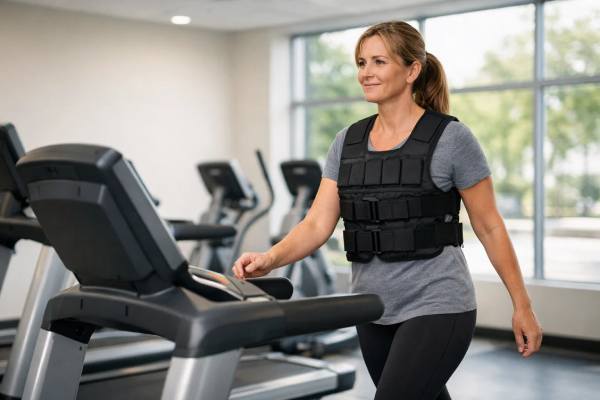
Weighted vest walking can make walking harder, raise calorie burn, and help some people get more from the same amount of time. But it is not a shortcut that suddenly turns easy walks into a fat-loss superpower. The real value is more specific: a vest can modestly increase intensity without forcing you into running, jumping, or high-impact cardio.
That makes it appealing for people who already walk regularly and want a tougher stimulus. It is less helpful for beginners who have not yet built a solid walking habit, and it can backfire if the added load irritates the knees, hips, feet, or lower back. The smartest way to use a weighted vest is to treat it like progressive resistance, not like an accessory you throw on and forget about. This guide explains the real benefits, the likely calorie bump, the main risks, and how to start safely.
Table of Contents
- What weighted vest walking can and cannot do
- Benefits for fat loss and fitness
- How many extra calories does it burn?
- Main risks and who should be careful
- How heavy should the vest be?
- How to start weighted vest walking safely
- Sample workout plan for weight loss
What weighted vest walking can and cannot do
Weighted vest walking is exactly what it sounds like: walking while wearing extra weight distributed across the torso rather than carried in the hands or on the back. That sounds simple, but it changes the exercise in a few useful ways. The extra load raises effort, increases the demand on the legs and trunk, and pushes heart rate and breathing a little higher at the same walking speed.
For weight loss, that can be useful because it makes a familiar activity more demanding without requiring advanced skill. If regular walking has started to feel too easy, a vest can provide progression in the same way slightly heavier dumbbells or a steeper treadmill incline provide progression elsewhere.
Still, it helps to be clear about what it does not do.
Weighted vest walking does not:
- guarantee faster fat loss on its own
- replace a calorie deficit
- automatically build significant muscle
- fix a weak walking routine or poor consistency
- make walking safe for everyone just because it is low impact
In real-world fat loss, the biggest driver is still the overall system: food intake, training consistency, daily movement, recovery, and adherence over time. A weighted vest can support that system. It cannot override it.
That is why it often works best for people who already have a base. If you are already walking most days, or you have already built a stable walking routine for weight loss, a vest can be a logical next step. If you are inconsistent, sore after normal walks, or returning after a long break, loaded walking may simply make the habit harder to maintain.
It also helps to think of a weighted vest as a tool for progression, not a better version of walking in every situation. Sometimes the smarter choice is to:
- walk longer
- walk faster
- add hills or incline
- increase daily steps
- keep the walk unloaded and recover better
That last point matters more than people expect. Some walkers add a vest, feel proud of the extra difficulty, then unknowingly reduce their total step count because the sessions are more tiring. In that case, the net result may be neutral or even worse than a longer, comfortable walk. This is one reason daily movement outside formal workouts still matters so much. A guide to burning more calories through daily movement is often more useful than adding intensity too early.
So yes, weighted vest walking can help with weight loss. But it works best as a measured upgrade to an already solid walking habit, not as a replacement for the basics.
Benefits for fat loss and fitness
The main reason people try weighted vest walking is straightforward: they want more from the same walk. That can be a smart move when time is limited or when flat walking no longer feels challenging enough.
It can increase intensity without forcing you to run
One of the best features of a weighted vest is that it can raise exercise intensity while keeping the movement pattern familiar. For people who dislike running, cannot tolerate jumping, or want a joint-friendlier alternative to harder cardio, that is appealing.
At a practical level, that means:
- heart rate tends to rise at the same pace
- breathing gets harder sooner
- perceived effort increases
- the walk feels more like training and less like casual movement
That can help bridge the gap between easy walking and more demanding cardio. For some people, that makes a vest a useful middle ground between regular walking and workouts like intervals or jogging.
It can modestly increase calorie burn
Weighted vest walking usually increases calorie expenditure, but the increase is usually modest, not dramatic. That still matters over weeks and months. A small bump repeated consistently can add up, especially when paired with a calorie deficit.
The important point is to avoid fantasy numbers. A vest does not double calorie burn. In most normal walking situations, it increases the workload enough to matter, but not enough to erase a poor diet or replace broader activity targets.
It may improve work capacity and make normal walking feel easier
There is also a simple training effect. When you regularly walk with some load, unloaded walking often feels easier afterward. That can improve tolerance for longer walks, hilly routes, and other forms of steady-state activity.
This is part of why loaded walking overlaps with the appeal of rucking for weight loss, although a weighted vest distributes load differently than a backpack and often feels more balanced on the torso.
It can provide progression without high complexity
For people who like simple plans, a vest can be easier to use than building elaborate interval sessions. Progression can happen through a few straightforward changes:
- slightly more vest weight
- a little more time
- a slightly faster pace
- more incline
- better posture and steadier effort
That makes it practical for busy people who want a harder walk without learning an entirely new training style.
It may strengthen some postural demands, but it is not a strength plan
A vest makes the legs and trunk work harder, and some people notice improved postural awareness or trunk engagement. But that should not be confused with a full strength-training effect. Weighted walking is still walking. It can complement resistance training, but it should not be mistaken for a substitute.
For fat loss, that matters because the best long-term setup usually includes both cardio-style activity and some form of strength work. Weighted walking can sit beside that, not replace it.
Overall, the biggest benefit is not that a vest transforms walking into magic. It is that it offers a practical way to make a low-skill, repeatable activity a bit more demanding without abandoning the basic movement most people can sustain.
How many extra calories does it burn?
This is usually the question people care about most, and it is also where expectations often get distorted.
The honest answer is that weighted vest walking usually burns somewhat more calories than regular walking, but the exact increase depends on several factors:
- your body weight
- vest weight
- walking speed
- incline or hills
- session length
- fitness level
- how efficiently you move
Research and current expert guidance suggest that the calorie increase is often in the low-to-moderate percentage range, not a massive jump. In practical terms, that means the added burn is useful but usually smaller than people expect when they first buy a vest.
| Walking setup | Likely calorie effect | Best way to think about it |
|---|---|---|
| 5% body weight vest on flat ground | Small increase | A gentle progression, not a major jump |
| 10% body weight vest at a brisk pace | Modest increase | Often enough to feel clearly harder |
| 15% body weight vest on flat ground | Low-teens percentage increase in some testing | More efficient than adding no load, but still not extreme |
| 10% body weight vest plus incline | Modest to meaningful increase | Usually more effective than just adding weight alone |
To make that more concrete, imagine a person whose normal 45-minute brisk walk burns around 180 to 240 calories. A weighted vest might add a modest amount on top of that, not another full workout’s worth. Depending on the load and terrain, that might mean a bump that is noticeable over time but not dramatic in a single session.
That is why the best question is not “How many extra calories does it burn?” but rather:
Is the extra burn worth the added stress for me?
Sometimes the answer is yes. For someone who tolerates it well, a vest can be an efficient upgrade. Sometimes the answer is no. If the extra load shortens the walk, causes soreness, or reduces total weekly activity, it may be less effective than simply walking longer, walking uphill, or adding another easy walk later in the week.
It is also worth remembering that calorie trackers, smartwatches, and treadmill readouts often struggle with loaded walking. They may not fully account for vest weight, body mechanics, or terrain. So use numbers as rough estimates, not as a precise measure of fat loss progress.
If you want a broader sense of where walking with a vest fits relative to other activities, a guide to calories burned by common exercises can help put the increase in context. In many cases, the most practical takeaway is simple: a vest can raise the demand of walking, but it is still the consistency of the full program that determines whether fat loss happens.
Main risks and who should be careful
Weighted vest walking is lower impact than running, but it is not risk free. The added load increases forces through the feet, ankles, knees, hips, and trunk. That is fine when the load is appropriate and the person tolerates it well. It is not fine when someone piles on too much weight too soon, ignores pain, or uses a vest despite clear joint or balance limitations.
The main risks
The most common problems tend to be mechanical rather than dramatic. They include:
- foot soreness
- shin or calf tightness
- knee irritation
- hip discomfort
- low back soreness
- neck and shoulder tension from poor vest fit
- chafing or hot spots from the vest moving around
These risks rise when the vest is too heavy, poorly fitted, or used for too long right away.
One of the most important practical mistakes is wearing a vest during daily chores or all-day movement because it “burns more calories.” Current expert guidance does not support that as a smart default. Long casual wear can add a lot of low-level stress without giving you the control, posture, and recovery you would use during a proper training session.
Who should be especially careful
Weighted vest walking is not the best starting point for everyone. Extra caution is reasonable if you have:
- current knee, hip, ankle, or foot pain
- low back or neck pain
- poor balance or fall risk
- osteoporosis or a history of fragility fracture
- recent surgery or recent injury
- uncontrolled heart or lung disease
- pregnancy
- very low fitness or major deconditioning
For those groups, regular walking, incline walking, cycling, or another lower-load option may be safer. Some people may also do better with a structured beginner plan before experimenting with a vest. If you are starting from a very low baseline, a more appropriate entry point may be a low-impact plan for obese beginners rather than immediately adding external load.
Pain is not “adaptation” here
A little muscle fatigue is normal. Joint pain is not. A vest is not the kind of tool where you should push through sharp discomfort to “get used to it.” If loaded walking makes your knees, feet, or back feel worse during or after the session, the response should be to reduce the load, shorten the session, improve the fit, or stop using the vest for now.
This is especially important for people who already need joint-friendly cardio. For them, options such as low-impact cardio for bad knees may be safer and more sustainable.
What the risk-benefit tradeoff really looks like
Weighted vest walking is most useful when:
- normal walking feels easy
- you already tolerate walking well
- the vest fits snugly
- the load is conservative
- total training stress is still manageable
It becomes a bad idea when the desire to burn a few more calories leads you to ignore biomechanics, recovery, or pain signals. Fat loss tools only help when they are safe enough to repeat.
How heavy should the vest be?
For most people, the best starting point is about 5% of body weight. That is light enough to let you assess tolerance, posture, and comfort without turning the walk into a grind.
For example:
- 120 lb person: about 6 lb
- 150 lb person: about 7.5 lb
- 180 lb person: about 9 lb
- 220 lb person: about 11 lb
That may sound light, and that is the point. Most people do better starting lighter than they think they need.
A common next step is moving toward 8% to 10% of body weight if:
- walks feel stable and pain free
- posture stays upright
- stride does not get sloppy
- recovery is still good the next day
For ordinary weight-loss walking, many people never need more than that. A heavier vest is not automatically better. Beyond a certain point, the extra load may increase stress faster than it increases useful training effect.
What about 15% to 20% of body weight?
That range is better viewed as advanced or goal-specific rather than necessary. It may make sense for experienced users with good tolerance, but it is not required for fat loss. In fact, for many people it makes the walk so fatiguing that pace drops, time drops, or irritation rises.
There is also a quality issue. Once the vest is heavy enough to change posture, shorten stride, increase trunk stiffness, or make you stomp through the walk, it is probably too heavy for the purpose.
How to tell if the load is appropriate
A good vest load usually allows you to:
- keep normal walking mechanics
- maintain a brisk but controlled pace
- finish the session feeling trained, not wrecked
- recover within a day
- repeat the workout later in the week
A too-heavy vest usually shows up as:
- back rounding or forward lean
- foot slapping
- shorter stride and awkward gait
- unusual joint soreness
- excessive fatigue that reduces other activity
Vest design matters too. A good walking vest should fit snugly, distribute weight front and back, and avoid bouncing. A poorly fitted vest can create discomfort even when the load itself is reasonable.
If you want to progress walking difficulty, do not assume weight should always be the first lever. Sometimes the better progression is more time, slightly more pace, or more incline. That is especially true if you already walk enough to reach meaningful weekly totals. A guide to step targets for weight loss can help you decide whether you need more total walking first or more intensity within the walking you already do.
How to start weighted vest walking safely
The safest approach is to treat weighted vest walking like a new training variable, not like a tiny tweak. Even if normal walking feels easy, loaded walking deserves a gradual ramp.
Start with time before weight
Once the vest load is modest, the first progression should often be session duration rather than more weight. That gives your feet, calves, hips, and back time to adapt.
A good beginner ramp might look like this:
- Start with 5% body weight.
- Use it for 10 to 15 minutes at the easier part of your usual walk.
- Do that 2 times per week for a week or two.
- Build toward 20 to 30 minutes before increasing load.
- Only add more weight if walks stay pain free and your form stays normal.
This usually works better than starting with a 30- to 45-minute full walk in a vest on day one.
Use posture and comfort as your guide
Good loaded walking usually looks almost the same as good unloaded walking. Think:
- tall posture
- ribs stacked over pelvis
- relaxed shoulders
- steady arm swing if the vest allows it
- smooth foot strike
- no excessive leaning
If you find yourself bracing hard, tensing the shoulders, or taking choppy steps, lower the load or shorten the session.
The best surfaces and conditions for beginners
Start on:
- flat ground
- a treadmill at easy incline
- familiar walking routes
- predictable surfaces
Avoid starting with:
- steep hills
- uneven trails
- long descents
- speed-walking efforts
- all-day wear
Incline can be helpful, but add only one challenge at a time. First learn the vest. Then layer in hills if you tolerate it well.
What to pair it with
Weighted vest walking works best inside a broader plan that still includes regular walking, strength work, and rest. It is not something you need to do every day. Two to three sessions per week is plenty for many people, especially at first.
If your main goal is fat loss, it also helps to match the higher walking demand with sensible recovery habits. That includes sleep, hydration, and enough protein. People often focus on the vest and ignore the basics that actually determine how well they adapt.
Finally, do not let the vest replace unloaded walks completely. Easy unloaded walking still has huge value for recovery, step totals, and adherence. The vest is the seasoning, not the whole meal.
Sample workout plan for weight loss
A simple weighted vest plan works better than an aggressive one. The goal is to add challenge while keeping weekly activity high and recovery manageable.
| Week | Sessions | Vest load | Session length |
|---|---|---|---|
| 1 | 2 | 5% body weight | 10 to 15 minutes inside a normal walk |
| 2 | 2 to 3 | 5% body weight | 15 to 20 minutes |
| 3 | 2 to 3 | 5% to 8% body weight if tolerated | 20 to 25 minutes |
| 4 | 2 to 3 | 5% to 10% body weight if tolerated | 25 to 30 minutes |
Here is what a balanced week could look like for someone using weighted walking for fat loss:
- Monday: regular brisk walk, 30 to 45 minutes
- Tuesday: strength training
- Wednesday: weighted vest walk, 15 to 25 minutes
- Thursday: easy walk or rest
- Friday: strength training
- Saturday: weighted vest walk, 20 to 30 minutes
- Sunday: longer easy walk without the vest
That kind of structure works because it does not make every walk hard. It also leaves room for recovery and for other useful exercise. If you want a broader framework, pairing vest sessions with a sensible weekly cardio target for weight loss usually works better than guessing.
Who tends to do best with this tool
Weighted vest walking tends to suit people who:
- already walk regularly
- want a harder but still low-skill cardio option
- do not tolerate running well
- prefer outdoor or treadmill walking to classes or machines
- want a modest progression rather than a full training overhaul
Who should skip it for now
You may be better off sticking with regular walking first if:
- you are still building consistency
- you have not yet reached a solid base of weekly walking
- your joints already get irritated by normal walks
- you are constantly tired and under-recovered
- the vest makes you do less total movement overall
For many people, simply walking more, adding incline, or improving pace will give most of the same fat-loss benefit with less downside.
The bottom line is straightforward: weighted vest walking can be an effective add-on for weight loss when used conservatively and progressively. It is most useful when regular walking is already established, when the load is modest, and when the extra challenge does not reduce the total amount of movement you can sustain each week.
References
- WHO guidelines on physical activity and sedentary behaviour 2020 (Guideline)
- Metabolic Costs of Walking with Weighted Vests 2024 (Study)
- Effect of load carriage on joint kinematics, vertical ground reaction force and muscle activity: Treadmill versus overground walking 2023 (Study)
- Weighted Vest Use or Resistance Exercise to Offset Weight Loss–Associated Bone Loss in Older Adults 2025 (RCT)
- Hot Topic | Are Weighted Vests Worth the Hype? 2026 (Official Expert Commentary)
Disclaimer
This article is for general educational purposes only and is not a substitute for medical advice, diagnosis, or treatment. If you have joint pain, osteoporosis, balance problems, heart or lung disease, are pregnant, or are unsure whether loaded walking is appropriate for you, speak with a qualified healthcare professional before starting.
If this article helped you, please share it on Facebook, X (formerly Twitter), or any other platform you prefer.