A white blood cell (WBC) count measures the total number of leukocytes circulating in a blood sample. These immune cells help identify and respond to infection, tissue injury, allergy, inflammation, and abnormal cells. A high result, called leukocytosis, is common and often temporary, but it is not a diagnosis by itself. The same total count can reflect very different patterns depending on whether neutrophils, lymphocytes, eosinophils, monocytes, basophils, or immature cells are increased. Recent illness, surgery, emotional or physical stress, pregnancy, smoking, and certain medicines can also shift the result. Interpretation therefore depends on the laboratory range, the WBC differential, symptoms, other blood counts, and whether the change persists. This guide explains what a WBC count shows, why it can rise, how infection and inflammation affect it, when blood disorders enter the differential, and what clinicians commonly check next.
- A high WBC count is a finding, not proof of infection or leukemia.
- The differential and absolute cell counts are often more informative than the total WBC alone.
- Temporary leukocytosis can follow stress, exercise, pregnancy, surgery, smoking, or corticosteroid use.
- Persistent elevation, abnormal cells, or changes in hemoglobin and platelets may require hematology evaluation.
- Urgency depends on symptoms, cell type, and clinical context—not only the number.
Table of Contents
- What a WBC Count Measures
- Normal WBC Range, Units, and Report Details
- WBC Patterns in Infection and Inflammation
- Noninfectious Causes of a High WBC Count
- Reactive Leukocytosis Versus Blood Disorders
- How Clinicians Evaluate an Abnormal WBC Count
- Treatment, Follow-Up, and Urgent Warning Signs
What a WBC Count Measures
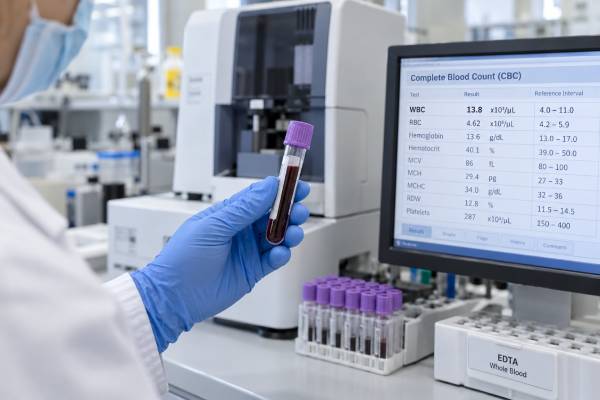
White blood cells are produced mainly in bone marrow and circulate between blood, lymphatic tissue, and organs. The WBC count reports the combined number of several immune-cell populations in a defined volume of blood. It is usually included in a complete blood count, or CBC, alongside red blood cell measurements, hemoglobin, hematocrit, and platelets.
The total is useful as an overview, but it does not reveal which cell population is responsible for an abnormal result. A CBC with differential separates the count into five major cell types. Laboratories may report each one as a percentage and as an absolute count. The absolute count usually provides the clearer clinical picture because a percentage can appear high simply because another cell type is low.
| White blood cell type | Main roles | Examples of reasons it may increase |
|---|---|---|
| Neutrophils | Rapid defense against many infections; response to tissue injury | Bacterial infection, acute inflammation, corticosteroids, physical stress |
| Lymphocytes | Antibody production, cellular immunity, immune memory | Many viral infections, certain chronic infections, lymphoid disorders |
| Monocytes | Removal of damaged cells and coordination of longer-term immune responses | Recovery from infection, chronic inflammation, selected infections or marrow disorders |
| Eosinophils | Parasite defense and participation in allergic inflammation | Allergic disease, drug reactions, parasites, eosinophilic disorders |
| Basophils | Release of inflammatory mediators in allergy and immune signaling | Allergic states and some myeloproliferative blood disorders |
A high total WBC can therefore arise from several biologically different processes. A person with pneumonia and neutrophilia, a person with an allergic drug reaction and eosinophilia, and a person with a lymphoid leukemia may all have leukocytosis, but the rest of their laboratory and clinical findings will differ.
The count also does not measure whether the cells are functioning normally. Someone may have a high number of abnormal or immature cells that do not protect against infection effectively. Conversely, a person with a result within range can still have an important infection, especially early in illness, with immune suppression, or at an older age. The test is one piece of evidence rather than a stand-alone measure of immune health.
Normal WBC Range, Units, and Report Details
A commonly quoted adult reference interval is approximately 4,500 to 11,000 cells per microliter, written as 4.5 to 11.0 × 10⁹/L. These units describe the same concentration: 1,000 cells/µL equals 1.0 × 10⁹/L. Some laboratories use a slightly different upper or lower limit, so the range printed on the report should guide interpretation.
Age matters. Newborns and young children normally have higher counts than adults, and the balance between lymphocytes and neutrophils changes through childhood. Pregnancy also raises the expected WBC range, particularly later in pregnancy and around labor. A value labeled high for a nonpregnant adult may therefore be expected in another physiologic setting. Clinicians should use age-, pregnancy-, and laboratory-specific intervals rather than applying one cutoff to everyone.
When reviewing a report, look beyond the H or L flag. Useful details include:
- The exact total WBC and whether it is mildly, moderately, or markedly above range
- The absolute neutrophil, lymphocyte, monocyte, eosinophil, and basophil counts
- Any immature granulocyte, band, blast, or atypical-cell comments
- Hemoglobin, red blood cell indices, and platelet count
- Automated analyzer flags or a recommendation for manual smear review
- Previous results and how quickly the count changed
A small isolated elevation after an acute illness may have a different meaning from a steadily rising count over months. Hydration can also affect concentration: dehydration may make multiple blood components appear relatively elevated, while fluid administration can dilute them. Timing around vigorous exercise, seizures, surgery, trauma, or corticosteroid treatment can explain a short-term shift.
No special preparation is usually needed for the WBC count itself. Fasting may be required if other tests are drawn at the same time. Patients should tell the clinician about prescriptions, nonprescription medicines, recent injections, pregnancy, smoking, intense exercise, and recent procedures. Medicines should not be stopped merely to change the result unless the prescribing clinician gives specific instructions.
WBC Patterns in Infection and Inflammation
Infection is one of the most familiar reasons for leukocytosis, but the total count cannot identify the organism or reliably separate bacterial from viral disease on its own. The pattern, symptoms, examination, and targeted testing matter more than a simple high-versus-normal distinction.
Acute bacterial infections often produce neutrophilia. Bone marrow may release less mature neutrophil forms when demand is high, creating a “left shift.” A laboratory may report increased bands or immature granulocytes, and a blood smear may show reactive changes such as toxic granulation. These findings can support an active inflammatory response, but they are not exclusive to infection. Burns, tissue death, major surgery, corticosteroids, and other stresses can also raise the neutrophil count.
Viral infections produce variable patterns. Some cause relative or absolute lymphocytosis, sometimes with atypical reactive lymphocytes. Others, especially early or severe infections, may leave the total WBC normal or low. It is therefore inaccurate to assume “high means bacterial” and “normal or low means viral.” The patient’s illness duration, immune status, and specific pathogen can substantially alter the response.
Chronic infections may cause sustained neutrophilia, lymphocytosis, or monocytosis depending on the organism and stage. Parasitic infections can increase eosinophils, although many parasites do not produce eosinophilia and allergy is a more common explanation in many settings. The differential narrows possibilities but rarely establishes the diagnosis without microbiology, imaging, or other evidence.
Inflammatory and autoimmune diseases can also raise WBCs even when no infection is present. Rheumatoid arthritis, inflammatory bowel disease, vasculitis, and acute gout are examples, but medication effects can overlap with disease activity. A person taking prednisone may have neutrophilia partly because corticosteroids shift neutrophils into the circulating blood, not necessarily because inflammation has worsened.
WBC values are sometimes interpreted with C-reactive protein, erythrocyte sedimentation rate, temperature, cultures, or organ-specific tests. These markers answer different questions. CRP reflects acute-phase protein production, while the WBC count reflects circulating cells. Either can be high when the other is normal. Trends may be more informative than one paired measurement, but improvement in a laboratory value should still be matched to clinical recovery.
Ratios derived from the differential, such as the neutrophil-to-lymphocyte ratio, may summarize immune stress in some clinical or research settings. They remain nonspecific and should not replace the absolute counts or the search for a cause.
Noninfectious Causes of a High WBC Count
Leukocytosis is part of the body’s general stress response, so many noninfectious events can raise the count. Some act within minutes or hours by moving cells from vessel walls or storage pools into circulating blood. Others stimulate marrow production over a longer period.
Common reactive causes include:
- Physical stress: strenuous exercise, seizures, trauma, burns, surgery, acute pain, or major blood loss
- Emotional stress: intense anxiety or panic can briefly increase circulating cells through stress-hormone effects
- Tissue injury: heart attack, pancreatitis, severe inflammation, or tissue necrosis can produce neutrophilic leukocytosis
- Pregnancy and postpartum changes: physiologic neutrophilia is common, especially near delivery
- Smoking: current smoking can be associated with a chronically higher baseline count
- Loss of splenic function: removal of the spleen or reduced splenic function can change circulating blood-cell counts
Medicines are another major consideration. Corticosteroids commonly cause neutrophilia through redistribution and delayed movement of cells out of the bloodstream. Epinephrine and some beta-agonist effects can produce rapid demargination. Lithium may stimulate neutrophil production. Colony-stimulating factors are intentionally used to increase white cells in selected patients after chemotherapy or stem-cell treatment. Other drugs may cause allergic reactions with eosinophilia, while many medicines can instead lower white cells.
Allergic asthma, eczema, food or environmental allergy, and drug hypersensitivity may increase eosinophils, though a normal eosinophil count does not exclude allergy. Marked or persistent eosinophilia requires a broader assessment that may include travel, medication exposure, organ symptoms, and possible hematologic disease.
Chronic inflammatory states, obesity, and smoking can be associated with mild persistent elevation. These associations do not make the WBC count a specific cardiovascular or metabolic test. They also should not lead to attributing a persistent abnormality to lifestyle without checking for other causes.
A laboratory artifact is less common but possible. Platelet clumps, nucleated red blood cells, sample handling problems, or analyzer interference can alter an automated count or trigger flags. Repeating the CBC and reviewing a smear can clarify whether the reported leukocytosis represents the actual circulating cells.
Reactive Leukocytosis Versus Blood Disorders
Most high WBC results are reactive, meaning the marrow and circulating cells are responding appropriately to another condition. Clinicians nevertheless look for clues that suggest a primary bone marrow or blood-cell disorder. The distinction cannot be made from a single cutoff alone.
Reactive leukocytosis often has an identifiable trigger, such as fever, surgery, corticosteroid use, inflammation, or recent trauma. The predominant cells are usually mature, and the count tends to improve as the trigger resolves. A smear may show activated or stressed cells but not a uniform population of abnormal blasts.
Leukemia and myeloproliferative neoplasms arise from abnormal blood-forming cells. Possible clues include:
- Persistent or progressively rising leukocytosis without a clear reactive explanation
- Blasts, markedly immature cells, or a monomorphic abnormal cell population
- Concurrent anemia, very high or low platelets, or other CBC abnormalities
- Unexplained bruising, bleeding, recurrent infection, profound fatigue, bone pain, night sweats, or weight loss
- Enlarged lymph nodes, liver, or spleen
- Basophilia, substantial monocytosis, or other unusual differential patterns that persist
These features do not prove cancer, but they justify timely evaluation. Likewise, a count that is not extremely high does not exclude a blood disorder. Early or chronic leukemia can present with a modest elevation, a normal total, or even a low count depending on the disease.
The term leukemoid reaction generally describes a very large reactive increase that can resemble leukemia. Severe infection, major tissue injury, and some tumors can produce this pattern. Additional testing is needed because the appearance and magnitude can overlap with myeloid disease.
Hyperleukocytosis commonly refers to a WBC above 100,000/µL, although clinical risk depends heavily on cell type. In acute leukemia, large numbers of poorly deformable blasts can impair small-vessel blood flow, causing leukostasis. Neurologic or breathing symptoms in this setting are an emergency. Some people with mature-cell elevations tolerate higher counts better, so the number alone does not determine the danger.
A low WBC, or leukopenia, is a different abnormality but is relevant when comparing trends. Viral illness, autoimmune disease, severe infection, marrow disorders, chemotherapy, and other medicines may lower the count. Infection risk is particularly linked to the absolute neutrophil count rather than total WBC alone. A shift from high to low during serious illness is not automatically improvement and must be interpreted clinically.
How Clinicians Evaluate an Abnormal WBC Count
Evaluation begins by confirming the result and placing it in context. A clinician may compare earlier CBCs, ask when symptoms started, review medicines and smoking, and look for infection, inflammation, allergy, recent stress, or tissue injury. The time course helps distinguish a transient response from a persistent process.
A repeat CBC with differential is common when the person is stable and the elevation is mild or unexpected. Repetition can show whether the count is resolving, remaining stable, or increasing. It also confirms that the result was not due to a collection or analyzer issue. The timing of a repeat test depends on the magnitude, symptoms, and suspected cause; there is no single interval appropriate for everyone.
A peripheral blood smear allows laboratory professionals to examine cell size, shape, maturity, and distribution under a microscope. It may reveal reactive lymphocytes, toxic neutrophil changes, immature granulocytes, blasts, platelet clumping, or other findings that an automated total cannot fully characterize. A smear supports interpretation but is not, by itself, a complete diagnosis.
Additional testing is selected rather than ordered as one universal panel. Depending on the situation, it may include:
- Urinalysis, cultures, respiratory testing, or other studies for a suspected infection
- Chest imaging or organ-specific imaging based on symptoms and examination
- CRP, ESR, or a broader inflammatory marker panel when inflammatory disease is being considered
- Liver, kidney, thyroid, or autoimmune tests when clinically indicated
- Testing for parasites, allergy, or drug reactions when eosinophilia is present
- Flow cytometry, molecular testing, or bone marrow examination when a clonal blood disorder is suspected
The other CBC lines are important. An isolated neutrophil elevation after corticosteroid treatment is different from leukocytosis accompanied by anemia and thrombocytopenia. Platelet and red-cell findings can point toward bleeding, marrow stress, chronic inflammation, nutrient deficiency, or a broader marrow process.
Clinicians also assess the patient rather than treating the laboratory flag. Fever pattern, blood pressure, breathing, mental status, hydration, rash, swollen joints, abdominal findings, lymph nodes, and spleen size may determine urgency. A normal WBC cannot safely override signs of sepsis, and a mildly high WBC in a well person does not automatically require antibiotics.
Treatment, Follow-Up, and Urgent Warning Signs
There is no general treatment whose purpose is simply to force the WBC count into range. Management targets the cause. Appropriate antibiotics may treat a confirmed or strongly suspected bacterial infection; anti-inflammatory or immune-directed therapy may control autoimmune disease; stopping an offending medicine may be considered under medical supervision; and blood cancers require disease-specific hematology care. Reactive leukocytosis generally falls as the trigger resolves.
Antibiotics should not be started solely because the WBC is high. They do not treat viral illness, medication effects, sterile inflammation, allergy, or leukemia. Similarly, attempting to lower the count with supplements, restrictive diets, or excessive fluid intake can delay diagnosis without addressing the underlying process. Healthy sleep, smoking cessation, balanced nutrition, and management of chronic conditions support overall health but are not substitutes for evaluating unexplained leukocytosis.
Follow-up is particularly important when the elevation persists, rises on repeated tests, or occurs with abnormal differential or other blood counts. Keep copies of results and note relevant timing, such as infection symptoms, steroid doses, surgery, vaccination, intense exercise, or pregnancy stage. A trend linked to clinical events is easier to interpret than an isolated number.
Seek prompt medical assessment for a high WBC accompanied by persistent fever, worsening localized pain, a spreading red wound, dehydration, unexplained bruising, recurrent infections, drenching night sweats, weight loss, or swollen lymph nodes. These symptoms have many possible causes, but they should not be dismissed as merely a laboratory variation.
Emergency care is warranted for signs of severe infection or organ dysfunction, including confusion, fainting, severe shortness of breath, blue or mottled skin, very low blood pressure symptoms, chest pain, or rapidly worsening illness. A person with a known or suspected leukemia and a very high count also needs emergency evaluation for new breathing difficulty, severe headache, vision change, weakness, seizure, or altered consciousness because leukostasis may threaten blood flow to the lungs or brain.
The most useful interpretation combines the total count, differential, smear findings, symptoms, medicines, and trajectory. A high WBC often reflects a normal immune response, but persistent or unusual patterns deserve explanation rather than reassurance based on one favored cause.
References
- White Blood Count (WBC) 2024
- Blood Differential 2024
- Blood Smear 2024
- Leukocytosis 2024
- High White Blood Cell Count 2025
Disclaimer
This article is for general education and does not diagnose the cause of a high or low white blood cell count. Reference ranges, urgency, and next steps vary with age, pregnancy, symptoms, medicines, immune status, and the rest of the CBC. Discuss abnormal or changing results with a qualified healthcare professional, and seek urgent care for severe infection symptoms, breathing difficulty, neurologic changes, or rapidly worsening illness.