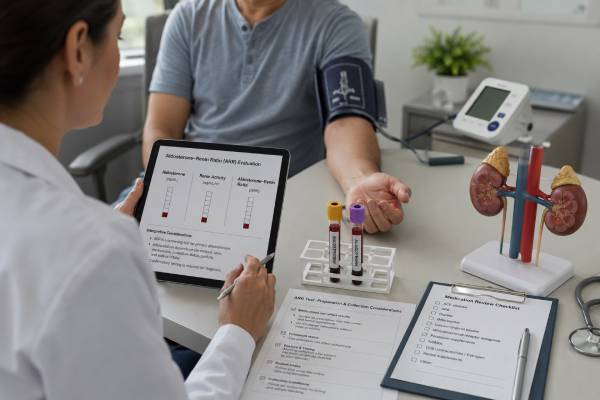
The aldosterone–renin ratio is the standard blood-screening approach for primary aldosteronism, a common hormonal cause of high blood pressure. The test measures aldosterone and renin from the same collection and asks whether aldosterone remains inappropriately active despite renin suppression. That mismatch is more revealing than a high aldosterone result alone.
ARR interpretation is unusually sensitive to preparation. Low potassium can suppress aldosterone and hide disease. Sodium restriction, dehydration, posture, time of day, kidney function, and many antihypertensive medicines change one or both components. The ratio also depends on whether renin is reported as plasma renin activity or direct renin concentration and whether aldosterone is measured by immunoassay or LC-MS/MS. A ratio from one unit system cannot be compared with a cutoff from another. A positive result is a screen, not proof that an adrenal nodule is producing hormone. The clinician reviews the absolute values, repeats or confirms the biochemical pattern when appropriate, and only then uses imaging and, when surgery is considered, adrenal vein sampling.
- A positive ARR requires suppressed renin plus aldosterone that is inappropriate for that suppression; a large ratio caused by two low values is not enough.
- Correct low potassium and avoid sodium restriction before testing when medically safe.
- Beta blockers can create false-positive ratios by lowering renin, while diuretics, ACE inhibitors, and ARBs can create false negatives by raising it.
- ARR cutoffs vary with renin method, aldosterone assay, units, posture, and laboratory protocol.
- Primary aldosteronism often occurs with normal potassium, so normal electrolytes do not rule it out.
Table of Contents
- How the ARR Works
- Who Should Be Screened
- Preparing for the ARR
- Cutoffs and Calculation
- Positive, Negative, and Borderline Results
- Confirmation and Subtyping
- Treatment and Follow-Up
How the ARR Works
Renin and aldosterone normally move together. When the kidneys detect reduced perfusion or sodium delivery, they release renin. Renin initiates formation of angiotensin II, which raises blood pressure and stimulates adrenal aldosterone. Aldosterone acts on the distal kidney to retain sodium and water and excrete potassium and hydrogen ions. As circulating volume expands, renin falls and aldosterone should fall with it.
Primary aldosteronism breaks this feedback relationship. One or both adrenal glands release aldosterone partly independently of renin. Sodium retention expands volume, which suppresses renin, yet aldosterone remains higher than it should be. The biochemical signature is therefore:
- low or suppressed renin;
- aldosterone that is elevated or inappropriate for the low renin;
- an increased aldosterone-to-renin ratio; and
- sometimes low potassium or metabolic alkalosis.
The condition may result from a unilateral aldosterone-producing adenoma or hyperplasia, bilateral adrenal production, or a less common familial form. “Conn syndrome” traditionally refers to an aldosterone-producing adrenal adenoma, not every form of primary aldosteronism.
The calculation is simple—aldosterone divided by renin—but the denominator creates a trap. If renin is extremely close to zero, almost any aldosterone value produces a large ratio. A ratio of 40 with aldosterone of 4 ng/dL is not equivalent to a ratio of 40 with aldosterone of 20 ng/dL. The absolute values and physiologic setting must accompany the quotient.
Renin may be reported in two fundamentally different ways:
- Plasma renin activity (PRA) measures the rate of angiotensin I generation, often in ng/mL/h.
- Direct renin concentration (DRC) measures renin protein, often in mU/L.
These denominators produce different numbers and need different thresholds. Aldosterone may be measured by immunoassay or liquid chromatography–tandem mass spectrometry. LC-MS/MS is more specific and often reports lower values, so its decision limit can be lower.
Who Should Be Screened
Primary aldosteronism is more common than the classic textbook presentation suggests and increases cardiovascular and kidney risk beyond blood pressure alone. The 2025 Endocrine Society guideline conditionally suggests screening all people with hypertension where resources and patient preferences support it, while emphasizing management of false positives and medication effects.
Screening is particularly important with:
- resistant hypertension on three suitable medicines, including a diuretic, or controlled pressure requiring four or more;
- spontaneous or diuretic-associated hypokalemia;
- severe, early-onset, or rapidly worsening hypertension;
- hypertension and an adrenal incidentaloma;
- hypertension with obstructive sleep apnea;
- hypertension with atrial fibrillation without a clear explanation;
- a family history of primary aldosteronism;
- hypertension or stroke at a young age in the patient or close relatives; or
- a first-degree relative with confirmed disease.
Most affected patients do not have dramatic symptoms. Some report headaches, thirst, frequent urination, muscle cramps, weakness, tingling, or palpitations, especially when potassium is low. Normal potassium is common and cannot be used as a screening gatekeeper.
ARR is designed for hypertension and renin-independent aldosterone excess. It is not the main way to diagnose low aldosterone in adrenal insufficiency, though the paired values may reveal a low-aldosterone, high-renin pattern. It does not screen for pheochromocytoma or Cushing syndrome.
Accurate blood-pressure diagnosis comes first. Use a validated device, correct cuff size, seated rest, and repeat or out-of-office measurements when appropriate. White-coat hypertension can lead to unnecessary endocrine workup; masked or treated hypertension can hide the true burden.
Primary aldosteronism matters even when blood pressure responds to ordinary treatment. Compared with essential hypertension at a similar pressure, chronic aldosterone exposure is associated with more atrial fibrillation, stroke, heart enlargement, and kidney injury. Targeted therapy blocks or removes the source rather than only lowering the cuff reading. Earlier recognition can also reduce years of potassium supplements and escalating multidrug regimens.
Children and adolescents with severe or resistant hypertension need specialist evaluation. Primary aldosteronism is uncommon in children, but a young presentation increases concern for familial disease or another monogenic hypertension. Pediatric reference values and genetic decisions differ from adult algorithms.
Preparing for the ARR
The ideal collection is usually performed in the morning after the patient has been awake and upright for at least two hours, then seated quietly for 5–15 minutes. Some centers use another validated posture. The report should record what actually occurred.
Do not restrict sodium during the several days before screening unless the clinician provides a different plan. Sodium restriction activates renin and may lower the ratio. Deliberate salt loading is unnecessary for the initial screen and may be unsafe in severe hypertension, heart failure, or kidney disease.
Measure potassium at the same time. Hypokalemia directly reduces aldosterone secretion and can produce a false-negative ARR. Correct it before testing when safe. Avoid repeated fist clenching and prolonged tourniquet use, which can falsely increase measured potassium and obscure the need for correction.
Medication effects
Almost every antihypertensive class affects the RAAS. Directional effects help explain a result but cannot be converted with a mathematical correction.
| Medicine class | Typical effect | Possible screening problem |
|---|---|---|
| Beta blocker or central alpha-2 agonist | Suppresses renin | False-positive ratio |
| ACE inhibitor or ARB | Raises renin; may lower aldosterone | False-negative ratio |
| Thiazide or loop diuretic | Raises renin through volume loss | False-negative ratio |
| Mineralocorticoid receptor antagonist | Raises renin and blocks aldosterone effect | Can substantially obscure the pattern |
| NSAID | May suppress renin | False-positive ratio |
Never stop these medicines without supervision. The 2025 guideline outlines no-withdrawal, minimal-withdrawal, and full-withdrawal strategies. A clinician may test on current therapy, repeat after a safe two- to four-week change, or substitute agents with less influence, such as selected alpha blockers, nondihydropyridine calcium-channel blockers, or hydralazine. Safety takes priority over perfect conditions.
If renin remains suppressed while the patient takes an ACE inhibitor, ARB, or diuretic that should raise it, the finding can strengthen suspicion. In contrast, a negative test on a renin-raising drug may warrant repetition when pretest probability is high.
Report oral contraceptives or estrogen, pregnancy, licorice, kidney disease, vomiting or diarrhea, supplements, and recent intense exercise. Estrogen changes angiotensinogen and can affect PRA and DRC differently. Pregnancy greatly activates RAAS and needs specialist reference expectations.
Schedule the draw for a day without acute vomiting, diarrhea, or unusual endurance exercise if clinically reasonable. These conditions activate renin and can hide suppression. Avoid arriving dehydrated after an unnecessary overnight fast; fasting is not inherently required unless another ordered test needs it. Continue normal water intake and follow the clinic’s food instructions.
Bring a written medicine list rather than relying on memory. Include combination pills, dose times, potassium supplements, oral contraception, NSAIDs, decongestants, and herbal products. Licorice root or glycyrrhizin can cause a low-renin, low-aldosterone mineralocorticoid-like state that resembles hypertension from aldosterone but produces a different biochemical pattern.
Cutoffs and Calculation
An ARR has no universal normal range. The laboratory must specify aldosterone method, renin method, units, and screening threshold. A result calculated with aldosterone in ng/dL and PRA in ng/mL/h cannot be compared with a threshold designed for pmol/L divided by mU/L.
The 2025 Endocrine Society guideline provides practical examples. A screen can be considered positive when renin is suppressed—PRA at or below 1 ng/mL/h or DRC at or below 8.2 mU/L—and aldosterone is at least 10 ng/dL by immunoassay or about 7.5 ng/dL by LC-MS/MS. An ARR above about 20 using aldosterone in ng/dL and PRA in ng/mL/h, or above about 70 using aldosterone in pmol/L and DRC in mU/L, can support the pattern. Local validated thresholds take priority, and LC-MS/MS ratio cutoffs may be about 25% lower.
These examples show why the report must contain all three numbers:
| Aldosterone | Renin | Interpretation |
|---|---|---|
| Clearly elevated | Suppressed | Strong positive pattern |
| Low | Nearly zero | Ratio may be high mathematically but not support aldosterone excess |
| High | High | Secondary RAAS activation, not primary aldosteronism |
| Borderline | Suppressed | Repeat under better conditions may be needed |
Screening thresholds balance sensitivity and specificity. Lower cutoffs identify milder disease but generate more false positives; higher cutoffs miss cases. Resistant hypertension, hypokalemia, or an adrenal mass increases the meaning of a borderline pattern.
Do not use a generic portal reference range as the ARR decision limit. The ratio may be reported without an automated flag, or the laboratory may cap very low renin at a minimum value for calculation. Ask how values below detection were handled.
For example, a laboratory may report PRA as “less than 0.2.” Dividing aldosterone by 0.2 yields only a minimum possible ratio because the true renin could be lower. Reporting the ratio as an exact value creates false precision. The suppressed renin and absolute aldosterone are more important than whether the calculated quotient is 50 or 100.
Aldosterone secretion fluctuates, so one borderline draw is not a permanent phenotype. Repeat testing on a separate morning can distinguish a consistent renin-independent pattern from ordinary biologic variation. Comparable posture, salt intake, potassium, and medication exposure make the repeat meaningful.
Positive, Negative, and Borderline Results
A positive screen shows renin-independent aldosterone activity is plausible. It does not identify unilateral versus bilateral disease and does not prove that a visible adrenal nodule is functional. First verify potassium, posture, sodium intake, medications, assay, and absolute aldosterone.
A strongly positive phenotype—suppressed renin, clearly high aldosterone, spontaneous hypokalemia, and compatible hypertension—may allow the clinician to proceed without a separate suppression test in some guideline pathways. Other positive or borderline cases are repeated or confirmed.
A negative screen makes primary aldosteronism less likely only when testing conditions could detect it. Repeat on another day when:
- potassium was low;
- sodium was restricted;
- a diuretic, ACE inhibitor, ARB, or mineralocorticoid antagonist raised renin;
- aldosterone was borderline while renin remained suppressed;
- resistant hypertension or hypokalemia creates high pretest probability; or
- collection posture or timing was not documented.
Beta blockers and clonidine can suppress renin and produce a false-positive ratio. The 2025 guideline advises considering repeat testing after a safe two-week withdrawal when a positive result occurs with modest aldosterone. If aldosterone remains clearly high, disease may still be likely despite the drug.
Age and chronic kidney disease can lower renin and increase false positives. Advanced kidney disease also changes potassium and aldosterone handling. Pregnancy and estrogen exposure require method-aware interpretation. No single correction handles these conditions.
The ARR is not a measure of disease severity. A larger number may reflect a smaller denominator rather than more aldosterone. Cardiovascular risk, blood pressure, potassium, kidney function, and confirmatory physiology matter more than ranking patients by ratio.
A low ARR can also be informative. If both renin and aldosterone are high, consider secondary RAAS activation from diuretics, volume loss, heart failure, cirrhosis, or reduced renal perfusion. If both are low with hypertension and hypokalemia, consider Liddle syndrome, apparent mineralocorticoid excess, licorice, or certain congenital adrenal enzyme defects. Those pathways need different tests and treatments.
Confirmation and Subtyping
Confirmatory tests assess whether aldosterone suppresses when RAAS should turn off. Options include:
- saline infusion;
- oral sodium loading with 24-hour urine aldosterone and sodium;
- captopril challenge; and
- fludrocortisone suppression.
Protocols and cutoffs vary. Sodium-loading procedures may be unsafe in uncontrolled hypertension, heart failure, significant kidney disease, or severe hypokalemia. Captopril testing may be selected when volume loading is unsuitable, but medication and kidney considerations remain. Not every patient needs the same confirmation.
During saline infusion, the expected normal response is suppression of aldosterone as volume expands. Oral salt loading checks 24-hour urine aldosterone only after urine sodium documents adequate intake and the collection is complete. Fludrocortisone suppression is intensive and closely supervised. Captopril blocks angiotensin II formation; persistent inappropriate aldosterone supports autonomy. Each test has method-specific thresholds.
Some patients with an unequivocal triad of suppressed renin, clearly elevated aldosterone, and hypokalemia can proceed directly to subtype evaluation or treatment under current guidance. Avoiding a redundant suppression test can shorten care, but skipping confirmation is a specialist decision based on the full phenotype.
Once primary aldosteronism is established, adrenal CT evaluates anatomy and excludes a large suspicious mass. CT cannot reliably assign hormone production. Nonfunctioning nodules are common with age, and small aldosterone-producing lesions may not be visible.
Adrenal vein sampling compares aldosterone-to-cortisol ratios from the right and left adrenal veins. It is generally recommended before surgery to determine whether production is unilateral, with selected exceptions for young patients with a very convincing phenotype and matching unilateral lesion. The procedure requires an experienced interventional radiology team.
Do not jump from a positive ARR to adrenal surgery. The sequence is biochemical recognition, confirmation where needed, anatomic imaging, and functional lateralization when the treatment choice depends on side.
Treatment and Follow-Up
Unilateral aldosterone production may be treated with laparoscopic adrenalectomy. Bilateral production is generally treated with a mineralocorticoid receptor antagonist such as spironolactone or eplerenone. People who do not pursue further subtyping can also receive aldosterone-directed medical therapy when appropriate.
Treatment monitoring includes blood pressure, potassium, creatinine or estimated filtration, medication tolerance, and renin. A rise from suppressed renin can show more complete blockade of aldosterone’s sodium-retaining effect, but targets are individualized. Kidney function may appear to fall after treatment because excess aldosterone had caused hyperfiltration; clinicians monitor rather than assuming therapy caused new damage.
Spironolactone can cause breast tenderness, gynecomastia, menstrual changes, sexual effects, and high potassium. Eplerenone is more selective but may require twice-daily dosing and can cost more. Surgery can normalize potassium and improve blood pressure, although longstanding essential hypertension may persist.
After adrenalectomy, aldosterone may remain temporarily low and the previously suppressed opposite adrenal gland may recover gradually. Potassium and kidney function need early monitoring. After medical treatment, a rising renin can indicate effective reversal of sodium retention, but dose changes must also consider pressure, potassium, kidney function, and side effects.
An expanded primary aldosteronism panel places the ARR alongside potassium and confirmatory steps. A focused aldosterone blood test interpretation also covers low-aldosterone patterns that the ARR screen is not designed to diagnose.
Ask the clinician:
- Were aldosterone and renin measured from the same draw under the planned posture?
- Is renin PRA or DRC, and which cutoff matches the units?
- Was aldosterone measured by immunoassay or LC-MS/MS?
- Could potassium, sodium intake, kidney function, or medication explain the pattern?
- Should the ARR be repeated before suppression testing?
- If primary aldosteronism is confirmed, do I prefer surgical evaluation or medical therapy?
Seek urgent care for chest pain, stroke-like symptoms, fainting, dangerous palpitations, severe weakness or paralysis, or extremely high blood pressure. The ARR is an outpatient diagnostic tool, not a substitute for treating a blood-pressure or potassium emergency.
The ARR works when it is treated as physiology rather than a single score. Suppressed renin, inappropriate aldosterone, correct units, controlled preparation, and a defined confirmation plan turn the calculation into a reliable path toward targeted treatment.
Save the complete laboratory report and preparation notes. They allow a specialist to judge whether a future change reflects treatment, biology, a different assay, or different collection conditions.
Follow-Up After the Cause Is Established
Follow-up is different after unilateral adrenal surgery and during treatment with a mineralocorticoid receptor antagonist. After adrenalectomy, blood pressure and potassium can change quickly, so clinicians review antihypertensive medicines and potassium supplements promptly. Some people no longer need as many blood-pressure drugs, while others retain essential hypertension even though aldosterone excess has been corrected. Temporary low aldosterone and high potassium can occur because the opposite adrenal gland and renin system were suppressed before surgery.
For bilateral disease or when surgery is unsuitable, spironolactone or eplerenone is commonly used to block aldosterone’s effects. Monitoring includes potassium, kidney function, blood pressure, symptoms, and medication tolerance. Spironolactone can cause breast tenderness, gynecomastia, menstrual changes, or sexual side effects; eplerenone is more selective but may require different dosing and can cost more. Dose adjustment should be supervised because excessive blockade can raise potassium, especially in chronic kidney disease or when combined with ACE inhibitors, angiotensin receptor blockers, or potassium supplements.
Renin can provide a useful treatment signal in some patients. A persistently suppressed value may suggest that aldosterone action and sodium retention remain inadequately blocked, although treatment decisions must also account for blood pressure, potassium, kidney function, and tolerance. Long-term care focuses on more than reaching a normal office blood pressure. Primary aldosteronism carries cardiovascular and kidney risk, so clinicians also address sleep apnea, diabetes, smoking, lipid levels, dietary sodium, and weight. Patients should seek urgent care for severe weakness, dangerous palpitations, fainting, or symptoms of a hypertensive emergency.
References
- Primary Aldosteronism 2025 (Guideline)
- Primary Aldosteronism: An Endocrine Society Clinical Practice Guideline 2025 (Guideline)
- 2023 Korean Endocrine Society Consensus Guidelines for the Diagnosis and Management of Primary Aldosteronism 2023 (Consensus Guideline)
- Diagnosis and management of primary hyperaldosteronism in patients with hypertension: a practical approach endorsed by the British and Irish Hypertension Society 2024 (Review)
- Endocrine Hypertension in Children and Adolescence 2025 (Review)
Disclaimer
This article is educational and cannot diagnose primary aldosteronism or direct medication changes. ARR thresholds vary by assay, renin method, units, posture, potassium, sodium, and medicines. Blood-pressure emergencies and severe potassium symptoms need urgent medical care.