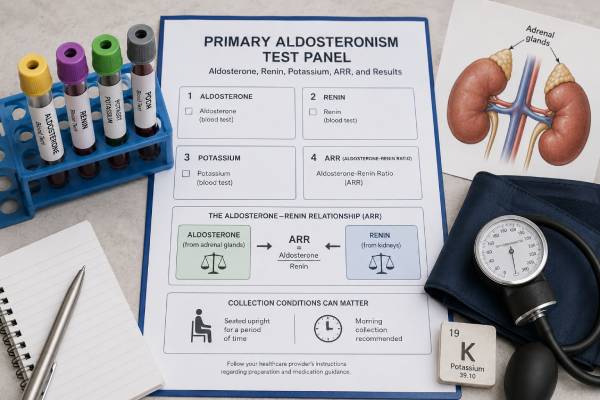
A primary aldosteronism test panel measures aldosterone, renin, potassium, and the aldosterone-to-renin ratio, or ARR, to look for inappropriate aldosterone production. Aldosterone helps the kidneys retain sodium and water and excrete potassium. Normally, renin stimulates aldosterone when blood volume or pressure is low. In primary aldosteronism, aldosterone remains too high for the body’s needs and renin becomes suppressed. The condition is an important, treatable cause of hypertension and can increase the risk of stroke, atrial fibrillation, kidney disease, and heart damage beyond the effect of blood pressure alone. A high ARR is a screening result, not a diagnosis. Potassium level, sodium intake, posture, collection time, kidney function, and many blood-pressure medicines can change aldosterone or renin. Results must be interpreted using the laboratory’s renin method and assay-specific thresholds, followed by confirmation or subtype testing when appropriate.
- The classic screening pattern is suppressed renin with inappropriately high aldosterone and an elevated ARR.
- Normal potassium does not exclude primary aldosteronism; many affected people are not hypokalemic.
- Correct low potassium and avoid sodium restriction before screening unless the clinician gives different instructions.
- Diuretics, mineralocorticoid blockers, ACE inhibitors, ARBs, beta-blockers, and other medicines can alter the ratio.
- A positive ARR may lead to repeat testing, confirmatory testing, adrenal CT, and adrenal vein sampling.
Table of Contents
- How Aldosterone, Renin, and Potassium Work Together
- Who Should Be Screened
- Preparation: Posture, Salt, and Medications
- Understanding the Aldosterone-Renin Ratio
- Common Result Patterns
- Confirmatory Testing After a Positive Screen
- CT, Adrenal Vein Sampling, and Subtyping
- Treatment, Monitoring, and Next Steps
How Aldosterone, Renin, and Potassium Work Together
The renin-angiotensin-aldosterone system helps maintain circulation. When the kidneys sense reduced blood flow, low sodium delivery, or sympathetic stimulation, specialized cells release renin. Renin starts a chain that produces angiotensin II, which constricts blood vessels and stimulates adrenal aldosterone.
Aldosterone acts mainly in the distal kidney. It increases sodium reabsorption, which helps retain water, and increases potassium and hydrogen ion excretion. When blood volume expands and blood pressure rises, renin normally falls and aldosterone should fall with it.
Primary aldosteronism breaks this relationship. One or both adrenal glands produce aldosterone partly independently of renin. Sodium retention expands volume, renin becomes suppressed, and potassium may fall. The earliest or milder cases often keep potassium in the normal range because dietary intake and kidney adaptation compensate.
The panel therefore needs all components. Aldosterone alone can look “normal” even when it is too high for a nearly undetectable renin. Renin alone can be low from high salt intake, beta-blockers, aging, kidney disease, or other forms of low-renin hypertension. The ARR expresses the relationship, while potassium helps explain whether aldosterone action has caused significant renal loss.
Aldosterone may be reported in ng/dL or pmol/L. Renin may be measured as plasma renin activity, or PRA, in ng/mL/hour, or as direct renin concentration, often in mU/L. These methods are not interchangeable. An ARR cutoff developed for PRA cannot be applied to direct renin without conversion and method validation.
The aldosterone-renin ratio test is a screen for physiology, not a scan for a tumor. Both bilateral adrenal hyperplasia and a unilateral aldosterone-producing adenoma can produce the same initial pattern.
Who Should Be Screened
Primary aldosteronism is more common than once believed, including in people with moderate hypertension and normal potassium. Recent guidance supports broad screening among people with hypertension where testing and follow-up are feasible. Local practice may prioritize higher-risk groups.
Strong indications include:
- Resistant hypertension despite three medicines, including a diuretic, or controlled blood pressure requiring four or more drugs.
- Hypertension with spontaneous or diuretic-induced low potassium.
- Hypertension with an adrenal incidentaloma.
- Severe hypertension or hypertension beginning at a young age.
- Hypertension with obstructive sleep apnea.
- Hypertension plus atrial fibrillation without another clear cause.
- A family history of early-onset hypertension, stroke at a young age, or confirmed primary aldosteronism.
- A first-degree relative of someone with primary aldosteronism in selected circumstances.
Symptoms are often absent. Some people have headaches or nonspecific fatigue from hypertension. Low potassium can cause weakness, cramps, constipation, palpitations, increased urination, or excessive thirst, but relying on symptoms misses many cases.
The reason to identify primary aldosteronism is not merely to choose another blood-pressure tablet. Aldosterone excess promotes inflammation, fibrosis, and damage in the heart, blood vessels, and kidneys. Targeted treatment can reduce that excess risk.
Screening during an acute hospitalization, severe illness, uncontrolled heart failure, or immediately after major medication changes may be misleading. Stable outpatient conditions are preferable unless urgency requires a different approach.
Children and very young adults with severe hypertension need specialist evaluation for monogenic forms, renal causes, and adrenal disorders. The interpretation and genetic strategy differ from routine adult screening.
Preparation: Posture, Salt, and Medications
Preparation aims to avoid falsely low aldosterone or falsely altered renin. Potassium should be measured and corrected if low because hypokalemia can suppress aldosterone and create a false-negative screen. Correction may require dietary potassium, supplements, and review of diuretics.
Patients should generally maintain their usual or liberal sodium intake rather than restrict salt immediately before testing. Sodium restriction raises renin and can lower the ARR. People with heart failure, advanced kidney disease, or another reason for sodium restriction need individualized instructions.
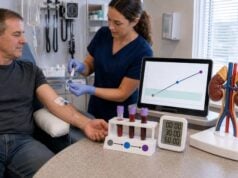
Collection is often performed in the morning after the patient has been awake and upright for a specified period, then seated for several minutes. Other centers use a seated or supine protocol. The laboratory’s posture-specific range and local endocrine protocol should be followed.
Many medicines affect the panel:
- Mineralocorticoid receptor antagonists such as spironolactone and eplerenone raise renin and directly block aldosterone action.
- Amiloride and triamterene alter potassium handling and renin.
- Loop and thiazide diuretics increase renin and may cause low potassium.
- ACE inhibitors and ARBs raise renin and can lower aldosterone.
- Beta-blockers and central sympatholytics suppress renin and can falsely raise the ARR.
- Dihydropyridine calcium-channel blockers may lower the ratio modestly.
- Nonsteroidal anti-inflammatory drugs can suppress renin.
- Estrogen-containing contraceptives can affect direct renin and create method-dependent changes.
Medication washout is not always safe or necessary. Severe hypertension, heart failure, and other conditions may make stopping therapy dangerous. The clinician can interpret on treatment, substitute less-interfering agents such as verapamil, hydralazine, or an alpha-blocker when appropriate, or repeat later.
The dose, timing, posture, sodium intake, potassium, and renin method should be documented. A ratio without these details is harder to interpret.
Understanding the Aldosterone-Renin Ratio
The ARR is calculated by dividing aldosterone by renin. The numeric cutoff depends on units and whether renin is PRA or direct concentration. A commonly used PRA-based threshold is around 20–30 when aldosterone is in ng/dL and PRA is in ng/mL/hour, often with a minimum aldosterone requirement such as 10 or 15 ng/dL. These values are examples, not universal standards.
A ratio can look very high when renin is nearly zero, even if aldosterone is low. For example, aldosterone of 5 ng/dL divided by PRA of 0.1 gives an ARR of 50, but the low aldosterone may not support autonomous secretion. Both components must be reviewed.
Conversely, a patient taking an ACE inhibitor may have a high renin that lowers the ARR despite primary aldosteronism. A suppressed renin despite a medicine expected to raise it can be an important clue.
| Panel feature | Why it matters | Common pitfall |
|---|---|---|
| Aldosterone | Shows mineralocorticoid production | “Normal” may still be inappropriate when renin is suppressed |
| Renin | Shows whether the kidney is signaling for aldosterone | Method and medicine effects are large |
| ARR | Expresses aldosterone relative to renin | Can be inflated by a very low denominator |
| Potassium | Shows downstream renal potassium loss | Normal potassium does not exclude disease |
A positive screen means the pattern deserves confirmation or specialist evaluation. It does not determine whether one or both adrenal glands are involved and does not prove that an adrenal nodule is functional.
Common Result Patterns
The classic primary aldosteronism pattern is low renin, aldosterone that is elevated or inappropriate for the suppressed renin, and a high ARR. Potassium may be low or normal. Metabolic alkalosis can occur in more severe disease.
High renin with high aldosterone usually indicates secondary activation, such as diuretic use, dehydration, renovascular disease, heart failure, or cirrhosis. The aldosterone is responding to renin rather than acting autonomously.
Low renin with low aldosterone points away from primary aldosteronism. Possibilities include high sodium intake, beta-blocker or NSAID effects, chronic kidney disease, Cushing syndrome, apparent mineralocorticoid excess, Liddle syndrome, licorice exposure, or excess deoxycorticosterone.
| Renin | Aldosterone | Possible pattern |
|---|---|---|
| Low | High or inappropriately normal | Primary aldosteronism |
| High | High | Secondary aldosterone response |
| Low | Low | Non-aldosterone low-renin hypertension or medication effect |
| High | Low | ACE inhibitor, ARB, adrenal impairment, or another disrupted response |
A deoxycorticosterone test may be relevant when hypertension, low potassium, low renin, and low aldosterone suggest another mineralocorticoid.
Repeated results matter. Renin and aldosterone vary with time, posture, salt, potassium, and medicines. A pattern that remains consistent under improved conditions is more convincing than one isolated ratio.
Confirmatory Testing After a Positive Screen
Confirmatory tests ask whether aldosterone can be suppressed when sodium or volume expands. Options include saline infusion, oral sodium loading with urine aldosterone, captopril challenge, and fludrocortisone suppression. Availability and expertise vary.
The saline infusion test gives intravenous saline over several hours and measures aldosterone afterward. Failure to suppress supports autonomous production. It may be unsuitable in uncontrolled hypertension, heart failure, advanced kidney disease, or severe hypokalemia.
Oral sodium loading requires high sodium intake and a 24-hour urine collection for sodium, aldosterone, and creatinine. It is not safe for everyone and depends on collection completeness.
Captopril normally reduces angiotensin II and aldosterone. Persistent aldosterone after captopril supports primary aldosteronism, although diagnostic accuracy and protocols vary.
Some patients with an overt biochemical pattern may not need a confirmatory test. Examples can include spontaneous hypokalemia, clearly suppressed renin, and markedly elevated aldosterone. Current guidance also allows a probability-based approach in selected patients, especially when the next decision is medical treatment rather than surgery.
Confirmatory testing should not become a barrier when the screening phenotype is strong and treatment is needed. The endocrinologist balances certainty, safety, local expertise, and the intended management path.
CT, Adrenal Vein Sampling, and Subtyping
After primary aldosteronism is established, adrenal CT evaluates anatomy and excludes a large suspicious mass. CT cannot reliably determine which gland is overproducing aldosterone. Nonfunctioning adrenal nodules are common, especially with age, and small aldosterone-producing lesions may be invisible.
Adrenal vein sampling, or AVS, measures aldosterone and cortisol from veins draining each adrenal gland. It determines whether secretion is unilateral or bilateral and is generally recommended for surgical candidates when the result would change treatment.
AVS is technically demanding. Cortisol confirms successful catheter placement and helps correct for dilution. Interpretation uses selectivity and lateralization indices that vary by center and whether ACTH stimulation is used.
Some young patients with a clear unilateral lesion and a very strong phenotype may be considered for surgery without AVS, but this is an exception. Most adults benefit from AVS because imaging alone frequently misclassifies the source.
Unilateral disease may come from an aldosterone-producing adenoma or unilateral hyperplasia. Bilateral disease usually reflects bilateral adrenal hyperplasia. Rare familial forms may involve both glands and require genetic evaluation.
Treatment, Monitoring, and Next Steps
Unilateral primary aldosteronism is often treated with laparoscopic adrenalectomy. Blood pressure may normalize, but many patients still need fewer medications rather than none. Potassium and renin often improve quickly, while cardiovascular remodeling takes longer.
Bilateral disease and patients who do not have surgery are treated with a mineralocorticoid receptor antagonist such as spironolactone or eplerenone. Amiloride may be used in selected situations. Monitoring includes potassium, kidney function, blood pressure, and treatment tolerance.
A rise in renin from a suppressed baseline can indicate that mineralocorticoid blockade and sodium balance are adequately countering aldosterone, although treatment targets are individualized. Persistent suppressed renin may suggest insufficient blockade, high sodium intake, or adherence issues.
Spironolactone can cause breast tenderness, gynecomastia, menstrual changes, or sexual side effects because it interacts with sex-hormone receptors. Eplerenone is more selective but often requires twice-daily dosing and can be more expensive. Both can cause high potassium, especially with kidney disease or ACE inhibitor/ARB therapy.
Questions after screening include:
- Which renin method and ARR cutoff did the laboratory use?
- Was potassium normal and sodium intake adequate?
- Which medicines may have changed renin or aldosterone?
- Is the absolute aldosterone high enough to support the ratio?
- Do I need repeat or confirmatory testing?
- If surgery is an option, will I need CT and adrenal vein sampling?
Primary aldosteronism is a treatable endocrine form of hypertension. Accurate preparation and method-aware interpretation prevent both missed diagnoses and false labels.
Special clinical situations and treatment outcomes
Primary aldosteronism exists on a spectrum. Some patients have obvious hypokalemia and very high aldosterone, while others have normal potassium and only modestly inappropriate aldosterone for a suppressed renin. This milder physiology can still be associated with cardiovascular risk. A binary view of “disease versus normal” may miss people with clinically important renin-independent aldosterone production.
Obstructive sleep apnea and primary aldosteronism can reinforce each other. Aldosterone-related fluid retention may worsen upper-airway swelling, while sleep apnea raises sympathetic activity and blood pressure. Screening is particularly relevant in resistant hypertension with sleep apnea, and both conditions may need treatment.
Atrial fibrillation without another clear explanation can be a clue. Aldosterone promotes atrial remodeling and fibrosis, and primary aldosteronism is overrepresented among patients with hypertension and atrial fibrillation. Identifying the cause may change long-term cardiovascular risk management.
Kidney disease complicates screening. Reduced kidney function, diuretics, altered potassium, and variable renin can distort the ARR. Confirmatory salt-loading tests may be unsafe. An endocrinologist and kidney specialist may use a probability-based approach, careful medication interpretation, and treatment response rather than insisting on a risky protocol.
Pregnancy also changes renin and aldosterone substantially. Nonpregnant ARR thresholds may not apply, and several standard medicines are contraindicated. Severe hypertension with spontaneous hypokalemia or a known adrenal lesion should prompt specialist evaluation. Treatment choices prioritize maternal and fetal safety, and definitive subtype procedures may be delayed when appropriate.
Familial hyperaldosteronism should be considered with very early onset, a strong family history, or strokes at young ages. Several genetic forms exist. Some respond to glucocorticoids, while others involve adrenal nodules or hyperplasia. Genetic testing is targeted rather than performed for every adult with a positive ARR.
The health impact extends beyond clinic blood pressure. Aldosterone excess is associated with albuminuria, left ventricular hypertrophy, arterial stiffness, atrial arrhythmia, and stroke. Treatment may improve these outcomes even when the initial blood-pressure reduction appears modest.
After adrenalectomy, potassium often normalizes quickly. Blood pressure improvement depends on age, duration of hypertension, vascular remodeling, kidney function, and coexisting essential hypertension. Biochemical cure can occur even when some blood-pressure medicine remains necessary. Postoperative aldosterone and renin help confirm the hormonal response.
After starting spironolactone or eplerenone, potassium and creatinine should be checked soon and after dose changes. The risk of hyperkalemia rises with kidney disease, older age, ACE inhibitors, ARBs, dehydration, and high potassium intake. Patients need clear instructions about illness, laboratory monitoring, and interacting medicines such as NSAIDs.
Dietary sodium affects treatment. A high-sodium diet can blunt the blood-pressure benefit of mineralocorticoid blockade and keep volume expanded. Moderate sodium reduction after diagnosis is often helpful, but it should not be confused with pre-screening preparation, when deliberate restriction may distort the ARR.
Adrenal vein sampling is not a general blood test and is not needed for patients who will choose medical treatment regardless of subtype. It is most valuable when surgery is a realistic option and knowing unilateral versus bilateral secretion will change management. Experience at the performing center strongly affects success.
A patient-centered plan separates three questions: Is aldosterone production inappropriate? Is secretion unilateral or bilateral? Which treatment offers the best balance of blood-pressure control, cardiovascular protection, safety, and patient preference? The panel begins that process but does not answer all three by itself.
Home blood-pressure readings can strengthen the evaluation by showing whether hypertension is sustained outside the clinic and how many medicines are truly required. Ambulatory monitoring may identify masked hypertension, nighttime hypertension, or an apparent treatment resistance caused by white-coat effect.
Potassium replacement should be rechecked before the ARR is interpreted. A single tablet on the morning of testing may not correct a meaningful deficit. Magnesium deficiency can also make potassium difficult to restore, and ongoing diuretic loss may continue.
The panel can be repeated after a medication strategy, but the plan should be documented. A ratio obtained while taking a beta-blocker may be deliberately accepted when stopping it is unsafe. In that case, the absolute aldosterone and the degree of renin suppression are reviewed more cautiously.
Patients pursuing surgery should understand that AVS answers a functional question that CT cannot. A visible nodule on one side and hormone production from the other side is possible. Basing surgery on CT alone can remove the wrong gland or fail to cure aldosterone excess.
Medical treatment is not second-rate care for bilateral disease. Adequate mineralocorticoid receptor blockade, potassium monitoring, sodium reduction after diagnosis, and blood-pressure control directly address the harmful physiology and can substantially reduce risk.
The ARR is best viewed as a probability tool. A strong phenotype can remain persuasive despite imperfect medication conditions, while a weak ratio in a low-risk setting may disappear after potassium and preparation are corrected.
References
- Primary Aldosteronism: An Endocrine Society Clinical Practice Guideline 2025 (Guideline)
- Primary aldosteronism 2.0: an update for clinicians on diagnosis and treatment 2023 (Review)
- The Spectrum of Dysregulated Aldosterone Production: An International Human Physiology Study 2024
- Subclinical Primary Aldosteronism and Cardiovascular Health: A Population-Based Cohort Study 2024
- A Systematic Review Supporting the Endocrine Society Clinical Practice Guideline on Management of Primary Aldosteronism 2025 (Systematic Review)
Disclaimer
This article is educational and cannot diagnose primary aldosteronism or guide medication withdrawal for an individual. Aldosterone, renin, ARR, and potassium depend on assay, posture, sodium intake, medicines, and kidney function. Blood-pressure treatment should be changed only with the prescribing clinician’s supervision.