A deoxycorticosterone test measures 11-deoxycorticosterone, usually shortened to DOC, in blood. DOC is an adrenal steroid made along the pathway that produces corticosterone and aldosterone. At ordinary concentrations it contributes little to day-to-day blood pressure control, but a large excess can act like a mineralocorticoid: the kidneys retain sodium, potassium falls, blood volume expands, renin becomes suppressed, and hypertension may develop. Doctors most often order the test when high blood pressure and low potassium suggest mineralocorticoid excess but aldosterone is not elevated, or when a rare adrenal enzyme disorder is being considered. DOC is not a general screening test for hypertension, fatigue, or “adrenal balance.” Its value comes from interpreting it with renin, aldosterone, potassium, cortisol, ACTH, and other steroid precursors. A result above the laboratory range does not identify the cause by itself, while a normal result can help redirect the evaluation toward more common explanations.
- DOC testing is mainly used for unexplained low-renin hypertension, suspected congenital adrenal hyperplasia, or a rare steroid-producing adrenal lesion.
- High DOC can cause hypertension, low potassium, metabolic alkalosis, and suppressed renin even when aldosterone is low.
- A common adult reference limit is below about 10–19 ng/dL, but laboratories use different methods and ranges.
- Morning collection is often preferred because adrenal steroids vary during the day and ACTH influences production.
- DOC must be interpreted with aldosterone, renin, cortisol, ACTH, electrolytes, and a broader steroid profile.
- Severe hypertension with weakness, palpitations, chest pain, confusion, or marked hypokalemia needs prompt medical assessment.
Table of Contents
- What the DOC Test Measures
- When the Test Is Used
- Preparation and Collection
- Normal Range and Units
- What High DOC Means
- What Low DOC Means
- Interpreting DOC With Other Tests
- Follow-Up and Next Steps
What the DOC Test Measures
DOC is a steroid produced mainly in the adrenal cortex. Its full biochemical name is 11-deoxycorticosterone, although some laboratory reports may use deoxycorticosterone, 21-hydroxyprogesterone, or the abbreviation DOC. It should not be confused with 11-deoxycortisol, which sits in the cortisol pathway and answers a different diagnostic question.
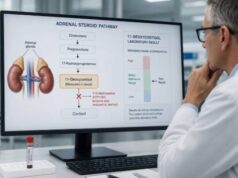
Adrenal steroid production begins with cholesterol. Enzymes convert cholesterol through branching pathways that lead to cortisol, aldosterone, and adrenal androgens. In the mineralocorticoid branch, progesterone is converted to DOC. DOC is then converted to corticosterone and, through additional steps, to aldosterone. A block farther along the pathway can therefore cause DOC to accumulate.
Although aldosterone is the principal mineralocorticoid in healthy adults, very high DOC concentrations can activate mineralocorticoid receptors. The kidneys then reabsorb more sodium and water while excreting more potassium and hydrogen ions. The resulting pattern may include:
- high blood pressure, sometimes resistant to several medications;
- low potassium, although potassium can remain normal early in the process;
- increased bicarbonate or metabolic alkalosis;
- suppressed renin because expanded blood volume signals the kidneys to stop releasing it;
- low or low-normal aldosterone because the renin-angiotensin system is switched down.
That pattern differs from classic primary aldosteronism, in which aldosterone itself is inappropriately high while renin is suppressed. The primary aldosteronism test panel is usually assessed before or alongside DOC because primary aldosteronism is much more common than DOC excess.
DOC testing is generally performed by liquid chromatography–tandem mass spectrometry, or LC-MS/MS. This method separates DOC from chemically similar steroids before measurement. That distinction matters because steroid immunoassays can cross-react with related compounds, especially at the low concentrations found in healthy people. Some centers order DOC as part of a multi-steroid profile rather than as a stand-alone result.
DOC is also different from deoxycorticosterone acetate, abbreviated DOCA. DOCA is a manufactured ester used in older treatments and in laboratory models of salt-sensitive hypertension; a clinical DOC blood test measures the naturally occurring hormone, not exposure to an experimental animal compound. The similar abbreviations can create confusion when reading older papers.
The hormone’s position in the pathway explains why a result must be read directionally. An enzyme block can raise DOC because production backs up before the blocked step. An adrenal lesion can raise it because abnormal tissue produces steroids without normal regulation. Strong ACTH stimulation can increase it by pushing more substrate through the adrenal cortex. These mechanisms may produce different companion results even when the DOC number is similar. For example, high androgens and high 11-deoxycortisol favor CYP11B1 deficiency, whereas low sex steroids with high corticosterone favor CYP17A1 deficiency. A mass with mixed cortisol or androgen secretion raises a different concern.
A result may also be analytically valid but clinically incidental. Small departures from the reference interval are commoner than true DOC-driven hypertension. Repeating a borderline measurement under standardized conditions can prevent an unnecessary scan, while a strongly abnormal value should not be dismissed simply because potassium is still normal.
When the Test Is Used
A clinician may request DOC after finding a biochemical pattern that looks like mineralocorticoid excess without the expected rise in aldosterone. The test is most useful when it answers a focused question rather than being added to a broad hormone panel without clinical context.
Low-renin hypertension with low aldosterone
When both renin and aldosterone are suppressed, an elevated aldosterone-to-renin ratio alone can be misleading because the denominator is extremely low. The clinician may look for other substances or mechanisms that activate the mineralocorticoid receptor. DOC is one possibility, but the differential diagnosis also includes apparent mineralocorticoid excess, licorice or glycyrrhizin exposure, Liddle syndrome, excess cortisol, certain medications, and advanced kidney disease.
The renin blood test helps define this pattern. A single low renin result is not enough, because sodium intake, posture, age, kidney function, and antihypertensive drugs can all suppress renin.
Suspected 11β-hydroxylase deficiency
11β-hydroxylase deficiency is a rare form of congenital adrenal hyperplasia caused by reduced CYP11B1 enzyme activity. Cortisol production falls, ACTH rises, and steroid precursors above the enzyme block accumulate. DOC and 11-deoxycortisol may become markedly elevated. Androgen production also increases, so affected children may have early virilization, rapid growth followed by reduced adult height, early pubic hair, or atypical genital development. Hypertension may appear later and potassium may be normal or low.
DOC is not interpreted alone in this setting. Testing commonly includes 11-deoxycortisol, cortisol, ACTH, androstenedione, testosterone, 17-hydroxyprogesterone, renin, aldosterone, and electrolytes. An adrenal hyperplasia test panel can show the broader pathway pattern. Genetic testing may confirm the diagnosis.
Suspected 17α-hydroxylase/17,20-lyase deficiency
CYP17A1 deficiency diverts steroid production toward DOC and corticosterone while reducing cortisol and sex-steroid synthesis. People may present with hypertension, low potassium, delayed or absent puberty, primary amenorrhea, or undervirilization in an individual with XY chromosomes. Aldosterone is often low because volume expansion suppresses renin, even though the clinical picture resembles aldosterone excess.
In this disorder, the whole steroid pattern is more informative than DOC alone. Progesterone, corticosterone, ACTH, cortisol, DHEA-S, testosterone, estradiol, gonadotropins, renin, and aldosterone may all be relevant.
Adrenal tumor or adrenal hyperplasia
A DOC-producing adrenal adenoma, adrenocortical carcinoma, or bilateral adrenal hyperplasia is rare. It becomes more plausible when hypertension and hypokalemia are accompanied by a clearly elevated DOC result, suppressed renin and aldosterone, or an adrenal mass. Some tumors secrete more than one steroid, so cortisol or androgen excess may coexist. Rapidly developing hypertension, new virilization, Cushing-like features, or a large irregular adrenal lesion increases concern.
Imaging should usually follow biochemical assessment rather than replace it. Incidental adrenal nodules are common, whereas functional DOC-producing lesions are not. A scan finding and a hormone pattern must agree before the lesion is assumed to be causal.
Clarifying an unusual newborn screen
Newborn screening is designed primarily to detect 21-hydroxylase deficiency using 17-hydroxyprogesterone. Moderate elevations can occasionally reflect another pathway disorder, prematurity, illness, or assay interference. Pediatric endocrinologists may use DOC, 11-deoxycortisol, 21-deoxycortisol, and other steroids to distinguish among causes. Neonatal values differ sharply from adult values, particularly during the first week of life, so adult cutoffs must never be applied to a newborn.
Preparation and Collection
DOC is measured in serum or plasma, depending on the laboratory. Many reference laboratories prefer a morning specimen, often near 8 a.m. Morning collection reduces one source of variability and makes the result easier to compare with cortisol, ACTH, and other adrenal steroids collected at the same time.
The blood draw itself is routine, but the preparation can be clinically important. Ask the ordering clinician which medicines should be continued. Do not stop blood-pressure drugs, glucocorticoids, hormonal medicines, or supplements on your own. Abruptly stopping some drugs can be dangerous, and the safest preparation depends on why the test was ordered.
Information worth sharing before collection includes:
- prescription and nonprescription corticosteroids, including pills, injections, inhalers, skin creams, and joint injections;
- mineralocorticoid receptor blockers such as spironolactone or eplerenone;
- diuretics, ACE inhibitors, angiotensin receptor blockers, beta blockers, central alpha agonists, and calcium-channel blockers;
- oral contraceptives, estrogen therapy, progesterone, testosterone, DHEA supplements, and fertility medicines;
- licorice root, chewing tobacco containing licorice, herbal mixtures, and glycyrrhizin-containing products;
- acute illness, severe pain, recent surgery, pregnancy, and menstrual-cycle phase when relevant.
Medication effects are especially important when renin and aldosterone are being collected with DOC. Diuretics and renin-angiotensin system blockers can raise renin. Beta blockers and central sympatholytic medicines can lower it. Mineralocorticoid receptor antagonists may make screening harder to interpret. A clinician may substitute medications temporarily when accurate renin and aldosterone assessment is essential, but this requires a personalized safety plan.
Sodium intake also affects renin and aldosterone. Extreme salt restriction can raise renin, while high intake can suppress it. Follow the clinician’s instructions rather than deliberately loading or restricting salt. Correct significant hypokalemia before aldosterone testing when feasible because low potassium can reduce aldosterone secretion and create a falsely reassuring result.
A laboratory may freeze the sample and send it to a specialized center. Turnaround can therefore be several days. The report should identify the assay, unit, and reference interval used for that specimen.
Normal Range and Units
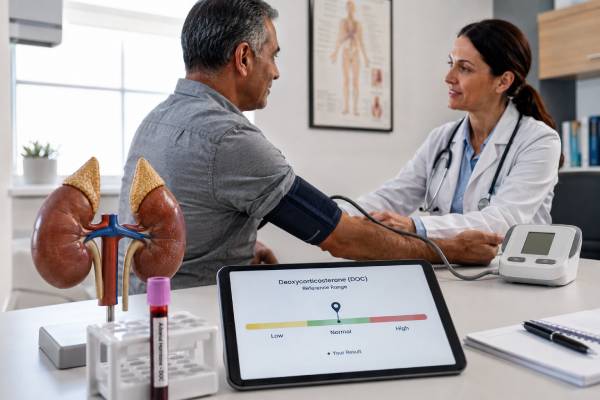
There is no single universal DOC range. Adult upper limits from major laboratories commonly fall around 10 to 19 ng/dL, while another laboratory may provide sex-specific or menstrual-phase limits. Pediatric and neonatal intervals are higher and strongly age dependent.
| Reporting issue | What to know |
|---|---|
| Adult reference limit | Often below about 10–19 ng/dL, depending on the laboratory and assay |
| Children | Age-specific limits are required; some laboratories use a higher cutoff than for adults |
| Newborns | Levels can be physiologically high soon after birth and decline during the first days or weeks |
| Alternative units | Some reports use ng/L, nmol/L, or another SI unit; compare only after correct conversion |
| Method | LC-MS/MS is commonly preferred because it separates DOC from related steroids |
A value just above the limit has a different meaning from one that is tens or hundreds of times higher. Small elevations may reflect collection timing, method variation, physiologic stress, medication effects, or a borderline pathway abnormality. Large elevations combined with a coherent clinical and laboratory pattern are much more persuasive.
The report’s own range takes priority over examples found online. Even two LC-MS/MS laboratories may use different calibrators, extraction methods, populations, and limits. Trend comparisons are most reliable when testing is repeated through the same laboratory under similar conditions.
What High DOC Means
High DOC means the measured concentration exceeds the assay’s reference interval. It does not, by itself, prove that DOC is causing hypertension or identify where the excess originates.
The first step is to decide whether the elevation fits the rest of the physiology. DOC-mediated mineralocorticoid activity usually produces suppressed renin. Potassium may be low, bicarbonate may be high, and aldosterone is often low or inappropriately normal. Blood pressure may be difficult to control. If renin is high, severe DOC-mediated volume expansion becomes less likely, although treatment, salt restriction, pregnancy, kidney disease, or another condition can alter the expected pattern.
Common diagnostic categories include:
- 11β-hydroxylase deficiency. DOC and 11-deoxycortisol rise because the pathway cannot efficiently convert them to downstream steroids. ACTH and adrenal androgens are often elevated, while cortisol production is impaired.
- 17α-hydroxylase/17,20-lyase deficiency. DOC, corticosterone, and progesterone may rise, while androgens and estrogens are low. Hypertension, hypokalemia, and delayed sexual development are typical clues.
- DOC-producing adrenal tissue. A rare adenoma, carcinoma, or hyperplasia can secrete DOC autonomously. Mixed steroid secretion may create overlapping cortisol, androgen, or estrogen findings.
- ACTH-driven steroid excess. Strong ACTH stimulation can increase precursor production, particularly when an enzyme step is partially blocked or a steroidogenesis inhibitor alters the pathway.
- Medication-related pathway changes. Drugs that inhibit adrenal enzymes may increase upstream precursors. Interpretation should consider cancer therapies and endocrine medications that affect CYP11B1 or related enzymes.
Magnitude matters. A slightly high isolated DOC result should usually be repeated or incorporated into a broader steroid profile before rare disease is pursued. By contrast, a striking elevation with low renin, low aldosterone, hypertension, and hypokalemia deserves focused endocrine evaluation.
Symptoms come mostly from the mineralocorticoid effect or the underlying disorder rather than from DOC as a unique symptom syndrome. Possible features include headaches, muscle weakness, cramps, constipation, excessive urination, thirst, palpitations, tingling, or fatigue. Severe hypokalemia can trigger dangerous heart rhythms. Very high blood pressure can damage the brain, heart, kidneys, and eyes even when the person feels well.
What Low DOC Means
A low DOC result is usually less diagnostically important than a high result. Many laboratories publish only an upper limit because healthy concentrations can be very low. A result near or below the assay’s detection limit may therefore be normal.
Low DOC can occur when ACTH drive is reduced, adrenal steroid production is suppressed, or substrate flow through the pathway is limited. Possible contexts include glucocorticoid treatment, central adrenal suppression, severe adrenal failure, or certain enzyme defects. However, DOC is not the primary test for diagnosing adrenal insufficiency. A morning cortisol test, ACTH measurement, and often an ACTH stimulation test provide much more direct information.
A low value can also be expected when treatment successfully suppresses an ACTH-driven enzyme disorder. In that situation, the clinician looks at symptoms, growth, blood pressure, electrolytes, renin, and multiple steroid markers to avoid both undertreatment and excessive glucocorticoid exposure.
Do not interpret a low DOC result as evidence of “adrenal fatigue.” DOC testing is not validated as a wellness marker, stress score, or guide to over-the-counter adrenal supplements.
Interpreting DOC With Other Tests
DOC becomes clinically useful when placed in a pattern. The same concentration can mean different things depending on renin, aldosterone, cortisol, ACTH, potassium, age, and symptoms.
| DOC | Renin | Aldosterone | Possible interpretation |
|---|---|---|---|
| High | Low | Low or low-normal | DOC-mediated mineralocorticoid excess, enzyme disorder, or DOC-producing adrenal lesion |
| Normal | Low | High or inappropriately normal | Primary aldosteronism is more likely than DOC excess |
| Normal | Low | Low | Consider medication effects, high sodium intake, Liddle syndrome, apparent mineralocorticoid excess, cortisol excess, or kidney disease |
| High | Variable | Variable | Recheck preparation, assay, illness, medicines, and the complete steroid profile |
Potassium is an important clue but not a gatekeeper. Many people with mineralocorticoid excess have normal potassium, especially early or while taking potassium-sparing medication. Conversely, low potassium has many causes, including vomiting, diarrhea, diuretics, low magnesium, and renal tubular disorders.
ACTH and cortisol help distinguish an ACTH-driven pathway problem from autonomous mineralocorticoid secretion. High ACTH with low or borderline cortisol and a characteristic precursor pattern suggests impaired cortisol synthesis. Suppressed ACTH with cortisol excess points toward a different adrenal process. A full adrenal hormone panel may be useful when several pathways appear abnormal.
11-deoxycortisol is especially important in suspected 11β-hydroxylase deficiency. Corticosterone, 18-hydroxycorticosterone, 17-hydroxyprogesterone, androstenedione, and DHEA-S can further map the block. Genetic testing may confirm CYP11B1 or CYP17A1 disease after biochemical findings support it.
Imaging is considered when biochemical evidence suggests autonomous adrenal secretion or when other features raise concern for a tumor. An adrenal CT cannot tell which steroid a mass secretes. Hormone testing must establish function, and specialist review is important because benign nonfunctioning nodules are common.
Follow-Up and Next Steps
Follow-up depends on the degree of elevation and the clinical pattern. A reasonable sequence may include confirming the result, reviewing collection conditions and medicines, repeating potassium and bicarbonate, and measuring renin, aldosterone, cortisol, ACTH, and selected steroid precursors. An endocrinologist may request a comprehensive LC-MS/MS steroid profile or dynamic testing.
For possible congenital adrenal hyperplasia, evaluation should be coordinated by an endocrinologist familiar with rare enzyme defects. Children may need pediatric endocrine care, growth and puberty assessment, genetic counseling, and family testing. Treatment aims to replace deficient hormones, reduce excess ACTH and precursor production, control blood pressure, and support normal development without giving excessive glucocorticoid.
For suspected DOC-producing adrenal disease, the workup may include repeat biochemical confirmation, adrenal imaging, testing for co-secreted hormones, and multidisciplinary review. Surgical decisions should not be based on one borderline DOC result. When an adrenal carcinoma is possible, referral to a center experienced in adrenal tumors is appropriate.
Seek urgent care for blood pressure around or above 180/120 mmHg when it is accompanied by chest pain, shortness of breath, weakness on one side, severe headache, confusion, vision loss, or another acute neurologic symptom. Prompt assessment is also warranted for severe muscle weakness, fainting, sustained palpitations, or known markedly low potassium.
Questions to discuss with the clinician include:
- Was DOC measured by LC-MS/MS, and what reference interval applies to my age and specimen?
- Were renin, aldosterone, potassium, bicarbonate, cortisol, and ACTH collected under suitable conditions?
- Could a medication, supplement, licorice product, acute illness, or salt intake explain the pattern?
- Is the elevation mild enough to repeat before imaging or genetic testing?
- Does the steroid profile suggest 11β-hydroxylase deficiency, 17α-hydroxylase deficiency, or autonomous adrenal secretion?
- Should blood pressure or potassium be treated while the diagnostic workup continues?
DOC testing is most informative as one piece of a pathway-based evaluation. The combination of hormone direction, electrolyte changes, blood pressure, age, symptoms, and assay method provides the answer—not the DOC number in isolation.
References
- 11-Deoxycorticosterone, Serum 2026 (Official Laboratory Test Catalog)
- Primary Aldosteronism: An Endocrine Society Clinical Practice Guideline 2025 (Guideline)
- Neonatal reference intervals for serum steroid hormone concentrations measured by LC-MS/MS 2024 (Research)
- Semi-automated serum steroid profiling with tandem mass spectrometry 2022 (Research)
- 11-Deoxycorticosterone Producing Adrenal Hyperplasia as a Very Unusual Cause of Endocrine Hypertension: Case Report and Systematic Review of the Literature 2022 (Systematic Review)
Disclaimer
This information is educational and cannot diagnose the cause of an abnormal DOC result or replace care from a qualified clinician. DOC ranges and interpretations vary by assay, age, medicines, and clinical setting; do not stop blood-pressure or steroid medicines without medical guidance. Severe hypertension or symptoms of marked hypokalemia require prompt assessment.