An androstenedione blood test measures a steroid that the adrenal glands and gonads make on the way to testosterone and estrogens. Doctors use it with other hormones to investigate androgen excess, early puberty, congenital adrenal hyperplasia, and rare androgen-producing tumors. It can also help monitor treatment in established congenital adrenal hyperplasia.
Androstenedione is not specific to one organ. A high result may come from the adrenal cortex, ovaries, or testes, so DHEA-S, testosterone, 17-hydroxyprogesterone, cortisol, ACTH, symptoms, age, and reproductive stage provide the source. Mild elevation is common in polycystic ovary syndrome and can also reflect normal timing, medicines, or supplements. A rapid increase with deepening voice, clitoral enlargement, marked muscle change, or quickly progressive hair growth requires prompt tumor evaluation. Low levels are less specific and may occur with adrenal or gonadal failure, pituitary suppression, glucocorticoid treatment, or normal age-related change. Reference intervals vary widely across childhood, puberty, sex, menstrual phase, and assay, making the laboratory’s own range essential.
- High androstenedione shows increased adrenal or gonadal androgen production but does not identify the source by itself.
- Mild elevation often accompanies PCOS or congenital adrenal hyperplasia; marked elevation with rapid virilization needs urgent evaluation.
- DHEA-S favors an adrenal source, while testosterone and clinical context help evaluate gonadal production.
- LC-MS/MS is preferred for specificity, especially at the low concentrations found in children and many women.
- A low result is nonspecific and should not be treated with androgen supplements without a confirmed disorder.
Table of Contents
- What Androstenedione Is
- Why the Test Is Ordered
- Preparation and Testing
- Normal Range and Result Interpretation
- Causes of High Levels
- Causes of Low Levels
- Related Tests and Follow-Up
What Androstenedione Is
Androstenedione is a weak androgen and an important intermediate in steroid synthesis. The adrenal zona reticularis makes it under ACTH influence. Ovarian theca cells and testicular Leydig cells also produce it under gonadotropin control. Enzymes in these organs and peripheral tissues can convert it to testosterone or estrone.
This shared production makes the test useful but incomplete. Unlike DHEA-S, which is predominantly adrenal, androstenedione cannot be labeled an “adrenal hormone” without qualification. A result represents combined production, metabolism, and clearance.
Androstenedione changes across life:
- concentrations are dynamic in newborns and early infancy;
- values are low in mid-childhood;
- adrenal maturation and puberty raise production;
- menstrual-cycle variation may occur, with ovarian contribution changing across the cycle;
- pregnancy alters steroid physiology; and
- concentrations tend to decline with age.
The test may be reported in ng/dL or nmol/L. Check units before comparing numbers. Laboratories increasingly use liquid chromatography–tandem mass spectrometry, or LC-MS/MS, which separates similar steroids and improves accuracy. Immunoassays can overestimate low concentrations through cross-reactivity.
Androstenedione should not be confused with androstenediol, a different steroid, or with androsterone, a metabolite. The full analyte name on the report matters.
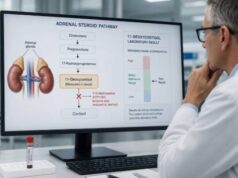
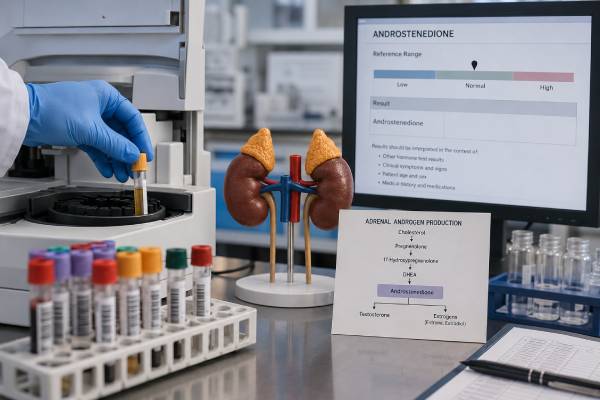
In the adrenal pathway, 17-hydroxylase and 17,20-lyase activities help produce DHEA, and 3β-hydroxysteroid dehydrogenase converts DHEA to androstenedione. Androstenedione then becomes testosterone through 17β-hydroxysteroid dehydrogenase or estrone through aromatase. Enzyme blocks in congenital adrenal hyperplasia alter the pattern of precursors and products.
Why the Test Is Ordered
The test is most useful when a clinician needs a broader androgen profile or a marker for adrenal steroid treatment. It is not routinely necessary for every person with mild acne or isolated hair growth.
Reasons include:
- moderate, severe, sudden, or progressive hirsutism;
- irregular or absent periods with biochemical androgen excess;
- virilization, such as voice deepening, clitoral enlargement, or rapidly increasing muscle mass;
- early pubic hair, adult body odor, rapid childhood growth, or advanced bone age;
- atypical puberty or suspected gonadal dysfunction;
- suspected congenital adrenal hyperplasia;
- an adrenal or gonadal mass with possible hormone production;
- monitoring known congenital adrenal hyperplasia; or
- distinguishing sources when testosterone or DHEA-S is abnormal.
For hirsutism, total testosterone measured accurately is usually the initial biochemical test, with free testosterone or SHBG assessment when indicated. Androstenedione can add information when the clinical picture is convincing but testosterone is not elevated, or when congenital adrenal hyperplasia or a tumor remains possible. Some laboratory guidance does not recommend it as the first test for ordinary PCOS evaluation.
In children, early androgen signs can result from benign premature adrenarche, central puberty, nonclassic CAH, external androgen exposure, or a rare tumor. Growth velocity, bone age, LH, FSH, sex steroids, DHEA-S, and 17-OHP help separate them.
For a person already diagnosed with CAH, androstenedione is a treatment marker rather than a diagnostic stand-alone. The clinician looks at trends alongside 17-OHP, testosterone, symptoms, growth, bone age, medication timing, and signs of glucocorticoid excess.
In postmenopausal patients, new androgen excess deserves particular attention because ordinary ovarian androgen output should be lower than during reproductive years. Longstanding mild facial hair can remain benign, but a new rapid pattern, scalp hair loss, voice change, or rising muscle mass needs timely biochemical assessment. Ovarian hyperthecosis and androgen-secreting ovarian tumors remain possible even when DHEA-S is not high.
In males, androstenedione is rarely the best first test for hypogonadism; morning total testosterone, LH, and FSH are more direct. It becomes useful when an adrenal disorder, abnormal puberty, congenital adrenal hyperplasia, or a steroid-producing tumor is suspected. Interpreting it as “low testosterone” would be incorrect.
Athletes may encounter androstenedione in supplement or anti-doping contexts. A product labeled as a prohormone can change testosterone and estrogen metabolism and may contain undeclared substances. A clinician evaluating an unexpected result needs the actual package or ingredient list, not only the brand name.
Preparation and Testing
Collection requirements vary by purpose. Morning sampling is often preferred for adrenal evaluation because ACTH-driven steroid production follows a daily rhythm. For reproductive evaluation, the clinician may request an early-follicular-phase sample to reduce cycle-related variation. Urgent evaluation of virilization should not be delayed solely for cycle timing.
Fasting is not usually required for androstenedione alone. Follow instructions if glucose, insulin, lipids, or another fasting test is ordered at the same visit.
Before the draw, report:
- menstrual pattern, first day of the last period, menopause, and possible pregnancy;
- oral contraception, fertility drugs, testosterone, estrogen, progesterone, or antiandrogens;
- glucocorticoid tablets, injections, inhalers, creams, sprays, and drops;
- DHEA, androstenedione, prohormone, bodybuilding, or “adrenal” supplements;
- antiseizure and other medicines affecting steroid metabolism;
- recent illness, surgery, intense exercise, or major sleep disruption; and
- the time of the last CAH treatment dose if monitoring.
Do not stop a prescribed hormone or glucocorticoid without instructions. Glucocorticoids suppress ACTH and adrenal androgen output; oral contraceptives can suppress ovarian production and change binding proteins. The result may be interpretable on therapy if the clinician knows the exposure.
High-dose biotin can interfere with some immunoassays. Follow the laboratory’s withholding period. For a borderline or clinically discordant result, confirmation by LC-MS/MS may prevent unnecessary imaging.
In a child, record exact age, pubertal stage, height trend, and medication exposure. Adult ranges should never be applied to pediatric results. In a menstruating adult, note the cycle day on the order.
If serial results will guide treatment, use the same laboratory and similar collection timing. A number drawn before the morning glucocorticoid dose cannot be compared directly with one drawn soon after it. Likewise, switching from immunoassay to LC-MS/MS may shift the result without a true physiologic change. Keep the assay name and units with the trend.
Acute illness can activate ACTH and alter adrenal steroids, while hospitalization may add medicines that suppress or stimulate the pathway. Unless the situation is urgent, repeating an unexpected outpatient value after recovery may provide a cleaner baseline. A severe or rapidly progressive clinical pattern should not wait for ideal conditions.
Normal Range and Result Interpretation
There is no universal normal range. Age, sex, Tanner stage, menstrual phase, menopause, pregnancy, and assay all matter. One laboratory may provide broad adult intervals while another uses age-stratified ranges. The report’s interval is the correct starting comparison.
Androstenedione is interpreted from magnitude, tempo, and companion hormones:
| Result pattern | Possible meaning | Useful context |
|---|---|---|
| Mild elevation | PCOS, nonclassic CAH, normal variation, medicine or supplement effect | Symptoms, cycle timing, 17-OHP, testosterone, DHEA-S |
| Marked elevation | Severe CAH or androgen-secreting adrenal/gonadal tumor | Rapid virilization, imaging after confirmation |
| Within range | Does not exclude all androgen disorders | Hair-follicle sensitivity and other androgens matter |
| Low | Adrenal/gonadal suppression or failure, age effect | Cortisol, ACTH, LH, FSH, sex hormones, medicines |
Some specialty laboratories note that levels at or above roughly 500 ng/dL can suggest an androgen-producing adrenal or, less commonly, gonadal tumor. This is not a universal cutoff. Tumors may produce other androgens, and severe non-tumor disorders can also cause high values. Repeat a surprising result with a specific method before localizing it.
The speed of symptom change often matters more than a small difference above range. Hirsutism developing gradually over years with stable mild elevation is more consistent with PCOS or idiopathic androgen excess. Virilization progressing over months deserves urgent assessment even if one analyte is only moderately high.
A normal androstenedione does not exclude PCOS, nonclassic CAH, or an androgen-producing lesion. Testosterone or DHEA-S may be the dominant abnormality. Conversely, biochemical elevation does not prove that it causes every symptom; hair growth depends on follicle sensitivity and local androgen metabolism.
Hair growth also changes slowly. A laboratory value can improve months before existing terminal hairs become finer, and cosmetic treatment may still be needed. Acne may respond sooner. When monitoring therapy, judge the hormone trend together with menstrual regularity, new hair growth, ovulation goals, and medication tolerance rather than expecting an immediate reversal of established features.
In children, the same concentration can be normal in one pubertal stage and abnormal in another. A rising value combined with rapid height gain and advanced bone age shows greater androgen effect than a stable result without physical progression. Pediatric endocrinologists may compare several adrenal and gonadal hormones under basal or stimulated conditions.
Causes of High Levels
Polycystic ovary syndrome
PCOS is a common cause of mild to moderate androgen excess in reproductive-age women. Androstenedione may be elevated even when testosterone is not. Diagnosis uses ovulatory pattern, clinical or biochemical hyperandrogenism, ovarian morphology or AMH in appropriate adult criteria, and exclusion of mimics. The PCOS blood test panel does not rely on androstenedione alone.
Congenital adrenal hyperplasia
In 21-hydroxylase deficiency, impaired cortisol synthesis raises ACTH and diverts precursors into adrenal androgens. 17-OHP is the main screening marker, while androstenedione shows androgen production and helps monitor control. Nonclassic CAH can resemble PCOS with hirsutism, acne, irregular periods, or infertility.
Eleven-beta-hydroxylase deficiency can also raise androstenedione, with high 11-deoxycortisol and deoxycorticosterone and often low-renin hypertension. In 3β-HSD deficiency, DHEA and 17-hydroxypregnenolone may rise disproportionately while androstenedione patterns differ.
An adrenal hyperplasia panel maps several steroids rather than assuming every high androgen indicates the same enzyme block.
Monitoring aims to keep androgen production appropriate without exposing the patient to chronic glucocorticoid excess. An elevated androstenedione may reflect a missed dose, inadequate regimen, poor absorption, illness, or a sample drawn at a different point in the dosing cycle. A very low value with suppressed 17-OHP can accompany overtreatment. Dose changes require an endocrinologist because both under- and overtreatment affect growth, bone, fertility, and metabolic health.
Adrenal or gonadal tumors
Androgen-secreting tumors are rare. Concern rises with rapid virilization, postmenopausal onset, a large biochemical elevation, abdominal symptoms, or a mass. DHEA-S strongly favoring an adrenal source, very high testosterone favoring an ovarian or testicular source, and mixed precursor secretion can guide imaging, but overlap exists.
Adrenocortical carcinoma may secrete several steroids, sometimes including cortisol. A comprehensive steroid profile and imaging are more informative than androstenedione alone. A benign adrenal incidentaloma should not automatically be blamed; many nodules are nonfunctioning.
Other explanations
Premature adrenarche, normal puberty, pregnancy-related change, rare gonadal disorders, and external androgens can raise the result. DHEA or androstenedione supplements are direct causes. Laboratory interference or immunoassay cross-reactivity should be considered when the number conflicts with symptoms.
Ovarian hyperthecosis can cause substantial testosterone and androstenedione production, particularly after menopause. Severe insulin resistance can amplify ovarian androgen production. Cushing syndrome can also present with androgen features, but it is evaluated with validated cortisol-excess tests rather than androstenedione alone.
Some antiseizure medicines and other drugs alter steroid metabolism or binding, while exogenous testosterone can suppress gonadotropins yet increase downstream androgen exposure. A medication effect may produce a laboratory pattern that does not match an untreated endocrine disorder.
Causes of Low Levels
Low androstenedione receives less diagnostic weight because many conditions reduce androgen production. Primary adrenal insufficiency can lower adrenal contribution, especially with low cortisol, high ACTH, high renin, and low aldosterone. Central adrenal insufficiency or glucocorticoid treatment can suppress ACTH and lower adrenal androgens.
Primary gonadal failure can reduce gonadal production. In ovarian insufficiency, FSH is typically high and estradiol low; in testicular failure, LH and FSH patterns and testosterone provide more direct information. Hypopituitarism can reduce both gonadal and adrenal stimulation.
Age-related decline, chronic illness, undernutrition, and medications may contribute. A single low result is not a diagnosis of androgen deficiency and does not establish a need for replacement.
In primary adrenal insufficiency, low androstenedione is only a supporting clue. Low morning cortisol, high ACTH, high renin, low aldosterone, and an impaired cosyntropin response provide stronger evidence. In central disease, ACTH and cortisol are low or inappropriate, and other pituitary hormones may also be affected.
In gonadal failure, androstenedione does not replace the standard diagnostic hormones. Menstrual history, estradiol and FSH inform ovarian function; morning testosterone and gonadotropins inform testicular function. The precursor is most useful when it fills a specific gap in the steroid profile.
Androstenedione supplements were once marketed for athletic performance but can alter lipids and sex hormones and expose users to androgenic effects. In competitive sport, prohormones may also violate anti-doping rules. Treat the cause of a confirmed endocrine disorder rather than trying to raise this precursor.
Related Tests and Follow-Up
The next tests depend on presentation:
- Total and free testosterone or SHBG: quantify circulating potent androgen and binding effects.
- DHEA-S: helps identify adrenal androgen contribution.
- 17-hydroxyprogesterone: screens for 21-hydroxylase-deficient CAH; a borderline morning result may require cosyntropin stimulation.
- Cortisol and ACTH: assess adrenal feedback when insufficiency or mixed tumor secretion is possible.
- LH, FSH, estradiol, or testicular hormones: evaluate gonadal function and puberty.
- TSH, prolactin, and pregnancy testing: investigate common mimics of menstrual disturbance.
- Pelvic or adrenal imaging: follows confirmed severe biochemical excess or rapid virilization, not a minor isolated flag.
For a high result, verify units, reference group, cycle or pubertal stage, medicines, and supplements. Repeat with LC-MS/MS if the finding is unexpected. If rapid virilization is present, do not delay specialist referral while waiting for every outpatient result.
Imaging should follow biochemical confirmation and likely source. Pelvic ultrasound can miss small androgen-producing ovarian tumors, while an adrenal CT can reveal common nonfunctioning nodules. Ordering both scans after one mild unconfirmed elevation can create incidental findings rather than clarity. The hormone pattern and symptom tempo set the sequence.
If an adrenal mass is found, clinicians may also assess cortisol and metanephrines according to imaging and symptoms. Mixed steroid secretion increases concern for adrenocortical carcinoma. Surgical decisions use size, imaging characteristics, growth, and the full biochemical profile rather than one androgen value.
For CAH monitoring, blood-draw timing relative to glucocorticoid dose must be consistent. Completely normalizing every precursor may require excessive glucocorticoid. Clinicians balance androstenedione and 17-OHP with growth, bone age, menstrual or testicular health, fertility, and signs of overtreatment.
Ask the clinician:
- Is the interval matched to age, sex, puberty, and menstrual phase?
- Was the assay LC-MS/MS or immunoassay?
- Do DHEA-S and testosterone suggest an adrenal or gonadal source?
- Is a morning 17-OHP or cosyntropin test needed?
- How fast have symptoms progressed, and does that require urgent imaging?
- Could a supplement or prescribed hormone explain the value?
Seek prompt care for rapidly progressive virilization, a new abdominal mass, severe childhood puberty changes, or acute adrenal symptoms. An androstenedione result is a pathway clue. Its clinical value comes from carefully combining the concentration with symptom tempo, related steroids, and an age-appropriate endocrine assessment.
Keep the original result with units, reference interval, collection time, cycle day or pubertal stage, assay method, and medication timing. Those details make a repeat comparable and help a specialist decide whether a small difference is biologic, analytical, or clinically important. A portal flag without context should not trigger supplements, imaging, or a treatment change.
Photographs documenting the pace of acne, scalp hair loss, or virilization can sometimes help when used with consent and stored privately. They do not replace examination, but they can show whether change occurred over months or years. For children, a height chart and prior growth records provide equally valuable evidence of androgen effect.
When the Result Does Not Match the Symptoms
A mismatch between androstenedione and the clinical picture should prompt verification before imaging or treatment. Concentrations vary with age, puberty, sex, menstrual phase, pregnancy, and time of day. Immunoassays may be affected by structurally similar steroids, particularly at the low concentrations seen in children and some adults. Repeating a morning sample with a laboratory method suited to steroid measurement, often liquid chromatography–tandem mass spectrometry, can determine whether the abnormality is reproducible.
The accompanying hormone pattern helps locate the source. Testosterone, DHEA-S, 17-hydroxyprogesterone, cortisol, ACTH, and sometimes gonadotropins or estradiol may be selected according to symptoms. A substantial DHEA-S elevation favors an adrenal source, although no single marker provides perfect localization. An elevated 17-hydroxyprogesterone may lead to ACTH stimulation testing for nonclassic congenital adrenal hyperplasia. In someone with irregular periods, acne, and gradual hair growth, polycystic ovary syndrome remains common and is assessed with the broader clinical and metabolic picture.
Speed of change influences urgency. Gradual symptoms over years are approached differently from deepening voice, rapidly increasing coarse hair, new clitoral enlargement, severe acne, or fast muscle changes over months. Rapid virilization or a marked and confirmed androgen elevation can justify prompt specialist evaluation for an ovarian or adrenal tumor. A low result is usually less specific and may reflect age, ovarian or adrenal dysfunction, medication effects, or chronic illness. Treatment should target the established cause and the person’s symptoms, not merely push androstenedione into the middle of a reference interval.
References
- Congenital Adrenal Hyperplasia 2026 (Review)
- Society for Endocrinology Clinical Practice Guideline for the Evaluation of Androgen Excess in Women 2025 (Guideline)
- Prevalence and Clinical Management of Adrenal Tumour-Associated Androgen Excess: A Retrospective Cohort Study 2024
- Postmenopausal onset of androgen excess: a diagnostic and therapeutic algorithm based on extensive clinical experience 2024 (Review)
- Congenital Adrenal Hyperplasia 2025 (Review)
Disclaimer
This article is educational and cannot diagnose an adrenal, ovarian, or testicular disorder. Androstenedione ranges vary by age, sex, pubertal stage, cycle, and assay. Rapid virilization or severe childhood androgen signs require prompt specialist evaluation.