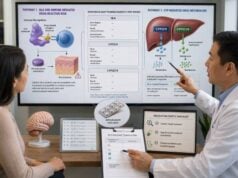
A CYP2D6 and CYP2C19 antidepressant pharmacogenetic test estimates how quickly a person may process selected antidepressants. It can help explain unusually high exposure, early side effects, low concentrations, or repeated difficulty finding a tolerable dose. The test does not identify the “best antidepressant,” diagnose depression, or guarantee that a medicine will work. CYP2C19 has useful prescribing guidance for citalopram, escitalopram, and sertraline. CYP2D6 is more important for paroxetine, fluvoxamine, vortioxetine, venlafaxine, and several tricyclic antidepressants. Results are reported as star alleles and metabolizer phenotypes, but the same phenotype can have different consequences for different drugs. Strong enzyme inhibitors can also make the real-time response differ from the inherited prediction. The most useful interpretation combines the exact genotype, current medicines, prior treatment history, symptoms, side effects, dose, and treatment duration. Used carefully, testing can reduce avoidable trial and error without turning a complex psychiatric treatment decision into a color-coded score.
- Poor metabolizers clear certain antidepressants slowly, which can raise exposure and increase dose-related side effects.
- Rapid or ultrarapid metabolizers may have lower exposure to selected drugs, but an automatic dose increase is not appropriate for every antidepressant.
- CYP2C19 most strongly guides citalopram, escitalopram, and sertraline, while CYP2D6 guides several other antidepressants.
- A normal result does not guarantee response, because diagnosis, dose, adherence, interactions, and non-genetic factors remain important.
- Strong CYP2D6 inhibitors can cause phenoconversion, making a genetically normal metabolizer function more like a poor metabolizer.
Table of Contents
- What the test can and cannot predict
- Why CYP2D6 results are complex
- How CYP2C19 changes SSRI exposure
- Drug-specific actions from the result
- Phenoconversion and medication interactions
- Monitoring response after a genotype-guided change
- Limits of multigene psychiatric panels
- Using the report in real clinical care
What the test can and cannot predict
CYP2D6 and CYP2C19 are liver enzymes that help clear many antidepressants. Genetic variants can reduce, increase, or eliminate enzyme activity. Testing predicts a person’s inherited metabolic capacity and translates it into categories such as poor, intermediate, normal, rapid, or ultrarapid metabolizer.
The result can support two kinds of decisions. First, it can identify a higher likelihood of excessive exposure at a standard dose, which may justify a lower starting dose, slower titration, or another medicine. Second, it can identify a risk of low exposure, which may support selecting a drug that is less dependent on that enzyme rather than repeatedly raising the dose.
What it cannot do is more extensive. The test does not measure serotonin, dopamine, or the severity of a psychiatric condition. It does not distinguish major depressive disorder from bipolar depression, trauma-related symptoms, attention problems, substance effects, grief, sleep disorders, thyroid disease, or another cause of low mood. It cannot predict whether psychotherapy, exercise, sleep treatment, or social support will help.
It also cannot determine response from metabolism alone. Antidepressant benefit depends on the medicine reaching a useful exposure, but exposure is not the same as efficacy. Receptor effects, illness subtype, adherence, expectations, coexisting anxiety, pain, medical conditions, and many genetic and environmental factors influence outcomes.
A pharmacogenetic result is most informative when there is a clear clinical question, such as:
- severe side effects at a low dose;
- no benefit despite an adequate trial and good adherence;
- several prior medication failures;
- a planned antidepressant with established gene-based guidance;
- a current regimen containing strong enzyme inhibitors;
- concern about citalopram exposure and QT prolongation;
- a need to explain an unusual blood concentration.
The test is less useful when the main problem is an inadequate trial. A medicine taken inconsistently for two weeks cannot be declared genetically ineffective. Many antidepressants need several weeks at a therapeutic dose before the full response can be judged, although side effects may appear much earlier.
The result should therefore answer a focused dosing or selection question, not serve as a stand-alone ranking of all psychiatric medicines.
Why CYP2D6 results are complex
CYP2D6 is one of the most technically challenging pharmacogenes. The gene can be deleted, duplicated, multiplied, converted into a hybrid with a nearby pseudogene, or carry combinations of variants on the same chromosome. A simple test that looks for a few single variants may miss copy-number changes or assign the wrong star allele.
Each CYP2D6 allele receives a function value. The values from both chromosomes are combined into an activity score, which is translated into a phenotype. Common examples include:
| Result pattern | Typical phenotype | General implication |
|---|---|---|
| Two no-function alleles | Poor metabolizer | Little or no CYP2D6 activity |
| Reduced total activity score | Intermediate metabolizer | Slower clearance for many CYP2D6 substrates |
| Typical activity score | Normal metabolizer | Expected population-average clearance |
| Increased copies of a functional allele | Ultrarapid metabolizer | Potentially faster clearance of selected drugs |
The exact star alleles matter more than a report color. A copy-number result such as 1×2/2 means something different from 1/2 even though both contain the same named alleles. The first has two copies of *1 on one chromosome and may produce greater activity.
CYP2D6 also has strong medication-based phenoconversion. Bupropion, fluoxetine, and paroxetine are strong CYP2D6 inhibitors. A person with a genetically normal phenotype who takes one of these drugs can function like a poor metabolizer for another CYP2D6 substrate. Moderate inhibitors can shift activity partway. A report that ignores current medications may overestimate real clearance.
Several antidepressants affected by CYP2D6 include paroxetine, fluvoxamine, vortioxetine, venlafaxine, and tricyclics such as nortriptyline and amitriptyline. The action is not identical for all of them. Paroxetine is both a substrate and a strong inhibitor, so its metabolism can become less efficient as the dose rises. Venlafaxine is converted to an active metabolite, meaning the parent-to-metabolite balance changes even when total active exposure may be less dramatically altered.
This complexity is why CYP2D6 testing should report gene copy number and use current consensus translations. A bare statement such as “CYP2D6 positive” is not clinically interpretable.
How CYP2C19 changes SSRI exposure
CYP2C19 is structurally simpler than CYP2D6 but still requires drug-specific interpretation. Common no-function alleles include *2 and *3. The *17 allele increases expression. A person with *1/*1 is usually a normal metabolizer, *1/*2 is intermediate, *2/*2 is poor, *1/*17 is rapid, and *17/*17 is ultrarapid. A *2/*17 result is generally intermediate because the increased-function allele does not cancel the no-function allele.
Citalopram and escitalopram are the clearest CYP2C19 examples. Poor metabolizers tend to have higher concentrations at the same dose, which may increase nausea, fatigue, activation, sexual side effects, and other dose-related problems. Citalopram deserves extra caution because high exposure can prolong the QT interval. The FDA limits citalopram to 20 mg per day in known CYP2C19 poor metabolizers.
Rapid and ultrarapid metabolizers may have lower citalopram or escitalopram exposure. If symptoms do not improve after an adequate, adherent trial, a medicine not predominantly cleared by CYP2C19 may be preferable to pushing the dose beyond usual safety limits. Genotype does not justify exceeding the labeled maximum.
Sertraline is influenced by CYP2C19 and, to a lesser degree in current guidance, CYP2B6. Poor CYP2C19 metabolizers may have higher sertraline exposure and may benefit from a lower starting dose, slower titration, or lower maintenance dose. Rapid and ultrarapid phenotypes do not automatically require a higher sertraline dose because the clinical evidence is less consistent.
The same CYP2C19 result can affect nonpsychiatric medicines in another direction. Clopidogrel requires CYP2C19 activation, while citalopram and escitalopram are active drugs that CYP2C19 helps clear. A poor metabolizer may have reduced clopidogrel effect but increased antidepressant exposure. The broader CYP2C19 medication guide explains why one phenotype cannot be labeled universally favorable or unfavorable.
CYP2C19 inhibitors can also alter the observed response. Fluvoxamine strongly inhibits CYP2C19, while omeprazole and esomeprazole can produce clinically relevant inhibition. A normal metabolizer taking an inhibitor may have antidepressant exposure closer to that expected in an intermediate or poor metabolizer.
Drug-specific actions from the result
A useful report maps a phenotype to a specific medicine rather than assigning a global green, yellow, or red category. Current guideline-based examples include the following.
| Antidepressant | Main gene | Result that commonly changes prescribing | Typical clinical approach |
|---|---|---|---|
| Citalopram | CYP2C19 | Poor metabolizer | Consider another drug or about 50% lower starting dose; do not exceed 20 mg/day |
| Escitalopram | CYP2C19 | Poor, rapid, or ultrarapid metabolizer | Use slower/lower dosing for poor metabolism or consider an alternative at either extreme |
| Sertraline | CYP2C19 | Poor metabolizer | Consider lower starting and maintenance doses or another antidepressant |
| Paroxetine | CYP2D6 | Poor or ultrarapid metabolizer | Consider lower/slower dosing for poor metabolism or an alternative for ultrarapid metabolism |
| Fluvoxamine | CYP2D6 | Poor metabolizer | Consider a 25%–50% lower starting dose and slower titration or an alternative |
| Vortioxetine | CYP2D6 | Poor metabolizer | Use a maximum of 10 mg/day under the FDA label |
| Venlafaxine | CYP2D6 | Poor metabolizer | Consider an alternative not predominantly metabolized by CYP2D6, especially with adverse effects |
These are starting frameworks, not self-treatment instructions. A person who is stable and doing well may not benefit from changing therapy merely because testing identifies a nonstandard phenotype. Switching can trigger withdrawal symptoms, relapse, new side effects, or loss of a medication that has already proved effective.
Paroxetine is a good example of why actual response matters. A poor metabolizer may have higher exposure and more anticholinergic effects, sexual dysfunction, weight gain, or discontinuation symptoms. Yet a patient who tolerates a low stable dose and remains well may be safer continuing than switching abruptly.
Vortioxetine has a clear product-label ceiling for CYP2D6 poor metabolizers: 10 mg per day. Strong CYP2D6 inhibitors can create a similar exposure increase, so the dose often needs reduction while the inhibitor is present. If the inhibitor is later stopped, the vortioxetine dose may need reassessment.
Venlafaxine illustrates active-metabolite complexity. CYP2D6 converts venlafaxine to desvenlafaxine. Poor metabolizers often have more parent drug and less metabolite. Some guidelines favor an alternative when tolerability or effectiveness is a concern rather than trying to calculate a universal dose reduction. Desvenlafaxine itself depends much less on CYP2D6 and may be considered in some cases.
Fluoxetine is not assigned a straightforward genotype-based dose because both fluoxetine and norfluoxetine are active, multiple pathways contribute, and the drug inhibits CYP2D6. A panel may color-code fluoxetine, but current evidence does not support a simple CYP2D6 dose rule.
For a deeper drug-by-drug explanation of the two pathways, see the CYP2D6 genetic test guide and the CYP2C19 guide rather than treating the combined panel as one score.
Phenoconversion and medication interactions
Phenoconversion occurs when medication or illness changes enzyme activity enough that observed metabolism no longer matches the inherited phenotype. It is one of the most important reasons a pharmacogenetic report can appear wrong.
Strong CYP2D6 inhibitors include bupropion, fluoxetine, and paroxetine. Suppose a patient has a normal CYP2D6 genotype and takes bupropion together with vortioxetine. The inhibitor can substantially reduce vortioxetine clearance, raising exposure as though the patient had a poor-metabolizer phenotype. The inherited result remains normal, but the prescribing decision must reflect the inhibited state.
This effect can also occur within an antidepressant regimen. Paroxetine strongly inhibits CYP2D6 and can slow its own metabolism at higher exposure. Fluoxetine and its active metabolite have long half-lives, so CYP2D6 inhibition can persist for weeks after fluoxetine is stopped. A medication switch planned only from the genotype may underestimate that carryover.
CYP2C19 can be inhibited by fluvoxamine, fluconazole, omeprazole, and esomeprazole, among other drugs. Inducers such as rifampin and some antiseizure medicines can increase enzyme activity and lower concentrations of susceptible antidepressants. Induction develops gradually and can persist after discontinuation.
Other clinical factors alter exposure without directly changing the genotype:
- liver disease can slow several pathways;
- older age and frailty can increase sensitivity even at ordinary concentrations;
- pregnancy can change enzyme activity and drug distribution;
- kidney impairment can affect active metabolites or overall tolerability;
- inflammation can suppress some metabolic pathways;
- smoking strongly affects CYP1A2, which is more relevant to drugs such as fluvoxamine and certain antipsychotics than to CYP2D6 or CYP2C19 alone.
A complete interpretation therefore needs the current medication list, including over-the-counter acid reducers, antifungals, seizure medicines, and supplements. It should also identify when an inhibitor was started or stopped. The safest dose today may not be the safest dose next month after the interacting drug changes.
Phenoconversion explains why a result should be stored as the actual diplotype and phenotype, not as a permanent instruction such as “avoid paroxetine forever.” The genotype is lifelong; the medication environment is not.
Monitoring response after a genotype-guided change
Genotype-guided prescribing still requires an ordinary antidepressant follow-up plan. A lower starting dose is useful only if the clinician later checks whether the dose remains effective. Choosing an alternative helps only if symptoms, side effects, and adherence are monitored.
Early follow-up often focuses on tolerability. Nausea, diarrhea, headache, sleep disruption, restlessness, sexual side effects, and emotional blunting may appear within days. New or worsening suicidal thoughts, severe agitation, mania, serotonin syndrome symptoms, or an allergic reaction need prompt assessment.
Therapeutic response usually takes longer. Some improvement in sleep, appetite, anxiety, or energy may occur before mood fully improves. A fair trial commonly requires several weeks at a dose that is both tolerated and likely to be therapeutic. The exact timeframe depends on diagnosis, severity, drug, dose, and prior treatment.
A structured follow-up can track:
- the target symptoms and a baseline severity score;
- the dose and date of each change;
- adherence and missed doses;
- side effects and their timing;
- new medicines or supplements;
- sleep, alcohol, cannabis, and stimulant use;
- signs of bipolar activation or mixed symptoms;
- functional change at work, school, or home.
Therapeutic drug monitoring is not routine for every SSRI, but measured concentrations can help when there is suspected nonadherence, extreme metabolism, a major interaction, unexplained toxicity, or failure despite an apparently adequate dose. A level should be interpreted with sampling time and laboratory reference information.
When switching antidepressants, genotype does not remove withdrawal or interaction risk. Paroxetine and venlafaxine can cause prominent discontinuation symptoms. Fluoxetine’s long half-life can create delayed interactions. Cross-tapering may be unsafe with certain combinations, while other switches require a washout period. The prescriber should design the transition.
A result is successful when it improves the overall treatment process, not merely when the prescription matches a guideline table. Better tolerability, adherence, symptom control, and fewer failed trials are the meaningful outcomes.
Limits of multigene psychiatric panels
Many commercial panels combine CYP2D6 and CYP2C19 with CYP2B6, SLC6A4, HTR2A, COMT, MTHFR, and other genes. The inclusion of a gene does not mean that it has equal evidence or a validated prescribing action.
Current antidepressant guidelines support drug-specific actions for selected CYP2D6, CYP2C19, and CYP2B6 results. They do not support using SLC6A4 or HTR2A variants to choose or dose serotonin reuptake inhibitors because findings have been inconsistent and do not establish a reliable clinical action. COMT does not identify the antidepressant most likely to work, and common MTHFR variants do not by themselves diagnose folate deficiency or prove that a person needs a supplement.
Commercial reports may disagree. A 2024 comparison found discrepancies in genotype-to-phenotype translation and in medication recommendations between vendors and established guidelines. Differences can arise from allele coverage, proprietary algorithms, old guideline versions, drug-interaction rules, or broad claims that go beyond the evidence.
Before relying on a panel, check:
- whether the laboratory tests CYP2D6 copy number and structural variants;
- which CYP2C19 and CYP2D6 alleles are included;
- whether phenotype translation follows a named current standard;
- whether drug recommendations cite a current guideline or FDA label;
- whether current inhibitors and inducers were considered;
- whether the report distinguishes evidence-based metabolism guidance from exploratory associations.
A red category does not necessarily mean a drug is contraindicated. It may mean a lower starting dose, slower titration, alternative if available, or closer monitoring. A green category does not prove safety or efficacy. Some vendors color a medicine green simply because no tested gene creates a warning, even though the patient can still have side effects or fail to respond.
Evidence from randomized trials and meta-analyses suggests that pharmacogenomic-guided care may modestly improve remission or response in some patients with major depressive disorder, particularly when results identify a meaningful gene–drug conflict. Effects are not uniform, and study designs, panels, sponsorship, and prescribing algorithms vary. Testing should be presented as a decision-support tool rather than a definitive matching system.
Using the report in real clinical care
Start by preserving the complete report. The most durable details are the star alleles, CYP2D6 copy number, activity score, CYP2C19 diplotype, test method, and laboratory. Vendor color categories can change as evidence or software is updated.
A clinician or pharmacist can then work through four layers:
- Confirm the technical result. Make sure CYP2D6 structural variation and copy number were assessed and that CYP2C19 allele coverage is clear.
- Match the exact drug. Identify whether CYP2D6, CYP2C19, both, or neither has actionable guidance for that antidepressant.
- Adjust for the present environment. Account for inhibitors, inducers, organ function, age, pregnancy, smoking, and prior adverse effects.
- Choose a monitoring plan. Define the dose, titration speed, symptom target, side-effect checks, and follow-up date.
Testing is often most helpful before starting a medicine with clear guidance or after an unusual treatment history. It may be less useful when a patient is stable, tolerating therapy, and in remission. A nonstandard phenotype alone is usually not a reason to disrupt effective treatment.
Because CYP2D6 and CYP2C19 variants are inherited, biological relatives may share them. The result does not show that depression or anxiety is inherited through these genes, and relatives do not need testing unless a medication decision makes it relevant.
Patients should not use the report to stop an antidepressant abruptly. Withdrawal, relapse, and suicidal worsening can follow unsupervised changes. Anyone with new suicidal intent, inability to stay safe, severe agitation, mania, confusion, high fever with muscle rigidity, or other urgent symptoms needs immediate clinical help rather than a genotype-based adjustment.
Used with realistic expectations, the test can clarify why a standard dose may be too high or too low for a particular medicine. Its value comes from narrowing avoidable dosing errors while leaving diagnosis, therapeutic relationship, careful follow-up, and patient preference at the center of care.
References
- Clinical Pharmacogenetics Implementation Consortium (CPIC) Guideline for CYP2D6, CYP2C19, CYP2B6, SLC6A4, and HTR2A Genotypes and Serotonin Reuptake Inhibitor Antidepressants 2023 (Guideline)
- Dutch Pharmacogenetics Working Group (DPWG) guideline for the gene-drug interaction between CYP2C19 and CYP2D6 and SSRIs 2022 (Guideline)
- Dutch Pharmacogenetics Working Group (DPWG) guideline for the gene-drug interaction between CYP2D6, CYP2C19 and non-SSRI/non-TCA antidepressants 2024 (Guideline)
- Comparing commercial pharmacogenetic testing results and recommendations for antidepressants with established CPIC guidelines 2024 (Review)
- Comparative effectiveness of pharmacogenomic-guided versus usual antidepressant treatment for major depressive disorder: a systematic review and meta-analysis 2025 (Systematic Review)
- TRINTELLIX (vortioxetine) tablets, for oral use 2021 (Official Label)
Disclaimer
Antidepressant pharmacogenetic results must be interpreted with the diagnosis, exact medication, current dose, interacting drugs, treatment history, and current clinical guidelines. Do not start, stop, or change an antidepressant based only on a test report. Seek urgent professional help for suicidal intent, severe agitation, mania, serotonin syndrome symptoms, or any inability to remain safe.