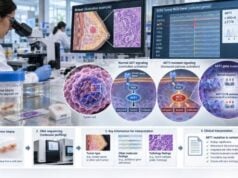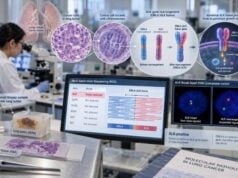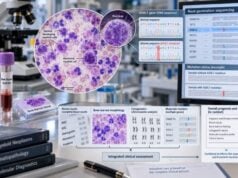
An EZH2 mutation test looks for tumor DNA changes in EZH2, a gene that controls how other genes are switched on and off through chromatin regulation. In lymphoma, the test is most clinically relevant in follicular lymphoma, where activating EZH2 mutations occur in a meaningful minority of cases and define an important molecular subtype. The result is usually reported as a specific mutation detected, no pathogenic mutation detected, or occasionally a variant of uncertain significance. Unlike a blood count or chemistry test, there is no normal numeric range. EZH2 status also is not a stand-alone diagnosis or a universal prognosis marker for every lymphoma. Its meaning depends on the lymphoma subtype, the exact variant, prior treatments, and whether testing is being used for diagnosis, treatment planning, or broader molecular profiling. Tazemetostat historically made EZH2 status a direct U.S. treatment-selection biomarker in relapsed or refractory follicular lymphoma, but the drug was withdrawn from the U.S. market in 2026 after a serious safety signal, so current treatment decisions should not rely on the former indication.
- A positive EZH2 mutation result in follicular lymphoma usually identifies an activating epigenetic driver, commonly involving codons such as Y646, A682, or A692.
- EZH2 mutations occur in roughly 20%–25% of follicular lymphomas, although reported frequencies vary by cohort and assay.
- There is no “high” or “low” EZH2 range; results are interpreted by mutation type and clinical significance.
- EZH2 status still has molecular and trial relevance, but the former U.S. tazemetostat follicular-lymphoma indication was withdrawn in June 2026 and should not be treated as a current approval.
- A negative EZH2 result does not mean the lymphoma lacks epigenetic abnormalities or that no targeted treatment options exist.
Table of Contents
- What EZH2 Does and Why Mutations Matter
- Lymphomas Associated With EZH2 Alterations
- How EZH2 Mutation Testing Is Done
- Understanding Positive and Negative Results
- Prognosis and Treatment Meaning
- Limitations and Common Misunderstandings
- Next Steps After an EZH2 Result
What EZH2 Does and Why Mutations Matter
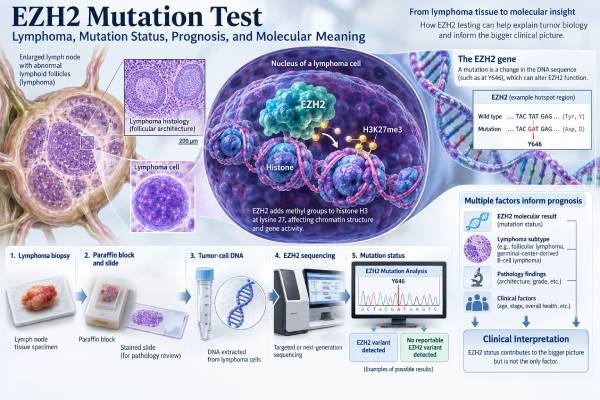
EZH2 encodes the catalytic component of polycomb repressive complex 2, usually shortened to PRC2. This complex adds methyl groups to histone H3 at lysine 27, producing a mark called H3K27me3. That chemical mark helps silence sets of genes without changing the underlying DNA sequence. This type of regulation is called epigenetic regulation.
Normal germinal-center B cells use EZH2 activity to control differentiation while they mature and refine antibody responses. In some B-cell lymphomas, activating EZH2 mutations increase or alter this repressive function. The affected cells can remain locked in a germinal-center-like state and gain a growth advantage.
In follicular lymphoma, recurrent activating mutations cluster in the EZH2 catalytic domain. Frequently described hotspots include Y646, A682, and A692. Older literature may use Y641 numbering for the major tyrosine hotspot because of transcript-numbering differences. The laboratory report should use standardized variant notation so the exact change is clear.
An EZH2 mutation test therefore asks whether the tumor carries a sequence alteration known or suspected to change EZH2 function. It does not directly measure H3K27me3, lymphoma burden, or the concentration of EZH2 protein in blood.
The test may be ordered alone, but it is often part of a broader hematologic molecular panel. In a complex lymphoma workup, molecular findings are considered alongside immunophenotyping, morphology, cytogenetics, and markers such as BCL2, BCL6, or MYC when relevant. A broad cancer gene mutation panel may detect EZH2 together with other pathogenic variants.
Lymphomas Associated With EZH2 Alterations
The strongest routine clinical association is follicular lymphoma, a mature B-cell lymphoma derived from germinal-center B cells. Activating EZH2 mutations are found in about one fifth to one quarter of cases in many series.
EZH2 dysregulation is also biologically important in some diffuse large B-cell lymphomas, especially germinal-center B-cell-like disease, although the clinical use of EZH2 mutation testing is not identical across lymphoma subtypes. The presence of an EZH2 mutation should therefore not be treated as if it carries the same therapeutic meaning in every diagnosis.
Follicular lymphoma is usually diagnosed from lymph-node or other tissue biopsy. Pathologists evaluate the growth pattern, cytology, B-cell markers, germinal-center markers, and often the characteristic BCL2-related biology. Molecular testing adds another layer but does not replace the foundational diagnosis.
A practical example shows why subtype matters. In follicular lymphoma, an activating EZH2 mutation has established biological meaning and historically selected patients for tazemetostat. After the 2026 U.S. withdrawal of that drug, the same result may still help characterize the disease or support clinical-trial matching, but it should not be presented as proof of eligibility for a currently approved U.S. EZH2 inhibitor. If an EZH2 mutation appears on broad sequencing from another lymphoma type, its clinical meaning can be different again.
Likewise, an EZH2 mutation is distinct from an EZH2 overexpression result. Increased EZH2 protein or activity can occur without a hotspot mutation. The mutation test specifically evaluates DNA sequence.
When the differential diagnosis includes multiple B-cell neoplasms, clinicians may also use tests such as a BCL2 rearrangement test or MYC rearrangement test, because those assays answer different diagnostic and risk questions.
How EZH2 Mutation Testing Is Done
EZH2 testing is usually performed on DNA from a lymphoma specimen. Depending on the disease and laboratory, material may come from a lymph-node biopsy, another involved tissue, bone marrow, or occasionally blood when there are enough circulating tumor cells.
Common methods include:
- targeted next-generation sequencing;
- broader hematologic malignancy NGS panels;
- validated allele-specific assays that cover known EZH2 hotspots; and
- less commonly, focused sequencing of selected exons.
The exact method matters because an assay that targets only common hotspots may miss an uncommon pathogenic variant outside those sites. A broad NGS panel can also detect coexisting alterations that may affect diagnosis, prognosis, or treatment planning.
Sample quality and tumor content
The laboratory needs enough tumor DNA to identify a mutation reliably. A small biopsy with few lymphoma cells may produce a false-negative result if the mutant allele falls below the assay’s detection limit. Formalin fixation can fragment DNA, although modern assays are designed for routine pathology specimens.
The report may list the variant allele fraction, the percentage of sequencing reads containing the variant. VAF can offer context about how prominent the clone is in the tested sample, but it is not a direct percentage of lymphoma cells because normal-cell admixture, copy-number changes, and tumor genetics affect the value.
No fasting or medication changes are generally needed for the molecular analysis itself. The important preparation issue is obtaining an adequate diagnostic specimen. If a repeat biopsy is being considered, its risks and benefits depend on the biopsy site and the clinical need for updated pathology.
Turnaround time varies from several days to a few weeks. Treatment urgency, specimen quality, and whether the result will change immediate management determine how the test is integrated into care.
Understanding Positive and Negative Results
An EZH2 report is best interpreted by the classification of the variant, not simply by whether the gene contains any change.
| Result | Typical interpretation | Important caution |
|---|---|---|
| Pathogenic/activating EZH2 mutation | Supports an EZH2-mutant lymphoma clone and may be therapeutically relevant in follicular lymphoma. | Clinical actionability depends on lymphoma subtype and treatment setting. |
| No pathogenic EZH2 mutation detected | The tested specimen is EZH2 wild type within assay limits. | Does not exclude other epigenetic drivers or every possible EZH2 abnormality. |
| Variant of uncertain significance | A sequence change was found, but evidence is insufficient to call it disease-driving. | Should not automatically be used like a validated activating mutation. |
| Insufficient/failed assay | The specimen did not yield a reliable molecular answer. | This is not equivalent to a negative result. |
A positive result does not tell how much lymphoma is present. It also does not mean the disease is necessarily more aggressive. In fact, the prognostic literature around EZH2 in follicular lymphoma is more nuanced than a simple “mutation equals poor prognosis” rule.
Likewise, a negative result should not be interpreted as a favorable prognosis. Follicular lymphoma behavior depends on many factors, including stage, symptoms, tumor bulk, lactate dehydrogenase, blood counts, age, treatment response, and the broader genomic landscape.
If a mutation is reported with multiple transcript names or unusual numbering, the clinician or molecular pathologist can clarify whether it corresponds to a known activating hotspot. This is especially helpful for the Y646/Y641 nomenclature issue.
Prognosis and Treatment Meaning
Historically, the most direct clinical use of EZH2 mutation status was treatment selection in relapsed or refractory follicular lymphoma. Tazemetostat is an oral EZH2 inhibitor, and in the pivotal phase 2 study responses occurred in both EZH2-mutated and EZH2-wild-type follicular lymphoma, with a substantially higher objective response rate in the mutant group. Those results supported accelerated U.S. approval in 2020.
That treatment context changed in 2026. The FDA reported an increased rate of hematologic second primary malignancies in the SYMPHONY-1 trial: 18 of 318 patients receiving tazemetostat developed new blood cancers, compared with none in the control arm at the reported cutoff. The agency stated that the risks outweighed the benefits, the sponsor moved to withdraw the product, and the accelerated follicular-lymphoma approval is listed as withdrawn effective June 22, 2026. As of September 2026, an EZH2-positive result therefore should not be interpreted as automatic eligibility for tazemetostat in the United States.
The history is still clinically useful because it shows that EZH2 can function as a predictive biomarker for sensitivity to a specific mechanism. Predictive means a biomarker helps estimate whether a treatment mechanism is relevant; prognostic means it predicts disease behavior independent of treatment. Those concepts are different, and a biomarker can have strong biological or investigational value even when a former drug indication is no longer available.
Current treatment planning depends on prior therapies, duration of previous remissions, symptoms, comorbidities, transformation risk, marrow reserve, patient preferences, and currently available options such as antibody-based treatments, bispecific antibodies, cellular therapy, or clinical trials. An EZH2 mutation may be useful for trial matching, but the study protocol must define which variants and lymphoma subtypes are eligible.
For prognosis, EZH2 status should not replace established clinical assessment. Molecular models that combine several genes have been studied, but individual-gene effects can vary across cohorts and treatment eras. A single EZH2 result is therefore not a reliable personal survival forecast.
Limitations and Common Misunderstandings
EZH2 testing is informative, but several limitations can change how much confidence to place in a result.
A mutation is not the same as protein activity. An EZH2 sequence result identifies DNA changes. It does not directly quantify enzyme activity or H3K27me3 levels.
Wild type does not mean biologically normal. EZH2 can be overexpressed or functionally important without a hotspot mutation. Other PRC2 components and epigenetic regulators can also be altered.
The result may depend on specimen timing. Lymphomas evolve under treatment pressure. A specimen from the original diagnosis may not fully represent a heavily pretreated relapse years later.
Low tumor content can cause false negatives. A negative result is most reassuring when the report confirms adequate sequencing depth and tumor content.
Variants of uncertain significance are not treatment biomarkers. Only variants with enough evidence to be considered activating or pathogenic should be treated as equivalent to the mutations used in clinical studies or companion diagnostics.
A positive result is not hereditary by default. In lymphoma testing, EZH2 mutations are generally somatic tumor findings. They do not automatically imply an inherited cancer syndrome or a need for relatives to undergo testing.
The result does not diagnose transformation. Follicular lymphoma can transform to a more aggressive lymphoma, but transformation is assessed through clinical features, imaging, and usually tissue biopsy. EZH2 status alone cannot establish that change.
Broad hematologic profiling can sometimes clarify the wider molecular context. A hematologic cancer biomarker panel may be more useful than a single-gene assay when diagnosis or treatment depends on several markers.
Next Steps After an EZH2 Result
After the report is available, the useful next step is not simply to label the lymphoma “EZH2 positive” or “negative.” The result should be tied to a decision.
Questions to discuss with the oncology team include:
- What exact EZH2 variant was found, and is it a recognized activating mutation?
- Is my lymphoma subtype one in which EZH2 status changes treatment choices?
- Was this tested on the original diagnosis or a recent relapse specimen?
- Was tumor content sufficient for a reliable negative result?
- Does the result qualify me for an EZH2-directed clinical trial or another biomarker-defined study?
- What other mutations or rearrangements were identified on the same panel?
- Are there clinical features suggesting transformation that require a new biopsy?
- Would repeating molecular testing at a later relapse provide useful new information?
For most patients with follicular lymphoma, EZH2 status is one part of a much larger picture. Its value is greatest when it is interpreted as a specific molecular feature with potential treatment relevance, not as a universal severity score.
The broader molecular context can also affect how an EZH2 finding is understood. Follicular lymphoma commonly carries alterations in several chromatin-regulating genes, including KMT2D and CREBBP, as well as the characteristic biology surrounding BCL2. EZH2 is therefore one piece of an epigenetically complex disease rather than the only driver. This helps explain why an EZH2 inhibitor can be active without eliminating every lymphoma clone and why response duration varies between patients.
A second practical issue is whether the reported result is somatic or unexpectedly suggestive of germline disease. Routine lymphoma sequencing is designed primarily to characterize tumor cells. When the same variant is present near a 50% allele fraction, that does not automatically prove it was inherited, because tumor purity and copy-number changes can create similar numbers. If a molecular laboratory believes a finding could have germline implications, confirmation requires a separately collected non-tumor specimen and appropriate genetic counseling.
Clinicians also distinguish treatment response from molecular response. A patient may have a radiographic partial response even though an EZH2-mutant clone remains detectable, and routine care does not generally use serial EZH2 VAF measurements as a standardized minimal-residual-disease test in follicular lymphoma. Imaging, symptoms, examination, and standard laboratory measures remain the usual tools for response assessment.
If older records or educational materials recommend tazemetostat, ask whether they predate the 2026 U.S. safety action and withdrawal. Patients who previously received the drug may also need individualized follow-up based on their treatment history and clinician guidance. The broader lesson is that a mutation report is a decision-support tool, while drug availability and safety recommendations can change after the molecular result itself was issued.
References
- The role of EZH2 dysregulation in the pathogenesis of B-cell lymphomas and its implications as a target therapy 2026 (Review)
- FDA Alerts Health Care Providers and Patients about Increased Risk of New Blood Cancers with Tazverik (tazemetostat) Use; Sponsor to Voluntarily Withdraw Product from Market 2026
- Pharmacology and pharmacokinetics of tazemetostat 2024 (Review)
- Targeted Therapy for Relapsed/Refractory Follicular Lymphoma: Focus on Clinical Utility of Tazemetostat. 2022 (Review)
- Follicular Lymphoma: a Focus on Current and Emerging Therapies 2022 (Review)
- Tazemetostat for patients with relapsed or refractory follicular lymphoma: an open-label, single-arm, multicentre, phase 2 trial 2020
Disclaimer
EZH2 mutation testing is a tumor biomarker test that should be interpreted with the specific lymphoma diagnosis, pathology, stage, prior treatments, and other molecular findings. A positive result does not determine prognosis by itself, and a negative result does not exclude other clinically important lymphoma alterations. Tazemetostat was withdrawn from the U.S. market in 2026; treatment and clinical-trial decisions should therefore be made with a hematology-oncology team using current regulatory information and guidelines.