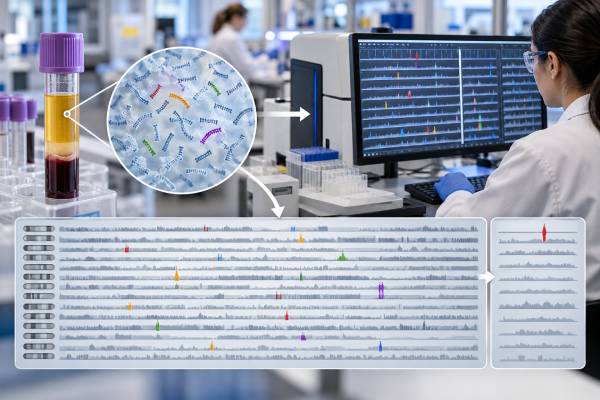
Guardant360 is a family of blood-based genomic profiling tests used mainly for people with advanced solid cancers. The current U.S. FDA-approved platform, Guardant360 Liquid CDx, analyzes cell-free DNA in plasma to identify cancer-associated genomic alterations that may guide targeted treatment or broader tumor profiling. Because the sample comes from blood, it can provide molecular information when tumor tissue is difficult to obtain and can sometimes capture DNA released from multiple tumor sites.
The name requires current context. Guardant360 CDx was an earlier FDA-approved assay, but Guardant Health states that the legacy Guardant360 CDx is no longer available to order in the United States; Guardant360 Liquid CDx became the newer FDA-approved assay in 2026. A liquid-biopsy result can be highly informative, but a negative blood result does not prove the tumor lacks a biomarker. Low ctDNA shedding, treatment response, disease location, and tumor burden can all reduce plasma sensitivity, so tissue testing may still be needed.
- Guardant360 Liquid CDx is a plasma next-generation sequencing test for people already diagnosed with solid cancer; it is not a general cancer screening test.
- The current FDA-approved assay detects small variants across 741 genes plus selected copy-number changes and rearrangements, with specific companion-diagnostic uses.
- A detected actionable mutation may support targeted therapy, but the exact cancer type, variant, drug label, and companion-diagnostic indication must match.
- A negative result can be false negative when little ctDNA is present, so tissue testing is recommended for relevant biomarkers when feasible.
- Variant allele frequency is not the percentage of tumor cells carrying a mutation, and some plasma variants can come from blood-cell clones rather than the cancer.
Table of Contents
- What the Guardant360 Test Is
- What Guardant360 Liquid CDx Measures
- How to Read a Guardant360 Report
- What Companion-Diagnostic Results Mean
- What a Negative Result Means
- Liquid Biopsy Versus Tissue Testing
- How Results Can Change Cancer Care
What the Guardant360 Test Is
Guardant360 is best understood as liquid comprehensive genomic profiling (CGP). A blood sample is collected, plasma is separated, and cell-free DNA is sequenced to search for molecular changes associated with a patient’s cancer. The tumor-derived portion of cfDNA is called circulating tumor DNA, or ctDNA.
The test is intended for people who have already been diagnosed with a solid malignant tumor. It does not determine whether a healthy person has cancer and should not be confused with an early-detection blood test. Its primary role is molecular profiling: finding genomic alterations that may help choose therapy, explain resistance, or identify clinical-trial options.
There are several Guardant-branded assays, so the exact test name matters. In the United States, FDA approved Guardant360 Liquid CDx on May 19, 2026. The company subsequently commercialized the newer assay and states that the older Guardant360 CDx is no longer available to order in the United States. Historical studies and older medical records may still refer to Guardant360 or Guardant360 CDx because those versions generated much of the evidence supporting plasma genomic profiling.
This version history matters when comparing reports. Older Guardant360 panels covered fewer genes than the current FDA-approved Guardant360 Liquid CDx. A mutation that was not reported on an older panel may simply have been outside that version’s target regions. Clinicians should therefore check the assay version, report date, and methodology before comparing serial results.
The broader concept is similar to other liquid biopsy testing: blood can provide a less invasive molecular snapshot of cancer, but the snapshot depends on what the tumor is shedding into circulation at that moment.
What Guardant360 Liquid CDx Measures
According to the current FDA approval, Guardant360 Liquid CDx uses targeted high-throughput hybrid-capture NGS. The FDA-approved assay detects single-nucleotide variants and insertions/deletions in 741 genes, copy-number amplifications in two genes, copy-number loss in one gene, and rearrangements in nine genes. It analyzes cfDNA from plasma collected from peripheral blood.
Those categories represent different types of tumor biology:
- Single-nucleotide variants (SNVs): one DNA letter is changed, such as a point mutation.
- Insertions and deletions (indels): small stretches of DNA are added or removed.
- Copy-number alterations: a cancer may gain extra copies of a gene or lose copies.
- Rearrangements/fusions: pieces of genes can join abnormally, potentially creating an oncogenic driver.
The report may include established oncogenic drivers, acquired resistance alterations, and other potentially relevant findings. Examples commonly encountered in advanced solid tumors include EGFR, KRAS, BRAF, ERBB2/HER2, ESR1, and other pathway genes, depending on the cancer type.
A key nuance is that the commercial Guardant360 Liquid CDx service may include professional-service features beyond the exact FDA-reviewed device claim. Guardant Health describes an expanded genomic and epigenomic footprint and genome-wide methylation-related features, while also stating that certain professional-service features are not reviewed or approved by the FDA. The FDA-approved companion-diagnostic scope should therefore be distinguished from additional information that may appear on a commercial report.
This is similar to the distinction between a broad ctDNA mutation panel and a particular regulatory claim. The panel may report many findings, but only specific biomarker-drug relationships have companion-diagnostic authorization.
How to Read a Guardant360 Report
The report is most useful when read in layers rather than as one long mutation list. Start with the biomarker that has the strongest treatment implication, then review the amount and quality of tumor signal, co-alterations, and findings that may need confirmation.
| Report element | What it can mean | Main caution |
|---|---|---|
| Pathogenic or actionable alteration | A cancer-associated variant with potential clinical relevance | Not every actionable-looking variant has an approved treatment in that cancer |
| Variant allele frequency (VAF) | Percentage of sequenced DNA at that site carrying the variant | Not equal to the percentage of tumor cells with the mutation |
| Amplification | Evidence of increased gene copy number | Detection often depends on adequate ctDNA signal |
| Fusion/rearrangement | Abnormal joining of genomic regions | Plasma sensitivity can vary by fusion and tumor shedding |
| Companion-diagnostic finding | Biomarker linked to a drug under an FDA-authorized test indication | The precise tumor type and labeling still apply |
VAF is frequently misunderstood. If an EGFR mutation is present at 4% VAF, that does not mean 4% of the patient’s cancer cells carry EGFR. Plasma is a mixture of normal cfDNA and tumor DNA; cancers may have abnormal chromosome copy numbers; and different tumor clones can shed at different rates. VAF is a sequencing proportion in the specimen, not a direct measure of tumor-cell fraction.
Some variants can also arise from clonal hematopoiesis, in which blood-forming cells acquire age-related somatic mutations and release DNA into plasma. Depending on the gene and clinical context, an unexpected finding may need comparison with tumor tissue or matched blood-cell DNA before it is treated as tumor-derived.
A report may also raise possible inherited, or germline, significance. Plasma tumor profiling is not a substitute for dedicated germline testing. When a variant pattern suggests hereditary risk, confirmatory testing using an appropriate non-tumor specimen and genetic counseling may be recommended.
What Companion-Diagnostic Results Mean
A companion diagnostic is an FDA-authorized test used to identify patients who may benefit from a specific therapy under that therapy’s approved labeling. Guardant360 Liquid CDx has companion-diagnostic indications for selected biomarkers in selected cancers.
Current FDA listings include examples such as:
- selected EGFR alterations in non-small cell lung cancer for osimertinib;
- EGFR exon 20 insertions for amivantamab in the specified NSCLC setting;
- KRAS G12C in NSCLC for an approved KRAS-targeted therapy;
- activating ERBB2/HER2 mutations in NSCLC for trastuzumab deruxtecan;
- BRAF V600E in colorectal cancer for the labeled targeted regimen; and
- selected ESR1 mutations in hormone receptor-positive, HER2-negative advanced breast cancer for certain endocrine therapies.
This list can change as the FDA approves new drug-test pairings, so the current device and drug labels should be checked at the time of treatment. A gene name alone is not enough. The exact variant, cancer type, stage or disease setting, and therapy indication all matter.
For example, an ESR1 liquid biopsy result can identify acquired endocrine-resistance mutations in advanced breast cancer, but only defined variants and treatment contexts meet a particular companion-diagnostic label. Likewise, an EGFR T790M plasma result has specific historical and regulatory context rather than serving as a universal marker for all EGFR-targeted therapy.
FDA labeling also makes an important distinction: genomic findings outside the listed companion-diagnostic biomarkers are not automatically prescriptive for a specific drug. They may still be clinically useful under oncology guidelines, trials, or expert molecular review, but they require a different level of interpretation.
What a Negative Result Means
A negative Guardant360 Liquid CDx result does not assure that the tumor is negative for genomic findings. The FDA states this explicitly and recommends reflex tissue testing for listed biomarkers when plasma is negative and tissue testing is feasible.
The main reason is ctDNA biology. Some tumors release substantial DNA into blood; others release very little. Plasma sensitivity can be reduced by:
- small or low-volume tumors;
- treatment that has already reduced tumor burden;
- disease confined to sites that shed poorly into blood;
- certain central nervous system tumors because of the blood-brain barrier;
- isolated lung, peritoneal, or other low-shedding patterns in some patients; and
- technical limits for particular alteration types.
A technically valid report can therefore be biologically uninformative. “No actionable alterations detected” is not the same as “the cancer has no actionable alterations.” Clinicians should ask whether enough ctDNA was present to make a negative result convincing.
This principle is especially important when the suspected biomarker has a major treatment consequence. If a person with metastatic lung cancer has a negative plasma panel but has never had complete tissue genotyping, a tissue biopsy may still reveal an actionable driver. Similarly, after targeted therapy, a negative plasma result may miss a resistance mechanism if the progressing tumor is shedding little DNA.
A ctDNA tumor fraction estimate can help contextualize negative findings when available. Higher ctDNA generally improves the chance of detecting tumor variants, while very low ctDNA makes false negatives more likely. There is no single tumor-fraction threshold that guarantees every mutation class will be detected.
Repeating plasma later can sometimes help if disease progresses and shedding increases, but repeat testing should not delay tissue diagnosis when tissue is safely obtainable and the result is needed now.
Liquid Biopsy Versus Tissue Testing
Liquid biopsy and tissue biopsy answer overlapping but not identical questions. Plasma is faster and less invasive and can sample DNA released from several tumor deposits at once. Tissue provides actual tumor cells, histology, protein expression, and local microenvironment information that blood cannot fully replace.
Advantages of plasma profiling include:
- no surgical biopsy procedure for the blood draw;
- usefulness when tumor tissue is scarce, old, or unsafe to obtain;
- potential to reveal heterogeneity across multiple metastatic sites; and
- repeatability during treatment or at progression.
Advantages of tissue profiling include:
- confirmation of the cancer type and histologic subtype;
- higher confidence for some variants when plasma ctDNA is low;
- access to RNA, protein, morphology, and tissue-specific biomarkers; and
- direct separation of tumor cells from blood-derived clonal hematopoiesis in many settings.
Prospective studies support using plasma when tissue-based NGS is impractical. A 2025 study of advanced solid tumors evaluated upfront liquid biopsy in patients for whom tissue NGS was not feasible and showed that plasma profiling could provide actionable information in real clinical practice. Earlier prospective evidence in advanced NSCLC also showed that comprehensive plasma genotyping can identify guideline-relevant alterations quickly.
However, discordance is expected. Plasma may detect a resistance clone that was absent from an old tissue biopsy. Tissue may detect a driver that plasma misses because ctDNA is low. A liquid biopsy resistance mutation test is especially useful when cancer has evolved under treatment pressure, but results still need to be reconciled with prior tissue findings.
The most complete strategy is often complementary rather than competitive: use the specimen most likely to answer the immediate question, and use the other when a negative or discordant result could change management.
How Results Can Change Cancer Care
Guardant360 results can influence care at several points in advanced cancer treatment. The value comes from linking a molecular finding to a specific decision, not from accumulating genomic information for its own sake.
A practical interpretation sequence is:
- Confirm the exact assay and report date. Guardant360 versions have changed, and the current Guardant360 Liquid CDx has a broader FDA-approved genomic scope than older panels.
- Identify established driver alterations. Prioritize variants with strong evidence in the patient’s cancer type.
- Check companion-diagnostic status. Verify the current FDA biomarker-drug pairing and the drug’s treatment setting.
- Review prior therapies. A mutation detected after targeted therapy may represent acquired resistance rather than the original driver.
- Assess negative-result confidence. Consider disease burden, ctDNA signal, and whether tissue reflex testing is needed.
- Separate uncertain findings. Do not treat every low-level or non-prescriptive alteration as a treatment target.
- Consider a molecular tumor board or genetics referral. Complex co-alterations, possible germline findings, and uncommon variants may need specialist review.
In newly diagnosed advanced cancer, plasma CGP can shorten the path to biomarker-driven therapy when waiting for tissue testing would delay care. At progression, it can reveal new mutations, amplifications, or fusions that explain why a therapy stopped working. In tumors with several metastatic sites, the blood may capture more clonal diversity than one biopsy core.
Serial testing should still be ordered for a reason. A new blood panel is most informative when the result could change the next treatment, clarify a suspected resistance mechanism, or replace an otherwise difficult tissue biopsy. Repeating broad profiling too frequently during stable disease can produce small VAF shifts that are hard to interpret and may not alter care. When monitoring response rather than searching for new targets, a dedicated ctDNA monitoring strategy may be more appropriate than repeatedly ordering comprehensive genomic profiling.
The test still needs the rest of the clinical picture. Pathology establishes what the cancer is. Imaging shows where it is and how it is responding. Clinical history shows what treatments have already shaped the tumor. Genomic profiling adds a molecular layer that can identify targets and resistance mechanisms.
Turnaround time can also affect how the information is used. A rapid blood result may allow treatment planning while tissue testing is still pending, but clinicians should reconcile later tissue results rather than automatically ignoring discordance. When both specimens are informative, the combined picture can reveal a driver that one specimen missed or show that the tumor has evolved since an older biopsy.
Used this way, Guardant360 Liquid CDx is a powerful precision-oncology tool rather than a stand-alone answer. A positive result can open a targeted-treatment path, while a negative result can signal the need for tissue rather than close the investigation. The most important skill is not simply finding mutations; it is deciding which findings are real, clinically relevant, current, and actionable for that particular patient.
References
- Premarket Approval (PMA) 2026
- List of FDA-Authorized Companion Diagnostic Devices (In Vitro and Imaging Tools) 2026
- Guardant Complete® for Early and Advanced Stage Cancer | Guardant Health 2026
- Analytical and Clinical Validation of the Plasma-Based Guardant360 CDx Test for Assessing HER2 (ERBB2) Mutation Status in Patients with Non-Small-Cell Lung Cancer for Treatment with Trastuzumab Deruxtecan in DESTINY-Lung01/02 2025
- Upfront liquid biopsy in patients with advanced solid tumors who were not feasible for tissue-based next-generation sequencing 2025
- ESMO recommendations on the use of circulating tumour DNA assays for patients with cancer: a report from the ESMO Precision Medicine Working Group 2022 (Guideline)
Disclaimer
Guardant360 Liquid CDx results should be interpreted by qualified cancer specialists together with pathology, imaging, treatment history, and the current FDA labeling. A negative plasma result does not rule out a tumor biomarker, and tissue testing may still be necessary when feasible. Do not start, stop, or change cancer treatment based only on a liquid-biopsy report without guidance from the treating oncology team.