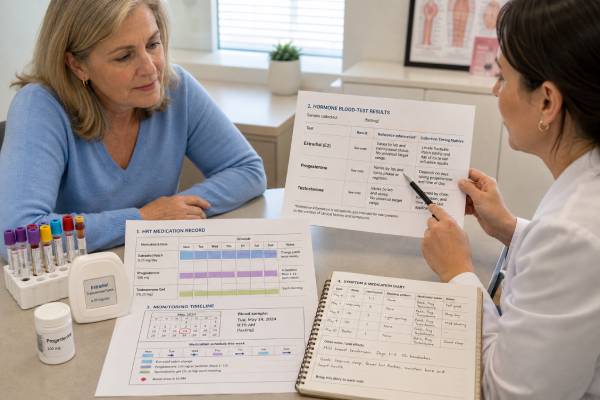
Hormone replacement therapy monitoring is mainly a clinical review, not a search for one perfect hormone number. Estradiol, progesterone, and testosterone tests can help in selected situations, but symptoms, bleeding patterns, side effects, medication use, treatment route, and personal health risks usually guide decisions more reliably than a single blood result. Estradiol levels vary widely with dose timing, absorption, assay method, and natural ovarian activity. Progesterone testing rarely proves that the uterine lining is adequately protected, because protection depends more on the prescribed progestogen dose and schedule. Testosterone is different: when it is prescribed for an evidence-based indication, a baseline total testosterone level and follow-up testing help prevent excessive exposure. Good monitoring also includes blood pressure, breast and cervical screening when due, bone or cardiovascular assessment when indicated, and prompt evaluation of unexpected bleeding or new warning symptoms.
- Routine estradiol testing is usually unnecessary when standard-dose HRT controls symptoms and causes no concerning effects.
- A single estradiol result cannot define the “right” HRT dose because levels vary by product, timing, absorption, and laboratory method.
- Progesterone blood levels do not reliably confirm endometrial protection; the prescribed progestogen regimen is more important.
- Total testosterone should generally be checked before treatment, again after starting or changing dose, and periodically during therapy.
- Review is commonly scheduled about 3 months after starting or changing systemic HRT, then at least yearly once treatment is stable.
- Heavy, persistent, or newly recurring bleeding after the expected adjustment period needs medical assessment rather than hormone dose changes alone.
Table of Contents
- What HRT Monitoring Includes
- When Hormone Blood Tests Help
- Estradiol Results on HRT
- Progesterone and Endometrial Protection
- Testosterone Monitoring in Women
- Preparation, Timing, and Test Quality
- Interpreting Results and Next Steps
- Safety Reviews and Warning Signs
What HRT Monitoring Includes
HRT monitoring checks whether treatment is relieving the symptoms it was prescribed for, whether the dose and route still fit the person’s needs, and whether any adverse effects or new health concerns require a change. Blood tests are only one possible part of that process.
A thorough review usually covers:
- hot flashes, night sweats, sleep disruption, vaginal symptoms, mood changes, and other treatment targets;
- adherence, missed doses, application technique, patch adhesion, and whether the product is being used as prescribed;
- headaches, breast tenderness, nausea, skin reactions, bloating, acne, unwanted hair growth, or other side effects;
- any vaginal bleeding, including when it occurs, how heavy it is, and whether the pattern has changed;
- blood pressure, weight trends, smoking, alcohol use, exercise, and cardiovascular risk factors;
- personal and family history of breast cancer, blood clots, stroke, heart disease, liver disease, and osteoporosis;
- medication interactions, including enzyme-inducing drugs that can alter hormone exposure;
- whether breast, cervical, bowel, and bone-health screening is current for age and risk.
For many people, the first structured review takes place about 3 months after systemic HRT is started or changed. That interval allows time for common early side effects to settle and for symptom response to become clearer. Once treatment is stable, an annual review is common, although earlier follow-up may be needed for dose changes, persistent symptoms, bleeding, complex medical conditions, or testosterone therapy.
Monitoring also depends on why hormones are being used. Menopausal symptom treatment, premature ovarian insufficiency, surgical menopause, and gender-affirming care may use different targets and follow-up plans. This article focuses on estradiol-, progestogen-, and testosterone-containing therapy used for menopause-related symptoms or ovarian hormone deficiency in women.
HRT is not usually adjusted to create youthful laboratory values. The aim is the lowest effective and acceptable regimen that controls symptoms and meets the person’s broader health needs. Someone with a uterus generally needs adequate progestogen alongside systemic estrogen to reduce the risk of endometrial overgrowth. Someone who has had a total hysterectomy may usually use estrogen without a progestogen unless another condition changes that plan.
People with early menopause or primary ovarian insufficiency may need a different discussion because hormone replacement is often continued until around the usual age of natural menopause unless contraindicated. In that setting, the purpose includes replacing hormones lost earlier than expected, not just suppressing hot flashes.
When Hormone Blood Tests Help
Blood testing is most useful when it answers a specific clinical question. Ordering estradiol, progesterone, and testosterone together as a routine “optimization panel” can produce confusing numbers without improving care.
Estradiol testing may be reasonable when symptoms remain severe despite correct use, when poor absorption is suspected, when an unusually high dose is being considered, or when treatment is used after very early ovarian loss and the clinician needs more information about exposure. It may also help when a patch repeatedly detaches, a gel is applied inconsistently, gastrointestinal disease may affect an oral product, or a medication interaction could reduce effectiveness.
Testing is less helpful when a person feels well on a licensed dose and has no concerning side effects. A satisfactory symptom response already shows that the regimen is having a clinical effect. In perimenopause, a blood sample also contains both naturally produced estradiol and estradiol from treatment, so a single value may be especially hard to interpret. The natural fluctuations described in a perimenopause hormone panel do not stop just because HRT has been started.
Progesterone testing is rarely part of routine menopausal HRT monitoring. Micronized progesterone has variable blood concentrations, and the level changes markedly according to when the capsule was taken. Synthetic progestogens may not be measured by a standard serum progesterone assay at all. A low result therefore does not automatically mean the uterine lining is unprotected, while a high result does not prove that the regimen is safe.
Testosterone testing has a clearer monitoring role. Before testosterone is prescribed, total testosterone is commonly measured to identify an unexpectedly high baseline value and create a reference for follow-up. Testing after treatment begins helps ensure that concentrations remain within the female physiological reference range and that the dose is not excessive.
Other tests may be more relevant than sex hormone levels. Depending on symptoms and history, clinicians may request a complete blood count, thyroid tests, liver enzymes, glucose or hemoglobin A1c, lipid profile, ferritin, vitamin B12, or pregnancy testing. For example, fatigue or palpitations should not automatically be blamed on “low estrogen.” A thyroid function test panel may be more useful when the symptom pattern suggests thyroid disease.
Questions a test should answer
Before blood is drawn, it helps to state the question clearly:
- Is estrogen being absorbed from the current product?
- Could the dose be unexpectedly high?
- Is testosterone above the laboratory’s female range?
- Is another endocrine condition causing the symptoms?
- Is a medication, illness, or application problem changing exposure?
A result that cannot answer a defined question is likely to create more uncertainty than clarity.
Estradiol Results on HRT
Estradiol is the main estrogen measured in most HRT blood tests, but there is no universally accepted serum estradiol target for routine menopausal treatment. Laboratories use different assays and reference intervals, products create different concentration patterns, and individual symptom response varies.
An oral estradiol tablet passes through the digestive system and liver before reaching the general circulation. A transdermal patch, gel, or spray delivers estradiol through the skin. These routes can produce different blood profiles even when they provide similar symptom relief. Blood drawn soon after gel or spray application may show a different value from blood drawn much later. Contamination can also occur if gel is applied near the venipuncture site or transferred to the arm used for the blood draw.
With patches, the concentration may change across the wear interval. A sample taken shortly after a new patch is applied may not match one taken just before replacement. Patch adhesion, sweating, skin condition, placement, body composition, and heat exposure can affect absorption. Oral dosing time, food, missed tablets, and gastrointestinal illness may also matter.
Natural ovarian function adds another layer. During perimenopause, estradiol can swing from low to high across days or weeks. A result may reflect the person’s own ovarian production, treatment, or both. That makes one number a poor guide to long-term exposure.
When estradiol testing is clinically justified, interpretation should include the exact product, dose, route, time of last dose or application, reason for testing, symptom response, and local assay range. The person’s estradiol test result should not be judged against a generic internet chart without those details.
What a low estradiol result may mean
A low value can reflect inadequate absorption, missed doses, poor patch contact, incorrect gel application, a long interval since the last dose, or an assay that performs poorly at low concentrations. It may also be expected with ultra-low-dose therapy or local vaginal estrogen, which is designed to act mainly in vaginal tissues rather than create high systemic levels.
The result is more meaningful when it matches persistent estrogen-deficiency symptoms and a plausible delivery problem. Even then, clinicians usually check technique and alternative causes before raising the dose. Increasing estrogen without adequate progestogen in someone with a uterus can increase endometrial risk.
What a high estradiol result may mean
A high value may result from sample timing, contamination, natural ovarian activity, excessive dosing, or unusual absorption. Symptoms such as breast tenderness, nausea, headaches, bloating, or unexpected bleeding may support the possibility of excessive exposure, but none is specific. A repeat sample under standardized conditions is often more useful than an immediate dose change based on one result.
There is no evidence-based benefit to chasing very high estradiol concentrations for energy, weight loss, cognition, or general “optimization.” Higher exposure may increase side effects, and the balance between estrogen and progestogen becomes especially important when the uterus is present.
Progesterone and Endometrial Protection
Progesterone or a progestogen is used with systemic estrogen in most people who still have a uterus. Its central safety role is to oppose estrogen-driven growth of the endometrium, the tissue lining the uterus. Monitoring therefore focuses on the prescribed regimen and bleeding pattern rather than a target progesterone blood concentration.
The word “progesterone” can refer to micronized progesterone, which is chemically identical to the hormone produced by the ovaries. “Progestogen” is the broader term that also includes synthetic medicines such as medroxyprogesterone acetate, norethisterone, levonorgestrel, and dydrogesterone. Standard progesterone blood assays do not reliably measure all of these medicines.
Oral micronized progesterone reaches a peak after dosing and then falls. A level drawn in the morning after a nighttime dose may differ greatly from a level drawn later in the day. Vaginal use creates high local uterine exposure that may not be reflected by serum levels. For these reasons, a serum progesterone test in women is useful for selected reproductive questions but is not a dependable test of HRT-related endometrial protection.
Protection depends on several practical factors:
- estrogen dose and route;
- progestogen type, dose, and number of days used each month;
- whether doses are missed;
- whether a levonorgestrel-releasing intrauterine system is in place and still within its effective period;
- body weight and individual risk factors;
- whether bleeding follows the expected pattern.
Sequential HRT usually gives estrogen continuously and a progestogen for part of each 28-day cycle. A predictable withdrawal bleed may follow. Continuous combined HRT gives estrogen and progestogen every day and is intended to become bleed-free after an adjustment period. The prescribed schedule should not be shortened or interrupted without clinical advice.
Unexpected bleeding is evaluated with the treatment timeline in mind. Bleeding can be common during the first months of systemic HRT or for a few months after a product or dose change. Persistent bleeding, very heavy bleeding, bleeding after a stable bleed-free interval, or bleeding that begins well beyond the expected adjustment period may require examination, ultrasound, or endometrial assessment. A “normal” progesterone result should never delay that evaluation.
Testosterone Monitoring in Women
Testosterone may be considered for low sexual desire associated with menopause when appropriate estrogen therapy and a broader assessment have not resolved the problem. It is not routinely recommended as a general treatment for fatigue, low mood, poor concentration, weight gain, or reduced wellbeing.
A baseline total testosterone level is used mainly for safety, not to diagnose a universal “testosterone deficiency syndrome.” Sexual desire is influenced by relationship factors, pain, medications, sleep, mental health, body image, illness, and genitourinary symptoms as well as hormones. A low number by itself does not prove that testosterone will help.
Total testosterone is preferred for monitoring. Female concentrations are low, so liquid chromatography–tandem mass spectrometry is the most accurate method when available. Direct immunoassays can be less precise at the low end. Free testosterone tests and calculated free androgen index may be affected by sex hormone-binding globulin, especially because oral estrogen can raise SHBG. The related SHBG test in women can provide context, but clinical response and total testosterone remain central.
A practical monitoring schedule often includes:
- Measure total testosterone before treatment.
- Repeat testing after treatment has begun or after a dose change, commonly within about 6 weeks to 3 months depending on local guidance and access.
- Continue periodic testing, often every 6 to 12 months once the dose is stable.
- Review benefit and adverse effects at each visit.
The aim is to keep total testosterone within the laboratory’s normal physiological range for women, not to reach the upper edge or a male reference interval. Results should be interpreted with the specific assay’s range. A testosterone test in women that rises above range calls for dose reduction or interruption and reassessment.
Possible androgenic adverse effects include acne, oily skin, increased facial or body hair, scalp hair thinning, and weight change. Voice deepening and clitoral enlargement are uncommon at physiological doses but may be irreversible, especially with excessive exposure. Oral testosterone is generally avoided because of liver and lipid effects. Compounded pellets or injections that create prolonged high levels are difficult to reverse and are not the standard approach for menopausal sexual symptoms.
Clinical benefit should also be reassessed. If there is no meaningful improvement after an adequate trial, commonly around 3 to 6 months, continuing treatment indefinitely is hard to justify. Monitoring should never focus on the laboratory number while ignoring whether the person actually feels better.
Preparation, Timing, and Test Quality
Consistent preparation makes a hormone result easier to interpret. The ordering clinician or laboratory should give product-specific instructions, because timing differs among tablets, patches, gels, sprays, vaginal products, and testosterone preparations.
Before the test, record:
- the exact brand, hormone, dose, and route;
- the date and time of the last dose;
- when a patch was applied and when it is due to be changed;
- where gel or cream was applied;
- missed or delayed doses during the previous week;
- any new medicines or supplements;
- whether the person is still having menstrual cycles;
- the reason the result is being requested.
Do not apply estradiol or testosterone gel to the arm that will be used for blood collection unless specifically instructed. Wash hands after application and avoid transfer to other people. If a gel was accidentally applied near the draw site, tell the phlebotomist and clinician because contamination can produce a falsely high result.
Fasting is usually not required for estradiol, progesterone, or testosterone alone, but it may be required if glucose, insulin, or lipids are ordered at the same time. Morning collection may improve consistency for testosterone, although treatment timing and local protocol matter more than a universal clock time.
Biotin supplements can interfere with some hormone immunoassays. The effect depends on the assay and dose, so the laboratory should be told about high-dose biotin used for hair, skin, nail, or medical purposes. Do not stop prescribed supplements without advice.
A result from one laboratory may not be directly interchangeable with a result from another. Reference ranges and methods differ. When monitoring a trend, using the same laboratory and similar timing conditions can reduce avoidable variation.
Interpreting Results and Next Steps
HRT results should be interpreted as a pattern: symptoms, side effects, adherence, route, timing, bleeding, health history, and laboratory data. A number outside range does not always require treatment, and a number inside range does not guarantee that the regimen is effective or safe.
| Finding | Possible explanation | Common next step |
|---|---|---|
| Symptoms controlled, no concerning effects | Current regimen is clinically effective | Continue with routine review; hormone testing may not be needed |
| Low estradiol with poor symptom control | Timing, missed doses, poor absorption, patch or gel problem, assay limits | Check technique and other causes; repeat under standardized conditions if useful |
| High estradiol on one sample | Dose timing, contamination, ovarian fluctuation, excessive exposure | Review product use and symptoms; confirm before major changes |
| Low serum progesterone | Expected timing variation or assay limitations | Do not use alone to judge endometrial protection; verify regimen and bleeding history |
| Testosterone above female range | Dose too high, product transfer, timing issue, assay variation | Reduce or pause treatment as advised and repeat testing |
| Persistent symptoms with “normal” hormone levels | Symptoms may have another cause or need a different treatment approach | Reassess diagnosis, route, comorbidities, sleep, mood, thyroid, anemia, and medications |
Dose changes should usually be modest and followed by enough time to judge the effect. Changing estrogen, progestogen, route, and testosterone all at once makes it difficult to know what helped or caused side effects. One change at a time is often safer and more informative.
Symptom diaries can add more value than repeated testing. Tracking hot flashes, sleep, bleeding, headaches, breast tenderness, sexual symptoms, and medication use for several weeks can reveal patterns that a single blood draw cannot.
Persistent poor control does not always mean “more hormone.” A switch from oral to transdermal estrogen may improve tolerability or provide more consistent delivery for some people. Vaginal estrogen may be added for local urinary or vaginal symptoms even when systemic treatment is used. A different progestogen may reduce mood or bleeding side effects. Nonhormonal therapy may be appropriate for symptoms that do not respond to estrogen.
Safety Reviews and Warning Signs
Monitoring must include symptoms that require prompt assessment. Hormone levels should not distract from conditions that need examination, imaging, or urgent care.
Seek urgent medical help for chest pain, sudden shortness of breath, coughing blood, one-sided leg swelling, sudden weakness or numbness, difficulty speaking, a severe new neurological headache, fainting, or signs of a serious allergic reaction. These symptoms can signal a blood clot, stroke, heart problem, or another emergency.
Contact a clinician promptly for:
- very heavy bleeding, bleeding with dizziness, or rapidly worsening pelvic pain;
- bleeding that persists beyond the expected adjustment period;
- bleeding that starts after a prolonged bleed-free interval on continuous combined HRT;
- a new breast lump, nipple discharge, or skin change;
- jaundice, dark urine, or severe upper abdominal pain;
- new voice deepening, marked hair loss, or clitoral enlargement during testosterone use;
- severe mood changes or thoughts of self-harm;
- a new pregnancy possibility, because standard menopausal HRT is not contraception.
Annual review should revisit whether benefits still outweigh risks. Age alone does not create an automatic stopping date, but changing health conditions may alter the safest route, dose, or treatment choice. Blood pressure, cardiovascular risk, breast history, migraine pattern, mobility, clot risk, and liver health may all influence decisions.
Commercial “hormone optimization” packages sometimes promote frequent testing and narrow target ranges that are not supported by menopause guidelines. Saliva and urine panels may be marketed as more precise, yet they generally do not replace clinical assessment or validated serum testing when a blood result is genuinely needed. Compounded preparations can also have variable potency and may lack the safety evidence and quality control of regulated products.
A well-run HRT review is individualized but not number-driven. Estradiol testing is selective, progesterone levels rarely determine uterine safety, and testosterone testing is used to avoid excessive exposure. The most reliable plan combines symptom response, correct use, bleeding assessment, appropriate screening, and targeted laboratory testing.
References
- Measurement of serum estradiol in the menopause transition 2025 (Guideline)
- Testosterone replacement in menopause 2026 (Guideline)
- HRT – Guide 2026 (Guideline)
- Menopause: identification and management 2024 (Guideline)
- The 2022 hormone therapy position statement of The North American Menopause Society 2022 (Position Statement)
- Menopause and MHT in 2024: addressing the key controversies – an International Menopause Society White Paper 2024 (Position Statement)
Disclaimer
This article provides general information about monitoring menopausal hormone therapy and cannot determine which tests, doses, or products are appropriate for an individual. Do not start, stop, or change estrogen, progestogen, or testosterone without guidance from a qualified clinician. Unexpected bleeding, clot symptoms, neurological symptoms, or serious adverse effects require prompt medical assessment.