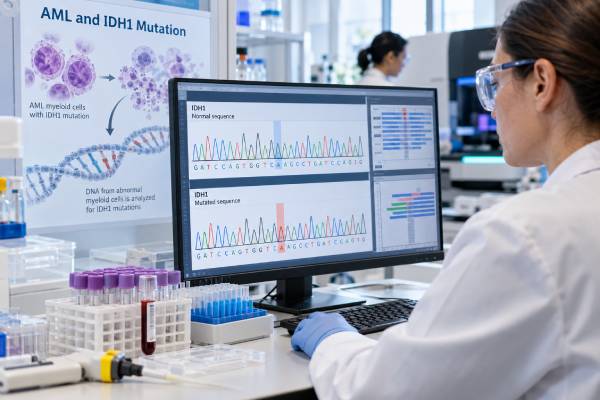
An IDH1 mutation test looks for acquired changes in the IDH1 gene that occur in a subset of acute myeloid leukemia (AML). Most AML-associated IDH1 mutations affect codon R132 and change the enzyme so it produces the abnormal metabolite R-2-hydroxyglutarate. That metabolic change can interfere with normal blood-cell maturation and help maintain leukemia. The result is usually reported as detected or not detected, often with the exact variant and a variant allele frequency (VAF). A positive IDH1 result can be important because it helps define the leukemia’s molecular profile and may identify an IDH1-targeted treatment option. It does not, by itself, prove that a person has AML or determine the entire prognosis. AML diagnosis and risk classification still depend on blood and bone marrow findings, chromosome results, and other mutations. IDH1 status can also matter later if disease relapses or if treatment with an IDH1 inhibitor is being considered.
- Most AML-associated IDH1 mutations involve codon R132; the laboratory report should name the exact variant when one is detected.
- A positive IDH1 mutation supports a clonal myeloid process in the right setting but is not sufficient by itself to diagnose AML.
- IDH1 mutations are actionable because approved IDH1 inhibitors are available for selected patients with IDH1-mutated AML.
- IDH1 mutation status is not a stand-alone favorable or adverse ELN 2022 risk category; coexisting genetics and cytogenetics matter.
- VAF estimates how much mutant DNA is present in the tested sample, but it is not the same as blast percentage or disease stage.
Table of Contents
- What the IDH1 Mutation Test Measures
- How IDH1 Testing Is Performed
- What a Positive IDH1 Result Means
- What a Negative or Low-Level Result Means
- IDH1 and AML Diagnosis, Risk, and Prognosis
- How IDH1 Status Can Guide Treatment
- Monitoring, Resistance, and Next Steps
What the IDH1 Mutation Test Measures
The test looks for pathogenic variants in the IDH1 gene, especially mutations at arginine 132 (R132). IDH1 normally encodes an enzyme that helps cells convert isocitrate to alpha-ketoglutarate in the cytoplasm and peroxisomes. AML-associated mutant IDH1 gains a new enzymatic activity: it converts alpha-ketoglutarate into R-2-hydroxyglutarate, often shortened to 2-HG.
Excess 2-HG disrupts enzymes that depend on alpha-ketoglutarate. The downstream effects include abnormal DNA and histone methylation and impaired differentiation of blood-forming cells. In simple terms, mutant IDH1 helps keep immature myeloid cells from maturing normally and contributes to the leukemia program.
IDH1 and IDH2 mutations together occur in roughly one fifth of AML cases in many modern series, although prevalence varies with age, AML subtype, and study population. IDH1 alone accounts for a smaller fraction. The most clinically important IDH1 variants cluster at R132, including substitutions such as R132H, R132C, R132G, R132S, and R132L. A report should specify the exact change rather than stating only “IDH positive” whenever possible.
The mutation is usually somatic, meaning it was acquired by blood-forming cells rather than inherited. A routine leukemia assay is therefore not designed to determine whether a variant is present in every cell of the body. If a result raises an unexpected concern for an inherited condition, germline evaluation requires a separate clinical question and an appropriate nonhematopoietic specimen.
IDH1 testing is one part of a broader AML molecular workup. Other findings such as NPM1 mutation status, FLT3, TP53, chromosome abnormalities, and gene fusions may carry equal or greater weight for classification and prognosis.
How IDH1 Testing Is Performed
IDH1 can be tested in bone marrow aspirate or peripheral blood when enough leukemia cells are present. Bone marrow is often used because AML is centered in the marrow, but blood can provide a reliable molecular result when circulating blasts are abundant.
Common laboratory methods include:
| Method | Main strength | Important limitation |
|---|---|---|
| Targeted PCR | Fast detection of defined IDH1 hotspot variants | May not detect variants outside the assay’s targeted mutations |
| Real-time PCR companion diagnostic | Validated detection of susceptible IDH1 mutations for a specific treatment indication | Designed for its stated variant set and clinical purpose |
| Next-generation sequencing (NGS) | Tests IDH1 together with many other AML genes | Turnaround time and sensitivity vary by laboratory |
A rapid IDH1 result can be useful when a treatment decision may depend on mutation status. Broader NGS is valuable because it shows co-mutations that help place IDH1 in context. Some centers use a rapid hotspot assay first and a larger panel later.
The report commonly includes the gene, DNA or protein-level variant, classification such as pathogenic or likely pathogenic, and VAF. VAF is the proportion of sequencing reads containing the variant. For example, a VAF of 30% means about 30% of the DNA reads at that position carried the mutation. It does not mean that 30% of cells are leukemia cells. Copy-number changes, normal-cell contamination, subclones, and whether the mutation is present on one or both gene copies can change the relationship between VAF and cell percentage.
There is no universal “normal range” for an IDH1 mutation test. A result is interpreted according to whether a relevant mutation was detected and whether it was above the assay’s validated limit of detection. A laboratory may report “not detected,” “negative,” or “no pathogenic IDH1 variant identified,” but these phrases do not guarantee that every possible IDH1 alteration is absent.
What a Positive IDH1 Result Means
A positive IDH1 result means that the tested specimen contains an IDH1 mutation recognized by the assay. In a patient who already meets criteria for AML, the finding establishes an IDH1-mutated molecular feature and can directly affect treatment planning.
The result has several possible uses:
- Molecular characterization: It identifies one of the leukemia’s driver or cooperating mutations.
- Treatment selection: A susceptible IDH1 mutation may make an approved IDH1 inhibitor relevant, depending on age, treatment setting, prior therapy, fitness, and local regulatory labeling.
- Clonal tracking: The mutation can sometimes be followed over time, although its role as a stand-alone measurable residual disease marker is more limited than some leukemia-specific targets.
- Relapse assessment: Finding the mutation again at relapse may reopen an IDH1-directed treatment option.
A positive result should not be read as “IDH1 caused the entire leukemia.” AML usually contains several acquired genetic changes. IDH1 may coexist with mutations in genes such as NPM1, DNMT3A, SRSF2, or others, and the combination influences biology.
It also does not establish the blast count or confirm AML in isolation. A person with an IDH1-mutated myeloid clone still needs the appropriate blood, marrow, and classification findings. Modern AML diagnosis can sometimes be made with a defining genetic abnormality at a blast percentage below the traditional 20% threshold, but IDH1 is not one of the abnormalities that, by itself, creates an AML diagnosis regardless of the rest of the case.
For that reason, the most useful way to read a positive report is: “IDH1-mutated clone detected; interpret with the full AML diagnostic profile.”
What a Negative or Low-Level Result Means
A negative IDH1 test means the laboratory did not detect a covered mutation above the assay’s detection threshold. It does not rule out AML. Most AML is IDH1-wild type, and other genetic drivers may be present.
A negative result should prompt two practical questions. First, did the assay cover the relevant IDH1 hotspot variants? Second, did the specimen contain enough leukemia cells for a reliable result? A blood specimen with very few circulating blasts can be less informative than marrow. Similarly, a small residual clone may fall below the sensitivity of a diagnostic assay.
The broader molecular workup remains important. In a newly diagnosed AML case, clinicians usually review other actionable and risk-defining findings rather than stopping after a negative IDH1 result. An FLT3 mutation test, NPM1 testing, chromosome analysis, and a broader myeloid panel may all answer different treatment and classification questions.
A low VAF positive result also requires context. It may represent a small leukemia subclone, low tumor content in the sample, or a clone that persists after treatment. The exact VAF should be interpreted against the assay’s validated sensitivity and the patient’s prior results.
Changes over time can be meaningful. A mutation present at diagnosis may no longer be detectable in remission, may persist in a small population, or may reappear at relapse. Conversely, AML can evolve, and a mutation that was not detected initially can sometimes be found later. If a major treatment decision depends on current IDH1 status, repeat testing on a current specimen may be appropriate.
IDH1 and AML Diagnosis, Risk, and Prognosis
IDH1 mutation status alone does not assign a patient to a single AML prognosis group. The European LeukemiaNet 2022 framework does not classify an IDH1 mutation by itself as favorable, intermediate, or adverse. Instead, risk is determined by the complete cytogenetic and molecular pattern.
That distinction matters because IDH1 can occur in biologically different AML contexts. Some patients have IDH1 together with NPM1 and otherwise favorable features. Others have myelodysplasia-related mutations or adverse chromosome abnormalities that drive a worse risk category. Age, white blood cell count, treatment fitness, response depth, and transplant eligibility also affect outcome.
Published studies of IDH1 prognosis have therefore produced context-dependent results. Differences in co-mutations, treatment era, use of transplant, and access to targeted therapy can change the observed survival of an “IDH1-mutated” group. A modern report should avoid treating IDH1 as a simple good-versus-bad prognostic switch.
The distinction between prognostic and predictive is useful. A prognostic marker relates to expected disease outcome independent of a specific treatment. A predictive marker identifies a group more likely to benefit from a particular therapy. IDH1 is especially important as a predictive marker because selective IDH1 inhibitors can target the mutant enzyme.
For a newly diagnosed patient, the risk discussion should therefore include the full ELN profile rather than just the IDH1 line. For a patient with relapsed disease, the current mutation profile may be even more important because it can reveal an actionable target that changes the treatment menu.
How IDH1 Status Can Guide Treatment
The most direct clinical meaning of a positive IDH1 test is that IDH1-targeted therapy may be available. In the United States, approved IDH1 inhibitors for AML include ivosidenib and olutasidenib in specified settings. Ivosidenib has approvals that include selected newly diagnosed adults with susceptible IDH1-mutated AML who are older or unable to receive intensive induction, including use with azacitidine, as well as other labeled AML settings. Olutasidenib is approved for adults with relapsed or refractory AML with a susceptible IDH1 mutation.
The exact treatment choice is not determined by the mutation alone. Clinicians consider whether AML is newly diagnosed or relapsed, whether intensive chemotherapy is appropriate, prior treatments, transplant plans, co-mutations, drug interactions, organ function, and patient goals. Venetoclax-based combinations and other AML regimens may also be relevant, and clinical trials continue to refine how IDH inhibitors are combined or sequenced.
Treatment response can also look different from classic chemotherapy. With an IDH1 inhibitor, marrow blasts may fall while mature neutrophils rise as the leukemic clone differentiates. Complete remission can take several treatment cycles, so response is judged with scheduled marrow assessments and blood-count recovery rather than from an early white blood cell change alone. At the same time, lack of response, worsening counts, or new genetic findings may signal resistant disease and prompt a change in strategy.
For newly diagnosed older or medically unfit adults, the randomized evidence supporting ivosidenib plus azacitidine is clinically important. The FDA approval summary reported improved event-free survival, overall survival, and complete remission compared with azacitidine plus placebo in the studied IDH1-mutated population. That evidence does not mean every older patient should receive the same regimen; venetoclax-based therapy, clinical trials, transplant plans, co-mutations, and individual risks still shape selection. For relapsed or refractory AML, prior exposure to IDH1-directed therapy also matters because resistance mechanisms can reduce the expected benefit of reusing the same strategy.
IDH inhibitors are differentiation therapies. Rather than simply killing every leukemia cell immediately, they can allow abnormal myeloid cells to mature. That mechanism creates a characteristic toxicity called differentiation syndrome. Symptoms can include fever, shortness of breath, low oxygen, rapid weight gain, swelling, low blood pressure, kidney dysfunction, and lung infiltrates or fluid accumulation. It can be severe or fatal if not recognized.
Because of this risk, patients receiving an IDH inhibitor need clear instructions about symptoms that require urgent contact with the treatment team. Treatment of suspected differentiation syndrome commonly includes prompt corticosteroids and supportive management, with drug interruption in selected severe cases according to the prescribing information.
Other treatment-specific issues can include QT interval prolongation, liver test abnormalities, leukocytosis, and drug interactions, depending on the agent. These risks belong to treatment management, not to the mutation test itself, but they explain why “IDH1 positive” should lead to a treatment discussion rather than an automatic prescription.
Monitoring, Resistance, and Next Steps
After an IDH1 mutation is identified, the next steps depend on where the patient is in the AML course. At diagnosis, the result should be incorporated into the complete molecular and cytogenetic profile before treatment is finalized. At relapse, current testing is valuable because the disease clone may have changed since the original diagnosis.
IDH1 can sometimes be measured with sensitive molecular methods during treatment, but it is not universally used as the sole standard marker for measurable residual disease. A leukemia MRD assessment may instead use multiparameter flow cytometry, NPM1 PCR when applicable, fusion-specific testing, or validated error-corrected sequencing. The most informative MRD method is the one validated for that patient’s leukemia and treatment setting.
Resistance to IDH1 inhibitors can occur. Leukemia may acquire additional changes that restore 2-HG production, alter the drug-binding target, activate alternative signaling pathways, or allow a different clone to become dominant. A clinical relapse should therefore not be interpreted from a single old molecular report. Repeat marrow evaluation and broad molecular testing can reveal whether IDH1 remains present and what new resistance features have emerged.
For a patient reading an IDH1 report, useful questions include:
- What exact IDH1 variant was detected?
- What was the VAF and the assay’s detection limit?
- Does the patient already meet diagnostic criteria for AML or another myeloid neoplasm?
- Which other mutations and chromosome findings are present?
- What is the complete ELN risk category?
- Does current IDH1 status make an IDH1 inhibitor appropriate now or later?
- What marker or method will be used to measure treatment response?
The key interpretation is straightforward: IDH1 positivity identifies a biologically important and potentially targetable AML feature, but its meaning is completed by the rest of the leukemia profile.
References
- Prognostic Implications and Therapeutic Landscape of IDH1-Mutated AML: An Updated Review of Evidence and Indian Perspective 2026 (Review)
- Metabolism and therapeutic response in acute myeloid leukemia with IDH1/2 mutations 2025 (Review)
- Management of isocitrate dehydrogenase 1/2 mutated acute myeloid leukemia 2024 (Review)
- Clinical Implications of Isocitrate Dehydrogenase Mutations and Targeted Treatment of Acute Myeloid Leukemia with Mutant Isocitrate Dehydrogenase Inhibitors-Recent Advances, Challenges and Future Prospects 2024 (Review)
- Diagnosis and management of AML in adults: 2022 recommendations from an international expert panel on behalf of the ELN 2022 (Guideline)
- FDA Approval Summary: Ivosidenib in Combination with Azacitidine for Treatment of Patients with Newly Diagnosed Acute Myeloid Leukemia with an IDH1 Mutation 2024 (Regulatory)
Disclaimer
An IDH1 mutation result must be interpreted with the complete blood, bone marrow, cytogenetic, and molecular evaluation. A positive result does not by itself diagnose AML, and a negative result does not rule AML out. Treatment decisions, including use of an IDH1 inhibitor and management of differentiation syndrome risk, should be made with a hematologist experienced in AML.