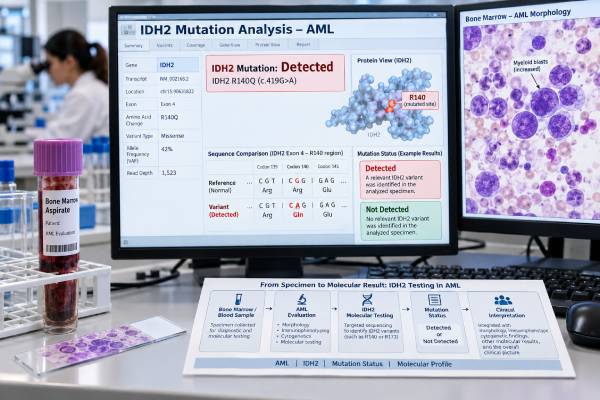
An IDH2 mutation test checks leukemia cells for acquired changes in the IDH2 gene, most often at codons R140 or R172. These mutations alter cell metabolism and produce the abnormal metabolite R-2-hydroxyglutarate, which can interfere with normal maturation of blood-forming cells. In acute myeloid leukemia (AML), a positive IDH2 result helps describe the leukemia’s molecular profile and may identify a treatment target. The result is usually reported as detected or not detected, with the exact mutation and often a variant allele frequency (VAF). IDH2 positivity does not diagnose AML by itself, and it does not automatically place a patient into one prognosis category. The meaning depends on the marrow or blood findings, chromosome abnormalities, other mutations, prior treatment, and current disease status. IDH2 testing can be important at diagnosis and again at relapse because an IDH2 inhibitor is approved for selected adults with relapsed or refractory IDH2-mutated AML.
- The two main AML IDH2 hotspots are R140 and R172; R140 mutations are generally more common.
- A positive IDH2 result identifies a clonal molecular abnormality but must be interpreted with the full AML diagnostic workup.
- IDH2 mutation alone is not a stand-alone favorable or adverse category in the ELN 2022 AML risk system.
- Enasidenib is an IDH2 inhibitor approved in the United States for adults with relapsed or refractory AML with a susceptible IDH2 mutation.
- IDH2 inhibitor treatment can cause differentiation syndrome, which requires prompt recognition and treatment.
Table of Contents
- What the IDH2 Mutation Test Measures
- How IDH2 Testing Is Done
- Meaning of a Positive IDH2 Result
- Meaning of a Negative or Low-Level Result
- IDH2 in AML Diagnosis, Risk, and Prognosis
- IDH2-Targeted Treatment and Differentiation Syndrome
- Monitoring, Relapse, and Next Steps
What the IDH2 Mutation Test Measures
The test looks for pathogenic changes in IDH2, especially mutations involving amino acid R140 or R172. IDH2 encodes an enzyme located in mitochondria. Its normal role includes producing alpha-ketoglutarate during cellular metabolism. When IDH2 is mutated at a leukemia-associated hotspot, the enzyme gains a new activity and makes R-2-hydroxyglutarate, also called 2-HG.
High 2-HG levels can block alpha-ketoglutarate-dependent enzymes involved in DNA and histone regulation. The result is an abnormal epigenetic state that helps keep myeloid precursor cells from differentiating normally. This does not mean that IDH2 mutation is the only cause of AML. Leukemia usually develops through several cooperating genetic and cellular changes.
IDH1 and IDH2 mutations together are found in roughly 15% to 20% of AML in many adult cohorts, although published estimates vary. IDH2 is often detected at R140 or R172. A large meta-analysis of older AML cohorts found R140 mutations more often than R172 mutations, illustrating why the exact hotspot matters when interpreting research data.
Common report wording may include variants such as IDH2 R140Q or IDH2 R172K. Other substitutions occur as well. The laboratory should identify the exact variant whenever possible because approved companion diagnostic assays recognize defined susceptible mutations.
Most IDH2 mutations found in AML are somatic, meaning they are acquired in the abnormal blood-cell clone. Routine leukemia sequencing is not the same as inherited genetic testing. If a clinician suspects a germline condition, confirmation should use a suitable nonblood specimen and a dedicated germline testing process.
IDH2 is one component of the larger AML molecular profile. Mutations such as NPM1, FLT3, DNMT3A, TP53, and myelodysplasia-related genes, along with cytogenetic findings, can substantially change how the overall case is classified and treated.
How IDH2 Testing Is Done
IDH2 testing can be performed on bone marrow aspirate or peripheral blood. Bone marrow is often preferred when circulating blasts are low, while blood can be adequate when leukemia cells are clearly present in circulation.
Laboratories may use a targeted PCR assay, an FDA-approved companion diagnostic, or a broader next-generation sequencing panel. Each method has a different purpose:
| Testing approach | What it provides | Key limitation |
|---|---|---|
| Targeted hotspot PCR | Rapid detection of defined IDH2 mutations | Does not evaluate all possible IDH2 variants |
| Companion diagnostic assay | Validated identification of susceptible mutations for a labeled treatment | Restricted to its stated specimen and variant scope |
| NGS myeloid panel | IDH2 plus many co-mutations in one test | Sensitivity and turnaround time vary by platform |
The result is usually qualitative—detected or not detected—but NGS often also provides a VAF. VAF is the fraction of sequence reads that carry the mutation. A 25% VAF, for example, means one quarter of reads at that position contained the variant. VAF should not be read as a direct percentage of blasts. Normal-cell DNA, subclones, copy-number changes, and zygosity can all shift the value.
There is no universal numeric reference range for an IDH2 mutation test. The important comparison is against the assay’s validated limit of detection. A diagnostic panel may reliably detect variants at a few percent VAF, while a specialized residual-disease assay may be designed for much lower levels. These are not interchangeable purposes.
If the report states “not detected,” it should be read as “no covered IDH2 mutation was detected above this test’s threshold.” That is more accurate than assuming the IDH2 gene is completely normal in every leukemia cell.
Meaning of a Positive IDH2 Result
A positive result means a pathogenic or susceptible IDH2 mutation was found in the tested sample. In a person with established AML, that result has immediate molecular and potentially therapeutic meaning.
A positive IDH2 result can contribute to four clinical questions:
- What is the leukemia’s molecular profile? IDH2 identifies one of the abnormal clones contributing to the disease.
- Is there a targeted treatment option? In relapsed or refractory AML, a susceptible IDH2 mutation can support consideration of enasidenib.
- Can the mutation be tracked over time? Serial testing may show whether the mutation becomes undetectable, persists, or returns, although IDH2 is not universally the sole preferred MRD marker.
- Has the leukemia evolved? Comparing diagnosis and relapse profiles can reveal clonal changes that affect treatment choices.
A positive result does not establish that every blast carries the mutation. AML can contain multiple related subclones. If IDH2 is present in a founding or large clone, VAF may be relatively high; if it is in a smaller subclone, VAF may be lower.
It also does not mean that IDH2 positivity is specific only to AML. IDH2 mutations can occur in other myeloid neoplasms and age-related clonal states. The diagnosis depends on morphology, blast percentage, blood counts, cytogenetics, and other molecular findings.
The exact mutation may also influence how published prognosis studies are interpreted. R140 and R172 are biologically related but not necessarily identical clinical groups. This is another reason a report should preserve the precise variant rather than reducing the result to a generic “IDH2 positive.”
Co-mutations can also hint at where the IDH2-mutated clone sits in the leukemia’s history. Some IDH2 mutations coexist with NPM1 or DNMT3A, while other cases carry spliceosome or myelodysplasia-related mutations. These combinations can influence phenotype, transplant discussions, and the likelihood that another marker is better suited for residual-disease monitoring. A molecular report is therefore most useful when the laboratory lists all clinically relevant variants together rather than treating each gene as a separate yes-or-no test.
Meaning of a Negative or Low-Level Result
A negative IDH2 result does not make AML less real; it simply means the leukemia does not have a detectable covered IDH2 mutation in that specimen. Most AML cases do not depend on IDH2, and other molecular abnormalities may be more important.
If testing was performed on blood with very few circulating blasts, a negative result may reflect limited tumor content. Bone marrow testing can be more informative when the disease is primarily marrow-based. The assay’s coverage also matters. A targeted test may evaluate only common R140 and R172 substitutions, while broad sequencing may examine a larger region.
The rest of the molecular workup should proceed according to the AML setting. Common companion tests include NPM1, FLT3, chromosome analysis, fusion testing, and a myeloid NGS panel. If a case has unexplained adverse biology, testing for TP53 mutation and myelodysplasia-related abnormalities may be especially important.
A low-level positive result deserves careful review. It can represent a small AML subclone, residual disease, low leukemia content in the specimen, or a persistent preleukemic clone. The meaning is strongest when the result is compared with the patient’s original mutation profile and with a sensitive, validated assay.
Mutation status may also change over time. Selective pressure from chemotherapy or targeted therapy can shrink one clone while another expands. Therefore, an IDH2-negative result from the original diagnosis should not always be assumed to remain valid years later if the leukemia relapses and a new targeted treatment decision is being made.
IDH2 in AML Diagnosis, Risk, and Prognosis
IDH2 is an important molecular marker, but it is not a stand-alone AML diagnostic or ELN risk-defining abnormality. The diagnosis first requires the appropriate clinical, blood, marrow, and genetic evidence for AML or another myeloid neoplasm.
ELN 2022 risk classification assigns prognosis based on a combination of chromosome changes and molecular abnormalities. IDH2 mutation by itself does not place a patient into favorable, intermediate, or adverse risk. For example, an IDH2-mutated AML with a favorable defining abnormality may have a very different outlook from an IDH2-mutated AML with adverse cytogenetics or high-risk myelodysplasia-related mutations.
Published prognosis studies also show why simple labels are unreliable. A 2023 systematic review and meta-analysis found no overall significant survival effect for R140 or R172 mutations across all included AML patients, while subgroup findings differed by age, geography, and mutation site. Treatment era is another major source of variation because targeted IDH therapy and modern venetoclax-based regimens were not equally available in older cohorts.
For an individual patient, clinicians therefore look beyond “IDH2 positive.” Important factors include:
- the full ELN 2022 genetic risk group;
- age and medical fitness;
- response to induction or lower-intensity therapy;
- depth of remission and MRD status;
- transplant candidacy;
- whether the disease is newly diagnosed or relapsed; and
- which co-mutations are present.
This distinction is useful: IDH2 is often more actionable as a predictive treatment marker than as a simple stand-alone prognostic marker.
That is also why treatment-era studies should be read cautiously. Outcomes from patients treated before routine molecular profiling and targeted therapy may not predict results for a patient treated today. Prognosis should be updated after treatment begins because remission quality and measurable residual disease can become more informative than the mutation label present at diagnosis.
IDH2-Targeted Treatment and Differentiation Syndrome
The main approved IDH2-targeted drug in AML is enasidenib. In the United States, it is approved for adults with relapsed or refractory AML with a susceptible IDH2 mutation detected by an FDA-approved test. The mutation result therefore serves as a treatment-selection biomarker in that setting.
Enasidenib inhibits the mutant IDH2 enzyme and lowers production of 2-HG. Its clinical effect often involves allowing leukemia cells to mature rather than causing immediate cell destruction. Because of that mechanism, blood counts and marrow appearance can change in ways that differ from traditional cytotoxic chemotherapy.
A major treatment-specific risk is differentiation syndrome. In a 2024 pooled analysis of enasidenib clinical trials, differentiation syndrome occurred in about 10% of the overall AML population studied, with rates varying by regimen. Common findings included shortness of breath or low oxygen and pulmonary infiltrates. The median time to first event was about one month, but cases occurred earlier and later.
Possible symptoms include:
- fever;
- shortness of breath or new oxygen requirement;
- lung infiltrates or pleural effusions;
- rapid weight gain and swelling;
- low blood pressure;
- kidney dysfunction; and
- rising white blood cell counts.
These features can overlap with infection, heart failure, leukemia progression, or other treatment complications, so clinicians often have to act before every alternative has been excluded. Prompt systemic corticosteroids and supportive care are central to management when differentiation syndrome is suspected.
Differentiation syndrome does not always appear immediately after treatment starts. In pooled enasidenib trials, the first event occurred at a median of about 32 days, with a range from 4 to 129 days. That wide window means patients and clinicians need to remain alert beyond the first week. Leukocytosis can accompany the syndrome but is not required. When symptoms are compatible, treatment decisions are based on the whole clinical picture rather than waiting for one confirmatory laboratory test, because no single blood marker proves differentiation syndrome.
Enasidenib responses can also develop gradually. Some patients improve through differentiation rather than rapid marrow aplasia, and blood counts can fluctuate before a formal remission is documented. Unless toxicity or progression requires a change, clinicians may allow enough treatment time to assess whether differentiation is producing a meaningful response. This is one reason a patient should not interpret a persistent early mutation signal or incomplete count recovery as automatic treatment failure without the scheduled marrow and clinical assessment.
A positive IDH2 test is therefore not an instruction to start enasidenib automatically. Treatment choice depends on the disease setting, prior therapy, transplant strategy, coexisting mutations, organ function, drug interactions, and available clinical trials. Newly diagnosed IDH2-mutated AML may be treated with intensive chemotherapy or lower-intensity combinations depending on fitness, and investigators continue to study how best to integrate IDH2 inhibition with other agents.
Monitoring, Relapse, and Next Steps
IDH2 mutation dynamics can add information during AML treatment, but they should not be interpreted in isolation. Molecular clearance of IDH2 can accompany response, while persistence may indicate residual clonal cells. Studies in patients undergoing allogeneic transplantation have shown that the presence or persistence of IDH1/IDH2 mutations can carry prognostic information, but the clinical meaning depends on the exact mutation, assay sensitivity, co-mutations, and treatment context.
For routine measurable residual disease, the most informative marker may be something else. If the leukemia has NPM1 or a trackable fusion, those can be highly sensitive molecular targets. Flow cytometry also remains widely used. A validated AML MRD test should be selected based on the patient’s diagnostic profile rather than assuming that IDH2 VAF alone is the best residual-disease measure.
Relapse is a particularly important time to repeat molecular testing. The leukemia may retain IDH2, lose it, or acquire additional mutations. If enasidenib is being considered, current confirmation of a susceptible IDH2 mutation helps ensure that the treatment target is still present.
Patients reviewing an IDH2 report can ask:
- Which IDH2 mutation was detected—R140, R172, or another variant?
- What was the VAF and what is the assay’s limit of detection?
- Was the specimen blood or bone marrow, and did it contain enough leukemia cells?
- What other mutations and chromosome findings define the AML?
- What is the full ELN risk category?
- Is enasidenib relevant in the current treatment setting?
- What method will be used to monitor response and MRD?
The central message is that IDH2 positivity is a meaningful molecular feature and a potential treatment target, but the full AML profile determines diagnosis, risk, and the best next step.
References
- Metabolism and therapeutic response in acute myeloid leukemia with IDH1/2 mutations 2025 (Review)
- Differentiation syndrome associated with treatment with IDH2 inhibitor enasidenib: pooled analysis from clinical trials 2024
- Management of isocitrate dehydrogenase 1/2 mutated acute myeloid leukemia 2024 (Review)
- IDH2 mutations in acute myeloid leukemia 2023 (Review)
- Prognostic value of IDH2R140 and IDH2R172 mutations in patients with acute myeloid leukemia: a systematic review and meta-analysis 2023 (Systematic Review)
- Diagnosis and management of AML in adults: 2022 recommendations from an international expert panel on behalf of the ELN 2022 (Guideline)
Disclaimer
An IDH2 mutation test is one part of AML diagnosis and treatment planning. A positive mutation does not diagnose AML by itself, and a negative result does not exclude AML. Treatment with an IDH2 inhibitor requires specialist supervision because differentiation syndrome and other complications can be serious.