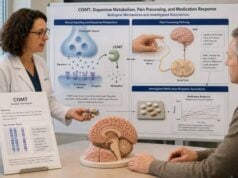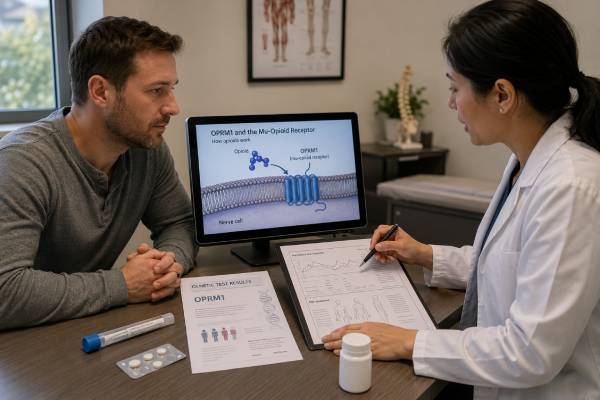
An OPRM1 genetic test looks for inherited variation in the gene that makes the mu-opioid receptor, a major target of medicines such as morphine, fentanyl, oxycodone, and hydromorphone. The most commonly reported variant is rs1799971, also called A118G or c.118A>G. Some studies have linked this variant to small differences in opioid dose needs, pain relief, or side effects, but results vary by drug, clinical setting, ancestry, and study design. For that reason, an OPRM1 result is not a reliable stand-alone instruction for selecting an opioid or changing its dose. It also cannot determine whether someone will develop opioid use disorder or experience an overdose. Clinicians interpret the result alongside the cause and severity of pain, prior opioid exposure, kidney and liver function, other medicines, breathing risk, treatment goals, and response after each dose change. The test may add context, especially when included in a broader pharmacogenetic panel, but safe opioid care still depends on careful prescribing and close follow-up.
- The test usually reports rs1799971 as AA, AG, or GG; these are genotypes, not “normal,” “high,” or “low” opioid levels.
- Current clinical guidelines do not recommend a specific opioid or dose solely from an OPRM1 result.
- A G allele may be associated with modestly different dose requirements in some settings, but the direction and size of the effect are not consistent enough for individual dosing.
- No fasting or medication pause is usually needed because the test measures inherited DNA from blood or a cheek swab.
- Severe sleepiness, slow or shallow breathing, blue or gray lips, or inability to wake requires emergency help and an opioid-reversal medicine when available.
Table of Contents
- What the OPRM1 Test Measures
- How to Read AA, AG, and GG Results
- What the Result Can and Cannot Predict
- How OPRM1 Fits Opioid Selection and Dosing
- Opioid Safety, Monitoring, and Urgent Warning Signs
- Testing Limitations and When It May Help
- Questions and Next Steps After Testing
What the OPRM1 Test Measures
OPRM1 provides instructions for making the mu-opioid receptor. These receptors sit on nerve cells in the brain, spinal cord, and other tissues. When an opioid agonist binds to the receptor, it can reduce pain signaling. The same receptor activity can also cause drowsiness, constipation, nausea, slowed breathing, euphoria, physical dependence, and other effects. Naturally produced endorphins also act through this system.
Most clinical OPRM1 tests examine one single-nucleotide variant: rs1799971. It can be described several ways on a laboratory report:
- A118G
- c.118A>G
- p.Asn40Asp or N40D
- AA, AG, or GG genotype
These labels describe the same DNA position using different naming systems. At that position, a person inherits one copy from each biological parent. An AA result means two A copies, AG means one A and one G copy, and GG means two G copies.
The variant changes one amino acid in the receptor protein and may affect receptor expression, signaling, or availability. That biological effect gives the test scientific plausibility, but a plausible mechanism does not guarantee a strong or predictable effect in daily care. Pain and opioid response arise from many interacting processes. Even when a statistical association appears across a group, it may be too small or inconsistent to predict what will happen to one person.
OPRM1 is mainly a pharmacodynamic gene. Pharmacodynamics describes what a medicine does to the body and how its target responds. This differs from a metabolism gene, which affects how quickly the body activates or clears a medicine. The distinction helps explain why OPRM1 results do not produce labels such as poor, intermediate, normal, rapid, or ultrarapid metabolizer.
For comparison, CYP2D6 changes the conversion of codeine to morphine and tramadol to an active metabolite. That gene has clearer prescribing implications for those medicines. A separate CYP2D6 opioid pharmacogenetic result should not be confused with an OPRM1 receptor result.
Testing may use blood, saliva, or a cheek swab. Food, exercise, pain intensity, and current opioid use do not change the inherited genotype, so special preparation is rarely needed. A person who has received an allogeneic stem-cell or bone-marrow transplant should tell the laboratory and ordering clinician. Blood cells after transplant may carry the donor’s DNA, and another specimen type may be needed to identify the recipient’s inherited genotype.
How to Read AA, AG, and GG Results
An OPRM1 report should be read as a description of a variant, not as a diagnosis or dosing order. Laboratories may use different comments, evidence ratings, or proprietary categories, so the genotype and the laboratory’s exact interpretation both deserve review.
AA genotype
AA is often called the reference or common genotype in many populations. It does not guarantee strong pain relief, a low dose requirement, or freedom from opioid side effects. An AA patient can still have inadequate analgesia, severe nausea, dangerous respiratory depression, or opioid use disorder. Clinical response remains the deciding evidence.
AG genotype
AG means the person carries one G allele. Some studies have found that G-allele carriers need slightly more opioid for comparable pain relief, especially in certain postoperative, cancer-pain, labor, or post-cesarean settings. Other studies have found no meaningful difference or a different pattern. The effect can vary by opioid, route, dose, population, and outcome measured.
An AG result therefore does not justify automatically increasing an opioid dose. Starting higher because of genotype could expose a patient to preventable sedation or breathing suppression. The safer approach is to use the same clinical safeguards applied to any patient and adjust only after observing benefit and harm.
GG genotype
GG means two G copies. It is less common than AG in many populations, although frequency varies substantially across ancestral groups. Some reports associate GG with larger differences than AG, but GG groups in studies are often small. Small sample sizes make estimates less stable and can exaggerate apparent effects.
A GG result is not proof of opioid resistance. It does not mean that opioids will fail, and it does not establish a minimum effective dose. It also does not make respiratory depression impossible. Receptor biology, tolerance, organ function, co-medications, and the specific opioid can outweigh the contribution of this single variant.
The following interpretation is more accurate than labeling one genotype “good” and another “bad”:
| Result | What it shows | Reasonable clinical interpretation |
|---|---|---|
| AA | Two A alleles at rs1799971 | Common reference genotype; no guaranteed response or safety profile |
| AG | One A and one G allele | Possible small change in response in some settings; no guideline-based dose change |
| GG | Two G alleles | Possible larger group-level effect in some studies, but evidence remains insufficient for a fixed dose rule |
Variant frequency differs among populations, but ancestry should never substitute for testing, and a genotype should not be treated as a racial category. People with similar self-identified backgrounds can have different genotypes, while people from different backgrounds can share the same result. The report describes one DNA position, not a person’s identity or overall genetic ancestry.
When OPRM1 appears on a multigene panel, review each gene separately. A pharmacogenetic panel result may contain both actionable findings and findings with limited clinical evidence. A brightly colored panel category or commercial label does not replace the evidence level for the individual gene–drug pair.
What the Result Can and Cannot Predict
OPRM1 rs1799971 has been studied for opioid dose requirements, pain scores, nausea, vomiting, itching, respiratory effects, opioid use disorder, and response to medicines such as naltrexone. The large number of studied outcomes can create an impression that the test answers many clinical questions. In practice, the evidence is mixed and usually does not support a dependable individual prediction.
Possible Contribution to Analgesic Response
Across some pooled studies, G-allele carriers used modestly more opioid than AA patients to reach similar pain control. Associations have appeared in selected postoperative, cancer, labor, and post-cesarean groups. However, studies have differed in the opioid used, route of administration, surgery type, pain scale, observation time, ancestry, age, and whether researchers adjusted for other genetic and clinical factors.
A statistically significant group average can still be too small for a safe bedside rule. Individual dose ranges overlap widely, so many AA patients may need more medicine than some AG or GG patients. The genotype therefore cannot function as a precise dose calculator.
Side Effects and Respiratory Depression
Research has examined whether rs1799971 predicts nausea, vomiting, itching, sedation, or respiratory depression. Findings are not consistent enough to classify one genotype as protected or high risk. Any person taking an opioid can develop serious breathing suppression, especially after treatment starts, after a dose increase, when switching products, or when another sedating substance is added.
Opioid Use Disorder and Addiction
An OPRM1 result cannot diagnose or reliably predict opioid use disorder. Addiction develops through a complex interaction of exposure, dose and duration, mental health, trauma, social environment, other substance use, family history, access to care, and many biological factors. A single common variant cannot divide people into “addicted” and “not addicted” groups.
The result should not be used to deny appropriate pain treatment, reduce monitoring for an AA patient, or reassure a G-allele carrier that risk is predetermined. Clinicians assess opioid-use risk from the full history and continue monitoring during treatment.
Physical dependence and tolerance are not the same as opioid use disorder. Dependence can cause withdrawal after abrupt stopping, while tolerance can reduce a dose’s effect after repeated exposure. Opioid use disorder involves impaired control and continued use despite harm.
Response to Naltrexone and Substance Use Treatment
OPRM1 has been studied in relation to naltrexone response, but findings vary across trials and populations. The genotype should not determine access to evidence-based treatment for alcohol or opioid use disorder. Treatment depends on the diagnosis, goals, contraindications, prior response, and access.
Current professional guidance recognizes the limited and inconsistent evidence for OPRM1-guided opioid therapy. In contrast, some gene–drug relationships have sufficient evidence for specific prescribing recommendations. This difference is why every result should be interpreted at the gene–drug level rather than assuming that all pharmacogenetic findings are equally actionable.
How OPRM1 Fits Opioid Selection and Dosing
No widely accepted clinical algorithm converts AA, AG, or GG into a starting opioid dose. Current CPIC guidance does not provide an OPRM1-based recommendation for choosing or dosing an opioid because the evidence is insufficient. A report that suggests a specific increase or decrease should therefore be checked against an independent guideline and reviewed by a clinician or pharmacist with pharmacogenetics expertise.
Opioid selection begins with the pain condition. Many episodes of acute back pain, neck pain, sprains, strains, dental pain, and minor surgical pain respond as well as or better to nonopioid approaches. Depending on the cause, treatment may include acetaminophen, a nonsteroidal anti-inflammatory drug when safe, local or regional anesthesia, ice or heat, physical therapy, movement, sleep support, behavioral strategies, or treatment of the underlying disease.
When an opioid is appropriate, clinicians commonly consider:
- The pain cause, duration, and whether opioids are likely to help that mechanism
- Previous opioid exposure and current tolerance
- Age, frailty, pregnancy, sleep-disordered breathing, and lung disease
- Kidney and liver function
- Other medicines or substances that increase sedation or alter opioid concentrations
- Overdose history, substance use disorder, mental health, functional goals, and ability to monitor safely
CYP2D6 can be more influential than OPRM1 for codeine and tramadol because these drugs require CYP2D6 to form important active metabolites. Poor metabolizers may receive little benefit, while ultrarapid metabolizers can form active metabolites quickly and face toxicity. OPRM1 does not replace those gene-specific recommendations.
Other opioids follow different pathways. Morphine metabolites can accumulate with reduced kidney function; fentanyl is vulnerable to strong CYP3A interactions; and methadone has complex metabolism, a long variable half-life, and cardiac considerations. A broad pain medication pharmacogenetic test can organize several findings, but it cannot account for these clinical differences.
Dose adjustment should follow observed response. Clinicians assess pain relief together with function, alertness, breathing, constipation, nausea, falls, confusion, and signs of misuse. A higher pain score alone does not always justify a higher dose; tolerance, withdrawal, opioid-induced hyperalgesia, or a poorly matched pain mechanism may require a different plan.
A G allele should never be treated as permission to bypass cautious initiation. Conversely, an AA result should not be used to assume a low dose will work or that adverse effects are unlikely. The same principle applies when changing opioids: equianalgesic conversion tables give estimates, not exact biological equivalence, and clinicians often reduce the calculated dose because cross-tolerance is incomplete.
For patients already receiving long-term opioids, genetic results do not justify abrupt discontinuation. Sudden reductions can cause withdrawal, uncontrolled pain, psychological distress, and other serious harm. Any taper should be individualized, gradual when clinically appropriate, and coordinated with treatment for pain and substance use disorders when needed.
Opioid Safety, Monitoring, and Urgent Warning Signs
Genotype does not remove the need for standard opioid precautions. Serious harm can occur at any genotype, and risk often changes faster than genetics. A new sedative, worsening lung disease, reduced kidney function, or an accidental extra dose can matter immediately.
The greatest acute danger is respiratory depression. Warning signs include:
- Slow, shallow, irregular, or stopped breathing
- Extreme sleepiness or inability to wake
- Blue, gray, or unusually pale lips or fingertips
- Choking, gurgling, or snoring sounds in an unresponsive person
- Pinpoint pupils together with reduced consciousness
- Limpness, confusion, or loss of consciousness
Call emergency services immediately when an opioid overdose is suspected. Give naloxone or another approved opioid-reversal medicine if available, follow the product instructions, and provide another dose if advised because the first dose may wear off before the opioid does. Stay with the person and support breathing as directed by emergency personnel. A person who wakes after naloxone still needs medical evaluation because sedation and breathing problems can return.
Risk rises when opioids are combined with alcohol, benzodiazepines such as alprazolam or diazepam, sleep medicines, sedating antihistamines, gabapentinoids, muscle relaxants, or other central nervous system depressants. Some combinations may be clinically necessary, but they require deliberate review and monitoring. Patients should not add, stop, or change these medicines without professional guidance.
Sleep apnea, chronic lung disease, older age, frailty, kidney or liver impairment, pregnancy, and a previous overdose can also increase risk. People who have lost tolerance after hospitalization, incarceration, detoxification, or a period without opioids may overdose on a dose they previously used. Illicitly manufactured fentanyl adds an unpredictable risk that an inherited test cannot measure.
Follow-up should examine function as well as pain intensity. Clinicians also review constipation, nausea, dizziness, falls, mood, cravings, extra doses, early refill requests, and other substance use. Prescription-monitoring data or toxicology testing may help in some settings when interpreted carefully and used to improve safety.
A written plan can specify the maximum dosing frequency, substances to avoid, who to call, and safe storage and disposal. Opioids should be locked away and never shared, even with someone who reports similar pain.
Naloxone is reasonable to discuss whenever an opioid is prescribed. It is especially important with prior overdose, substance use disorder, higher opioid exposure, concurrent sedatives, sleep-disordered breathing, or household accidental-ingestion risk. Caregivers should know where it is and how to use it.
OPRM1 testing does not replace any of these measures. A genotype may remain unchanged for life, while the safe dose can change from one week to the next as health, tolerance, and co-medications change.
Testing Limitations and When It May Help
The main limitation is restricted clinical actionability. OPRM1 rs1799971 is relevant and repeatedly studied, but current evidence does not support a dependable dose adjustment for an individual patient. A result can be scientifically valid while having limited value for a specific prescribing decision.
Laboratory scope also varies. Many tests examine only rs1799971, even though OPRM1 contains other variants and regulatory regions. A negative or AA result does not mean the entire gene was sequenced or that all relevant variation was excluded. The report should identify the tested position and assay limits.
Other limitations include:
- Study populations may be small or limited to one ancestry, surgery type, cancer group, or opioid.
- Outcomes such as pain score, total opioid use, nausea, and satisfaction are measured differently across studies.
- Opioid doses may be converted into morphine equivalents, but conversions introduce uncertainty.
- Many studies cannot fully adjust for tolerance, pain mechanism, organ function, psychological factors, co-medications, and other genes.
- Commercial interpretation systems may assign different categories to the same genotype.
- Evidence for one opioid or setting should not be assumed to apply to every opioid or pain condition.
An OPRM1 test may still add context when it is already included in a clinically indicated panel, a specialist is investigating unusually variable response, or testing is part of research. It may also prompt review of actionable genes, drug interactions, and non-genetic causes of poor response.
The test is less useful when ordered with the expectation that it will identify the “best opioid,” prove that a patient needs a high dose, predict addiction, or eliminate the need for a monitored trial. It should not delay urgent pain treatment or evidence-based care for opioid use disorder.
Insurance coverage and out-of-pocket cost vary. Before testing, ask whether the result will change a current decision, whether the laboratory examines only rs1799971, whether a broader panel is being ordered, and who will interpret the findings. A targeted test may be inexpensive, but a low price does not make an unsupported recommendation clinically reliable.
Genetic privacy also deserves attention. Clinical laboratories should explain how samples and data are stored, whether results enter the medical record, and whether deidentified data may be used for research. Direct-to-consumer raw data may not meet clinical laboratory standards. A clinically important result from consumer testing may require confirmation before it influences care. General guidance on a genetic variant test result can help distinguish the laboratory finding from the strength of evidence linking that finding to a treatment outcome.
Questions and Next Steps After Testing
Begin with the exact genotype and variant. Confirm whether the report tested rs1799971 only or included additional OPRM1 positions. Then separate what the laboratory detected from what can be acted on clinically.
Useful questions for the prescribing clinician or pharmacist include:
- Does this report recommend a dose change, and is that recommendation supported by an independent guideline? Current guidance does not provide an OPRM1-based opioid dose.
- Were actionable genes also tested? CYP2D6 may affect codeine and tramadol, while other genes may matter for selected medicines.
- Could kidney or liver function, drug interactions, tolerance, or the pain diagnosis explain the response better than OPRM1? These factors often have a larger immediate effect.
- How will benefit be measured? Agree on functional goals, not only a numeric pain score.
- What side effects require a call, and what symptoms require emergency help? Obtain clear instructions before leaving the clinic or pharmacy.
- Should naloxone be available at home? Discuss who should carry it and how household members can use it.
- When will treatment be reassessed? Follow-up is especially important after starting therapy, increasing a dose, changing opioids, or adding a sedating medicine.
Bring a complete medication list, including sleep aids, antihistamines, cannabis products, alcohol use, and supplements. Mention poor pain relief, severe side effects, breathing problems, or previous overdose. The opioid name and dose matter because “opioid response” is not one uniform trait.
Do not change a dose from the report without the prescriber. An increase can cause fatal respiratory depression, while abrupt reduction after regular use can trigger withdrawal. A safer plan may address drug interactions, organ function, nonopioid treatment, sleep, mental health, or specialist care rather than simply moving the dose.
For planned surgery, share the result with the anesthesia team. They will weigh it alongside the procedure, regional anesthesia options, prior opioid exposure, nausea history, sleep apnea, and the expected recovery course.
For chronic pain, reassessment should focus on whether function and quality of life improve enough to justify ongoing risk. Limited benefit is not necessarily genetic; the pain mechanism, tolerance, hyperalgesia, sleep, or psychological and social factors may need attention.
Carry the OPRM1 result forward as a permanent laboratory fact with a cautious interpretation: it may contribute to variability, but it does not dictate treatment. Observed response, clinical risk, and evidence-based prescribing remain more dependable than an isolated AA, AG, or GG label.
References
- Clinical Pharmacogenetics Implementation Consortium (CPIC) Guideline for CYP2D6, OPRM1, and COMT Genotypes and Select Opioid Therapy 2021 (Guideline)
- CDC Clinical Practice Guideline for Prescribing Opioids for Pain — United States, 2022 2022 (Guideline)
- FDA is requiring opioid pain medicine manufacturers to update prescribing information regarding long-term use 2025 (Safety Communication)
- Evidence Regarding Pharmacogenetics in Pain Management and Cancer 2023 (Review)
- Pharmacogenetic Approaches in Personalized Medicine for Postoperative Pain Management 2024 (Review)
- Pharmacogenetics of opioid medications for relief of labor pain and post-cesarean pain: a systematic review and meta-analysis 2025 (Systematic Review)
Disclaimer
This information is educational and does not replace care from a qualified clinician. An OPRM1 result should not be used alone to start, stop, select, or change the dose of an opioid. Seek emergency help for severe sleepiness, slowed or stopped breathing, blue or gray lips, or inability to wake, and use an opioid-reversal medicine when available.