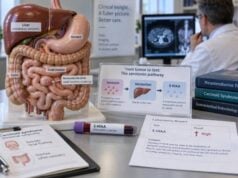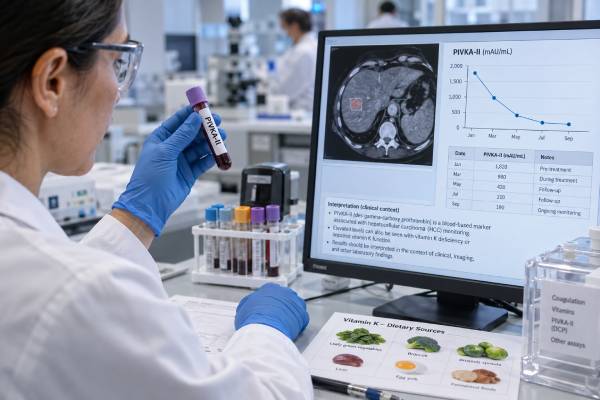
A PIVKA-II test measures an abnormal form of prothrombin that can rise in hepatocellular carcinoma (HCC), the most common primary liver cancer. PIVKA-II is also called des-gamma-carboxy prothrombin (DCP) or protein induced by vitamin K absence or antagonist II. The marker is useful because some HCCs produce PIVKA-II even when alpha-fetoprotein (AFP) is not elevated. However, a high PIVKA-II result does not prove liver cancer. Vitamin K deficiency, warfarin and other vitamin K antagonists, obstructive jaundice, cholestasis, and some antibiotic-related effects can increase the result. A normal value also does not rule out HCC. The test is therefore interpreted with liver disease history, medications, vitamin K status, AFP or AFP-L3 when appropriate, and imaging. In a patient whose HCC produced PIVKA-II before treatment, falling or rising levels may also help with response and recurrence monitoring.
- What it measures: PIVKA-II/DCP, an under-carboxylated form of prothrombin associated with HCC and impaired vitamin K-dependent carboxylation.
- High result: Can occur with HCC, but also with vitamin K deficiency, warfarin, obstructive jaundice, cholestasis, and some antibiotic exposure.
- Reference value: One major U.S. laboratory uses <7.5 ng/mL; cutoffs and units vary by assay.
- Normal result: Does not exclude HCC because a substantial minority of HCCs do not produce elevated PIVKA-II.
- Monitoring: Most useful after treatment when PIVKA-II was clearly elevated before therapy and can be followed as a patient-specific tumor marker.
Table of Contents
- What the PIVKA-II Test Measures
- Why PIVKA-II Rises in HCC
- What High PIVKA-II Levels Mean
- Reference Range, Cutoffs, and Units
- PIVKA-II for HCC Detection and Risk Assessment
- Monitoring HCC Treatment and Recurrence
- What Happens After the Result
What the PIVKA-II Test Measures
PIVKA-II is an abnormal form of prothrombin, a protein made by the liver that normally participates in blood clotting. The same analyte is commonly called des-gamma-carboxy prothrombin (DCP). These names describe the biology from different angles: “PIVKA-II” emphasizes that the protein can appear when vitamin K is absent or blocked, while “DCP” describes incomplete gamma-carboxylation of prothrombin.
Normal prothrombin production requires vitamin K-dependent modification of specific glutamic acid residues. This process creates gamma-carboxyglutamic acid residues that allow prothrombin to function correctly in coagulation. When carboxylation is incomplete, an abnormal prothrombin molecule is released and can be detected as PIVKA-II/DCP.
Many HCC cells have abnormal vitamin K handling or reduced activity of the vitamin K-dependent carboxylation pathway. They can therefore release PIVKA-II even when the person’s overall vitamin K intake is adequate. This tumor-associated production is why PIVKA-II became a serum marker for HCC.
The test is usually performed on serum. It does not measure the same thing as prothrombin time or INR, although vitamin K antagonists can affect both coagulation and PIVKA-II. It is also distinct from an alpha-fetoprotein blood test, which measures a fetal-associated protein that can rise in HCC, germ cell tumors, pregnancy, and some nonmalignant liver conditions.
PIVKA-II has several possible clinical roles:
- Adding information to HCC risk assessment in people with chronic liver disease
- Complementing AFP in selected HCC detection strategies
- Providing prognostic information in known HCC
- Following treatment response when the marker was elevated before therapy
- Supporting recurrence surveillance after treatment in patients with a marker-producing tumor
It should not be viewed as a universal “liver cancer blood test.” HCC can be present with normal PIVKA-II, and high results can occur without cancer.
Why PIVKA-II Rises in HCC
Hepatocellular carcinoma develops from hepatocytes, the liver cells responsible for many metabolic and synthetic functions. Cancer-related changes in these cells can disrupt normal prothrombin processing. The result is secretion of incompletely carboxylated prothrombin into the bloodstream.
PIVKA-II therefore reflects a biologic feature that is partly independent of AFP. This is clinically useful because the two markers do not always rise in the same patient. An HCC may be AFP-negative but PIVKA-II-positive, or the reverse. Combining markers can increase sensitivity in some studied populations.
Higher PIVKA-II has also been associated in many studies with features such as larger tumor size, vascular invasion, intrahepatic spread, and more aggressive tumor biology. These associations are statistical, not absolute. A high number does not by itself establish stage, prove vascular invasion, or determine whether the cancer is resectable.
The marker is not simply a measure of liver damage. Acute hepatitis, cirrhosis, and chronic liver disease can alter many blood tests, but PIVKA-II has a more specific relationship to abnormal prothrombin carboxylation. Even so, cholestasis and vitamin K problems can create false-positive elevations and must be considered.
PIVKA-II is the same marker as DCP
Reports and research papers may use PIVKA-II and DCP as if they are different tests. In most clinical contexts, they refer to the same abnormal prothrombin analyte. The related des-gamma-carboxy prothrombin test therefore addresses the same basic marker under a different name.
However, assays can differ in calibration, antibodies, reporting units, and cutoffs. A result from one method should not automatically be converted or compared numerically with a result from a different method without laboratory guidance.
What High PIVKA-II Levels Mean
A high PIVKA-II result means that the assay detected more abnormal, under-carboxylated prothrombin than expected. HCC is an important cause, especially in a person with cirrhosis or chronic hepatitis, but the result has a meaningful noncancer differential diagnosis.
Common or clinically important causes include:
- Hepatocellular carcinoma. HCC cells can produce PIVKA-II through abnormal vitamin K-dependent prothrombin processing.
- Vitamin K deficiency. Inadequate vitamin K availability prevents normal carboxylation of prothrombin.
- Vitamin K antagonists. Warfarin deliberately interferes with vitamin K recycling and can raise PIVKA-II substantially.
- Obstructive jaundice or cholestasis. Reduced delivery of bile to the intestine can impair absorption of fat-soluble vitamin K.
- Broad-spectrum antibiotic exposure. Antibiotics can alter intestinal bacteria that contribute to vitamin K availability and, in susceptible patients, may contribute to deficiency.
- Other severe hepatobiliary illness. The clinical context can affect vitamin K handling and prothrombin processing.
- Rare non-HCC tumors. Some other tumors have been reported to produce DCP/PIVKA-II, so the marker is not absolutely HCC-specific.
A result should therefore be interpreted with a medication list and bilirubin/cholestasis pattern. Someone taking warfarin for atrial fibrillation may have a high PIVKA-II for a completely different reason from a person with cirrhosis and a new liver lesion.
Vitamin K deficiency versus tumor production
The distinction is not always obvious from one number. Clues supporting a vitamin K problem include warfarin use, prolonged poor nutrition, fat malabsorption, biliary obstruction, cholestasis, or recent broad-spectrum antibiotics. Coagulation tests may also be abnormal, although liver disease itself can affect them.
Clinicians should not advise a patient to stop warfarin or take high-dose vitamin K simply to “fix” a tumor marker without medical guidance. Reversing anticoagulation can create serious clotting risk, and vitamin K supplementation can alter anticoagulant treatment.
If a high PIVKA-II is thought to reflect reversible vitamin K deficiency, the clinician may address the cause and repeat the test when appropriate. If the value remains elevated in a high-risk patient, liver imaging and the full HCC evaluation remain important.
Reference Range, Cutoffs, and Units
PIVKA-II reference values are method-specific. Mayo Clinic Laboratories currently reports serum DCP/PIVKA-II with a reference value of less than 7.5 ng/mL. A result at or above that laboratory’s cutoff is considered elevated.
Other laboratories and regions may report PIVKA-II in mAU/mL or use a different numerical decision threshold. A value such as 40 mAU/mL from one assay cannot be compared directly with 7.5 ng/mL from another by assuming the numbers represent the same scale.
| Result issue | How to interpret it |
|---|---|
| Below laboratory cutoff | Reduces concern but does not rule out HCC |
| Above laboratory cutoff | Requires clinical interpretation; HCC and vitamin K-related causes are both possible |
| Rising serial values | May be concerning if collection method and clinical conditions are stable, especially in known HCC |
| Falling after HCC therapy | Can support treatment response when the marker was elevated before treatment |
The trend may matter more than one isolated value during cancer follow-up. A stable patient monitored by the same laboratory provides a cleaner comparison than measurements performed by different assays with different units.
At the same time, trends can be misleading if the patient’s vitamin K status changes. Starting warfarin, developing biliary obstruction, receiving antibiotics, or correcting vitamin K deficiency can alter PIVKA-II independently of tumor burden.
PIVKA-II for HCC Detection and Risk Assessment
PIVKA-II can improve HCC detection when used in the right population, but it does not replace established surveillance or diagnostic imaging.
People at meaningful HCC risk commonly include many patients with cirrhosis and selected people with chronic hepatitis B, depending on age, region, family history, and other risk factors. Surveillance recommendations vary somewhat by professional society and region. In U.S. AASLD guidance, surveillance centers on liver ultrasound plus AFP at approximately 6-month intervals for appropriate at-risk populations. PIVKA-II is not used as a stand-alone substitute for that strategy.
When surveillance identifies a suspicious liver lesion, multiphasic contrast-enhanced CT or MRI may establish an HCC diagnosis noninvasively in many at-risk patients based on the enhancement pattern. Biomarkers can support risk assessment but do not replace the imaging criteria.
Research supports PIVKA-II as a useful complementary marker. A 2023 systematic review and meta-analysis comparing PIVKA-II with AFP found pooled sensitivity around 71% and specificity around 90% for PIVKA-II across included studies, with performance varying by cutoff, population, disease stage, and HCC cause. Another meta-analysis found that PIVKA-II and AFP together can add diagnostic information compared with either marker alone.
These pooled numbers should not be treated as the personal probability that an individual patient has cancer. Positive predictive value depends heavily on the pretest risk. The same elevated result has very different meaning in a patient with cirrhosis and a suspicious lesion compared with a healthy person tested without a clinical indication.
Why a normal PIVKA-II cannot rule out HCC
A substantial minority of patients with HCC have PIVKA-II within the reference range. Mayo’s laboratory guidance notes that roughly 25% to 50% of HCC cases may have a normal DCP result. Tumor size, biology, stage, and assay threshold all contribute to this variability.
Therefore, a normal result should never be used to cancel appropriate liver imaging or surveillance. If ultrasound, CT, or MRI is suspicious, the imaging finding needs evaluation regardless of PIVKA-II.
Combining PIVKA-II, AFP, and AFP-L3
PIVKA-II can complement AFP because the markers reflect different tumor biology. AFP-L3 measures a particular glycoform fraction of AFP associated with HCC risk and aggressive features. An AFP-L3 test may be used with total AFP and DCP in multianalyte strategies.
The GALAD model combines gender, age, AFP, AFP-L3, and DCP/PIVKA-II into a calculated score. Research has shown promising detection performance, but the exact role of GALAD and related panels varies by country, laboratory, and guideline. A liver cancer biomarker panel should be understood as a risk-assessment aid, not a replacement for imaging or specialist evaluation.
Monitoring HCC Treatment and Recurrence
PIVKA-II can be particularly useful when a patient’s HCC clearly secreted the marker before treatment. In that situation, the patient’s own baseline establishes whether PIVKA-II is a meaningful tumor-associated signal.
After potentially curative treatment such as resection, ablation, or liver transplantation, a substantial fall toward the reference range can support a favorable biochemical response. Persistently elevated values may raise concern for residual disease, although noncancer causes still need review.
During systemic or locoregional therapy, serial PIVKA-II may provide additional information alongside imaging. A falling marker can be reassuring, while a persistent or rising marker can prompt a closer review of imaging, treatment timing, liver function, and possible vitamin K-related confounders.
For recurrence monitoring, a rising PIVKA-II after prior normalization can be an early warning signal in a patient whose original tumor was PIVKA-II-positive. It is not enough to diagnose recurrence by itself. Confirmatory imaging is generally needed.
Why baseline marker status matters
If PIVKA-II was normal at initial diagnosis despite proven HCC, it is unlikely to become a highly reliable personal monitoring marker later. The same principle applies to AFP. Clinicians often follow whichever biomarkers were informative for that individual tumor rather than assuming every HCC will secrete every marker.
PIVKA-II has also been studied as a prognostic marker in surgical and transplant settings. Higher levels have been associated with vascular invasion and recurrence risk in many cohorts, and some transplant selection models outside the United States incorporate DCP. These applications use specific validated models and should not be reduced to a universal “danger level.”
The most important monitoring data remain the combination of clinical status, liver function, appropriate imaging, and tumor markers that were informative for the individual patient.
What Happens After the Result
A high PIVKA-II result should trigger contextual review, not an automatic cancer diagnosis.
The clinician may ask:
- Does the patient have cirrhosis, chronic hepatitis B, chronic hepatitis C, or another major HCC risk factor?
- Is the patient taking warfarin or another vitamin K antagonist?
- Is there obstructive jaundice, cholestasis, fat malabsorption, poor nutrition, or recent broad-spectrum antibiotic exposure?
- What are the AFP and, if available, AFP-L3 results?
- Has PIVKA-II been high before, and is the current value rising?
- Is there recent liver imaging, and was any lesion seen?
For a high-risk patient with an abnormal surveillance test or elevated biomarker, the next step often includes diagnostic liver imaging with multiphasic CT or contrast-enhanced MRI. A suspicious lesion may then be characterized according to established HCC imaging criteria. Biopsy is used selectively when imaging is not diagnostic or when the clinical situation requires tissue confirmation.
For a person with known HCC, the treating team compares PIVKA-II with the pretreatment level and with imaging response. A marker rise after treatment may lead to repeat imaging or closer follow-up, but treatment is not generally changed on the blood test alone.
If a likely vitamin K-related cause is present, the clinician may address it when medically appropriate and reassess. Patients taking prescribed anticoagulation should not stop warfarin or alter vitamin K intake on their own based on a PIVKA-II result.
A normal PIVKA-II requires just as much context. It can be reassuring if imaging and other tests are also negative, but it does not remove the need for scheduled HCC surveillance in someone who remains at risk.
Seek prompt medical care for symptoms such as vomiting blood, black stools, severe confusion, fainting, rapidly increasing abdominal swelling, high fever with jaundice, or severe worsening abdominal pain. These symptoms can reflect complications of advanced liver disease, bleeding, infection, or biliary obstruction and are more urgent than the tumor-marker number itself.
References
- DCP – Overview: Des-Gamma-Carboxy Prothrombin, Serum 2026 (Laboratory Reference)
- AASLD Practice Guidance on prevention, diagnosis, and treatment of hepatocellular carcinoma 2023 (Practice Guidance)
- Hepatocellular carcinoma: ESMO Clinical Practice Guideline for diagnosis, treatment and follow-up 2025 (Clinical Practice Guideline)
- Protein induced by vitamin K absence or antagonist II: Experience to date and future directions 2023 (Review)
- Research progress of protein induced by vitamin K absence or antagonist II in liver transplantation for hepatocellular carcinoma 2024 (Review)
- Protein Induced by Vitamin K Absence or Antagonist-II Versus Alpha-Fetoprotein in the Diagnosis of Hepatocellular Carcinoma: A Systematic Review With Meta-Analysis 2023 (Systematic Review and Meta-analysis)
Disclaimer
This article provides general information about PIVKA-II/DCP testing and does not diagnose hepatocellular carcinoma or determine treatment. Results must be interpreted with the assay-specific reference range, medication use, vitamin K status, liver disease, AFP-related markers, and imaging. Do not stop warfarin, change anticoagulation, or take high-dose vitamin K because of a PIVKA-II result without guidance from the prescribing clinician.