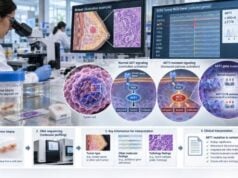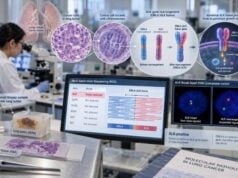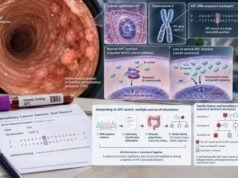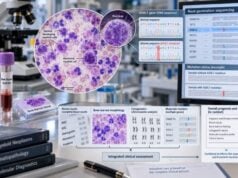
A PMS2 mutation test looks for inherited or acquired changes in the PMS2 gene, one of the genes responsible for DNA mismatch repair. A harmful germline PMS2 variant can cause PMS2-associated Lynch syndrome, an inherited condition that raises the risk of colorectal and endometrial cancer. PMS2 testing may also be ordered after a tumor shows loss of mismatch repair proteins on immunohistochemistry or microsatellite instability. The result is not interpreted in isolation: the exact variant classification, whether testing was performed on blood/saliva or tumor tissue, the tumor’s MLH1/PMS2 staining pattern, family history, and the laboratory’s ability to distinguish PMS2 from its highly similar pseudogene all matter. Compared with Lynch syndrome caused by MLH1 or MSH2, PMS2-associated cancer risks are generally lower, so surveillance is increasingly gene specific. A positive result can still change colonoscopy timing, family testing, and sometimes treatment decisions.
- A pathogenic or likely pathogenic germline PMS2 variant supports a diagnosis of PMS2-associated Lynch syndrome.
- A variant of uncertain significance (VUS) does not confirm Lynch syndrome and should not guide irreversible medical decisions by itself.
- Tumor loss of PMS2 alone raises suspicion for a PMS2 abnormality, while combined MLH1/PMS2 loss often points first to an MLH1-related cause.
- PMS2 testing is technically difficult because the PMS2CL pseudogene closely resembles part of PMS2; validated methods are important.
- Cancer surveillance for PMS2 carriers is usually tailored to the lower, gene-specific risk rather than copied automatically from MLH1/MSH2 recommendations.
Table of Contents
- What PMS2 Testing Measures
- When the Test Is Used
- How PMS2 Testing Is Performed
- How to Interpret PMS2 Results
- PMS2, Lynch Syndrome, and Cancer Risk
- What Happens After a Positive Result
- Limitations and Common Misunderstandings
What PMS2 Testing Measures
PMS2 encodes a protein that works with MLH1 in the DNA mismatch repair system. This system corrects small copying errors that occur when cells replicate DNA. If both working copies of PMS2 are lost in a tumor cell, mismatch repair can fail. DNA errors then accumulate, often producing microsatellite instability and a high number of small insertion/deletion mutations.
A PMS2 mutation test may look for single-nucleotide variants, small insertions or deletions, and larger exon-level deletions or duplications. The exact detection range depends on the laboratory method. Germline testing usually analyzes DNA from blood, saliva, or another non-tumor sample to determine whether a variant is inherited and present throughout the body. Tumor testing analyzes cancer tissue and may detect changes that arose only in the tumor.
This distinction is essential. A PMS2 variant found on a tumor panel is not automatically inherited. Conversely, a negative tumor-only panel cannot always rule out a germline PMS2 variant, especially if the assay has limited coverage of technically difficult regions. When hereditary risk is the clinical question, a dedicated mismatch repair gene test or hereditary cancer panel is usually more appropriate than relying solely on tumor sequencing.
PMS2 is especially challenging because several pseudogenes share similar DNA sequence. PMS2CL is the most important source of interference, particularly in the final exons. Good laboratories use strategies such as long-range PCR, specialized bioinformatics, reflex testing, or other confirmatory methods to make sure a detected variant belongs to PMS2 rather than the pseudogene.
When the Test Is Used
PMS2 testing is commonly ordered in two broad situations: evaluation for hereditary Lynch syndrome and clarification of an abnormal tumor mismatch repair result.
Hereditary testing may be considered when a person has colorectal, endometrial, or another Lynch-associated cancer at an unusually young age; multiple Lynch-associated cancers; a family history suggesting autosomal dominant inheritance; or a relative with a known PMS2 pathogenic variant. Many centers also use universal tumor screening for newly diagnosed colorectal and endometrial cancers, which can identify people who would not otherwise meet family-history criteria.
Tumor screening often begins with mismatch repair immunohistochemistry (IHC), which evaluates MLH1, PMS2, MSH2, and MSH6 protein expression, or with a microsatellite instability test. A mismatch repair-deficient tumor may be caused by Lynch syndrome, but it may also result from changes limited to the tumor.
The IHC pattern helps guide the next step. PMS2 normally pairs with MLH1. If MLH1 is lost, PMS2 protein often becomes unstable and disappears too. Therefore, loss of both MLH1 and PMS2 usually prompts evaluation for an MLH1-related cause, including sporadic MLH1 promoter methylation in appropriate tumors, before PMS2 germline testing is assumed to be the answer. In contrast, isolated loss of PMS2 with retained MLH1 is more suggestive of PMS2 dysfunction, although uncommon MLH1 variants can sometimes produce that pattern.
Testing is also relevant to relatives. Once a clearly pathogenic germline PMS2 variant has been identified in one family member, relatives can usually have targeted testing for that exact familial variant rather than repeating a broad panel.
How PMS2 Testing Is Performed
For germline testing, blood is often preferred, but saliva or buccal samples may also be accepted. No fasting is required. The laboratory extracts DNA and sequences the PMS2 coding regions and splice boundaries, usually with deletion/duplication analysis. Because of pseudogene interference, some laboratories perform a two-stage process in which ambiguous findings are resolved with a PMS2-specific method.
Tumor testing may use DNA-based next-generation sequencing, RNA-based methods in selected settings, or paired tumor-normal sequencing. A solid tumor NGS panel can report PMS2 alongside many other genes, but the report should be checked for assay limitations. Tumor purity, coverage depth, copy-number sensitivity, and whether the platform can confidently analyze pseudogene-homologous regions all affect interpretation.
A complete Lynch evaluation often combines several layers of information rather than one test:
- Tumor IHC for MLH1, PMS2, MSH2, and MSH6.
- MSI testing when appropriate.
- MLH1 promoter methylation or BRAF testing in selected colorectal tumors with MLH1/PMS2 loss.
- Germline sequencing and deletion/duplication analysis.
- Tumor sequencing when germline testing is negative but suspicion remains high, to look for two somatic mismatch repair hits.
This layered approach helps separate inherited Lynch syndrome from sporadic mismatch repair deficiency. It also reduces the risk of overcalling an inherited disorder based on a tumor finding alone.
How to Interpret PMS2 Results
The most important line on a germline report is the laboratory’s variant classification. Clinical laboratories generally use five categories: pathogenic, likely pathogenic, variant of uncertain significance, likely benign, and benign.
Pathogenic or likely pathogenic
A pathogenic or likely pathogenic germline PMS2 variant is considered clinically actionable and supports PMS2-associated Lynch syndrome. “Likely pathogenic” does not mean the result is weak or preliminary; in clinical genetics it generally carries enough evidence to guide management similarly to a pathogenic result.
The report may describe a nonsense variant, frameshift, splice-disrupting variant, exon deletion, or another change known to impair PMS2 function. The exact DNA and protein notation should be preserved when relatives are tested.
Variant of uncertain significance
A VUS means the laboratory does not yet have enough evidence to decide whether the variant causes disease. A VUS should not be treated as a positive Lynch syndrome result. Colon surgery, risk-reducing gynecologic surgery, or predictive testing of unaffected relatives should not be based on a VUS alone.
Management should instead follow the person’s cancer history, family history, and other validated findings. Laboratories periodically reclassify variants as new evidence appears, so patients should keep contact information current with the ordering clinic or genetics service.
Negative result
A negative result has different meanings depending on why testing was ordered. If a known familial PMS2 variant was specifically tested and not found, the person generally did not inherit that familial variant. If no familial variant is known, a negative result does not erase a strong personal or family history. Another gene, an undetected variant type, mosaicism, or a non-hereditary explanation may still be relevant.
For a mismatch repair-deficient tumor with negative germline testing, paired tumor analysis may identify two acquired PMS2 or other mismatch repair abnormalities. This “double somatic” pattern can explain many Lynch-like tumors without indicating an inherited syndrome.
PMS2, Lynch Syndrome, and Cancer Risk
PMS2-associated Lynch syndrome is real but generally less penetrant than Lynch syndrome caused by MLH1 or MSH2. Large family studies have estimated cumulative colorectal cancer risk by age 80 at about 13% in men and 12% in women with heterozygous pathogenic PMS2 variants, with endometrial cancer risk around 13%. These figures are estimates, not personal predictions, and newer cohorts continue to refine the risk.
The evidence for markedly increased risk of many other classic Lynch-associated cancers is weaker for PMS2 than for MLH1 or MSH2. That is why gene-specific counseling matters. A person should not automatically assume that every cancer risk quoted for “Lynch syndrome” applies equally to PMS2.
Colonoscopy remains the main proven surveillance tool. The exact starting age and interval vary among professional guidelines and are increasingly individualized by gene, family history, prior polyps, and prior cancer. Some guidance begins PMS2 surveillance later than for MLH1/MSH2, often around age 30–35, while emerging data in younger carriers are prompting continued debate. A family with colorectal cancer in the 20s or early 30s may warrant an earlier plan than a family with later-onset disease.
For people with a uterus, counseling about endometrial cancer symptoms is important. Abnormal uterine bleeding, bleeding after menopause, or unexplained persistent pelvic symptoms should be evaluated promptly. Routine endometrial screening has not been proven to reduce mortality as clearly as colonoscopy does for colorectal cancer, so surveillance and risk-reducing surgery decisions are individualized.
Biallelic PMS2 pathogenic variants are a different condition called constitutional mismatch repair deficiency. It usually presents in childhood and can cause hematologic malignancies, brain tumors, gastrointestinal cancers, café-au-lait-like skin findings, and other problems. A standard adult Lynch result involving one PMS2 copy should not be confused with this rare recessive condition.
What Happens After a Positive Result
A positive germline result should usually trigger genetic counseling and a written surveillance plan rather than a one-size-fits-all checklist. The clinician reviews the exact variant, personal cancer history, prior colonoscopy findings, age, family history, reproductive considerations, and whether any relatives developed cancer unusually young.
Because PMS2-associated Lynch syndrome is autosomal dominant, each biological child of a heterozygous carrier has a 50% chance of inheriting the familial variant. Parents, siblings, and adult children may therefore be offered targeted testing. Testing healthy children for a typical heterozygous PMS2 Lynch variant is usually deferred until results would affect medical management, although families with concern for biallelic PMS2 disease need specialized genetics advice.
If a person already has cancer, mismatch repair status can also affect therapy. Mismatch repair-deficient or MSI-high tumors may be candidates for immune checkpoint inhibitors in several advanced-cancer settings. The treatment decision depends on tumor type, stage, prior therapy, regulatory approvals, and the tumor biomarker result; a germline PMS2 result alone is not a prescription for immunotherapy.
A practical follow-up checklist is:
- Confirm that the report says pathogenic or likely pathogenic, not VUS.
- Verify that the laboratory used a validated PMS2-specific approach where pseudogene interference matters.
- Meet with genetics or a clinician experienced in Lynch syndrome.
- Establish a gene- and family-specific colonoscopy schedule.
- Discuss endometrial risk and symptom awareness when relevant.
- Offer targeted testing to appropriate adult relatives.
- Keep a copy of the exact variant notation and laboratory report for future care.
Limitations and Common Misunderstandings
The biggest technical limitation is pseudogene interference. A report should not merely say “PMS2 sequenced” without explaining whether difficult homologous regions and copy-number changes are adequately covered. If a result conflicts sharply with the tumor IHC pattern or family history, confirmatory testing at a laboratory experienced with PMS2 may be reasonable.
Another common mistake is treating IHC as germline testing. Loss of PMS2 protein shows that the tumor has abnormal mismatch repair biology; it does not by itself prove that the person was born with a PMS2 variant. Similarly, normal IHC lowers suspicion but does not absolutely exclude every germline mismatch repair variant.
A third mistake is overinterpreting variant allele fraction on tumor sequencing. A PMS2 variant present near 50% of sequencing reads may be germline, but tumor purity, copy-number changes, loss of heterozygosity, and clonal structure can produce similar values. Confirmation requires a non-tumor specimen when hereditary status matters.
Finally, risk numbers should be viewed as population estimates. Surveillance decisions may change as evidence evolves. The most useful PMS2 result is therefore one interpreted in context: the exact variant, assay quality, tumor findings, personal history, and family history together determine what the result means in practice.
References
- PMS2-associated Lynch syndrome: Past, present and future 2023 (Review)
- Neoplasia Detection Through Colonic Surveillance Among Young Individuals With MSH6 / PMS2 -Associated Lynch Syndrome 2025
- Diagnosis and management of Lynch syndrome 2022 (Review)
- Review article: Lynch Syndrome-a mechanistic and clinical management update 2022 (Review)
- Cancer Risks for PMS2-Associated Lynch Syndrome 2018
Disclaimer
PMS2 results can affect hereditary cancer surveillance and family testing, so they should be interpreted by a qualified clinician or genetics professional who can review the exact laboratory report and family history. This article is educational and does not replace individualized medical advice, genetic counseling, or cancer screening recommendations.