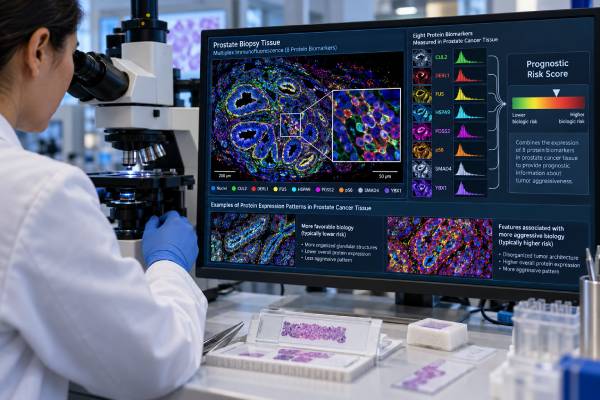
The ProMark test is a protein-based prognostic assay performed on prostate biopsy tissue after cancer has been diagnosed. It measures eight proteins linked to cell signaling, stress response, and tumor growth, then generates a score estimating the likelihood that apparently favorable localized prostate cancer has more aggressive pathology. The test was developed mainly for men with biopsy Gleason 3+3 or 3+4 disease who are deciding whether active surveillance is reasonable or definitive treatment should be considered. Current ProMark materials report a score from 1 to 100, with lower scores associated with less aggressive disease and higher scores with a greater likelihood of adverse pathology. Foundational validation studies originally described the same risk concept on a 0-to-1 scale. ProMark does not diagnose prostate cancer, measure PSA, sequence tumor DNA, or identify inherited cancer risk. Its result should be combined with Grade Group, PSA, stage, MRI, biopsy volume, life expectancy, and patient preferences rather than used as a stand-alone reason to treat or defer treatment.
- What it measures: ProMark quantifies eight tumor proteins—CUL2, DERL1, FUS, HSPA9, PDSS2, pS6, SMAD4, and YBX1—in prostate biopsy tissue.
- Score meaning: Current reports use a 1–100 score; lower values indicate a more favorable protein pattern and higher values indicate greater risk of aggressive disease.
- Main use: The test is intended to refine prognosis in localized, lower-risk prostate cancer when choosing between active surveillance and definitive treatment.
- What “aggressive” means: The assay was validated against adverse pathology such as Gleason 4+3 or higher and/or non-organ-confined disease at prostatectomy.
- Important limitation: ProMark adds risk information but cannot prove whether an unsampled higher-grade tumor focus is present elsewhere in the prostate.
Table of Contents
- What ProMark measures and how it differs from genomic tests
- Who may benefit from ProMark testing
- How the test is performed
- How to interpret the ProMark score
- What the score can mean for prognosis and treatment
- Evidence, limitations, and competing tests
- What to do after receiving a ProMark result
What ProMark measures and how it differs from genomic tests
ProMark measures protein expression directly in prostate cancer cells rather than measuring RNA gene expression. That makes it different from tissue assays such as Oncotype DX GPS, Prolaris, and Decipher even though all of these tests are used to refine prostate cancer prognosis.
The assay evaluates eight proteins:
- CUL2
- DERL1
- FUS
- HSPA9
- PDSS2
- pS6, or phosphorylated S6
- SMAD4
- YBX1
These proteins participate in pathways involving proliferation, stress response, protein handling, cell signaling, and tumor behavior. ProMark uses automated quantitative multiplex immunofluorescence imaging to measure the proteins within preserved biopsy tissue.
The original development strategy was designed around a major prostate cancer problem: tumor heterogeneity. A prostate can contain several cancer foci, and the biology within one tumor can vary from one area to another. A needle biopsy samples only a tiny fraction of the gland. Researchers therefore looked for protein markers whose association with aggressive disease remained useful even when measured in tissue that did not appear to be the highest-grade area.
ProMark’s output is an individualized risk score. Current manufacturer materials describe a 1–100 scale and pair the score with a predicted percentage risk of aggressive disease. Lower scores support a more favorable prognosis; higher scores indicate increasing concern for aggressive pathology.
This is not the same as the PSA blood test. PSA is useful for detection and follow-up but is not cancer-specific. ProMark is performed only after biopsy has already established prostate cancer and evaluates proteins inside the tumor tissue itself.
It is also not hereditary genetic testing. A ProMark score cannot tell whether someone carries a germline BRCA2, HOXB13, or other inherited cancer-risk variant.
Who may benefit from ProMark testing
ProMark is mainly aimed at men with early, localized prostate cancer whose biopsy looks relatively favorable but whose treatment choice remains uncertain. Its classic target population includes Gleason 3+3 and 3+4 disease, corresponding broadly to Grade Group 1 and selected Grade Group 2 cancers.
A common decision is whether to choose active surveillance or proceed with surgery or radiation. Active surveillance can avoid or delay urinary, sexual, and bowel side effects from treatment in cancers unlikely to cause harm. The challenge is identifying the minority of apparently low-risk tumors that are more aggressive than the biopsy suggests.
ProMark may be considered when:
- A biopsy shows Grade Group 1 or favorable Grade Group 2 localized cancer.
- The patient is a reasonable candidate for active surveillance.
- PSA, MRI, tumor volume, or family history creates some uncertainty despite favorable pathology.
- The patient wants additional tumor-specific prognostic information before choosing surveillance or treatment.
- The result would realistically change the management plan.
Current ProMark materials describe use in very-low-, low-, and selected intermediate-risk disease. Coverage rules may be narrower than the laboratory’s general indication and can depend on age, life expectancy, prior treatment, biopsy findings, and whether the person is genuinely deciding between conservative and definitive management.
The test is not designed for people who have not yet had a positive biopsy. A prebiopsy test asks whether cancer is likely enough to justify tissue sampling; ProMark asks whether a known cancer has a protein profile associated with adverse pathology.
It also has limited value when the clinical picture already shows clearly aggressive disease. A patient with obvious high-grade cancer, nodal involvement, or distant metastases needs staging and treatment planning rather than a test created to resolve uncertainty in lower-risk localized disease.
Before ordering ProMark, the best question is: What decision will change if the result is low or high? If the answer is “none,” testing may not add meaningful value.
How the test is performed
ProMark is usually performed on tissue already collected during the diagnostic prostate needle biopsy, so no new blood draw, urine collection, or biopsy is needed when suitable tissue is available. The laboratory analyzes protein expression in formalin-fixed, paraffin-embedded tissue.
The general process is:
- A pathologist confirms prostate adenocarcinoma in the biopsy.
- A suitable cancer-containing tissue section is selected.
- The laboratory stains the tissue for the eight ProMark proteins.
- Automated imaging identifies tumor cells and quantifies protein signals.
- The proprietary algorithm combines the measurements into a ProMark score.
- The report places the molecular result into a risk context for the treating clinician and patient.
Unlike RNA-based assays, ProMark uses immunofluorescence, a method in which antibodies bind specific proteins and fluorescent signals allow their abundance to be measured. The automated system is intended to reduce subjectivity and provide reproducible quantitative measurements.
There is no special patient preparation because the analysis happens on stored tissue. Practical issues include whether the biopsy block contains enough tumor, whether the laboratory can obtain the specimen, turnaround time, insurance coverage, and out-of-pocket cost.
The assay does not eliminate the problem of biopsy sampling. A biomarker panel can be designed to be robust to heterogeneity, but it still analyzes the tissue that was actually collected. MRI and biopsy technique therefore remain important.
If a multiparametric MRI shows a highly suspicious lesion that was not sampled, obtaining adequate tissue may be more important than relying on a favorable protein score from another region. Similarly, expert pathology review can matter when the distinction between Grade Group 1 and 2 is uncertain.
ProMark should be thought of as additional information from the biopsy, not as a substitute for the biopsy’s histologic diagnosis.
How to interpret the ProMark score
A lower ProMark score supports a lower likelihood of adverse pathology, while a higher score supports a higher likelihood that the cancer is more aggressive than favorable biopsy features alone suggest. The score is a risk estimate, not a pass/fail cancer test.
Current ProMark patient-management materials use a score range of 1 to 100 and provide a corresponding predicted percentage risk of aggressive disease. The laboratory may also display the patient’s risk in the context of standard clinical risk categories.
The foundational 2015 validation study used a mathematically scaled result from 0 to 1. In that study:
- A score of 0.33 or lower was defined as a favorable biomarker risk range.
- A score above 0.80 was defined as a nonfavorable range.
- The intermediate region contained more uncertainty and was not a simple binary category.
Because current reports use a 1–100 presentation, patients should follow the interpretation on the actual report rather than trying to convert historical thresholds on their own.
The assay’s adverse-pathology endpoint is also important. “Aggressive” did not simply mean any cancer recurrence. The test was developed to estimate the chance that prostatectomy would reveal Gleason 4+3 or higher and/or disease extending beyond the organ-confined category.
A simplified reading is:
| Score pattern | General meaning | What it cannot prove |
|---|---|---|
| Lower score | Protein pattern is associated with more favorable pathology | That higher-grade cancer is absent elsewhere or progression cannot occur |
| Middle-range score | Risk lies between the clearly lower and higher ends of the spectrum | That one management option is automatically best |
| Higher score | Greater likelihood of aggressive or non-organ-confined pathology | That metastasis or recurrence is certain |
The score should always be combined with Grade Group, PSA, number and percentage of positive cores, MRI, clinical stage, prostate size, age, health, and life expectancy. A protein signature can refine these measures but does not erase them.
What the score can mean for prognosis and treatment
ProMark is intended to refine the choice between conservative management and definitive treatment by estimating whether a seemingly favorable cancer has aggressive biology. Its strongest practical role is therefore at the time of an initial management decision.
For a person with Grade Group 1 disease, low PSA, limited tumor volume, reassuring MRI, and a low ProMark score, the combined picture may strengthen confidence in active surveillance. That does not mean the cancer can be ignored. Surveillance still requires repeated PSA follow-up over time, clinical review, MRI when appropriate, and repeat biopsy or other reassessment.
A higher score may shift the discussion toward definitive therapy or toward further evaluation before committing to surveillance. Useful next steps can include expert pathology review, checking whether MRI-targeted cores sampled the most suspicious lesion, or repeating biopsy if the original sampling was limited.
The original validation study showed that the eight-protein assay added information beyond standard risk classification. At the low end of the original scale, predictive values for favorable pathology were high in very-low- and low-risk clinical groups. At the high end, the assay identified a group with a substantial likelihood of nonfavorable pathology.
Later studies and reviews have also linked ProMark results with outcomes such as biochemical recurrence and metastatic risk, but the evidence base is much smaller than for some other prostate cancer classifiers. That should influence how confidently the result is used outside the population for which it was developed.
A prognostic score also does not directly prove that one treatment produces better survival than another. It can show that risk is higher or lower; it does not automatically show that surgery is better than radiation, or that immediate treatment is better than carefully monitored surveillance for a particular individual.
This is why the score works best as part of shared decision-making. The patient’s priorities matter. Some people strongly prefer avoiding treatment side effects when surveillance is medically reasonable; others are more comfortable accepting treatment to reduce uncertainty.
Evidence, limitations, and competing tests
ProMark has biologically plausible and clinically validated prognostic value, but its evidence base is smaller and less contemporary than that of the most widely studied prostate tissue classifiers. Recent reviews therefore support using it as an adjunct rather than treating it as a definitive standard.
The original blinded validation included hundreds of men with matched biopsy and prostatectomy tissue and showed that the eight-protein score independently separated favorable from nonfavorable pathology. Contemporary reviews continue to describe ProMark as a localized-disease prognostic option, especially for Grade Group 1–2 cancers.
A 2026 systematic review of several commercial risk-stratification tests found that genomic and related molecular tests can reclassify risk and influence choices between surveillance and treatment, but also concluded that more long-term clinical and health-economic evidence is needed. ProMark had far fewer clinical-impact studies than some gene-expression classifiers.
Important strengths include:
- Direct protein measurement in intact biopsy tissue.
- An eight-marker panel designed to reduce vulnerability to sampling variation.
- No additional invasive procedure when stored biopsy tissue is sufficient.
- A score and predicted risk designed for an actionable surveillance-versus-treatment decision.
- Foundational validation against prostatectomy pathology.
Important limitations include:
- The assay cannot sample tissue that was never biopsied.
- Evidence is concentrated in lower-risk localized disease.
- Long-term independent outcome studies are relatively limited.
- A favorable score cannot replace active-surveillance monitoring.
- A high score cannot specify which definitive treatment is best.
- Commercial availability, coverage, and reporting can change over time.
ProMark also measures different biology from RNA-based classifiers. The Prolaris test focuses on cell-cycle gene expression, while the Genomic Prostate Score measures a 17-gene expression panel. Decipher uses another expression signature and has a different body of evidence. Their numeric scores should never be compared directly.
No biomarker should be ordered as a “tie-breaker” without understanding the test’s validated population and endpoint. The most appropriate assay depends on the exact decision, disease risk, available tissue, local practice, insurance, and which evidence the treating team considers most relevant.
What to do after receiving a ProMark result
After receiving a ProMark result, ask how the score changes your estimated risk compared with the biopsy and clinical findings alone. The practical value comes from translating the number into a management choice.
Useful questions include:
- What is my exact Grade Group and clinical risk category?
- What does my ProMark score predict in percentage terms?
- Does “aggressive disease” on my report mean adverse prostatectomy pathology, recurrence, metastasis, or another endpoint?
- Are my MRI findings consistent with the tissue that was tested?
- How many biopsy cores were positive and how much cancer was present?
- What is my PSA density, and is the PSA pattern stable?
- If I choose active surveillance, what PSA, MRI, and repeat-biopsy schedule will I follow?
- If the score is high, should the biopsy be reviewed or repeated before treatment?
- Would another tissue classifier answer a different question, or merely duplicate this test?
- What are the likely treatment side effects compared with the absolute cancer risk being estimated?
A lower score can be reassuring only when the rest of the case supports a conservative strategy. A high score deserves attention, but it is not proof that treatment must start immediately. Discordant findings often justify a more careful review of pathology and imaging.
The best decision integrates tumor biology with the patient’s actual clinical risk and values. For many lower-risk cancers, the goal is to avoid unnecessary treatment while maintaining a safe surveillance plan. For cancers with a more aggressive protein signature, the goal is to recognize risk early enough to discuss curative treatment while disease remains localized.
References
- Systematic Review of Genomic-Based Risk Stratification in Localised Prostate Cancer Treatment Optimisation: Clinical Impact and Health Economic Evidence 2026 (Systematic Review)
- Integration of Genomic Tests in Prostate Cancer Care: Implications for Clinical Practice and Patient Outcomes 2024 (Review)
- Contemporary Update on Clinical and Experimental Prostate Cancer Biomarkers: A Multi-Omics-Focused Approach to Detection and Risk Stratification 2024 (Review)
- Prostate Cancer Tissue-Based Biomarkers 2023 (Review)
- Tumour markers in prostate cancer: The post-prostate-specific antigen era 2022 (Review)
- Development and clinical validation of an in situ biopsy-based multimarker assay for risk stratification in prostate cancer. 2015
Disclaimer
ProMark is a prognostic aid for selected patients with localized prostate cancer and cannot determine treatment by itself. Results should be interpreted by a qualified prostate cancer clinician with biopsy pathology, PSA, MRI, stage, life expectancy, overall health, and personal treatment preferences. Current assay availability, report format, and insurance coverage can change.