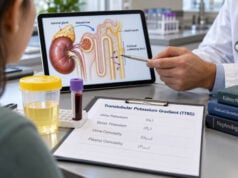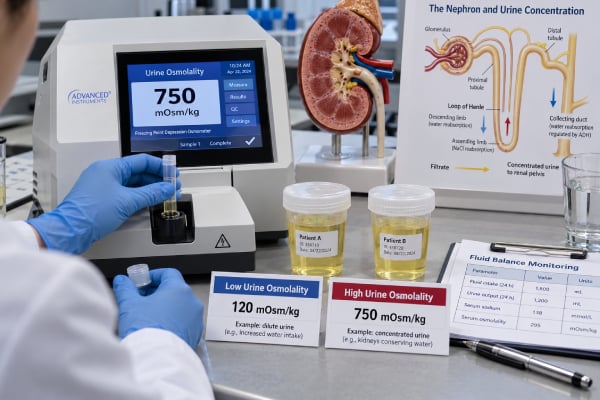
A urine osmolality test measures how concentrated or dilute urine is by counting the number of dissolved particles per kilogram of water. The kidneys can change urine osmolality over a very wide range to keep blood water balance stable, so a high or low result is not automatically abnormal. A low urine osmolality may be exactly what should happen after drinking a large amount of water, while a high result may be appropriate during dehydration. The test becomes most useful when it is interpreted with serum sodium, serum osmolality, urine volume, and the clinical situation. It is central to the evaluation of hyponatremia, hypernatremia, polyuria, suspected arginine vasopressin deficiency or resistance, and impaired kidney concentrating ability. Because glucose, urea, sodium salts, and other particles all contribute to osmolality, the result describes total solute concentration rather than any one electrolyte. Timing, fluid intake, medications, kidney function, and recent IV fluids can all change the value.
- Low urine osmolality means dilute urine; in hyponatremia, a value below about 100 mOsm/kg usually shows strong suppression of arginine vasopressin.
- High urine osmolality means concentrated urine, but whether that is appropriate depends on serum sodium, serum osmolality, and hydration status.
- Polyuria with low urine osmolality suggests a water diuresis; polyuria with higher osmolality points more toward solute or osmotic diuresis.
- Urine osmolality is usually more informative than specific gravity when glucose, protein, or contrast material is present.
- There is no single ideal urine osmolality for everyone because healthy kidneys deliberately vary concentration throughout the day.
Table of Contents
- What Urine Osmolality Measures
- Normal Range and Why It Is So Wide
- What Low Urine Osmolality Means
- What High Urine Osmolality Means
- Hyponatremia, Polyuria, and Water Balance
- Collection, Testing, and Common Pitfalls
- What Happens After an Abnormal Result
- Practical Urine Osmolality Examples
What Urine Osmolality Measures
Urine osmolality is expressed in milliosmoles per kilogram of water, usually written mOsm/kg. It counts dissolved particles rather than measuring their weight. Sodium, potassium, chloride, urea, and other small molecules contribute to the result, and glucose can become an important contributor when present in large amounts.
The kidneys use changes in water reabsorption to adjust urine concentration. Arginine vasopressin, formerly called antidiuretic hormone, is a major regulator. When the body needs to conserve water, vasopressin increases water permeability in the collecting ducts, allowing water to move back into the bloodstream and leaving a smaller volume of more concentrated urine. When the body has excess water, vasopressin falls and the kidneys produce a larger volume of dilute urine.
Urine osmolality therefore provides a direct window into renal water handling. It is not a measure of glomerular filtration and it does not by itself diagnose dehydration, diabetes insipidus, syndrome of inappropriate antidiuresis, or chronic kidney disease.
An urine specific gravity test can also estimate urine concentration, but specific gravity measures density rather than particle number. Large molecules such as glucose, protein, or radiographic contrast can raise specific gravity disproportionately, while osmolality more directly reflects the number of dissolved particles.
Normal Range and Why It Is So Wide
Unlike serum osmolality, which is maintained within a narrow range, urine osmolality is designed to change dramatically. A healthy kidney may produce very dilute urine after excess water intake and highly concentrated urine during water deprivation.
One major laboratory lists a broad reference interval of about 150–1,150 mOsm/kg for people aged 12 months and older. Under ordinary fluid and food intake, values around 500–850 mOsm/kg are common, but a healthy person can be far outside that middle range depending on recent water intake and physiologic need. With strong water loading, urine may fall toward 40–100 mOsm/kg. With dehydration, a healthy adult may concentrate urine well above 800 mOsm/kg, although maximum concentrating ability declines with age.
This wide range means that a result should be judged against the expected response. For example:
- Urine osmolality of 80 mOsm/kg after drinking several liters of water may be appropriate.
- The same 80 mOsm/kg in a person with hypernatremia and dehydration would be very inappropriate and would suggest impaired water conservation.
- Urine osmolality of 700 mOsm/kg during dehydration may be appropriate.
- The same 700 mOsm/kg in severe hypotonic hyponatremia shows that water excretion is being restricted when the blood is already too dilute.
For this reason, serum sodium and serum osmolality should often be obtained close to the urine sample time.
What Low Urine Osmolality Means
Low urine osmolality means the urine contains relatively few dissolved particles per kilogram of water. It usually reflects either high water excretion or limited ability to concentrate urine.
Appropriate dilution
The most common benign reason is simply high water intake. If plasma osmolality is low-normal and the body has excess water, suppressing vasopressin and producing dilute urine is the correct response. A very low result is therefore not automatically evidence of kidney disease.
Primary polydipsia
People who drink water faster than the kidneys need it can produce persistently dilute urine. If intake exceeds excretory capacity, serum sodium can fall. In hypotonic hyponatremia, urine osmolality below about 100 mOsm/kg strongly suggests that vasopressin is appropriately suppressed, making primary polydipsia or very low dietary solute intake more likely than classic syndrome of inappropriate antidiuresis.
Arginine vasopressin deficiency or resistance
Arginine vasopressin deficiency, formerly central diabetes insipidus, occurs when the brain does not release enough vasopressin. Arginine vasopressin resistance, formerly nephrogenic diabetes insipidus, occurs when the kidneys do not respond adequately. Both can cause large volumes of dilute urine, intense thirst, and, when water access is limited, hypernatremia.
The initial clue is usually hypotonic polyuria, not just one low osmolality result. A 24-hour urine volume above about 3 liters in an adult is commonly used as a practical definition of polyuria, though body size and clinical context matter.
A fluid balance urine test panel can help place the osmolality result alongside urine volume, sodium, and creatinine.
Reduced concentrating ability
Chronic kidney disease, tubulointerstitial disease, sickle cell disease, lithium exposure, hypercalcemia, and low potassium can reduce the kidney’s ability to build or respond to the medullary concentration gradient. In these conditions, urine may remain relatively dilute even when water conservation would be expected.
What High Urine Osmolality Means
High urine osmolality means the urine is concentrated, but the cause can be either normal water conservation or increased excretion of solute.
Appropriate water conservation
Dehydration from low intake, fever, sweating, vomiting, or diarrhea should increase vasopressin and produce concentrated urine if kidney function is intact. A high urine osmolality in that setting is often an appropriate response.
Vasopressin activity in hyponatremia
When serum sodium is low, a urine osmolality above 100 mOsm/kg indicates that urine is not maximally dilute. Vasopressin is active or the kidney cannot fully dilute the urine. Causes include reduced effective circulating volume, syndrome of inappropriate antidiuresis, adrenal insufficiency, nausea, pain, certain medications, and advanced kidney disease.
Urine sodium then helps narrow the differential diagnosis. A low urine sodium often supports sodium retention from reduced effective circulating volume, while a higher value can occur in SIAD, adrenal insufficiency, or during diuretic therapy. A urine sodium test is therefore commonly paired with osmolality in hyponatremia.
Osmotic diuresis
Urine can be concentrated even when urine volume is high if a large solute load is pulling water into the urine. Common examples include glucosuria from uncontrolled diabetes, high urea excretion after high protein intake or catabolic illness, sodium excretion after IV fluids, and mannitol therapy.
This is why polyuria should be divided into water diuresis and solute diuresis. Urine osmolality is one of the fastest ways to make that distinction.
Hyponatremia, Polyuria, and Water Balance
Urine osmolality has several high-value clinical uses because it shows whether the kidneys are responding appropriately to a water-balance problem.
Hyponatremia
A common diagnostic sequence is:
- Confirm that serum sodium is low.
- Measure serum osmolality to confirm hypotonic hyponatremia.
- Check urine osmolality.
- If urine osmolality is above about 100 mOsm/kg, use urine sodium and clinical context to determine why vasopressin is active.
This avoids the common mistake of classifying hyponatremia only by physical examination of volume status, which can be inaccurate.
Hypernatremia
In hypernatremia, healthy kidneys should conserve water strongly. Urine should become concentrated unless the person is excreting a large solute load or has impaired vasopressin production, vasopressin resistance, or renal concentrating dysfunction. A low urine osmolality in hypernatremia is therefore a red flag for inappropriate water loss.
Polyuria
For large urine volumes, an osmolality below about 250–300 mOsm/kg suggests water diuresis. Values above 300 mOsm/kg point more toward solute diuresis, while intermediate values can reflect mixed mechanisms.
If hypotonic polyuria persists, clinicians may use supervised water deprivation, desmopressin response testing, or copeptin-based algorithms to distinguish vasopressin deficiency, vasopressin resistance, and primary polydipsia. These tests should not be attempted without medical supervision because water deprivation can be dangerous in true diabetes insipidus.
Kidney concentration defects
Urine osmolality also helps assess whether chronic kidney disease or tubular injury has reduced concentrating reserve. However, a single random result cannot measure “kidney concentration capacity” unless the blood and water balance provide an appropriate stimulus. Formal testing is sometimes needed when the diagnosis remains unclear.
Collection, Testing, and Common Pitfalls
A random urine sample is sufficient for most hyponatremia, hypernatremia, and acute polyuria evaluations. Ideally, the sample is collected close to the blood sample because water balance can change quickly after fluids, diuretics, nausea control, or other treatment.
No special preparation is usually needed unless the clinician is conducting a formal concentration test. Do not intentionally dehydrate yourself or change fluid intake unless instructed. Water deprivation tests require supervision.
Several factors can complicate interpretation:
- Recent IV fluids: Saline or dextrose solutions can rapidly change serum and urine measurements.
- Diuretics: These alter sodium delivery and urine volume and can make urine sodium harder to interpret.
- Glucose: Glycosuria can raise urine osmolality and cause osmotic polyuria.
- High urea excretion: High protein intake, tube feeds, or catabolism can drive a solute diuresis.
- Reduced GFR: Advanced kidney disease narrows the kidney’s ability to dilute and concentrate urine.
- Age: Maximum concentrating ability generally declines with aging.
- Desmopressin or vasopressin-active drugs: These directly alter water handling.
A 24-hour urine osmolality result represents an average concentration across the collection period. It can be useful in selected stone or fluid-balance evaluations but may hide large hour-to-hour changes. For acute diagnostic questions, a contemporaneous spot sample is often more useful.
What Happens After an Abnormal Result
The next step depends on the blood sodium, serum osmolality, urine volume, symptoms, and whether the urine response is appropriate.
If hyponatremia is present with concentrated urine, clinicians may check urine sodium, thyroid function, morning cortisol, kidney function, medications, and clinical triggers such as pain or nausea. If hypernatremia occurs with dilute urine and polyuria, evaluation may include a formal polyuria workup, medication review, calcium and potassium testing, and copeptin or desmopressin-based testing.
If osmotic diuresis is suspected, blood glucose, urine glucose, urea production, recent IV therapy, and medication exposures are reviewed. A urine glucose test may be particularly relevant when diabetes is poorly controlled.
Urgent care is needed for severe neurologic symptoms such as confusion, seizures, marked lethargy, or loss of consciousness in the setting of a sodium disorder. Severe dehydration, inability to access water, or rapidly changing sodium also requires prompt treatment. The danger comes from the underlying water and sodium imbalance, not from a urine osmolality value alone.
The most useful way to read the result is to ask: Given the serum sodium and osmolality, should these kidneys be making dilute urine or concentrated urine? That question turns the number into a physiologic test rather than a generic reference-range comparison.
Practical Urine Osmolality Examples
The same urine osmolality can be normal in one setting and abnormal in another. Practical examples make that contrast clear.
Urine osmolality 75 mOsm/kg with normal serum sodium after heavy water intake: This is an appropriate dilution response. The kidneys are removing excess water, and a low urine osmolality is expected.
Urine osmolality 75 mOsm/kg with serum sodium 151 mmol/L and intense thirst: Now the result is inappropriate. The blood is concentrated and the kidneys should be conserving water. If urine volume is also high, arginine vasopressin deficiency or resistance becomes a major consideration. Access to water, medication history, calcium, potassium, and kidney function are reviewed urgently because hypernatremia can worsen when water losses continue.
Urine osmolality 600 mOsm/kg with serum sodium 128 mmol/L: In hypotonic hyponatremia, this shows that the kidneys are retaining water rather than maximally diluting urine. The result does not prove SIAD. Volume depletion, nausea, pain, adrenal insufficiency, diuretics, and other vasopressin-stimulating conditions can produce the same pattern. Urine sodium and history are needed next.
Urine osmolality 550 mOsm/kg with 4 liters of urine per day and glucose in urine: High volume does not always mean dilute urine. Here, glucose is acting as an osmole and carrying water with it. The mechanism is osmotic diuresis rather than a pure water diuresis.
Urine osmolality 280 mOsm/kg with persistent polyuria: This intermediate range can be difficult. Partial vasopressin deficiency, partial resistance, chronic primary polydipsia, CKD, or mixed water and solute diuresis can overlap. Formal diagnostic testing may be needed rather than relying on one random sample.
Urine osmolality 450 mOsm/kg in advanced CKD during dehydration: Although the urine is concentrated relative to plasma, it may still be less concentrated than expected because reduced nephron mass impairs maximal concentrating capacity. A midrange value can therefore represent a kidney limitation when the physiologic stimulus for concentration is strong.
These examples show why “high” and “low” should always be completed with the phrase “for this situation.” Urine osmolality is not a hydration score. It is a measurement of the kidney’s water response, and the correct interpretation depends on what the blood and body are asking the kidney to do at that moment.
There is also a difference between a random urine osmolality and a test of maximal concentrating ability. A random value obtained after breakfast and normal drinking mainly reflects the person’s current water balance. It cannot prove that the kidneys are capable of reaching their maximum concentration. Likewise, a random dilute result cannot prove a dilution defect or water-balance disease unless the blood chemistry provides a reason the urine should have been concentrated.
When monitoring treatment, changes can be clinically important. For example, a patient with hyponatremia may suddenly begin producing large amounts of dilute urine after the cause of vasopressin release resolves. Serum sodium can then rise quickly. In that situation, urine output and osmolality trends can warn clinicians that water excretion has changed and that sodium correction needs close monitoring.
This is also why clinicians often repeat paired serum and urine measurements after treatment changes. A new sample can distinguish a persistent concentrating defect from a temporary response to pain, nausea, fluids, or medication.
References
- Diagnostic Updates for Polyuria-Polydipsia Syndromes 2026 (Review)
- Approach to the Patient With Suspected Hypotonic Polyuria 2025 (Review)
- Central and nephrogenic diabetes insipidus: updates on diagnosis and management 2025 (Review)
- The laboratory investigation of diabetes insipidus: A review 2024 (Review)
- Diagnostic algorithm of hyponatremia 2026 (Review)
- UOSMU – Overview: Osmolality, Random, Urine 2026
Disclaimer
This article is for general education and cannot diagnose a sodium or water-balance disorder. Urine osmolality must be interpreted with serum sodium, serum osmolality, urine volume, medications, kidney function, and recent fluid intake. Severe confusion, seizures, loss of consciousness, or severe dehydration requires urgent medical evaluation.